Smart Locker Systems for Retail: Optimizing BOPIS and Returns in 2026
Optimize your store with smart locker systems for retail. Streamline BOPIS & returns, cut labor costs, and offer secure, 24/7 self-service access.

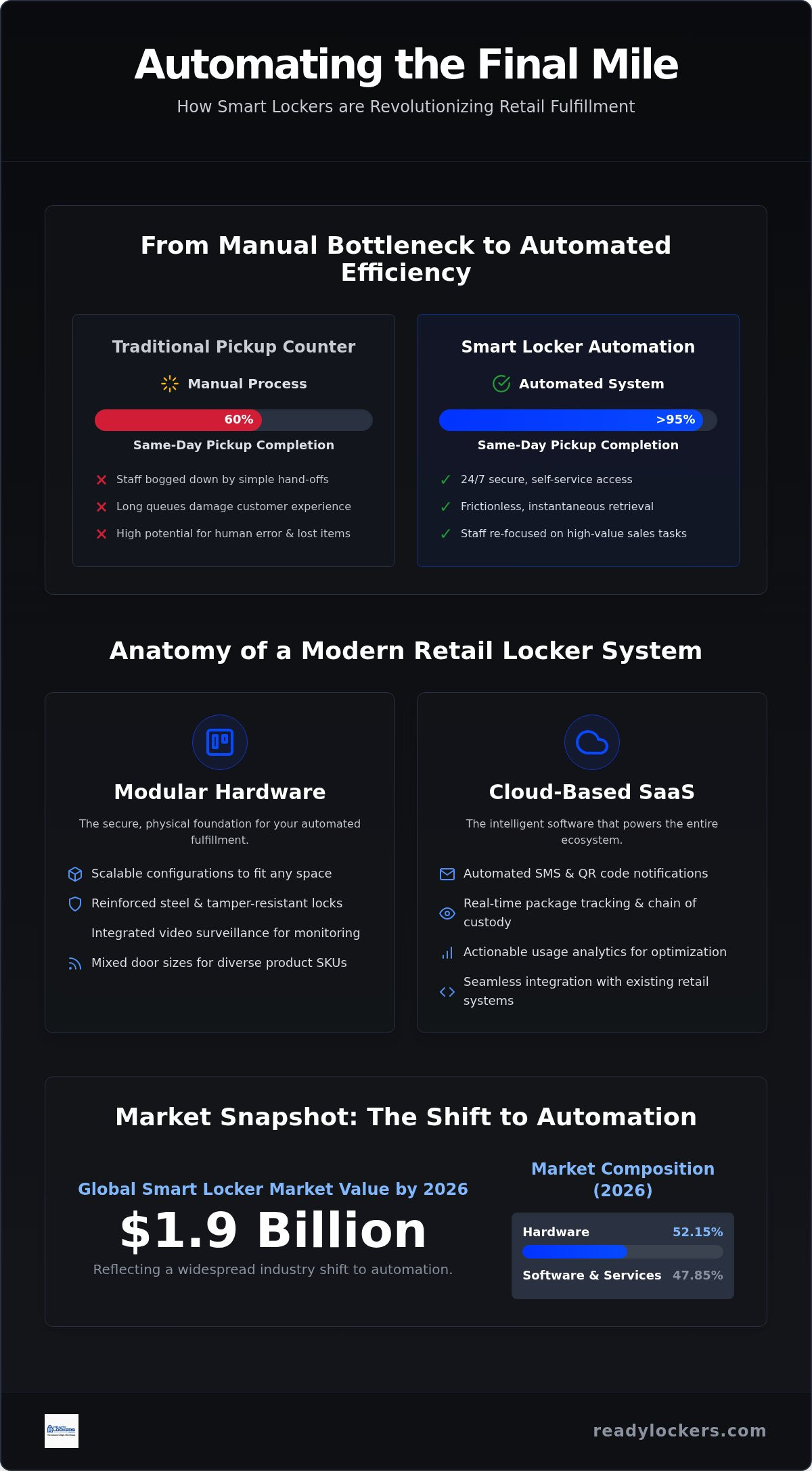
Retailers using automated systems report that same-day pickup completion rates jump from 60% to over 95% when they remove the manual counter from the equation. You've likely felt the strain of rising labor costs at your customer service desk, where staff are often bogged down by simple order hand-offs and return processing. These bottlenecks create long queues that damage the customer experience and lead to missed sales opportunities. Implementing smart locker systems for retail solves these logistical hurdles by automating the final mile of the in-store journey. It's time to transition from a staff-heavy fulfillment model to one that prioritizes speed, security, and 24/7 accessibility.
You understand that modern shoppers demand a frictionless process that doesn't involve waiting in line. In this article, you'll discover how retail smart locker systems transform the customer experience, reduce fulfillment labor hours, and secure your inventory against loss or theft. We'll examine the integration of modular hardware with cloud-based management software to provide the data-driven insights your operation needs to scale. From streamlining BOPIS workflows to simplifying the returns process, we provide a clear roadmap for optimizing your store's logistics for 2026 and beyond.
Key Takeaways
- Learn how to transition to a staff-lite fulfillment model that significantly reduces manual labor hours at customer service desks.
- Understand the critical role of cloud-based SaaS in managing modular hardware to provide real-time tracking and actionable usage analytics.
- Discover how smart locker systems for retail automate BOPIS and returns to offer customers secure, 24/7 self-service access.
- Calculate your potential ROI by analyzing direct labor savings and the reduction of package liability in high-volume retail environments.
- Identify the essential steps for scaling your logistics with ReadyLockers, from initial volume assessment to national installation and support.
The Evolution of Retail Fulfillment: Why Smart Lockers are Essential in 2026
Retailers are rapidly moving toward a "staff-lite" operational model to remain competitive. Manual order fulfillment at a customer service desk is no longer sustainable. It's too slow. It's too expensive. By 2026, the global smart locker system market is valued at USD 1.9 billion, reflecting a widespread shift toward automation. Traditional storage methods fail when package volumes spike, leading to cluttered aisles and frustrated employees. Smart locker systems for retail provide a structured, scalable solution that removes the friction from the final step of the customer journey.
From BOPIS to 'Always-On' Retail
The transition from manual Buy Online Pick Up In Store (BOPIS) to automated retrieval is driven by a demand for instant gratification. Customers don't want to wait for a staff member to locate a package in a backroom. Smart locker systems bridge the gap between a digital order and physical possession. This "always-on" capability allows for 24/7 access, ensuring that your storefront remains functional even after the sales floor closes. When retrieval is instantaneous, customer loyalty increases. You're not just selling a product; you're selling time.
Addressing the Retail Labor Crisis
Labor costs for in-store staff continue to rise, making manual "Click and Collect" processes a significant financial drain. Every minute an employee spends searching for a package is a minute they aren't assisting customers on the floor or closing sales. Automation offsets these costs by shifting the workload from the employee to the technology. Smart locker systems for retail use secure QR codes and SMS notifications to handle the verification process automatically. This ensures the right package reaches the right customer every time. Key benefits include:
- Reducing the need for dedicated customer service desk staffing for pickups.
- Eliminating human error and lost items during the manual handoff process.
- Shifting staff focus from administrative tasks to high-value, revenue-generating service.
- Providing a secure, contactless interface that meets modern safety expectations.
By removing these administrative hurdles, you create a more efficient environment that prioritizes the customer's schedule over your staffing constraints. As order volumes grow, the ability to automate these touchpoints becomes the difference between a streamlined operation and a logistical bottleneck.
Anatomy of a Retail Smart Locker System: Hardware Meets SaaS
Modern smart locker systems for retail are not just digital cabinets. They're unified ecosystems where physical security meets advanced software. The physical hardware provides the necessary protection and storage, while the software layer acts as the brain that manages the entire fulfillment process. This combination ensures that every transaction is secure, tracked, and frictionless. In 2026, hardware accounts for approximately 52.15% of the market share, but the value of these systems lies in how effectively the physical units integrate with cloud-based management platforms.
Modular Hardware and Physical Security
Modular layouts allow you to build a configuration that fits your specific floor plan. You can mix and match door sizes to accommodate everything from small electronics to larger home appliances. This flexibility is essential for future-proofing your investment as order volumes and product varieties grow. High-traffic retail lobbies require commercial-grade materials like reinforced steel to withstand daily use. Security is maintained through a series of physical and digital layers:
- Electronic locks that only release upon successful QR code or SMS verification.
- Tamper-resistant construction to prevent unauthorized access.
- Integrated video surveillance for real-time visual monitoring of the locker bank.
- Door variety that optimizes space for different SKU dimensions.
The SaaS Management Platform
The SaaS layer is what transforms a storage unit into a proactive logistics tool. It handles the automated notification process, sending secure codes to customers the moment their order is scanned into a locker. This reduces the administrative burden on your staff. Real-time tracking allows managers to see exactly who accessed which locker and when. By analyzing smart locker market trends, it's clear that data-driven insights are becoming the standard for retail efficiency. Cloud-based analytics help you monitor peak usage times and locker turnover rates, allowing you to optimize your inventory flow.
Data security is equally critical. Professional systems utilize AES-256 encryption for all transmissions and maintain SOC 2 Type II compliance to protect customer information. These platforms integrate directly with your existing POS and inventory software, ensuring that order statuses update automatically across all channels. If you're ready to modernize your storefront, you can explore modular locker configurations that align with your specific retail requirements. This integration removes the need for manual data entry and minimizes the risk of human error in the package handoff process.
Strategic Retail Use Cases: Examples of ROI in Action
Retailers implementing automation see a massive shift in fulfillment efficiency. While manual systems struggle with a 60% same-day pickup completion rate, automated smart locker systems for retail push that figure over 95%. This improvement isn't just about speed; it's about reclaiming labor hours and driving "halo" sales. When customers arrive for a quick pickup, they often stay to browse, leading to a documented 25% rise in basket size. This makes the locker bank a revenue generator rather than just a storage solution.
The BOPIS Customer Journey
The transition from a digital cart to physical possession must be seamless. ReadyLockers facilitates this through a structured three-step workflow that eliminates wait times. First, the order is placed online and fulfilled by in-store staff. Second, staff members place the item into a secure ReadyLockers unit, which automatically triggers a notification. Third, the customer receives a unique QR code via SMS, allowing for 24/7 retrieval without staff intervention. This process relies on integrated smart locker technology components that synchronize hardware and software in real-time to ensure every handoff is secure.
Automating the Returns Cycle (BORIS)
Returns are a significant pain point, with 30% of online purchases eventually being sent back. Managing these "Buy Online, Return In-Store" (BORIS) transactions manually creates long queues and negative customer experiences. Self-service drop-offs allow customers to bypass the service desk entirely. This reduces "return friction," a critical factor since 77% of shoppers check return policies before buying. Automated logging ensures that returned items are tracked immediately, allowing for faster inventory restocking and better asset management. It's a proactive way to handle the high volume of out-of-home returns, which nearly half of all shoppers now prefer.
Asset Control and B2B Applications
Beyond customer-facing roles, these systems serve as essential infrastructure for internal logistics. In a warehouse setting, smart locker systems for retail provide secure handoffs for high-value assets like handheld scanners or specialized tools. This creates a clear audit trail of who used which device and when. For B2B applications, retailers can facilitate secure handoffs for third-party contractors or vendors without requiring a manager to be present. This 24/7 accessibility ensures that maintenance and deliveries happen on schedule, regardless of store hours. By diversifying how you use your locker bank, you maximize the utility of the hardware and accelerate your return on investment.
Calculating ROI: How Smart Lockers Reduce Retail Labor Costs
Measuring the return on investment for automation requires looking beyond the initial hardware purchase. It involves analyzing reclaimed labor hours and reduced operational risks. Every manual pickup represents a hidden cost. When you remove the need for a dedicated staff member to manage the handoff, those hours are reinvested into sales-generating activities. Smart locker systems for retail provide a quantifiable reduction in overhead by shifting the workload from the payroll to the technology.
The Cost of Manual vs. Automated Fulfillment
Staff-assisted pickups are inherently inefficient. While a traditional staff-assisted pickup often takes several minutes of searching and manual verification, a 10-second locker retrieval allows the customer to self-serve instantly. This massive time difference adds up quickly when scaled across hundreds of weekly orders. Automating this process minimizes staff distraction and eliminates the logistical chaos of misplaced orders within the store. For a detailed breakdown of these financial variables, you can review our smart locker system pricing guide. Reducing these "soft" costs is essential for maintaining margins in a competitive market.
Mitigating Package Liability and Theft
Package liability is another critical factor that impacts your bottom line. Secure smart locker systems for retail create a permanent digital audit trail for every transaction. This log provides definitive proof of pickup, resolving customer disputes about missing items without requiring lengthy internal investigations. It also protects the retailer from theft or "porch piracy" occurring directly in the store lobby. You can explore more about package liability for property managers to understand how these systems mitigate modern security risks. These features provide peace of mind for both the business owner and the customer.
Operational Efficiency and the Halo Effect
By automating the retrieval process, you can significantly minimize the footprint of your customer service desk. This allows you to reallocate valuable floor space to high-margin product displays. There is also a documented "Halo Effect" associated with automated pickups. Because customers aren't frustrated by long wait times, they're more likely to stay and browse, leading to additional unplanned in-store purchases. You're not just saving money on labor; you're creating a environment that encourages higher spending. If you're ready to see how these savings apply to your specific volume, you can request a custom ROI analysis to see the projected numbers for your storefront.
Implementing ReadyLockers: The Modern Retailer's Fulfillment Solution
Successful implementation of smart locker systems for retail requires a strategic approach that balances physical space with digital connectivity. ReadyLockers acts as a long-term partner, providing national US installation and support to ensure your system remains operational from day one. You begin by assessing your store's specific package volume and choosing a modular configuration that matches your current SKU variety. This ensures you don't over-invest in unused space while maintaining the capacity to handle peak seasonal surges. The goal is to create a frictionless handoff that benefits both the store's bottom line and the customer's schedule.
Planning Your Locker Layout
Optimal placement is critical for driving adoption. You should position your locker bank in a high-visibility area, such as a lobby or near the entrance, to ensure easy customer access. This visibility serves as a constant reminder of the convenience you offer. When balancing indoor space requirements, it's vital to account for projected order growth through 2026. Consulting with ReadyLockers experts allows you to design a custom layout that maximizes your floor plan without creating congestion. A well-placed system becomes an intuitive part of the shopping experience rather than an obstacle.
Seamless Software Integration
The physical setup is only half of the solution. You must leverage the ReadyLockers API for deep integration with your existing retail tech stack to ensure data flows between your POS and the locker management software. This connectivity allows for automated SMS and QR code workflows, creating a consistent brand experience that requires zero manual intervention. For a deeper look at technical best practices, you can review our guide on smart locker integration for property management. These protocols ensure that your system is secure, scalable, and easy for IT teams to maintain across multiple locations.
Finalizing the implementation involves training your staff to move from administrative roles to fulfillment facilitators. Onboarding customers is equally important; clear signage and simple digital instructions encourage maximum adoption. ReadyLockers provides the robust SaaS management system needed to track these interactions and provide actionable analytics. By choosing a comprehensive platform, you're not just buying hardware. You're securing a scalable infrastructure that evolves with the demands of modern retail logistics. This proactive approach anticipates obstacles and removes them before they impact your customer experience.
Securing a Competitive Advantage in 2026
The transition toward a staff-lite fulfillment model is a logistical necessity. By implementing smart locker systems for retail, you remove the friction that often stalls the path from online purchase to in-store pickup. Throughout this guide, we've explored how these systems reclaim labor hours, mitigate package liability, and provide the real-time cloud analytics needed to optimize your daily operations. These are no longer luxury amenities. They're the foundational infrastructure required to meet the demands of modern shoppers who prioritize speed and security over traditional service models.
ReadyLockers provides the modular hardware design and 24/7 contactless access your storefront needs to thrive. This proactive approach ensures your logistics remain scalable even as order volumes grow. It's time to transition from manual bottlenecks to a streamlined, digital-first environment that respects the customer's time and your store's resources. You're now equipped with the roadmap to modernize your fulfillment process and drive meaningful growth.
Streamline your retail operations with a custom ReadyLockers solution today.
Frequently Asked Questions
How do smart locker systems for retail improve the customer experience?
Smart locker systems for retail improve the customer experience by eliminating wait times at the service desk. Customers no longer need to coordinate their schedules with store hours or wait for staff assistance. Instead, they receive an automated notification and use a secure QR code for instant retrieval. This self-service model provides a sense of autonomy and convenience. It ensures that the final step of the shopping journey is as fast and frictionless as the initial online purchase.
Can smart lockers integrate with my existing retail POS system?
Yes, ReadyLockers is designed for deep integration with your existing retail POS and inventory management systems via a robust API. This connectivity ensures that order statuses update in real-time across all your sales channels. When an item is placed in a locker, the system automatically triggers a notification to the customer. This synchronization removes the need for manual data entry and reduces the risk of human error in the fulfillment process, creating a unified digital-to-physical workflow.
What happens if a customer doesn't pick up their retail order?
If a customer fails to retrieve their order within a specified timeframe, the SaaS platform sends automated SMS or email reminders to encourage pickup. Managers can configure these intervals based on store policy. If the item remains uncollected after the final reminder, the system notifies staff to remove the package and process a return to inventory. The cloud-based analytics dashboard tracks these abandoned pickups, helping you adjust your holding policies and optimize locker turnover for active orders.
Are smart lockers secure enough for high-value retail items?
Smart locker systems for retail are engineered with multiple security layers to protect high-value assets. The units feature reinforced steel construction and tamper-resistant electronic locks that only release with a unique, encrypted access code. Every transaction creates a permanent digital audit trail, documenting exactly when a locker was accessed and by whom. Additionally, the system integrates with your store's video surveillance. These features significantly reduce the risk of package theft and provide definitive proof of pickup for dispute resolution.
How much space does a typical retail smart locker system require?
Space requirements vary because the system uses a modular hardware design. You can start with a small bank of lockers and scale upward as your order volume increases. A typical starter configuration requires only a few linear feet of wall space in a lobby or near an entrance. ReadyLockers experts consult with you to design a custom layout that maximizes your available floor plan. This flexibility ensures that the installation fits your specific environment without creating congestion for foot traffic.
Do customers need to download an app to use ReadyLockers?
No, customers aren't required to download a dedicated app to use the system. When an order is ready, the SaaS platform sends a unique QR code or access PIN directly to the customer's mobile device via SMS or email. They simply scan this code at the locker bank's interface to open their assigned door. This browser-based and kiosk-driven approach removes barriers to adoption, ensuring that even first-time users can complete their pickup in seconds without any technical friction.
How does a smart locker system reduce retail labor costs?
The system reduces labor costs by automating the manual package handoff and verification process. Retailers can minimize the staffing requirements for customer service desks, as the technology handles the entire pickup and return workflow. This reallocates your team to high-value, revenue-generating tasks on the sales floor. By shifting administrative work to a secure digital interface, you reclaim hundreds of labor hours annually. This transition is essential for maintaining operational efficiency in a staff-lite retail environment.
Can I use smart lockers for customer returns as well as pickups?
Yes, the platform fully supports self-service returns, often referred to as Buy Online, Return In-Store (BORIS). Customers can drop off items at the locker bank at their convenience, bypassing the service desk entirely. The system logs the return immediately and notifies your staff to retrieve the item for restocking. This reduces return friction, which is a major factor in customer loyalty. It also ensures that returned inventory is tracked and processed faster than manual collection methods allow.

Frequently Asked Questions
How do smart locker systems for retail improve the customer experience?+
Smart locker systems for retail improve the customer experience by eliminating wait times at the service desk. Customers no longer need to coordinate their schedules with store hours or wait for staff assistance. Instead, they receive an automated notification and use a secure QR code for instant retrieval. This self-service model provides a sense of autonomy and convenience. It ensures that the final step of the shopping journey is as fast and frictionless as the initial online purchase.
Can smart lockers integrate with my existing retail POS system?+
Yes, ReadyLockers is designed for deep integration with your existing retail POS and inventory management systems via a robust API. This connectivity ensures that order statuses update in real-time across all your sales channels. When an item is placed in a locker, the system automatically triggers a notification to the customer. This synchronization removes the need for manual data entry and reduces the risk of human error in the fulfillment process, creating a unified digital-to-physical workflow.
What happens if a customer doesn't pick up their retail order?+
If a customer fails to retrieve their order within a specified timeframe, the SaaS platform sends automated SMS or email reminders to encourage pickup. Managers can configure these intervals based on store policy. If the item remains uncollected after the final reminder, the system notifies staff to remove the package and process a return to inventory. The cloud-based analytics dashboard tracks these abandoned pickups, helping you adjust your holding policies and optimize locker turnover for active orders.
Are smart lockers secure enough for high-value retail items?+
Smart locker systems for retail are engineered with multiple security layers to protect high-value assets. The units feature reinforced steel construction and tamper-resistant electronic locks that only release with a unique, encrypted access code. Every transaction creates a permanent digital audit trail, documenting exactly when a locker was accessed and by whom. Additionally, the system integrates with your store's video surveillance. These features significantly reduce the risk of package theft and provide definitive proof of pickup for dispute resolution.
How much space does a typical retail smart locker system require?+
Space requirements vary because the system uses a modular hardware design. You can start with a small bank of lockers and scale upward as your order volume increases. A typical starter configuration requires only a few linear feet of wall space in a lobby or near an entrance. ReadyLockers experts consult with you to design a custom layout that maximizes your available floor plan. This flexibility ensures that the installation fits your specific environment without creating congestion for foot traffic.
Do customers need to download an app to use ReadyLockers?+
No, customers aren't required to download a dedicated app to use the system. When an order is ready, the SaaS platform sends a unique QR code or access PIN directly to the customer's mobile device via SMS or email. They simply scan this code at the locker bank's interface to open their assigned door. This browser-based and kiosk-driven approach removes barriers to adoption, ensuring that even first-time users can complete their pickup in seconds without any technical friction.
How does a smart locker system reduce retail labor costs?+
The system reduces labor costs by automating the manual package handoff and verification process. Retailers can minimize the staffing requirements for customer service desks, as the technology handles the entire pickup and return workflow. This reallocates your team to high-value, revenue-generating tasks on the sales floor. By shifting administrative work to a secure digital interface, you reclaim hundreds of labor hours annually. This transition is essential for maintaining operational efficiency in a staff-lite retail environment.
Can I use smart lockers for customer returns as well as pickups?+
Yes, the platform fully supports self-service returns, often referred to as Buy Online, Return In-Store (BORIS). Customers can drop off items at the locker bank at their convenience, bypassing the service desk entirely. The system logs the return immediately and notifies your staff to retrieve the item for restocking. This reduces return friction, which is a major factor in customer loyalty. It also ensures that returned inventory is tracked and processed faster than manual collection methods allow.