Knowledge Center / Package Loss Prevention Systems A 2026 Buyers Guide
Package Loss Prevention Systems: A 2026 Buyer’s Guide
Find the best package loss prevention system for your property in 2026. Compare smart lockers, package rooms, and workflows to eliminate delivery theft today.

What if the biggest package risk isn’t the delivery itself, but the gap between drop-off and pickup? Choosing a package loss prevention system means looking beyond where parcels are placed. Consider how deliveries are handed off, how recipients are notified, and how packages are retrieved, especially when deliveries arrive in shared or unattended areas.
Staff shouldn’t have to spend hours sorting packages and answering “Has mine arrived?” while recipients struggle to find or collect their deliveries. Yet a system that adds complicated daily tasks can create a new problem instead of solving one. The right approach makes handoffs more accountable while giving property teams and recipients a process they can follow easily.
This guide compares smart lockers, package rooms, and staff-managed processes, then explains how to assess security, package capacity, notifications, courier access, and administrative demands. You’ll learn how to match an option to your property’s layout, delivery volume, and management capacity. We’ll also show how smart lockers and management software can support a more visible, contactless process from delivery to pickup.
Key Takeaways
- A package loss prevention system should make package custody more visible across delivery, storage, and pickup, while recognizing that no approach can guarantee every parcel will be recovered.
- Compare staffed reception, manual package rooms, and smart lockers by how each handles access control, recipient convenience, staffing demands, and accountability.
- Before choosing a system, assess package sizes and peak volumes alongside your property layout, recipient access needs, courier access, and management tools.
- Smart lockers connect courier deposit, recipient notifications, and pickup in one workflow. SMS or QR code notifications can help recipients know when a package is ready.
- ReadyLockers may suit properties seeking modular lockers and a cloud-managed process, with courier access management and usage analytics to support daily operations.
What a Package Loss Prevention System Should Protect
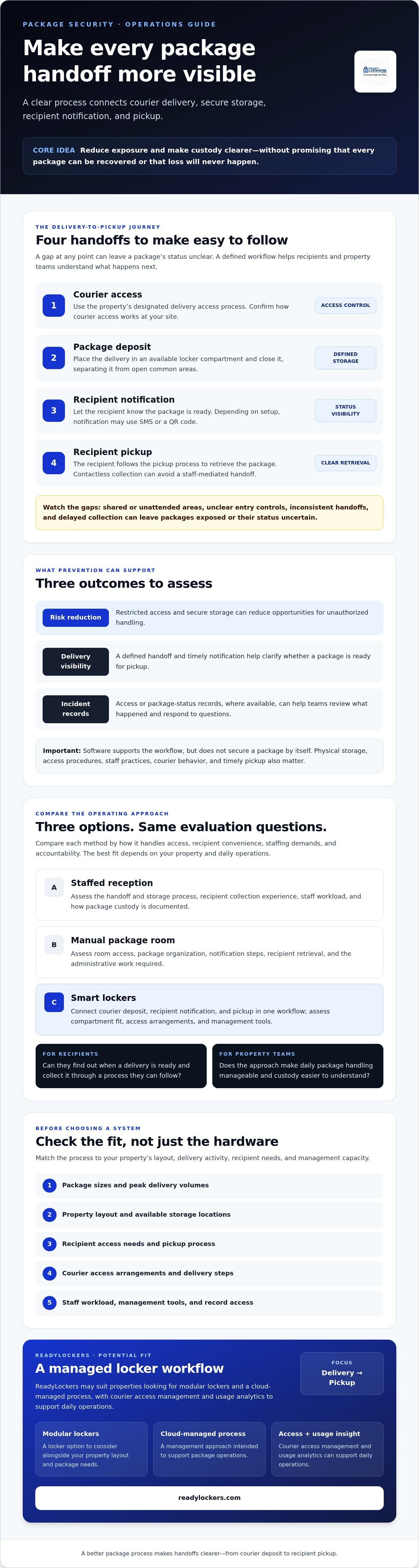
A package loss prevention system combines physical controls and operating procedures to reduce exposure as a delivery moves from courier handoff to recipient pickup. Depending on the property, that may mean controlled courier access, secure storage, clear package ownership, timely notifications, and a defined retrieval process. The goal is to make each handoff more accountable, not to promise that loss can never happen.
Secure custody reduces opportunities for loss; it does not guarantee that theft will never occur or that every missing package will be recovered. Prevention focuses on lowering risk and improving visibility, while recovery depends on the circumstances and available records. For background on common methods and prevention approaches, see Package theft.
Where package loss can occur in the delivery workflow
Follow a package through each stage: the courier arrives, hands it off or places it in storage, the recipient is notified, and the recipient retrieves it. A gap at any point can make the parcel’s status unclear. An unattended lobby may leave packages accessible to people passing through. An open package room may lack clear entry controls. If staff, couriers, and recipients don’t follow a consistent process, it may be difficult to confirm who last handled a delivery or whether it was collected.
Delayed collection adds another challenge. A package can remain in a shared area after its recipient has been notified, extending the time it is exposed. Clear custody steps and prompt communication help property teams identify where the process needs attention without assuming every delay signals a security incident.
What buyers should expect from prevention
Evaluate prevention as three related but distinct outcomes:
- Risk reduction: Physical controls, such as restricted access and secure storage, can reduce opportunities for unauthorized handling.
- Delivery visibility: A defined handoff process and timely recipient notifications help clarify whether a package is ready for pickup.
- Incident documentation: Access records or package-status records, where available, can help teams review what happened and respond to questions.
Software supports the workflow, but it doesn’t secure a package by itself. Notifications can tell recipients when a parcel is ready, and management tools can help organize delivery activity. Physical storage and access procedures still matter. Building rules, staff practices, courier behavior, and how promptly recipients collect packages also shape the outcome. Before buying, check what the system records, who can access that information, and how records fit into your property’s existing procedures.
How a Smart Package Locker System Controls Delivery and Pickup
A smart locker system gives a package a defined path from courier handoff to recipient collection. That structure can help a property move beyond informal drop-offs, while keeping in mind that no storage method can guarantee a package will never be lost or stolen. The U.S. Postal Service Office of Inspector General’s report on package theft provides further context for why clear delivery and pickup processes matter.
What happens when a courier deposits a package
The delivery procedure depends on the property and system configuration. In general, the workflow has four stages:
- 1. Courier access: The courier uses the system’s designated access process to reach the lockers. A Courier Access Interface can support managed access, but buyers should confirm how it works at their property.
- 2. Locker deposit: The courier places the package in an available compartment and closes it. The compartment separates the stored delivery from open common areas, though it doesn’t remove every possible risk.
- 3. Recipient notification: The recipient receives an SMS or QR code notification that the package is ready for collection, based on the system’s notification setup.
- 4. Secure pickup: The recipient follows the provided pickup process to retrieve the package from the compartment. Contactless retrieval can avoid a staff-mediated handoff.
Before rollout, confirm the exact courier steps, access arrangements, and package-handling procedures for the site. Walk through the process from courier arrival to recipient pickup so the locker workflow fits existing property operations.
How recipients retrieve packages and managers track activity
Recipients can collect packages through a contactless process, with pickup available around the clock as a system capability. This gives people flexibility to retrieve a delivery when it suits them, rather than relying on a staffed handoff. Notifications prompt collection, but they aren’t proof that a recipient received or retrieved the parcel. Clear pickup procedures and records, where available, remain important when answering questions.
On the management side, connected locker software can support courier access management and provide usage analytics for operational oversight. Analytics offer a view into system activity, but buyers should verify which reports and records are available before relying on specific metrics. A package loss prevention system works best when its physical compartments, access process, notifications, and staff procedures reinforce one another.
For an example of how lockers and cloud-based management tools can work together, explore ReadyLockers’ package management platform.
Package Loss Prevention System Comparison: Lockers, Package Rooms, and Staff
The best approach depends on delivery volume, reception coverage, building layout, and how much package handling staff can take on. A package loss prevention system should fit the property’s real workflow, not just promise more control. The U.S. Postal Service OIG report offers broader context on package theft, but each property needs to assess its own handoff points and operational needs.
| Approach | Custody visibility | Recipient convenience | Staffing needs | Access control | Scalability |
|---|---|---|---|---|---|
| Staffed reception | Can be clear with consistent logging and handoffs | Depends on reception hours and pickup process | Requires staff to receive, organize, and release packages | Staff can manage access and handoff directly | May require more staff time as volume grows |
| Manual package room | Depends on accurate records and room procedures | Recipients retrieve packages from a shared location | Staff may still sort packages, manage access, and answer questions | Varies with room access rules and oversight | Depends on available space and process capacity |
| Smart package lockers | Digital tools can support delivery and pickup visibility | Notifications and contactless pickup offer flexibility | Can reduce routine manual handling, though oversight remains necessary | Compartment-based storage and managed courier access | Modular configurations can be planned around site needs |
When staffed reception or a manual package room may fit
These approaches can work well when a property already has reliable reception coverage, established delivery procedures, and suitable space. A staffed handoff gives recipients direct help, while a package room may suit a site with clear entry rules and a dependable logging process. Both depend on consistent execution: gaps in staff availability, records, or room access can make package status harder to confirm.
When smart lockers may better match the workflow
Smart lockers may be a stronger fit where deliveries are frequent, reception coverage is limited, or recipients need more flexibility to collect packages. Before selecting them, confirm that the site can accommodate locker placement and define how couriers will access the system. Size the configuration to actual package dimensions and delivery patterns, including busy periods, rather than assuming one locker mix will suit every property.
For a closer look at selection considerations, see the smart package lockers buyer’s guide. Compare the workflow as carefully as the hardware: the right option is the one your property can operate consistently.
How to Evaluate a Package Loss Prevention System Before Buying
A useful evaluation starts with your property’s actual delivery workflow, not a generic capacity estimate. Gather package records, note where handoffs become difficult, and ask vendors to demonstrate the complete process using scenarios that reflect your site. Include a busy delivery period, an oversized parcel, and a recipient who needs help retrieving a package.
Match capacity, layout, and access to the property
Use your own records to estimate typical and peak package volumes, along with the mix of parcel sizes. Then walk the proposed placement area and assess usable space, recipient circulation, accessibility, and how couriers will approach the lockers. A configuration that fits the floor plan but obstructs movement or complicates delivery access may not suit daily operations. For more site-planning considerations, review the smart locker installation guide.
- Volume and package mix: How many deliveries arrive during normal and peak periods, and what sizes are common?
- Layout: Where can lockers fit without disrupting access or building circulation?
- Recipients: Who needs to collect packages, and what access arrangements will work for residents, employees, students, guests, or other user groups?
- Courier approach: Can couriers reach the system and complete the deposit process clearly?
Context matters. An apartment building may serve residents with varied schedules, while an office may need to account for employees and visitors. Schools, hotels, and other properties have distinct users and operating procedures. Check how the system can accommodate the groups and delivery patterns specific to your site.
Check the software and operating responsibilities
Clarify who will manage user access, courier access, recipient notifications, and exceptions such as a misdirected or uncollected parcel. Ask what activity and usage information the platform presents, who can review it, and which reports are available. Don’t assume a feature is included until the vendor confirms it. The smart locker management software guide can help frame questions about day-to-day administration.
During a demonstration, follow one delivery from courier arrival through locker deposit, notification, and pickup. Ask staff and recipients to test the steps, too. This reveals whether instructions are clear and whether the workflow creates extra work. A well-matched package loss prevention system should fit both the physical site and the team’s capacity to manage it.
Ready to assess a locker-based workflow for your property? Explore ReadyLockers’ smart package lockers.
When ReadyLockers Fits a Package Loss Prevention Strategy
ReadyLockers may suit properties looking to pair modular smart package lockers with a cloud-managed pickup workflow. The hardware provides secure compartments for package storage, while the platform supports courier access management and usage analytics. Recipients can receive SMS or QR code notifications, then collect packages through a contactless process available around the clock. These controls can help organize handoffs, but they don’t guarantee that packages will never be lost or stolen.
ReadyLockers provides locker hardware and software, not courier or delivery services. The property remains responsible for determining how deliveries reach the lockers and how the system fits its own procedures. As part of a package loss prevention system, the solution is most relevant where a managed pickup process addresses a specific operational need.
Which properties may benefit from the ReadyLockers workflow
Apartments, offices, warehouses, hotels, hospitals, schools, and retail locations may all handle packages, but their delivery patterns and recipient groups differ. An office may need a process for employees and visitors; a school may need to account for students, staff, or departments. A hotel or hospital may have distinct procedures for guests, patients, or teams. Suitability depends on package volume, available space, courier access, and how recipients will collect items. A workflow that fits one property type won’t necessarily produce the same operational result at another.
Modular configurations can be planned around a property’s layout and package volumes. Before choosing a locker setup, consider where packages currently accumulate, who needs access, and whether the site can support a clear delivery and pickup path.
What to confirm before taking the next step
Prepare useful site information before discussing a configuration:
- Typical and peak package volumes, plus the range of package sizes.
- Available placement areas and any access or circulation constraints.
- Recipient groups and who will manage users, exceptions, and day-to-day procedures.
- How couriers currently reach the delivery area and how that process may change.
Ask about locker configuration, installation requirements, subscription terms, and support, and confirm the details directly with the provider. A workflow discussion can help establish how the hardware and software fit the site before selecting capacity. Discuss a package locker solution with ReadyLockers.
Build a More Accountable Package Workflow
The right package loss prevention system connects delivery, storage, and pickup in a process your property can manage consistently. Compare lockers, package rooms, and staffed reception based on your delivery patterns, site layout, recipient needs, and available staff capacity. No approach can guarantee every package will be recovered, but clear handoffs and defined access can help reduce exposure and make package status easier to track.
ReadyLockers brings modular locker configurations together with cloud-based management. Recipients can receive SMS or QR code notifications and use contactless pickup, available 24/7. The workflow also supports courier access management, helping properties coordinate delivery and retrieval without taking on the role of a delivery provider.
Start with your property’s package volume, space, and operating procedures, then assess how a locker workflow could fit. Discuss a package locker solution with ReadyLockers and take the next step toward a clearer, more convenient pickup process.
Frequently Asked Questions
What is a package loss prevention system?
A package loss prevention system uses physical controls and operating procedures to reduce opportunities for packages to be lost or taken during delivery, storage, and pickup. It may include controlled courier access, secure storage, recipient notifications, and records of package activity. The right combination depends on the property’s layout and delivery process. These measures can improve visibility and custody, but they can’t guarantee that every package will be recovered.
Can package lockers prevent package theft?
Package lockers can reduce exposure by placing deliveries in secure compartments instead of leaving them in open common areas. Access controls and a defined pickup process can make unauthorized handling more difficult. However, lockers can’t guarantee that theft or loss will never occur. Their effectiveness depends on the system, how it’s configured, courier and recipient procedures, and how well the property manages access and exceptions.
How does a smart package locker system work?
A courier accesses the locker system, deposits a package in a compartment, and completes the property’s delivery procedure. The recipient then receives an SMS or QR code notification that the package is ready. They follow the pickup instructions to retrieve it, often without staff handling the parcel. Management software can support courier access and provide usage information. Confirm the exact deposit, pickup, and recordkeeping steps with the provider.
Are package lockers better than a staffed package room?
Neither option is better for every property. Staffed reception can work well where employees consistently log deliveries and manage handoffs. A package room may suit a site with appropriate space and clear access procedures. Lockers can offer compartment-based storage and flexible pickup while reducing some routine handling. Compare staffing capacity, package volume, recipient access needs, available space, and custody visibility before choosing an approach.
What should I compare when choosing a package loss prevention system?
Compare how each option handles package capacity, parcel sizes, busy delivery periods, property layout, and recipient access. Check the courier access process, notification methods, access controls, management tools, and what activity records are available. Consider who will handle user administration and delivery exceptions, too. Ask providers to demonstrate the full workflow using realistic delivery and pickup scenarios, rather than evaluating hardware or software features in isolation.
Can package lockers work for offices and apartments?
Yes. Smart package lockers can be used in apartments and offices, as well as other property types, when the configuration matches the site’s delivery patterns and available space. An apartment may need to serve residents with different pickup schedules, while an office may need to accommodate employees or visitors. Assess package sizes, peak volumes, courier approach, and who will manage access before deciding whether lockers fit.
Do package lockers eliminate the need for property staff?
No. Lockers can reduce some routine tasks, such as manually sorting packages or answering basic arrival questions, but staff may still need to oversee the process. Responsibilities can include managing users and courier access, helping with exceptions, reviewing activity, and maintaining property procedures. Before adopting a system, identify who will handle these tasks and make sure the workflow fits the team’s capacity.
What information should I prepare before requesting a locker system recommendation?
Gather package records that show typical and peak delivery volumes, common parcel sizes, and busy periods. Note possible locker locations, space constraints, recipient groups, access needs, and how couriers currently deliver packages. Also identify who will manage users, notifications, courier access, and exceptions. This information helps a provider discuss a suitable configuration and workflow. Confirm installation requirements, subscription terms, and support details directly before making a decision.
