School Parcel Delivery Systems: A 2026 Case Study in Campus Logistics
Discover how modern school parcel delivery systems use smart lockers to solve campus logistics, cut costs, and ensure 24/7 secure access. A 2026 case study.

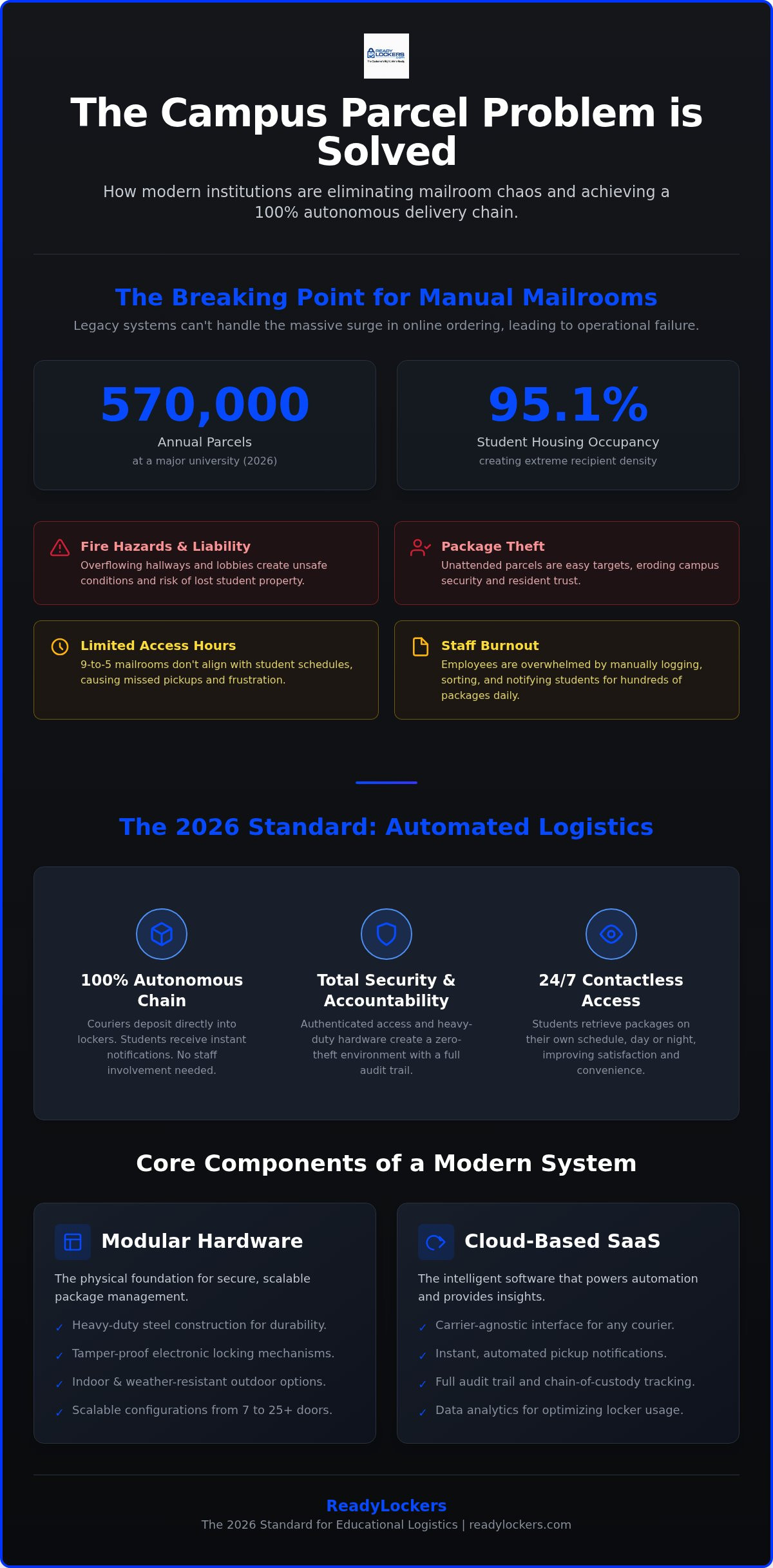
Annual parcel deliveries at major institutions like Stanford University have surged to 570,000 packages as of 2026. This massive volume has transformed campus mailrooms from simple sorting centers into high-risk logistical bottlenecks. You've likely seen the result: overflowing hallways that create fire hazards, increasing liability for lost student property, and staff members overwhelmed by manual notifications. It's a costly, inefficient cycle that most administrators find unsustainable in a high-density housing environment where occupancy rates now exceed 95%.
Modern school parcel delivery systems offer a definitive resolution to these operational challenges. By integrating automated smart lockers with carrier-agnostic software, schools are finally eliminating the chaos of the last yard. This article explores how institutions are achieving a 100% autonomous delivery chain that ensures security and total accountability. You'll discover how modular hardware and cloud-based platforms reduce labor costs, provide 24/7 contactless access, and establish a zero-theft campus environment that scales effortlessly with your student population.
Key Takeaways
- Learn how educational institutions are transitioning from manual mailrooms to high-velocity logistical hubs using automated, hybrid solutions.
- Discover how modern school parcel delivery systems leverage modular hardware and cloud-based SaaS to create a 100% autonomous delivery chain.
- Understand the data-driven process for identifying mailroom bottlenecks and resolving package theft through secure, authenticated access.
- Gain a practical framework for planning your campus deployment, including site surveys and right-sizing locker banks for high-density student housing.
- See why carrier-agnostic interfaces and 24/7 contactless pickup are the 2026 standard for reducing administrative overhead and securing student property.
The Evolution of School Parcel Delivery Systems in 2026
In 2026, the definition of school parcel delivery systems has shifted from passive mail sorting to active, high-velocity logistics management. These modern systems function as a sophisticated hardware-software hybrid, combining modular physical storage with cloud-based intelligence. To understand this transition, it's helpful to look at what parcel lockers are and how they've evolved into specialized campus assets. Educational institutions are rapidly moving away from legacy processes in favor of automated mailroom solutions that can handle the current explosion in e-commerce volume.
The scale of campus logistics in 2026 is unprecedented. For example, annual parcel deliveries at Stanford University reached 570,000 packages this year, a massive jump from 350,000 just four years ago. With U.S. student housing occupancy hitting 95.1% across 200 universities, the density of recipients creates a logistical strain that manual systems simply can't resolve. Traditional mailroom staff are no longer just sorting letters. They're managing a constant influx of oversized boxes, tech equipment, and perishable goods that demand immediate processing, leading to a system that is often over capacity before the first delivery truck even arrives.
The Problem with Manual Campus Mailrooms
Manual mailrooms are currently facing a breaking point. Staff burnout is at an all-time high as employees struggle to log, sort, and notify students for hundreds of packages daily. This labor-intensive process often leads to high turnover in campus logistics roles, further destabilizing operations. Beyond the human cost, the physical footprint of unorganized packages in building lobbies creates significant safety hazards. Hallways blocked by delivery piles aren't just an eyesore; they represent a fire hazard and a major security risk. Unattended packages are prime targets for theft, increasing the institution's liability for lost student property and creating a sense of insecurity for residents.
Why 24/7 Access is the New Campus Standard
Students in 2026 operate on an on-demand schedule that rarely aligns with traditional business hours. They expect to retrieve their orders immediately upon notification. Implementing school parcel delivery systems with 24/7 access eliminates the "missed delivery" cycle where couriers can't drop off packages and students can't find staff to assist them. This model ensures that the delivery chain remains fluid regardless of the time of day. A 24/7 autonomous pickup model is the only viable solution for 2026 campus life because it aligns institutional efficiency with student expectations for frictionless, immediate service.
Core Components of a Secure Campus Locker Network
A high-functioning logistical network relies on the seamless integration of physical durability and digital intelligence. Modern school parcel delivery systems utilize high-grade smart package lockers as the structural foundation. These units must withstand high-traffic university environments, featuring heavy-duty steel construction and tamper-proof electronic locking mechanisms. However, hardware alone cannot solve campus chaos. The physical units must be paired with a carrier-agnostic courier access interface. This allows any delivery service, from national couriers like UPS and FedEx to local vendors, to deposit items securely without requiring mailroom staff to act as intermediaries.
Modular Hardware for Scalable Campus Growth
Modularity is essential for educational institutions managing fluctuating enrollment and housing density. Administrators can deploy compact units, such as a 7-door cabinet, in specific residential wings and later add 25-door enterprise cabinets as demand increases. This flexibility extends to physical placement. While indoor installations in student unions remain common, weather-resistant outdoor configurations allow for centralized hubs on open campus grounds. Heavy-duty materials and reinforced locking systems ensure these assets remain secure against both environmental factors and unauthorized access attempts. This scalability ensures that your initial investment remains functional as your campus logistics evolve.
The SaaS Brain: Notifications and Analytics
The true efficiency of the system originates from the smart locker management software. This cloud-based platform acts as the central brain, automating the entire notification chain to eliminate manual sorting. When a courier scans a package at the locker, the system instantly generates a unique QR code or SMS alert for the recipient. Beyond basic notifications, usage analytics provide deep insights into locker turnover rates and peak delivery times, allowing staff to optimize cabinet availability.
For schools with complex IT ecosystems, using a smart locker API is the definitive way to bridge the gap between logistics and administration. This technical layer allows for direct integration with existing student databases and campus identity systems. It ensures that access remains restricted to authorized personnel and current students, maintaining a secure perimeter while reducing the administrative burden on IT departments. You can see how these digital and physical layers work together by reviewing our modular configuration options.
Case Study: Transitioning a High-Volume Campus to ReadyLockers
Consider a mid-sized university managing a daily volume of 500 packages across three main residential halls. Before modernizing their school parcel delivery systems, this institution relied on a centralized mailroom where staff manually logged every arrival. This process created a significant logistical bottleneck, especially during peak afternoon hours when student traffic peaked. The transition to an automated chain required a three-step strategic overhaul to shift from manual labor to autonomous hardware.
Before: The Liability and Labor Trap
The manual sorting process consumed approximately 25 staff hours per week, diverting employees from high-value administrative tasks to basic package handling. Beyond the labor cost, the institution faced a growing crisis regarding package liability for property managers and school boards. When packages are left in open mailrooms or unsecured hallways, the school becomes the de facto guardian of student property. This university reported a "lost package" cost of nearly $45 per student per semester due to theft and misplacement. This financial leak, combined with the stress of cybersecurity staffing shortages and data breach risks, made the legacy system a clear liability.
After: The Autonomous Delivery Hub
The solution involved adapting successful multi family parcel locker systems for the unique needs of a campus environment. The school board utilized a modified HOA package management system template to establish clear rules for courier access and student retrieval. By installing modular cabinets in high-traffic lobbies, the university transitioned to a 100% contactless pickup environment. Couriers now use a dedicated interface to deposit items directly into secure lockers, bypassing the mailroom entirely.
The results of this transition were immediate and measurable. The institution saw a 60% reduction in staff time dedicated to mail handling, allowing the logistics team to focus on campus security and facility management. Courier accountability reached 100% because every delivery is now backed by a digital event log and authenticated access. Most importantly, the "lost package" incidents dropped to zero. Hallways that were once cluttered with fire-hazard delivery piles are now clear, and students enjoy the convenience of retrieving their property at any hour. This case study proves that school parcel delivery systems are no longer a luxury; they are a fundamental utility for modern campus safety and efficiency.
Strategic Implementation: Planning Your School’s Deployment
Deploying school parcel delivery systems requires a methodical planning phase to ensure the infrastructure matches actual campus demand. Administrators should begin with a volume estimation audit, analyzing historical mailroom data from the previous academic year. In 2026, where e-commerce volume has reached record levels, it's vital to account for seasonal surges like move-in week and holiday periods. This data informs the selection of smart locker installation services, ensuring the hardware footprint is right-sized for your specific student population and building layouts.
Site Selection and Power Requirements
High-traffic hubs like student unions, library foyers, or central residential courtyards are ideal for locker placement. These locations must provide 24/7 student access while remaining under existing campus security surveillance. From a technical standpoint, each locker bank requires a dedicated power source and a stable internet connection for real-time cloud syncing. By replacing bulky, staffed mailrooms with compact, modular lockers, schools can reclaim valuable square footage for study spaces or student lounges. Space optimization is a primary benefit for high-density campuses where every square foot of real estate is at a premium.
Courier Onboarding and Access Control
Success depends on the seamless interaction between the hardware and national carriers like UPS, FedEx, DHL, and the USPS. The system provides unique, trackable access codes for authorized delivery personnel, ensuring that every drop-off is logged without staff intervention. Utilizing contactless delivery locker technology makes the process intuitive for drivers, reducing dwell times and preventing delivery errors. This interface acts as the definitive gatekeeper, maintaining a secure perimeter while allowing for carrier-agnostic deliveries at any hour.
School IT departments must ensure the system integrates with campus identity management protocols for secure authentication. Once the technical layer is active, a clear communication strategy for students and faculty is necessary to drive adoption. Use campus-wide SMS alerts and digital signage to explain the QR code retrieval process. This proactive approach minimizes the learning curve and immediately reduces the administrative burden on mailroom staff. If you're ready to modernize your campus logistics, view our modular locker configurations to start your site survey.
Why ReadyLockers is the 2026 Standard for Educational Logistics
ReadyLockers serves as the definitive bridge between high-volume e-commerce and secure campus operations. In an environment where mailroom clutter and liability are no longer acceptable, our school parcel delivery systems provide a streamlined, zero-theft solution. We position ourselves as a "Modern Efficiency Expert," proactive in removing the obstacles that currently drain university resources. This isn't just about storage; it's about establishing a secure, inclusive standard for every contemporary educational environment. Our role is to act as a reliable partner that understands the intricacies of campus property management.
Hardware Reliability and Modular Design
Our modular design philosophy ensures that schools aren't locked into a static configuration. Whether you need a compact cabinet for a specific dorm or an enterprise-level unit for a central student union, the hardware adapts to your physical footprint. These units are built from heavy-duty steel with reinforced electronic locks to withstand the rigors of high-traffic campus life. By opting for a one-time hardware purchase paired with a low, recurring SaaS fee, institutions achieve a predictable cost structure that simplifies annual budgeting. The long-term ROI of the system is realized through the total elimination of lost package claims and the drastic reduction in manual labor costs.
Seamless Software Integration
The SaaS platform acts as the central brain of the operation, allowing administrators to manage an entire campus network from a single, intuitive dashboard. This centralized oversight ensures that every locker across multiple buildings remains functional and secure at all times. Our carrier-agnostic interface removes courier chaos by providing a standardized delivery workflow for all major drivers, including USPS, FedEx, and UPS. We provide ongoing support and automatic software updates as part of the subscription, ensuring your technology remains current with 2026 security and data protection standards. This software-driven approach reduces the daily workload for staff while maintaining a constant, secure chain of custody for all student property.
This partnership approach ensures that your institution isn't just buying hardware but is gaining a proactive facilitator for all logistical hurdles. We understand that modern schools require more than just a place to put boxes; they need a system that anticipates and removes bottlenecks. The result is a frictionless environment where packages are secured instantly and retrieved at the student's convenience. Transform your campus logistics with ReadyLockers today and eliminate mailroom chaos for good.
Securing the Future of Campus Logistical Operations
The shift toward automated campus logistics is no longer a luxury; it's a fundamental requirement for the 2026 academic environment. Manual sorting methods cannot compete with the current explosion in e-commerce volume and the resulting liability of lost property. By integrating modern school parcel delivery systems, institutions successfully eliminate mailroom clutter and staff burnout. This transition allows your team to focus on high-value student services while the hardware manages the heavy lifting of the last yard. You're not just installing lockers; you're establishing a new standard for campus safety and operational excellence.
ReadyLockers provides a definitive answer to these challenges through modular hardware designed for high-traffic campuses and cloud-based SaaS analytics. This combination ensures a 100% autonomous delivery chain, providing students with 24/7 secure contactless pickup and total peace of mind. You don't have to manage the chaos of delivery piles and courier errors anymore. A professional, scalable solution is ready to transform your campus into a model of modern efficiency and reliability. Take the first step toward a frictionless environment that supports your institution's growth.
Get a Custom Quote for Your Campus Locker System to begin your transition toward a secure, frictionless logistics network today.
Frequently Asked Questions
How do school parcel delivery systems prevent package theft on campus?
These systems eliminate theft by replacing unsecured lobbies with heavy-duty steel containment and authenticated access protocols. When a package arrives, it's secured immediately within a tamper-proof locker. Access is only granted to the recipient through a unique QR code or SMS notification, ensuring that student property is never left unattended. This creates a secure chain of custody that reduces institutional liability and provides students with peace of mind regarding their high-value deliveries.
Can any courier deliver to a ReadyLockers system?
Yes, the courier access interface is carrier-agnostic, allowing any delivery service to use the system securely. This includes national carriers like UPS, FedEx, DHL, and USPS, as well as local vendors or campus-specific delivery teams. Drivers use a streamlined interface to scan packages and select appropriately sized lockers without needing assistance from mailroom staff. This universal compatibility ensures that school parcel delivery systems remain efficient regardless of which courier a student chooses for their order.
How do students receive their package notifications?
Students receive instant notifications through their choice of SMS or email as soon as a courier completes the delivery scan. These alerts include a unique QR code or a secure PIN that serves as the digital key for their specific locker compartment. This automated process removes the need for manual sorting and logging by staff. Because the notification is sent the moment the locker door closes, students can retrieve their property immediately, minimizing dwell times and maximizing locker turnover.
Is the locker management software compatible with school ID systems?
The locker management software is designed to integrate with existing campus identity systems through a dedicated API. This technical compatibility allows schools to use Single Sign-On or link locker access directly to student ID databases. It ensures that only authorized students and faculty can interact with the system. By syncing with the school's central database, the platform automatically updates recipient lists as students enroll or graduate, significantly reducing the administrative burden on IT departments.
What happens if a student doesn’t pick up their package within 24 hours?
If a package remains uncollected after 24 hours, the system automatically sends a series of escalating reminders to the recipient. Administrators can monitor these uncollected items through the cloud-based SaaS dashboard and set custom rules for overdue packages. For example, some institutions implement a policy where items are moved to a secondary holding area after 48 hours to free up locker space. Usage analytics help staff identify high-volume periods to optimize locker availability for the entire campus population.
Are the lockers secure enough for expensive textbooks and electronics?
Yes, the hardware is engineered specifically for the security of high-value items like electronics and expensive academic materials. Each unit is constructed from heavy-duty steel and features reinforced electronic locking mechanisms that are far more secure than traditional mailroom storage. Additionally, the software maintains a complete digital event log for every transaction. This provides a transparent audit trail that documents exactly when a package was delivered and who accessed the locker, ensuring total accountability for all student property.
Do smart lockers require significant maintenance after installation?
Smart lockers are designed for high-traffic environments and require minimal physical maintenance after the initial installation. The modular hardware is built for durability, while the software components receive regular, remote updates through the cloud-based SaaS platform. These updates ensure the system remains compliant with the latest security standards and logistical innovations. Most technical troubleshooting is handled remotely by the support team, allowing campus facilities managers to focus on other priorities without worrying about the daily operation of the delivery chain.
Can the system handle high-volume periods like the start of a semester?
The system is built to scale for peak volume periods such as move-in week or the start of a semester. Because the hardware is modular, schools can expand their locker banks as enrollment grows or volume increases. Additionally, the management software provides usage analytics that help administrators predict surges and allocate resources effectively. By automating the intake and notification process, school parcel delivery systems prevent the typical mailroom bottlenecks that occur when hundreds of students receive textbooks and supplies simultaneously.

Frequently Asked Questions
How do school parcel delivery systems prevent package theft on campus?+
These systems eliminate theft by replacing unsecured lobbies with heavy-duty steel containment and authenticated access protocols. When a package arrives, it's secured immediately within a tamper-proof locker. Access is only granted to the recipient through a unique QR code or SMS notification, ensuring that student property is never left unattended. This creates a secure chain of custody that reduces institutional liability and provides students with peace of mind regarding their high-value deliveries.
Can any courier deliver to a ReadyLockers system?+
Yes, the courier access interface is carrier-agnostic, allowing any delivery service to use the system securely. This includes national carriers like UPS, FedEx, DHL, and USPS, as well as local vendors or campus-specific delivery teams. Drivers use a streamlined interface to scan packages and select appropriately sized lockers without needing assistance from mailroom staff. This universal compatibility ensures that school parcel delivery systems remain efficient regardless of which courier a student chooses for their order.
How do students receive their package notifications?+
Students receive instant notifications through their choice of SMS or email as soon as a courier completes the delivery scan. These alerts include a unique QR code or a secure PIN that serves as the digital key for their specific locker compartment. This automated process removes the need for manual sorting and logging by staff. Because the notification is sent the moment the locker door closes, students can retrieve their property immediately, minimizing dwell times and maximizing locker turnover.
Is the locker management software compatible with school ID systems?+
The locker management software is designed to integrate with existing campus identity systems through a dedicated API. This technical compatibility allows schools to use Single Sign-On or link locker access directly to student ID databases. It ensures that only authorized students and faculty can interact with the system. By syncing with the school's central database, the platform automatically updates recipient lists as students enroll or graduate, significantly reducing the administrative burden on IT departments.
What happens if a student doesn’t pick up their package within 24 hours?+
If a package remains uncollected after 24 hours, the system automatically sends a series of escalating reminders to the recipient. Administrators can monitor these uncollected items through the cloud-based SaaS dashboard and set custom rules for overdue packages. For example, some institutions implement a policy where items are moved to a secondary holding area after 48 hours to free up locker space. Usage analytics help staff identify high-volume periods to optimize locker availability for the entire campus population.
Are the lockers secure enough for expensive textbooks and electronics?+
Yes, the hardware is engineered specifically for the security of high-value items like electronics and expensive academic materials. Each unit is constructed from heavy-duty steel and features reinforced electronic locking mechanisms that are far more secure than traditional mailroom storage. Additionally, the software maintains a complete digital event log for every transaction. This provides a transparent audit trail that documents exactly when a package was delivered and who accessed the locker, ensuring total accountability for all student property.
Do smart lockers require significant maintenance after installation?+
Smart lockers are designed for high-traffic environments and require minimal physical maintenance after the initial installation. The modular hardware is built for durability, while the software components receive regular, remote updates through the cloud-based SaaS platform. These updates ensure the system remains compliant with the latest security standards and logistical innovations. Most technical troubleshooting is handled remotely by the support team, allowing campus facilities managers to focus on other priorities without worrying about the daily operation of the delivery chain.
Can the system handle high-volume periods like the start of a semester?+
The system is built to scale for peak volume periods such as move-in week or the start of a semester. Because the hardware is modular, schools can expand their locker banks as enrollment grows or volume increases. Additionally, the management software provides usage analytics that help administrators predict surges and allocate resources effectively. By automating the intake and notification process, school parcel delivery systems prevent the typical mailroom bottlenecks that occur when hundreds of students receive textbooks and supplies simultaneously.