Smart Locker System Pricing: The 2026 Comprehensive Buyer’s Guide
Master smart locker system pricing with our 2026 guide. We break down hardware costs, SaaS fees, and ROI to help you budget and invest with confidence.

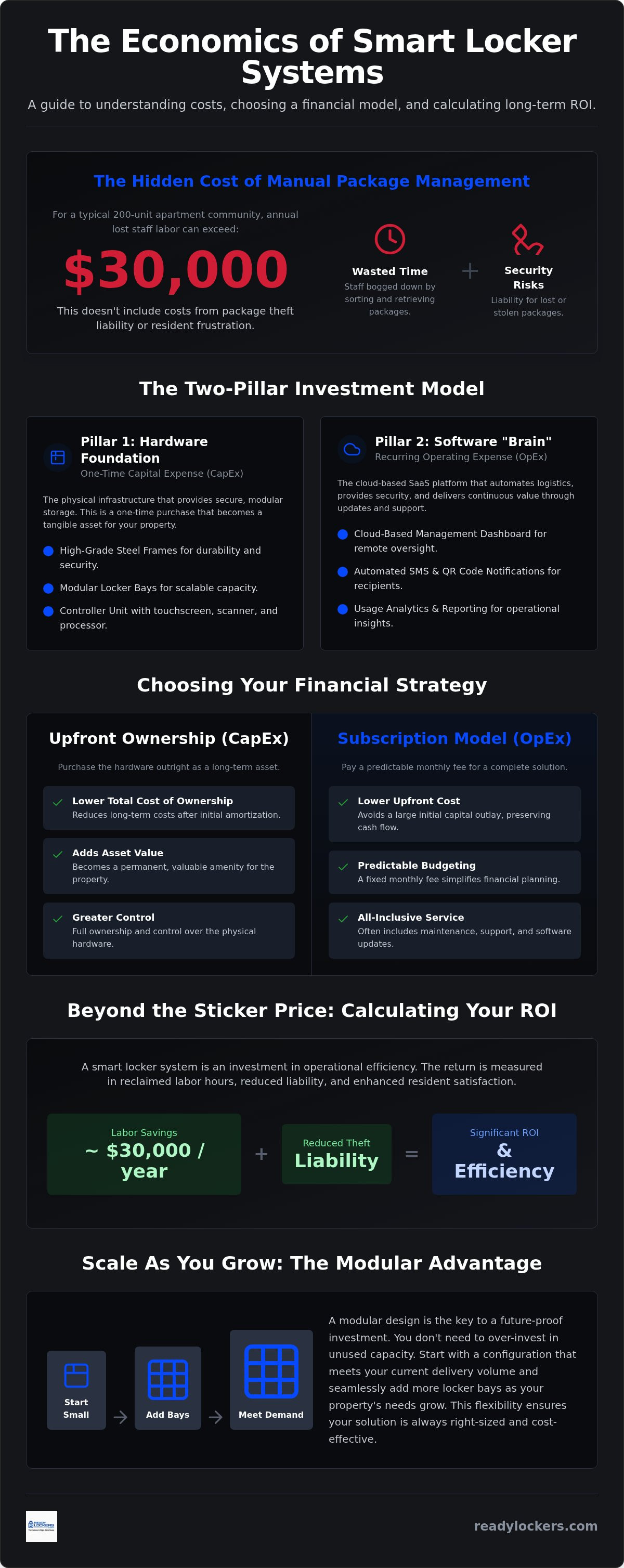
For a 200-unit apartment community, the hidden cost of manual package management can exceed $30,000 in lost staff labor every year. You likely already know that package theft liability and courier chaos are more than just minor inconveniences. They are operational bottlenecks that drain your resources and frustrate your residents or customers. Understanding smart locker system pricing is the first step toward reclaiming that time and securing your perimeter.
We recognize that the distinction between upfront hardware costs and recurring software fees often feels opaque. This guide will help you master the complexities of your investment by breaking down hardware modularity, software capabilities, and the long term ROI of automated delivery. We will examine how to build a clear budget framework that reduces liability and scales alongside your delivery volume. By the end, you will have a definitive roadmap for a system that provides frictionless operation and modern convenience for any contemporary environment. This approach ensures you transition from manual liability to automated efficiency with total confidence.
Key Takeaways
- Understand the two-pillar investment model that separates one-time hardware costs from the recurring SaaS platform "brain."
- Evaluate the strategic differences between CapEx and OpEx models to determine if upfront ownership or predictable monthly subscriptions suit your budget.
- Learn how variables like locker bay volume and installation environment directly influence your final smart locker system pricing.
- Quantify the long-term ROI by calculating significant labor savings and the reduction of package theft liability.
- Discover how modular configurations allow for a scalable entry point that grows alongside your property's delivery volume.
Breaking Down the Components of Smart Locker System Pricing
Smart locker system pricing follows a two-pillar model that balances physical infrastructure with digital intelligence. You aren't simply purchasing a set of metal cabinets. You're investing in an ecosystem where one-time hardware expenses provide the physical foundation, while recurring software fees power the operational "brain." This distinction is critical for long-term budgeting and ensures that your property remains equipped to handle evolving delivery demands.
The evolution of smart lockers has transformed these units from passive storage bins into active IoT endpoints. Modern systems require a cloud-based SaaS platform to manage the complex logic of courier access, recipient notifications, and security protocols. Without this digital layer, the hardware remains a static asset rather than a dynamic logistics solution. This integrated approach allows for a seamless handoff between carriers and recipients without requiring staff intervention.
Hardware: The Modular Foundation
Hardware costs focus on three main elements: the outer frames, the digital controller units, and the individual modular bays. Modular designs are essential for property managers who need a scalable entry point. Instead of purchasing a massive, fixed installation, you can start with a smaller configuration and add bays as your delivery volume increases. This flexibility prevents over-investing in unused capacity while providing a path for future growth.
Material quality significantly impacts longevity and your total cost of ownership. High-grade steel provides the durability required for high-traffic environments and protects against tampering. Every installation centers on the controller unit. This hardware interface serves as the primary touchpoint for couriers and recipients alike. It houses the touchscreen, scanner, and processing unit that communicates with the software backend to trigger door releases.
Software: The Recurring Value Driver
The software component represents the ongoing value driver of the system. This SaaS layer handles the heavy lifting of automated delivery management. It justifies a subscription fee by providing continuous security updates and maintaining the backend infrastructure necessary for 24/7 operation. Digital management removes the burden of manual logging from your team, allowing them to focus on high-value resident services.
Key software features include:
- SMS Gateways and QR Generation: These tools ensure recipients receive instant notifications and secure, contactless pickup codes via their mobile devices.
- Cloud-Based Management: This allows property managers to oversee locker availability, monitor security logs, and manage user access from any web browser.
- Usage Analytics: The platform tracks turnover rates and peak delivery times. This turns raw delivery data into actionable property management insights.
Cloud-based management justifies its subscription by removing the need for local server maintenance. It provides a centralized dashboard where you can monitor every transaction in real time. These digital components ensure that the system remains secure and functional long after the initial physical installation is complete.
CapEx vs. OpEx: Choosing Between Upfront Purchase and Subscription Models
Deciding how to finance your logistics infrastructure is as critical as selecting the hardware itself. Smart locker system pricing generally falls into two distinct categories: Capital Expenditure (CapEx) or Operating Expenditure (OpEx). Your choice depends on your property’s cash flow requirements, tax strategy, and long-term financial goals. Understanding the trade-offs between these models ensures that your investment remains a sustainable asset rather than a financial burden.
The Benefits of Upfront Hardware Ownership
The CapEx model involves purchasing the hardware outright as a one-time capital improvement. This path is often preferred for luxury residential developments or stable corporate headquarters where the primary goal is building equity. By owning the physical asset, you achieve a lower long-term Total Cost of Ownership (TCO) once the initial investment is amortized. Ownership adds tangible value to the building infrastructure, turning a logistics solution into a permanent amenity.
Property owners also benefit from greater control over their physical assets. They can leverage asset tracking benefits to monitor high-value equipment and parcels while keeping the asset on the balance sheet. In many high-end residential settings, budgeting for a one-time improvement is often simpler than managing long-term service contracts. Once the hardware is paid off, the only remaining cost is the "brain" of the system: the recurring software subscription.
The Flexibility of the Subscription Model
The Operating Expenditure (OpEx) model, frequently branded as "Locker as a Service," has become a dominant trend in 2026 commercial real estate. This strategy replaces large upfront costs with predictable, manageable monthly payments. It significantly lowers the barrier to entry for properties that need immediate relief from package management chaos but prefer to preserve their liquid capital. This model shifts the responsibility of hardware longevity and maintenance back to the provider.
This subscription approach offers several functional advantages for fast-growing properties:
- Predictable Budgeting: A flat monthly fee covers hardware, software, and maintenance, preventing unexpected repair costs.
- Continuous Modernization: Regular software updates and security patches are included as part of the service.
- High Scalability: You can easily add more modular bays as your tenant volume or delivery frequency increases without renegotiating major capital budgets.
Tax incentives can also favor the OpEx model. Subscription payments are typically fully deductible as business expenses in the year they occur, whereas CapEx investments must be depreciated over a longer schedule. If you want to avoid a heavy initial outlay, you might explore our subscription options to see how they align with your current operational needs. This flexible approach ensures your property stays at the cutting edge of logistics technology without straining your annual budget.
Key Variables That Influence Your Final Smart Locker Investment
While the base architecture of a delivery system is predictable, several property-specific factors determine your total smart locker system pricing. A standard configuration rarely fits every environment perfectly. You must account for variables that range from physical durability to digital connectivity. These choices don't just change the initial sticker price; they define the system's long-term utility and its ability to handle your specific package volume.
Environment plays a significant role in the hardware selection process. Indoor lobbies offer a controlled climate, whereas outdoor weather-protected kiosks require specialized seals, internal cooling systems, and corrosion-resistant finishes to withstand the elements. Similarly, maintaining a universal courier interface involves ongoing integration work to ensure compatibility with all major carriers. Customization is another factor. Adding custom colors or unique branding wraps provides a professional look that encourages resident trust and adoption, though it adds to the initial production cost.
Capacity and Modular Scaling
Choosing the right number of openings is a balancing act. You don't want to overpay for empty bays, but you can't afford a system that's constantly at capacity. A common industry benchmark suggests a ratio of one bay for every three to five tenants, depending on your specific delivery volume. Modular hardware allows for a phased investment strategy. You can start with a core unit and add expansion modules as your occupancy grows or as residents increase their online ordering frequency. This approach provides a scalable entry point without the risk of investing in unused infrastructure.
Site Preparation and Installation Logistics
Site readiness is often a hidden variable in smart locker system pricing. Every installation requires dedicated power and a reliable data connection, whether through hardwired ethernet or cellular gateways. If your site isn't already wired, electrical work will be a necessary part of your budget. The physical configuration also matters. Freestanding units might require floor anchoring to meet safety standards, while wall-mounted systems need structural reinforcement within the wall itself.
Logistics and shipping represent the final piece of the variable cost puzzle. Moving heavy steel units from a delivery truck to their final location inside your building involves specialized equipment and labor. When planning your budget, consider the following site factors:
- Electrical Access: Proximity to existing power outlets or the need for new dedicated circuits.
- Data Connectivity: Availability of a strong Wi-Fi signal or the installation of hardwired data ports.
- Floor Load Capacity: Ensuring the installation surface can support the weight of multiple steel modules.
- Clearance and Accessibility: Maintaining enough space for couriers to maneuver and for bay doors to open fully.
Beyond the Sticker Price: Calculating ROI and Hidden Operational Savings
Evaluating smart locker system pricing requires looking past the initial invoice to the operational dividends the technology provides. Property managers often focus on the capital outlay while overlooking the "cost of doing nothing." This hidden expense includes escalating labor hours, package theft claims, and resident dissatisfaction. An automated system transforms delivery from a staff-heavy burden into a self-service utility. This shift directly impacts your bottom line by recapturing hundreds of hours spent on manual courier coordination and resident notifications.
Labor efficiency is the most immediate ROI driver. For a 200-unit apartment community, research from 2026 indicates that automated lockers can save between $18,000 and $30,000 per year in staff labor alone. When you calculate the "per-package" cost of manual reception, the financial benefit of automation becomes undeniable. Your team can refocus on high-value property management tasks rather than sorting boxes in a back room. This efficiency creates a more professional environment and ensures that your staff remains productive during peak delivery hours.
Mitigating Package Liability and Theft
The financial impact of "porch piracy" in multi-family lobbies extends beyond the value of the stolen items. It includes the administrative time spent investigating claims and the potential for increased insurance premiums. By implementing a secure chain-of-custody, you create a verifiable digital paper trail for every delivery. This data reduces the volume of disputed claims and provides peace of mind for both management and residents. You can perform a detailed risk assessment by reviewing our guide on package liability for property managers. Secure storage effectively eliminates the liability associated with packages left in unsecured common areas.
Labor Efficiency and Amenity Value
In the competitive luxury apartment market, smart lockers have transitioned from a premium perk to a standard requirement. High-value tenants expect 24/7 contactless pickup as part of a modern living experience. This amenity justifies higher rental rates and improves tenant retention by removing the friction of missed deliveries. Residents no longer need to rush home before the leasing office closes to retrieve their parcels. This constant availability provides a sense of modern convenience that manual systems cannot match.
The reduction in missed deliveries also benefits your building's operational flow. Couriers complete their routes faster when they have a single, secure point of entry. This reduces congestion in your lobby or loading zones and prevents the chaos of multiple couriers searching for recipients. If you are ready to stop losing revenue to manual logistics, contact us for a customized ROI analysis. This strategic shift ensures your property remains efficient, secure, and attractive to the modern consumer.
Selecting the Right Configuration: ReadyLockers’ Modular Approach to Value
ReadyLockers provides a definitive answer to the logistical challenges of modern property management. Our modular approach ensures that smart locker system pricing remains accessible without sacrificing the functionality of a custom-built solution. We focus on universal application across offices, apartments, and retail environments. These modular units are designed to integrate into your existing building layout. This strategy avoids the high costs associated with bespoke construction while maintaining a sleek, professional aesthetic. When evaluating smart locker system pricing, the modular nature of our hardware allows you to avoid paying for excess capacity you don't yet need.
The system pairs a secure courier access interface with our proprietary SaaS platform. This combination provides a frictionless experience for delivery drivers and recipients alike. By automating the hand-off, you eliminate the need for staff intervention entirely. This streamlined process ensures that every parcel is tracked from the moment it enters the locker until the final pickup is complete.
Why a Unified Hardware and SaaS Approach Wins
A unified approach ensures the physical hardware and the notification system stay in constant sync. When a courier secures a parcel, the cloud-based brain immediately triggers an SMS or QR code notification. This 24/7 availability isn't a luxury. It's a standard requirement for today’s fast-paced logistics environment. ReadyLockers acts as a long-term partner in property efficiency. We provide the tools you need to manage increasing delivery volumes without adding to your headcount. Recipients enjoy the freedom of 24/7 contactless pickup, while couriers benefit from a streamlined drop-off process that reduces their time on-site.
Next Steps for Your Pricing Quote
Before requesting a formal estimate, you should conduct an internal volume audit to determine your average daily package count. This data allows us to recommend the ideal bay-to-tenant ratio for your specific needs. Professional installation is another critical factor for long-term hardware health. Proper anchoring and network configuration protect your investment and ensure a high level of reliability from the first day of operation. If you're ready to modernize your property’s logistics, you can request a custom pricing proposal from ReadyLockers today. This step moves you closer to a scalable, secure, and highly efficient delivery ecosystem.
Securing Your Property’s Future with Automated Logistics
Transitioning from manual package management to an automated ecosystem is a strategic necessity for any modern property. By mastering the nuances of smart locker system pricing, you can effectively balance your initial investment with long-term operational savings. You now understand how modular hardware and a robust SaaS platform work together to eliminate staff bottlenecks and reduce theft liability. This shift ensures your logistics infrastructure remains a dependable utility rather than an ongoing management headache.
ReadyLockers provides a scalable foundation that grows alongside your delivery volume. Our systems offer secure 24/7 contactless pickup, automated SMS and QR code notifications, and modular hardware for any property size. These features provide the peace of mind that comes with a reliable, high-tech solution. It's time to reclaim your staff's productivity and provide your residents with a premium amenity that justifies higher retention rates.
Get a Customized Smart Locker Pricing Quote to see how an efficient delivery system can transform your property's operations. We look forward to helping you build a more secure and streamlined environment today.
Frequently Asked Questions
How much does a basic smart locker system cost to install?
Installation costs are determined by your specific site requirements, including the need for dedicated electrical circuits and reliable data ports. Freestanding units typically require floor anchoring, while wall mounted configurations might need structural reinforcement within the building's frame. Professional installation is vital for ensuring the long term health of your hardware. This phase of the project ensures your system is properly configured for immediate, frictionless operation upon deployment.
Is there a monthly fee for smart package lockers?
Yes, most modern systems utilize a recurring subscription model to power the software brain. This monthly fee covers cloud based management, security updates, and the backend infrastructure required for 24/7 operation. This OpEx approach ensures that the system remains secure and functional without requiring the property manager to handle server maintenance or manual software patches. It provides a predictable budgeting framework for ongoing logistics management.
Does smart locker software pricing include SMS notifications?
Standard smart locker software pricing typically encompasses the automated notification suite, including instant SMS and secure QR code delivery. These digital alerts are triggered the moment a courier secures a parcel within a bay. This automation removes the burden of manual logging from property staff. It ensures recipients receive immediate, actionable information to complete their contactless pickup at any time of day or night.
What are the hidden costs of buying smart lockers outright?
Beyond the initial hardware purchase, hidden costs often include site preparation such as running dedicated electrical circuits and ensuring strong data connectivity. Shipping and logistics for heavy steel units can also add to the total. Long term maintenance, future software licensing, and potential integration fees for third party property management tools are additional factors to consider when calculating the total cost of ownership for an outright purchase.
Can I add more lockers to my system later if volume increases?
Modular hardware configurations allow you to scale your system as delivery volume grows. You can start with a core controller unit and a small number of bays, then add expansion modules as your occupancy or resident ordering frequency increases. This phased investment strategy prevents overspending on unused capacity while providing a scalable path for future property growth. It's a highly efficient way to manage smart locker system pricing.
Do smart lockers provide a return on investment for property managers?
ROI comes from recapturing hundreds of staff hours previously lost to manual parcel sorting. It also stems from eliminating the administrative costs of investigating theft claims and disputed deliveries. By positioning the system as a standard requirement for modern living, you enhance your property's competitive edge. This shift from manual liability to automated efficiency provides a clear financial benefit that outweighs the recurring software costs.
How does courier access affect the pricing of a locker system?
The complexity of the courier access interface and its integration with the SaaS platform can influence the overall investment. A universal interface that supports all major carriers requires ongoing software maintenance to ensure seamless operation. This digital layer is what allows couriers to drop off parcels without staff assistance. It provides the secure chain of custody data that is essential for reducing liability and improving building security.
Are there different pricing tiers for indoor vs. outdoor lockers?
Environmental factors significantly impact smart locker system pricing due to the specialized hardware required for outdoor installations. Outdoor kiosks need weather resistant seals, internal climate control, and corrosion resistant finishes to protect the digital components from the elements. These specialized features often place outdoor units in a different tier compared to standard indoor lobby configurations. Choosing the right environment ensures the longevity and reliability of your physical infrastructure.

Frequently Asked Questions
How much does a basic smart locker system cost to install?+
Installation costs are determined by your specific site requirements, including the need for dedicated electrical circuits and reliable data ports. Freestanding units typically require floor anchoring, while wall mounted configurations might need structural reinforcement within the building's frame. Professional installation is vital for ensuring the long term health of your hardware. This phase of the project ensures your system is properly configured for immediate, frictionless operation upon deployment.
Is there a monthly fee for smart package lockers?+
Yes, most modern systems utilize a recurring subscription model to power the software brain. This monthly fee covers cloud based management, security updates, and the backend infrastructure required for 24/7 operation. This OpEx approach ensures that the system remains secure and functional without requiring the property manager to handle server maintenance or manual software patches. It provides a predictable budgeting framework for ongoing logistics management.
Does smart locker software pricing include SMS notifications?+
Standard smart locker software pricing typically encompasses the automated notification suite, including instant SMS and secure QR code delivery. These digital alerts are triggered the moment a courier secures a parcel within a bay. This automation removes the burden of manual logging from property staff. It ensures recipients receive immediate, actionable information to complete their contactless pickup at any time of day or night.
What are the hidden costs of buying smart lockers outright?+
Beyond the initial hardware purchase, hidden costs often include site preparation such as running dedicated electrical circuits and ensuring strong data connectivity. Shipping and logistics for heavy steel units can also add to the total. Long term maintenance, future software licensing, and potential integration fees for third party property management tools are additional factors to consider when calculating the total cost of ownership for an outright purchase.
Can I add more lockers to my system later if volume increases?+
Modular hardware configurations allow you to scale your system as delivery volume grows. You can start with a core controller unit and a small number of bays, then add expansion modules as your occupancy or resident ordering frequency increases. This phased investment strategy prevents overspending on unused capacity while providing a scalable path for future property growth. It's a highly efficient way to manage smart locker system pricing.
Do smart lockers provide a return on investment for property managers?+
ROI comes from recapturing hundreds of staff hours previously lost to manual parcel sorting. It also stems from eliminating the administrative costs of investigating theft claims and disputed deliveries. By positioning the system as a standard requirement for modern living, you enhance your property's competitive edge. This shift from manual liability to automated efficiency provides a clear financial benefit that outweighs the recurring software costs.
How does courier access affect the pricing of a locker system?+
The complexity of the courier access interface and its integration with the SaaS platform can influence the overall investment. A universal interface that supports all major carriers requires ongoing software maintenance to ensure seamless operation. This digital layer is what allows couriers to drop off parcels without staff assistance. It provides the secure chain of custody data that is essential for reducing liability and improving building security.
Are there different pricing tiers for indoor vs. outdoor lockers?+
Environmental factors significantly impact smart locker system pricing due to the specialized hardware required for outdoor installations. Outdoor kiosks need weather resistant seals, internal climate control, and corrosion resistant finishes to protect the digital components from the elements. These specialized features often place outdoor units in a different tier compared to standard indoor lobby configurations. Choosing the right environment ensures the longevity and reliability of your physical infrastructure.