Package Liability for Property Managers: 2026 Risk Guide
Facing rising package theft? Our 2026 guide to package liability for property managers shows how to mitigate risk with smart tech and clear legal policies.

Is your property one missing delivery away from a costly legal dispute? Most property managers operate under the assumption that "courtesy" package handling shields them from responsibility, yet rising porch piracy and vague lease terms often create the opposite effect. Understanding the nuances of package liability for property managers is no longer optional as delivery volumes hit record highs. You already know the frustration of staff spending hours managing logistics instead of focusing on essential property tasks, creating a drain on resources that increases your exposure to resident claims.
This 2026 guide clarifies the legal landscape and provides actionable strategies to mitigate risk. You'll learn how to establish legal boundaries and implement automated systems that protect your property from financial and reputational damage. We will explore the transition from manual handling to a secure chain of custody, the necessity of precise contract language, and how digital interfaces create the verifiable data needed to resolve disputes instantly. This overview provides a clear roadmap to a streamlined, hands-off delivery process that ensures both security and modern operational efficiency.
Key Takeaways
- Define the legal shift from "courtesy" to "constructive bailment" and how it impacts your specific duty of care in 2026.
- Identify the critical failure points in manual package rooms that lead to rising resident complaints and unmanaged theft.
- Learn how a "No-Touch" policy and courier access interfaces effectively mitigate package liability for property managers.
- Establish a verifiable digital chain of custody for every delivery using smart locker hardware and automated notifications.
- Utilize SaaS platform analytics to generate the precise data needed to resolve disputes and defend against false claims.
Understanding Package Liability for Property Managers in 2026
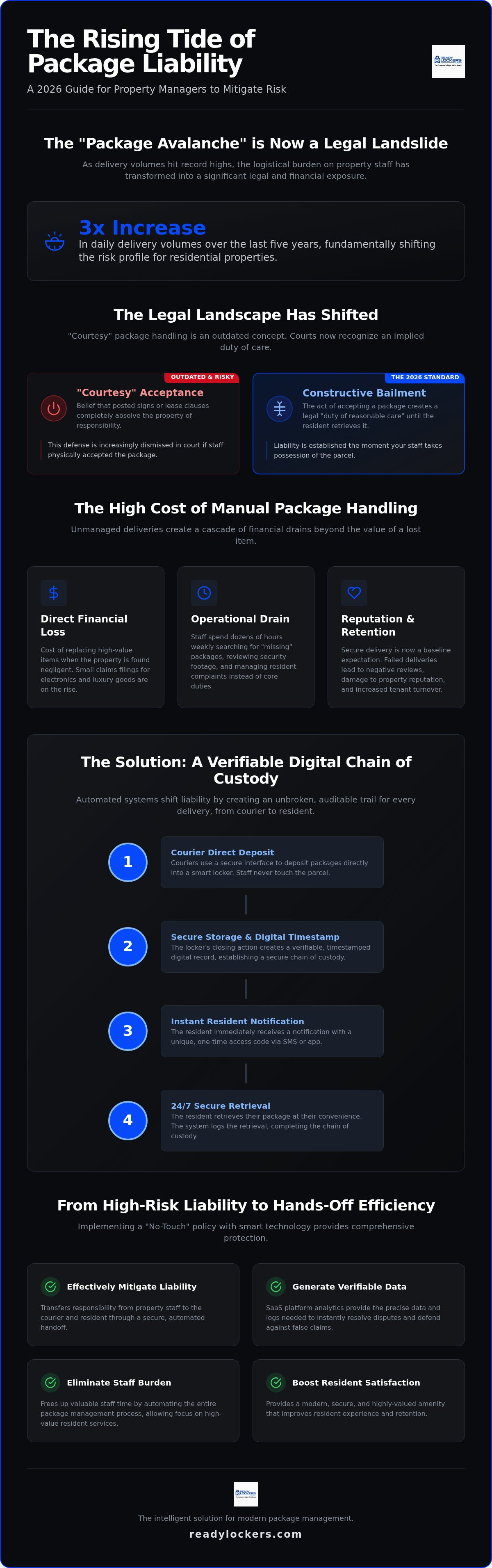
Package liability for property managers represents the legal and financial accountability for any parcel that is lost, stolen, or damaged while under the building’s control. It marks the specific point where a manager assumes "reasonable care" for a delivered item. In 2026, the "Package Avalanche" has reached a critical mass. Daily delivery volumes have tripled over the last five years, fundamentally shifting the risk profile for residential assets. Managing this volume manually is no longer just a logistical hurdle; it's a significant legal exposure.
Distinguishing between external threats and internal failures is vital for risk mitigation. Porch piracy, or theft by third parties in common areas, is an external security issue. However, if a staff member accepts a package and subsequently loses it or leaves it in an unsecured lobby, the property faces a negligence claim. This distinction often determines whether a resident’s small claims filing will be successful. Clear boundaries are necessary to prevent "courtesy" services from becoming permanent legal obligations.
The Financial Impact of Unmanaged Deliveries
Unstructured package handling creates a cascade of financial drains. Direct costs include the replacement of high-value items if a court finds the property failed its duty of care. Indirect costs are often more damaging. Staff spend dozens of hours weekly investigating "missing" boxes and reviewing grainy security footage. This administrative burden coincides with rising insurance premiums as claims history worsens. There is also a "Resident Satisfaction" tax to consider. Tenants view secure package delivery as a baseline requirement. When deliveries fail, frustration leads to negative reviews and increased tenant turnover.
Current Trends in Multi-Family Litigation
Litigation patterns in 2026 show a sharp increase in small claims court filings related to lost high-value electronics and luxury goods. Residents are less likely to accept "not responsible for lost items" signs as a valid defense. Consumer expectations have evolved. Secure delivery is now viewed as essential infrastructure rather than an optional amenity. This shift is forcing managers to rewrite lease language with stricter liability clauses. Modern courts often look past broad disclaimers if the property manager took physical possession of the item but failed to provide a secure environment for it. Without a digital paper trail, proving "reasonable care" becomes nearly impossible in a legal setting.
The Legal Nuances: Bailment vs. Courtesy Package Acceptance
Managing package liability for property managers requires a firm grasp of bailment law. Bailment occurs when one party (the bailee) takes possession of personal property belonging to another party (the bailor) with the intent to return it or deliver it as instructed. In residential settings, this relationship is often "constructive." You didn't sign a formal contract for that specific box, but by accepting it from a courier, you've legally assumed control. This act creates a duty of care that cannot be ignored simply because the service is provided for free.
Constructive Bailment Explained
When a doorman or leasing agent accepts a parcel, the property enters a state of constructive bailment. The court views this as an implied agreement to keep the item safe until the resident retrieves it. This triggers a "Standard of Care" requirement. Managers must exercise the same level of caution a reasonable person would use to protect their own property. This is why "Not Responsible for Stolen Goods" signs are frequently dismissed in court. If the building's staff took possession of the item and then left it in an unmonitored area, the property is often found negligent regardless of any posted disclaimers.
The "Gratuitous Bailment" defense suggests that because you aren't charging for the service, you should only be held to a lower standard of care. Modern courts are increasingly skeptical of this argument. If you provide a package room as a marketed amenity, the court may view it as part of the value the resident pays for in their rent. This elevates the requirement back to "reasonable care," making it harder to dismiss negligence claims when items go missing from common areas.
Lease Clauses and Liability Waivers
Standard rental agreements often attempt to limit liability, but the effectiveness of these clauses depends on the distinction between acceptance and storage. Courts generally distinguish between a property manager acting as a courier’s recipient and providing a secure storage solution. To minimize risk, lease language should clearly state that package acceptance is a gratuitous service and that the resident assumes all risk once the courier completes the delivery. However, even the best legal language can't excuse gross negligence. Implementing smart locker integration for property management allows you to formalize these boundaries by removing staff from the physical handling process entirely. This shift creates a definitive break in the chain of custody, ensuring that your liability ends the moment the courier secures the item in a locker.
A verifiable chain of custody is your strongest defense against claims. Without digital proof of when an item arrived and when it was retrieved, you're left with the resident's word against your staff's memory. Automation provides the data needed to prove that "reasonable care" was maintained through every step of the process. You can protect your property from delivery disputes by adopting systems that track every interaction in real time.
Identifying High-Risk Failure Points in Manual Package Rooms
Manual package management is a significant liability magnet for modern residential assets. When buildings rely on unsecured common areas or outdated tracking methods, they create systemic vulnerabilities that residents can easily exploit in a legal dispute. Assessing package liability for property managers requires identifying exactly where the chain of custody breaks down. Most failures aren't the result of a single event but rather a series of predictable security gaps in the daily delivery workflow.
The "Open Lobby" problem is one of the most frequent drivers of resident claims. Unsecured common areas allow couriers to drop parcels in plain sight, inviting both external theft and internal disputes. Universal door codes for package rooms offer a security illusion; once a code is shared with a single courier, it's effectively public knowledge. This lack of individual accountability makes it impossible to determine who entered the room when an item goes missing. Manual logbooks further complicate the issue. Handwritten tracking is prone to human error, illegible entries, and missed signatures, leaving you with no verifiable evidence to dispute a claim of non-delivery.
Courier chaos adds another layer of risk to your operations. Allowing unverified delivery personnel deep access into building corridors creates a broad security threat that extends beyond simple parcel theft. Without a controlled interface to manage these entries, you're essentially granting building-wide access to dozens of strangers daily. Industry data suggests that 30% of package losses occur due to "misplacement" by building staff, highlighting that internal handling is often as risky as external theft.
The Vulnerability of Open-Access Package Rooms
Open-access rooms often lead to the liability of "co-mingled" deliveries. In these environments, residents must sort through stacks of mail belonging to their neighbors to find their own items. This creates constant opportunities for accidental pick-ups or intentional theft by other tenants. For high-end developments, maintaining a premium experience requires package management for luxury apartments that eliminates these common security gaps. A room that everyone can enter is a room that no one is responsible for.
Staff Handling Risks
Staff involvement in the delivery process introduces professional liability. Employee theft, often referred to as the "Inside Job" suspicion, can devastate resident trust even if it's never proven. Beyond intentional acts, staff often accidentally damage fragile items during sorting or organization. There's also the legal risk of "holding" packages past a certain timeframe. If your staff accepts an item but fails to notify the resident promptly, a court may find the property liable for any subsequent loss because the manager prevented the resident from taking timely possession of their property.
Operational Strategies to Minimize Resident Claims
Preventing claims is more cost-effective than litigating them or paying higher insurance premiums. The most decisive step you can take is establishing a "No-Touch" policy. This strategy shifts the responsibility from staff acceptance to self-service systems, effectively removing your team from the physical chain of custody. When employees don't touch the parcels, they can't be held liable for accidental damage or "inside job" theft. By automating the intake process, you eliminate the human error inherent in manual sorting and storage.
You should also audit your current lease language to include specific exclusions for third-party theft and force majeure events. While these clauses don't excuse gross negligence, they establish a clear baseline for resident expectations. A robust operational framework combines these legal protections with physical security measures to create a comprehensive defense against package liability for property managers. Modernizing your approach ensures that you aren't just reacting to losses but actively preventing the conditions that allow them to occur.
The Power of Automated Notifications
Automated notification systems provide the digital evidence needed to resolve disputes quickly. When a courier secures a parcel, the system generates an immediate SMS or QR code alert for the resident. This creates a verifiable "Time of Delivery" stamp that exists outside of human error. These digital timestamps act as a receipt of transfer, proving exactly when the property fulfilled its duty to notify the tenant. Automated reminders also reduce the "unclaimed package" liability by encouraging residents to retrieve items promptly. The faster an item is picked up, the lower the risk of it being targeted for theft or accidental damage in common areas. This process reinforces resident accountability and ensures that the lobby doesn't become a cluttered, high-risk storage zone.
Courier Management Protocols
Standardizing how delivery personnel interact with your facility is essential for building security. Implementing a courier access interface allows you to track exactly who enters the building and when they arrive. This secure interface verifies delivery personnel before granting access to specific drop-off zones, reducing the risk of unauthorized individuals wandering through residential corridors. By providing 24/7 access solutions for couriers, you also eliminate "missed delivery" claims that often lead to resident frustration and subsequent complaints. A secure, designated drop-off point ensures that couriers aren't tempted to leave packages in unmonitored hallways or open lobbies.
A streamlined delivery workflow protects your bottom line and your reputation. You can automate your package security to ensure every parcel is accounted for without increasing your staff's workload or liability exposure.
Shifting Liability through Secure Chain-of-Custody Technology
The most effective way to address package liability for property managers is to remove human intervention from the delivery cycle. Smart lockers act as a dedicated third-party custodian. They insulate the property by ensuring that building staff never take physical possession of the items. This technology creates an unbreakable digital chain of custody. Every interaction is recorded, from the moment the courier scans the parcel to the second the resident uses their QR code for pickup. You aren't just improving convenience; you're fundamentally changing your legal relationship with the delivery.
SaaS analytics provide the data needed to resolve disputes instantly. If a resident claims a package was never delivered, you can provide a high-resolution log of the exact locker, time, and courier identity. This digital paper trail serves as an objective witness. It eliminates the "he-said, she-said" dynamic that often leads to costly claims. Contactless pickup systems act as a liability shield by removing human error from the exchange. There's no risk of staff misplacing a box or handing it to the wrong person. Automation ensures that the right package always reaches the right resident.
Smart Lockers and the End of Bailment
Technology shifts the legal "Standard of Care" from the property manager to the secure system itself. When you provide a smart locker, your duty isn't to personally guard each box. Instead, your responsibility is limited to maintaining the functional integrity of the system. This shift significantly lowers your legal exposure. The evidentiary value of digital access logs and video snapshots provides a robust defense in any dispute resolution process. Additionally, 24/7 availability ensures that residents have constant access to their property. This reduces the manager's burden of providing "reasonable access" during limited office hours, further minimizing potential friction and claims.
Implementing a Universal Smart Locker Platform
Modern locker platforms offer versatility across diverse property types. Whether you manage luxury condos, student housing, or commercial warehouses, the core principles of secure custody remain the same. Modular hardware allows you to scale the system as delivery volumes grow, ensuring you don't outgrow your liability protection. Understanding the smart locker system pricing helps you quantify the ROI of long-term risk reduction. Smart lockers are the only way to future-proof your asset against the rising tide of package liability for property managers. They transform a chaotic logistical burden into a streamlined, secure, and legally defensible operation.
Future-Proofing Your Delivery Operations
Eliminating the ambiguity of package liability for property managers requires a transition from manual oversight to automated precision. You've seen how "courtesy" services can quickly transform into legal obligations under the principles of constructive bailment. By removing staff from the physical handling of goods, you effectively dismantle the high-risk failure points found in open lobby environments and manual logbooks. Replacing these outdated methods with a verifiable digital chain of custody ensures that your property remains protected against rising delivery volumes and resident claims.
Transitioning to a universal platform provides the security needed for modern residential, office, and retail environments. ReadyLockers offers automated digital audit trails for every delivery and 24/7 contactless pickup available nationally. These systems provide the data necessary to resolve disputes immediately while maintaining a frictionless experience for your residents. It's time to replace logistical chaos with a reliable, tech-driven solution that prioritizes both security and operational efficiency. Secure your property and reduce liability with ReadyLockers today and gain the peace of mind that comes with a truly modern delivery infrastructure.
Frequently Asked Questions
Are property managers responsible for stolen packages in 2026?
Responsibility depends on whether the manager assumed a duty of care through constructive bailment. If staff accepted a package or left it in an unsecured common area, they may be found negligent in court. However, if the manager provides a secure self-service system and clear lease disclaimers, they typically avoid liability for third-party theft. Establishing a no-touch policy is the most effective way to limit package liability for property managers.
What is the difference between a package room and a smart locker for liability?
A package room often creates a shared liability environment because multiple residents and couriers access the same space, making it difficult to prove responsibility for a loss. Smart lockers shift the legal standard of care by isolating each delivery. Since the locker acts as a third-party custodian, the property manager never takes physical possession. This separation provides a definitive break in the chain of custody that a communal room cannot offer.
Can a tenant sue a property manager for a lost delivery?
Tenants can file suits in small claims court if they believe the manager was negligent in handling their property. These claims usually hinge on whether the manager exercised reasonable care after taking possession of the item. Without digital evidence or automated tracking, managers often struggle to defend against these claims. Providing a secure, automated pickup system reduces the likelihood of these disputes reaching a courtroom by providing verifiable delivery data.
Does General Liability insurance cover stolen resident packages?
General liability insurance typically covers damage to third-party property, but it may not cover theft of resident parcels unless specific endorsements are added. Most standard policies exclude property in your care, custody, or control, which is the exact situation during a bailment. Managers should review their policies to see if they have Bailee’s Customers Insurance. Relying solely on a general policy often leaves a significant gap in coverage for parcel-related losses.
How does a smart locker create a legal chain of custody?
Smart lockers use locker management software to record every touchpoint of the delivery process. This includes the courier's identity, the exact time of deposit, and the unique QR code used for resident pickup. These SaaS analytics create a digital audit trail that serves as objective evidence in disputes. By documenting the transfer of the item from the courier to the secure unit, the system proves the property manager fulfilled their duty of care effectively.
What lease language best protects property managers from package theft?
Effective lease language should explicitly state that package acceptance is a gratuitous courtesy service and not a contractual obligation. Clauses should include a liability waiver for third-party theft, damage, or misdelivery. It's also helpful to specify that the resident assumes all risk once a courier leaves an item on the premises. While these clauses provide a baseline defense, they're most effective when paired with physical security measures like a contactless pickup system.
Is a property manager liable if they sign for a resident’s package?
Signing for a package is a clear admission of taking possession, which immediately establishes a constructive bailment. Once a staff member signs, the property assumes a legal duty to protect that item until it's retrieved. If the item is later lost or stolen from a back office, the manager is often held liable for negligence. Avoiding staff signatures and using courier access interfaces helps maintain a no-touch environment that limits this specific package liability for property managers.
How do smart lockers reduce insurance premiums for commercial properties?
Insurance providers often view automated security systems as a significant risk mitigation factor. By implementing smart lockers, you reduce the frequency of claims related to theft and mysterious disappearance. This improved claims history can lead to lower premiums over time. Additionally, the presence of a 24/7 contactless pickup system demonstrates a proactive approach to property security, which may qualify the asset for specific safety-related discounts from certain insurance carriers after a risk assessment.

Frequently Asked Questions
Are property managers responsible for stolen packages in 2026?+
Responsibility depends on whether the manager assumed a duty of care through constructive bailment. If staff accepted a package or left it in an unsecured common area, they may be found negligent in court. However, if the manager provides a secure self-service system and clear lease disclaimers, they typically avoid liability for third-party theft. Establishing a no-touch policy is the most effective way to limit package liability for property managers.
What is the difference between a package room and a smart locker for liability?+
A package room often creates a shared liability environment because multiple residents and couriers access the same space, making it difficult to prove responsibility for a loss. Smart lockers shift the legal standard of care by isolating each delivery. Since the locker acts as a third-party custodian, the property manager never takes physical possession. This separation provides a definitive break in the chain of custody that a communal room cannot offer.
Can a tenant sue a property manager for a lost delivery?+
Tenants can file suits in small claims court if they believe the manager was negligent in handling their property. These claims usually hinge on whether the manager exercised reasonable care after taking possession of the item. Without digital evidence or automated tracking, managers often struggle to defend against these claims. Providing a secure, automated pickup system reduces the likelihood of these disputes reaching a courtroom by providing verifiable delivery data.
Does General Liability insurance cover stolen resident packages?+
General liability insurance typically covers damage to third-party property, but it may not cover theft of resident parcels unless specific endorsements are added. Most standard policies exclude property in your care, custody, or control, which is the exact situation during a bailment. Managers should review their policies to see if they have Bailee’s Customers Insurance. Relying solely on a general policy often leaves a significant gap in coverage for parcel-related losses.
How does a smart locker create a legal chain of custody?+
Smart lockers use locker management software to record every touchpoint of the delivery process. This includes the courier's identity, the exact time of deposit, and the unique QR code used for resident pickup. These SaaS analytics create a digital audit trail that serves as objective evidence in disputes. By documenting the transfer of the item from the courier to the secure unit, the system proves the property manager fulfilled their duty of care effectively.
What lease language best protects property managers from package theft?+
Effective lease language should explicitly state that package acceptance is a gratuitous courtesy service and not a contractual obligation. Clauses should include a liability waiver for third-party theft, damage, or misdelivery. It's also helpful to specify that the resident assumes all risk once a courier leaves an item on the premises. While these clauses provide a baseline defense, they're most effective when paired with physical security measures like a contactless pickup system.
Is a property manager liable if they sign for a resident’s package?+
Signing for a package is a clear admission of taking possession, which immediately establishes a constructive bailment. Once a staff member signs, the property assumes a legal duty to protect that item until it's retrieved. If the item is later lost or stolen from a back office, the manager is often held liable for negligence. Avoiding staff signatures and using courier access interfaces helps maintain a no-touch environment that limits this specific package liability for property managers.
How do smart lockers reduce insurance premiums for commercial properties?+
Insurance providers often view automated security systems as a significant risk mitigation factor. By implementing smart lockers, you reduce the frequency of claims related to theft and mysterious disappearance. This improved claims history can lead to lower premiums over time. Additionally, the presence of a 24/7 contactless pickup system demonstrates a proactive approach to property security, which may qualify the asset for specific safety-related discounts from certain insurance carriers after a risk assessment.