Automated Mailroom Solutions: The 2026 Guide to Modernizing Building Logistics
Discover how a mailroom package locker system can modernize your building's logistics. Our 2026 guide shows you how to cut labor, stop theft & automate deliv...

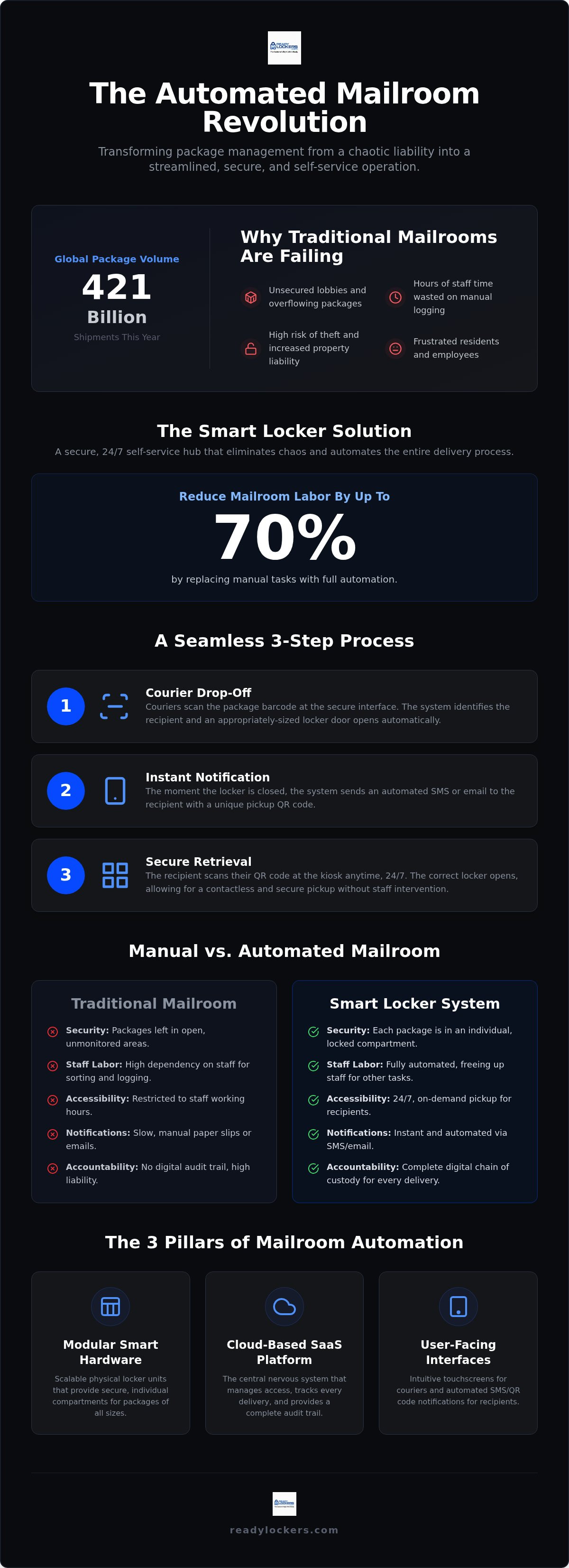
With an estimated 421 billion packages moving through global supply chains this year, the traditional mailroom has officially reached its breaking point. You've likely seen the results firsthand. Unsecured lobbies overflow with boxes, couriers leave parcels in crowded hallways, and staff members spend hours every week manually logging deliveries. It's a chaotic, high-liability environment that drains resources and frustrates the people who live or work in your building.
We understand that managing this volume isn't just a convenience issue; it's a security and operational necessity. Implementing a modern mailroom package locker system transforms this logistical nightmare into a streamlined, 24/7 self-service hub that eliminates theft and automates every notification. This technology provides immediate peace of mind by ensuring every delivery is tracked, secured, and accessible without staff intervention. This guide explores how current automation solutions reduce mailroom labor by up to 70% while maintaining compliance with 2026 accessibility standards and USPS regulations.
Key Takeaways
- Modern mailroom solutions combine modular hardware with SaaS platforms to automate the entire delivery lifecycle from courier drop-off to recipient pickup.
- Implementing a mailroom package locker system provides a secure, 24/7 self-service environment that eliminates package theft and reduces property liability.
- Property managers can reclaim significant staff time by replacing manual logging and notification tasks with automated SMS and QR code alerts.
- Strategic implementation requires assessing package volume and courier flow to determine the ideal placement and configuration of modular locker units.
- Integrated logistics platforms offer the versatility needed to manage high-volume deliveries across residential, corporate, and healthcare facilities.
What Are Automated Mailroom Solutions in 2026?
An automated mailroom solution is a sophisticated integration of physical smart hardware and cloud-based SaaS platforms. In 2026, these systems have evolved beyond simple shelving; they function as self-service logistics hubs that manage the entire chain of custody without human intervention. This technology is essentially a modern iteration of the automated postal box, designed specifically for the high-density requirements of corporate offices, hospitals, and residential complexes.
The Shift from Manual Sorting to Digital Hubs
Manual logging has become a major operational liability. With global package volume hitting 421 billion shipments this year, the pressure on building staff is unsustainable. Traditional mailrooms often result in courier chaos where parcels sit in unsecured lobbies or hallways, creating easy targets for theft. Automation removes the middleman from this equation. By using a mailroom package locker system, couriers deposit items directly into secure compartments. This process eliminates manual data entry and prevents staff from spending hours sorting through daily deliveries. It's a direct response to the massive growth of e-commerce that demands both speed and total security.
Core Components of a Modern System
A functional system relies on three specific elements. First, modular smart locker units provide the physical storage. These units are scalable, allowing property managers to add capacity as delivery volumes grow. Second, cloud-based SaaS platforms act as the central nervous system. This software manages courier access interfaces, monitors locker occupancy, and tracks every transaction for liability protection. It allows administrators to oversee multiple locations from a single digital dashboard. Finally, user-facing interfaces provide the bridge to the recipient. When a package is secured, the system triggers automated notifications via SMS or QR codes. This setup ensures 24/7 contactless pickup availability, meeting the expectations of a modern on-demand workforce.
The three pillars of this technology are secure storage, automated notifications, and streamlined courier access. By providing constant availability, a mailroom package locker system ensures that building logistics never stop. It protects goods from theft while providing a level of convenience that manual systems simply can't match. This integration is no longer a luxury; it's a standard requirement for any building that handles a high volume of physical assets.
How Modern Mailroom Automation Systems Function
The operational success of a building's logistics depends on a frictionless handoff between the carrier and the property. A mailroom package locker system acts as the primary interface for this exchange, standardizing how goods enter the building. Rather than relying on staff to sort through piles of boxes, the system creates a high-tech chain of custody that begins the moment a courier arrives at the property.
The Courier Access Interface
Major carriers, including USPS, Amazon Logistics, UPS, and FedEx, currently handle over 92% of domestic shipments. A modern system provides these couriers with a standardized digital interface that prevents "lobby dumping," the practice of leaving parcels in unsecured common areas. Upon arrival, the courier uses the secure access interface to scan the parcel's barcode. The system automatically cross-references the recipient with the building’s integrated directory. Once a match is confirmed, a locker of the appropriate size opens automatically. This process creates a permanent digital audit trail, recording the exact time of delivery and the specific compartment used for storage. It effectively shifts the responsibility of secure placement back to the carrier while providing the property manager with total visibility.
Automated Notification and Retrieval
The moment the courier closes the locker door, the cloud-based software triggers an immediate notification flow. Recipients receive an SMS alert or email containing a unique QR code. This digital delivery is significantly faster than manual paper slips or staff-led logging. Because the notification is instantaneous, the "time-to-pickup" is drastically reduced, which prevents lockers from becoming stagnant storage spaces. To retrieve their items, users simply scan their QR code at the locker kiosk. This contactless pickup system allows for 24/7 access, meaning residents or employees can collect their goods at their own convenience without requiring any staff intervention. It's a secure, zero-touch process that maintains building safety while maximizing user satisfaction.
Beyond the physical handoff, the management software tracks real-time usage analytics. Property managers can monitor locker occupancy rates, identify peak delivery times, and flag "stale" packages that haven't been retrieved within a set timeframe. This data is essential for optimizing locker turnover and ensuring that there is always enough capacity for incoming shipments. If you are ready to eliminate courier chaos, you can learn more about our contactless pickup system and how it integrates with your existing building operations.
Manual vs. Automated Mailroom Management: A Comparative Analysis
Transitioning from a manual mailroom to an automated system represents more than just a hardware upgrade. It's a fundamental shift in how a building handles physical assets. Manual management relies on staff availability and physical floor space, whereas a mailroom package locker system operates as a zero-touch logistics hub. This comparison highlights the specific areas where automation delivers a superior return on investment by addressing the inherent flaws of human-led sorting.
Security and Liability Reduction
Manual sorting introduces significant chain of custody risks. When building personnel accept, log, and store parcels, the property assumes legal liability for any loss, misplacement, or damage. Automation removes this burden entirely. The courier places the item directly into a secure compartment, and the recipient retrieves it using a unique code. This direct exchange is documented by digital logs that provide indisputable proof of delivery and pickup. By eliminating unauthorized access and human error, properties can virtually eliminate claims related to package theft. It provides peace of mind for both the management team and the end user.
Operational Efficiency and Labor Costs
The labor savings associated with automation are substantial. Reports from mailroom directors indicate a 60-70% reduction in labor hours after implementing parcel locker systems. In a manual environment, staff often spend several hours per day managing deliveries, especially during peak e-commerce seasons. Automation frees front-desk personnel from these repetitive tasks, allowing them to focus on higher-value resident services or corporate administrative duties. This scalability is critical during holiday surges when package volumes can triple, often overwhelming manual sorting capacities and leading to hallway clutter.
Tenant expectations have shifted toward immediate, 24/7 availability. Manual systems force users to wait for office hours or staff availability to collect their goods. In contrast, a self-service mailroom package locker system allows for retrieval at any time, day or night. This convenience directly impacts resident retention and corporate productivity. Beyond the physical experience, smart locker management software provides detailed usage analytics that help managers justify the initial capital expenditure through documented efficiency gains. Properties no longer have to guess about their logistics needs; they have the data to prove the ROI through optimized locker turnover and reduced overhead.
Steps to Implementing an Automated Mailroom Strategy
Implementing a mailroom package locker system requires a methodical approach to ensure the hardware and software align with your building's specific traffic patterns. It's not just about placing a box in a lobby; it's about creating a scalable logistics node that grows with your needs. A successful rollout follows a logical path from data assessment to final user onboarding.
Volume Assessment and Hardware Scaling
Start by auditing your current delivery volume to determine your baseline needs. For new constructions or major renovations, USPS regulations (STD-4C) mandate at least one package locker for every five mailboxes. However, for high-volume corporate or residential sites, you should analyze peak delivery periods to determine if your modular capacity needs to exceed these minimums. Modular units are the most efficient choice because they allow you to expand your capacity without replacing the entire system as your building's requirements evolve.
When planning the layout, you must prioritize accessibility and physical flow. ADA compliance requires that at least one compartment is positioned no higher than 48 inches from the floor, with no interior shelf lower than 15 inches. Strategic placement is equally important. Utilizing smart locker installation services ensures that your units are placed in high-visibility, high-traffic areas where they're easily accessible to both couriers and tenants without obstructing hallways.
Software Integration and Onboarding
The transition to automation is only as successful as the software integration behind it. Your locker management software should sync directly with your existing property management or employee databases. This connection ensures that tenant lists remain current, which prevents delivery errors when people move in or out. Once the data is synced, you can configure notification preferences. While email is a standard option, SMS alerts are preferred for their immediacy, often leading to significantly faster locker turnover and higher availability for incoming shipments.
Finally, launch a clear communication plan to educate your users. They need to understand how to use the QR code interface and what to expect when a delivery arrives. Training your staff on the administrative dashboard is also vital. They should know how to monitor real-time analytics to identify stale packages or high-occupancy alerts. If you're ready to modernize your building's logistics, you can explore our smart package lockers to find the right configuration for your facility.
ReadyLockers: Scaling Your Buildings Logistics Infrastructure
ReadyLockers provides the integrated infrastructure needed to transform building mailrooms into high-efficiency logistics nodes. As a comprehensive partner, we combine modular hardware with a cloud-based SaaS platform to solve the complexities of modern delivery management. Our mailroom package locker system is engineered for high-volume environments, providing a secure, contactless pickup system that operates 24/7. Whether you're managing a corporate campus, a healthcare facility, or a residential complex, our platform scales to meet the specific demands of your property.
Universal Platform for Diverse Property Types
The versatility of our technology allows for seamless customization across different sectors. In corporate environments, the system manages more than just personal deliveries; it acts as a central hub for office supplies, sensitive documents, and internal equipment transfers. In healthcare settings, it provides a secure chain of custody for critical supplies. For residential managers, the system ensures that every tenant receives their goods without staff intervention. We provide national hardware support and a cloud infrastructure with high uptime, ensuring your logistics operations never stall. For property managers looking for specific residential layouts, our multi family parcel locker systems guide provides detailed configuration options.
Future-Proofing with Cloud-Based Management
Investing in building logistics requires a focus on long-term durability and digital security. ReadyLockers utilizes commercial-grade hardware designed to withstand over a decade of high-frequency use. However, the physical locker is only half of the solution. Our cloud-based management platform receives recurring software updates, ensuring that your security protocols and courier interfaces remain current with industry standards. These updates protect your data and maintain the integrity of the mailroom package locker system as new delivery technologies emerge.
Our integrated analytics dashboard allows you to track turnover rates and occupancy trends. This data provides the concrete evidence needed to justify the investment to stakeholders by documenting labor savings and operational improvements. By choosing a partner that prioritizes both physical resilience and digital innovation, you ensure that your building remains a leader in modern logistical efficiency. The combination of secure hardware and intelligent software removes the obstacles of manual management, allowing your team to focus on core operations while we handle the complexities of the last-inch delivery.
Modernize Your Building Logistics with Confidence
Transitioning from a manual mailroom to an automated hub is a critical step in future-proofing your building's operations. By implementing a mailroom package locker system, you eliminate the liability of unsecured parcels and reclaim significant staff time. You've seen how the integration of modular hardware and cloud-based software creates a secure, self-service environment that meets the high expectations of today's tenants.
Success in 2026 depends on reliability and frictionless operation. With 24/7 secure contactless pickup, automated SMS and QR alerts, and modular hardware designed for any space, you can transform your mailroom into a high-performance logistics node. It's time to replace courier chaos with a system that works as hard as your team does. Modernize your building with ReadyLockers automated solutions today. Your property deserves a logistics strategy that's as innovative and dependable as the community it serves.
Frequently Asked Questions
What are the primary benefits of automated mailroom solutions?
Automated mailroom solutions primary benefits include eliminating package theft, reducing staff workload, and providing 24/7 access. By implementing a mailroom package locker system, property managers can reduce manual labor hours by 60-70%. This efficiency allows staff to focus on resident services rather than sorting boxes. The system also removes the liability associated with "lobby dumping" by ensuring every parcel is secured in a designated compartment until the recipient arrives for pickup.
How do smart lockers prevent package theft in apartment buildings?
Smart lockers prevent theft by moving packages from unsecured common areas into heavy-duty, locked compartments. Only a recipient with a unique QR code or SMS pin can open the specific locker containing their delivery. This process creates a secure chain of custody and a digital audit trail for every transaction. Unlike open shelving or unsecured lobbies, these systems ensure that parcels remain protected from unauthorized access or theft within the building.
Can automated mailrooms handle deliveries from all major couriers?
Yes, a modern mailroom package locker system is designed to work with all major national couriers, including USPS, FedEx, UPS, and Amazon Logistics. The courier access interface standardizes the delivery process regardless of the carrier. Drivers simply scan the package, select the recipient from the integrated directory, and place the item in the assigned locker. This universal compatibility ensures that your building logistics remain streamlined no matter which service is delivering the goods.
Is a cloud-based software subscription necessary for smart lockers?
A cloud-based SaaS subscription is essential for the ongoing functionality of a smart locker system. This software manages the automated notification engine, courier access permissions, and real-time usage analytics. It also ensures that the system receives critical security updates and remains integrated with your property management database. Without the software platform, the physical lockers wouldn't be able to trigger alerts or provide the necessary digital audit trails for liability protection.
How much space is required for a modular smart locker system?
The space required depends entirely on your building's daily package volume and available floor plan. Because the hardware is modular, you can configure locker banks to fit narrow hallways or large lobby alcoves. It's important to account for ADA compliance, which requires that at least one compartment is accessible within a 15 to 48-inch reach range. A professional assessment helps determine the exact number of towers needed to handle your specific delivery traffic.
What happens if a recipient loses their pickup QR code or SMS?
If a recipient loses their notification, the property administrator can easily assist through the management software dashboard. Staff members have the authority to resend the SMS alert or QR code to the recipient's registered device instantly. In cases where a manual override is necessary, the administrative interface allows authorized personnel to open a specific locker after verifying the recipient's identity. This ensures that residents or employees always have a reliable way to retrieve their goods.
Are automated mailroom solutions suitable for small office buildings?
Automated mailroom solutions are highly effective for small office buildings, especially those supporting hybrid work schedules. Modularity allows for smaller locker configurations that don't overwhelm limited lobby space. These systems provide a secure drop-off point for office supplies and sensitive documents when administrative staff aren't present. It ensures that employees can pick up their items at their convenience, maintaining professional logistics standards without the need for a full-time mailroom attendant.
How long does it typically take to install a smart locker system?
The physical installation of a modular locker system typically takes one to two business days once the hardware arrives on-site. This includes the assembly of the towers, anchoring the units for safety, and connecting the central kiosk to power and internet. The software onboarding process, including syncing your tenant directory and training staff on the administrative dashboard, is usually completed during the same window. This quick turnaround minimizes disruption to your building's daily operations.

Frequently Asked Questions
What are the primary benefits of automated mailroom solutions?+
Automated mailroom solutions primary benefits include eliminating package theft, reducing staff workload, and providing 24/7 access. By implementing a mailroom package locker system, property managers can reduce manual labor hours by 60-70%. This efficiency allows staff to focus on resident services rather than sorting boxes. The system also removes the liability associated with "lobby dumping" by ensuring every parcel is secured in a designated compartment until the recipient arrives for pickup.
How do smart lockers prevent package theft in apartment buildings?+
Smart lockers prevent theft by moving packages from unsecured common areas into heavy-duty, locked compartments. Only a recipient with a unique QR code or SMS pin can open the specific locker containing their delivery. This process creates a secure chain of custody and a digital audit trail for every transaction. Unlike open shelving or unsecured lobbies, these systems ensure that parcels remain protected from unauthorized access or theft within the building.
Can automated mailrooms handle deliveries from all major couriers?+
Yes, a modern mailroom package locker system is designed to work with all major national couriers, including USPS, FedEx, UPS, and Amazon Logistics. The courier access interface standardizes the delivery process regardless of the carrier. Drivers simply scan the package, select the recipient from the integrated directory, and place the item in the assigned locker. This universal compatibility ensures that your building logistics remain streamlined no matter which service is delivering the goods.
Is a cloud-based software subscription necessary for smart lockers?+
A cloud-based SaaS subscription is essential for the ongoing functionality of a smart locker system. This software manages the automated notification engine, courier access permissions, and real-time usage analytics. It also ensures that the system receives critical security updates and remains integrated with your property management database. Without the software platform, the physical lockers wouldn't be able to trigger alerts or provide the necessary digital audit trails for liability protection.
How much space is required for a modular smart locker system?+
The space required depends entirely on your building's daily package volume and available floor plan. Because the hardware is modular, you can configure locker banks to fit narrow hallways or large lobby alcoves. It's important to account for ADA compliance, which requires that at least one compartment is accessible within a 15 to 48-inch reach range. A professional assessment helps determine the exact number of towers needed to handle your specific delivery traffic.
What happens if a recipient loses their pickup QR code or SMS?+
If a recipient loses their notification, the property administrator can easily assist through the management software dashboard. Staff members have the authority to resend the SMS alert or QR code to the recipient's registered device instantly. In cases where a manual override is necessary, the administrative interface allows authorized personnel to open a specific locker after verifying the recipient's identity. This ensures that residents or employees always have a reliable way to retrieve their goods.
Are automated mailroom solutions suitable for small office buildings?+
Automated mailroom solutions are highly effective for small office buildings, especially those supporting hybrid work schedules. Modularity allows for smaller locker configurations that don't overwhelm limited lobby space. These systems provide a secure drop-off point for office supplies and sensitive documents when administrative staff aren't present. It ensures that employees can pick up their items at their convenience, maintaining professional logistics standards without the need for a full-time mailroom attendant.
How long does it typically take to install a smart locker system?+
The physical installation of a modular locker system typically takes one to two business days once the hardware arrives on-site. This includes the assembly of the towers, anchoring the units for safety, and connecting the central kiosk to power and internet. The software onboarding process, including syncing your tenant directory and training staff on the administrative dashboard, is usually completed during the same window. This quick turnaround minimizes disruption to your building's daily operations.