Smart Locker API: 2026 Technical Integration Guide
Unlock efficiency with our 2026 guide to smart locker property management software integration. Learn to use APIs for secure, automated, and scalable access.

What if your property's physical hardware could communicate as fluently as your digital management suite? In 2026, a static locker bank is no longer a solution; it's an operational bottleneck. You already know that manual data entry across disconnected systems isn't just tedious, it's a security risk that compromises your facility's integrity. Achieving a deep smart locker property management software integration is the only way to ensure your team remains focused on resident experience rather than troubleshooting logistical gaps.
You've likely felt the frustration of zero visibility into real-time locker occupancy or the stress of managing hardware access across multiple sites. We'll show you how to bridge the gap between physical hardware and digital property management systems using robust, scalable smart locker APIs. This guide provides a technical roadmap for modern deployments. We will cover secure authentication protocols, automated white-labeled notification workflows, and the architecture needed to scale your operations across a growing multi-property portfolio. By the end, you will understand how to turn 24/7 contactless pickup into a programmable, high-efficiency utility that works for your developers and your tenants alike.
Key Takeaways
- Modernize your logistics by transitioning from closed-loop hardware to open, programmable cloud-based APIs for total system control.
- Execute a robust smart locker property management software integration to enable bi-directional data synchronization for all tenant moves and changes.
- Automate your delivery lifecycle with custom notification workflows that trigger branded SMS and QR code alerts upon package arrival.
- Secure your infrastructure using industry-standard OAuth2 authentication and SOC2 compliance to ensure data privacy and hardware protection.
- Implement a scalable architecture that transforms multi-family parcel locker systems into a standard, manageable building utility across large portfolios.
The Architecture of a Modern Smart Locker API
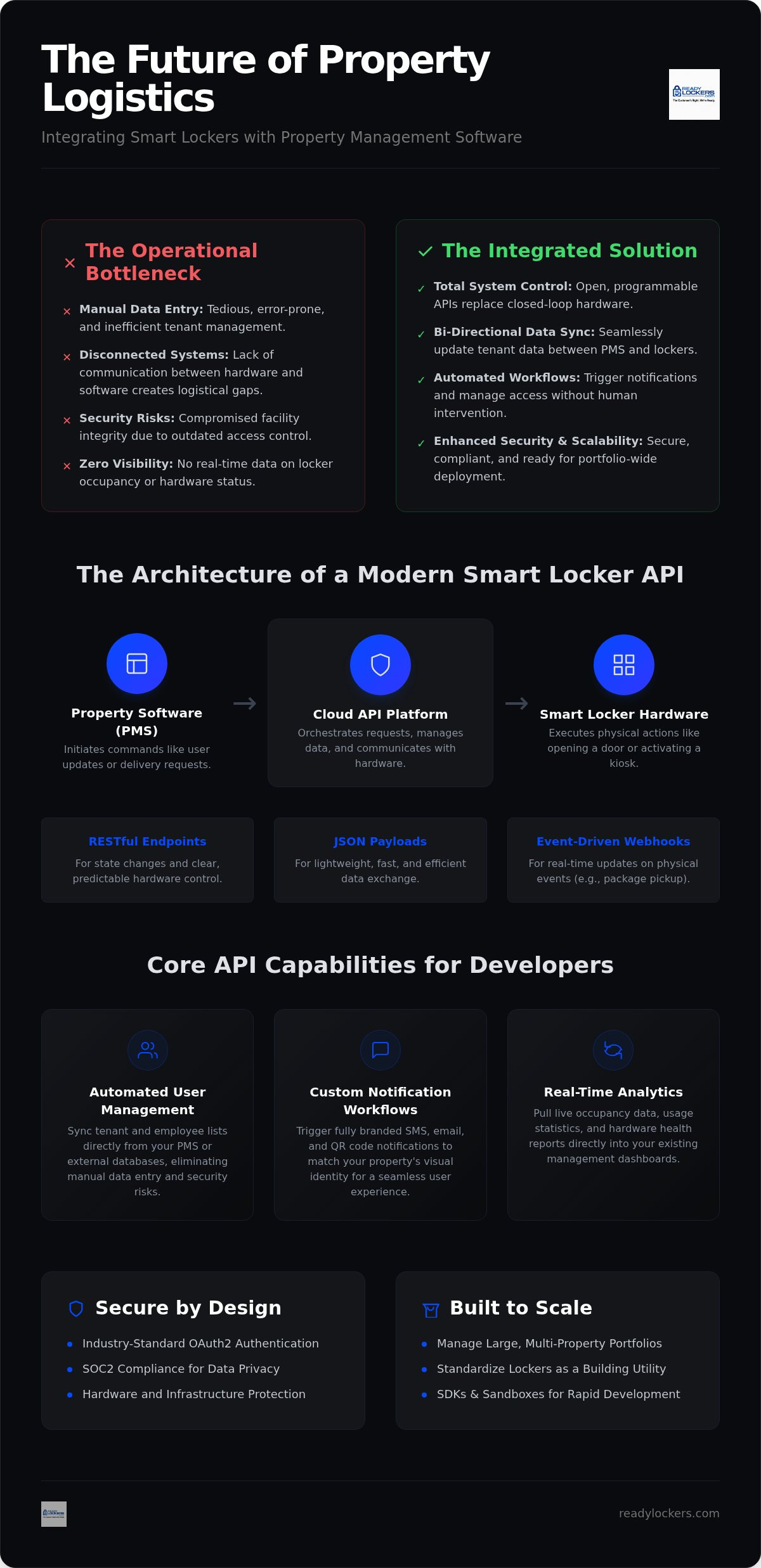
A Smart Locker API is an interface that allows third-party software to control locker hardware and manage data in real time. In 2026, the industry has completed its transition from closed-loop, proprietary systems to open, programmable cloud-based locker software. This shift allows property managers and developers to treat physical storage as a digital endpoint. The API acts as the command center, translating complex code into physical actions. It utilizes three primary components to maintain this connection: RESTful endpoints for state changes, JSON payloads for lightweight data exchange, and event-driven webhook listeners for real-time activity updates. By leveraging these tools, a smart locker property management software integration transforms static cabinets into a dynamic building utility.
This programmable architecture is what makes a 24/7 contactless pickup system possible. When a courier drops off a package, the system generates a unique digital key. This key is validated against the hardware via the API, ensuring that only the intended recipient can trigger the door relay. This process relies heavily on modern smart lock technology, which provides the physical security layer for the digital command.
Cloud-to-Hardware Communication
Commands sent through the API don't interact with the lockers directly; they pass through a cloud-based management platform. This platform acts as an orchestrator, relaying instructions to the specific locker bank while managing hardware latency. Ensuring reliable door actuation is a primary challenge in high-traffic environments. Modern systems solve this by maintaining persistent connections or "heartbeats" between the cloud and the hardware. This allows for constant status monitoring, where the system can programmatically check locker availability and hardware health before a delivery is even attempted. If a door is jammed or a kiosk is offline, the API redirects the workflow immediately to prevent user frustration.
The Developer Ecosystem in 2026
As modularity becomes the standard for hardware, developers require a flexible and well-documented API to keep up. 2026 has seen a surge in developer-friendly tools, including comprehensive SDKs and sandbox environments that allow for rapid prototyping without needing physical hardware on-site. These sandboxes simulate the entire delivery lifecycle, from package induction to final pickup. This testing phase is vital for a successful smart locker property management software integration, as it ensures that the bi-directional data sync between the PMS and the locker hardware is flawless. A Smart Locker API serves as a bridge for automated building logistics, enabling a future where physical assets are as agile as the software that manages them.
Core Capabilities: What Developers Can Build with a Locker API
The 2026 developer landscape demands more than just basic connectivity. A robust API transforms hardware into a programmable asset. By implementing a smart locker property management software integration, developers can automate the entire lifecycle of a package without human intervention. This starts with automated user management. Instead of manual data entry, the API allows for real-time synchronization of tenant or employee lists from external databases. When a resident moves out or a new employee is hired, the locker system updates instantly. This reduces administrative overhead and eliminates the risk of unauthorized access to abandoned accounts.
Custom notification workflows are equally critical. Developers don't have to rely on generic alerts. They can trigger branded SMS or QR code notifications that match the property's specific visual identity. This level of customization ensures a frictionless experience for the end user. Beyond notifications, the API provides real-time usage analytics. Property managers can pull occupancy data directly into their existing dashboards to identify peak times or underutilized locker banks. Courier access management has also evolved. The API can create temporary digital credentials for third-party delivery services, ensuring secure building entry without compromising long-term safety protocols.
Webhook Triggers and Event Listeners
Webhooks are the backbone of a responsive system. They allow the management software to "listen" for specific physical events and react immediately. For instance, a "Package Delivered" trigger can fire an immediate recipient notification via SMS or a QR code. Once the recipient retrieves their item, the "Package Picked Up" event closes the chain of custody in the management software, providing an audit trail for liability protection. To maintain high turnover rates, developers can set up "Locker Overdue" listeners. These generate automated alerts for abandoned packages, allowing staff to optimize space before the locker bank reaches capacity. If you are looking to build these custom workflows, exploring a locker management software solution is the first step toward a fully automated facility.
Dynamic User and Access Control
Security and flexibility are paramount in 2026. Developers use programmatic CRUD (Create, Read, Update, Delete) operations to manage residents, employees, or retail customers on the fly. This capability is vital for properties with high turnover or complex access requirements. Many modern facilities now integrate RFID card access with their existing building security systems using the API. This allows a single credential to open the front gate and the smart locker. For guest access or one-time deliveries, the system can generate one-time-use QR codes for contactless retrieval, maintaining a high security posture while offering maximum convenience. This integration ensures that hardware access is as dynamic as the digital environment it serves.
Integrating with Property Management Software (PMS) Ecosystems
A smart locker integration for property management is no longer an optional luxury in 2026. It's the standard for operational efficiency. Without a direct link between your hardware and your management suite, your staff is forced to act as data entry clerks. A robust smart locker property management software integration solves this by enabling bi-directional data synchronization. This ensures that moves, adds, and changes (MACs) are reflected across your entire ecosystem instantly. When a tenant signs a lease or an employee joins a department, the system provisions their access automatically. This removes the "package middleman" and allows your team to focus on high-value resident interactions rather than logistical troubleshooting.
Efficiency also comes from precise asset mapping. You can map specific locker units to individual units or departments within your PMS. This granular control allows the system to receive packages, assign space, and handle notifications with zero human intervention. It reduces the administrative burden on front-desk staff by automating the building package reception process from end to end. The result is a frictionless workflow that scales effortlessly as your portfolio grows.
Residential Integration (Yardi, RealPage, Entrata)
In the residential sector, platforms like Yardi, RealPage, and Entrata serve as the primary source of truth. Integrating your locker hardware with these systems automates resident onboarding and offboarding for package access. When a resident moves out, their digital key is revoked immediately. Conversely, new residents receive their onboarding credentials the moment their lease is activated. Linking package delivery events directly to resident ledgers or communication portals provides a transparent audit trail. This level of connectivity is essential for managing smart package lockers for apartments, where high volume and rapid turnover are daily challenges.
Commercial and Corporate Office Integration
Corporate environments require a different approach focused on identity management and security. Integrating with Active Directory (AD) or Single Sign-On (SSO) providers allows for automated employee locker assignments based on existing corporate credentials. This is a foundational component of modern automated mailroom solutions in busy corporate hubs. As hybrid work models persist, the API manages shared lockers for hot-desking environments. This allows employees to reserve and access storage only when they are physically in the office. The system tracks occupancy in real time, ensuring that physical resources are utilized as efficiently as the digital workspace.
Implementation Architecture: Security, Authentication, and Scalability
Security is the foundation of any successful smart locker property management software integration. In 2026, protecting user data and physical hardware requires a multi-layered approach that begins at the code level. We implement OAuth2 and Bearer Token authentication to ensure that every API request is verified and authorized. This protocol prevents unauthorized actors from triggering door relays or accessing sensitive resident information. To maintain infrastructure integrity, we employ aggressive rate limiting and throttling. These measures protect the system from Denial of Service (DoS) attacks, ensuring that legitimate delivery and pickup requests are processed without delay even during peak e-commerce seasons.
Data privacy is managed through strict adherence to global standards. All communications between the cloud management platform and the locker kiosks utilize TLS 1.3 for encryption in transit. At rest, sensitive recipient data is protected using AES-256 encryption. This architecture ensures full compliance with SOC 2 Type II, GDPR, and CCPA requirements. By prioritizing these protocols, property managers can offer residents peace of mind, knowing their personal information and physical assets remain secure within a hardened digital environment. If you are ready to secure your building's logistics, you can explore our secure smart package lockers for your next project.
Authentication and Authorization
Managing a smart locker property management software integration across diverse portfolios requires granular control. Our developer console provides Role-Based Access Control (RBAC), allowing administrators to define specific permissions for different team members or third-party partners. API keys are managed at the property level to isolate data and prevent cross-site security leaks. This system is particularly vital for the courier access interface, where temporary credentials must be generated and revoked with surgical precision to maintain building security without hindering delivery speed.
Scalability for Multi-Property Portfolios
Scalability is essential for managers overseeing multi-property portfolios. A single organizational API key can manage hundreds of locker banks across different geographic locations, streamlining the management experience for enterprise users. Centralized logging and error handling allow IT teams to monitor the health of every unit from a single pane of glass, identifying potential hardware issues before they impact the user experience. In the high-stakes environment of 2026 logistics, "maintaining a 99.9% system uptime is the absolute baseline for ensuring resident trust and operational continuity in automated buildings." This level of dependability ensures that your investment continues to provide value as your property count grows.
Scaling with ReadyLockers: The Future of Programmable Hardware
ReadyLockers leads the industry by treating hardware as a programmable extension of your digital strategy. Our commitment to open-API standards ensures that your investment remains future-proof. By leveraging multi family parcel locker systems as a standard building utility, you create a foundation for long-term operational success. A successful smart locker property management software integration isn't just about opening doors today. It's about the data you'll use tomorrow. Our 2026 roadmap introduces AI-driven occupancy forecasting via API, allowing managers to predict peak volume periods based on historical delivery patterns. This proactive approach prevents locker overflow before it happens, maintaining the frictionless experience your residents expect.
Getting started is straightforward through the ReadyLockers developer portal. We provide the tools needed to bridge the gap between physical infrastructure and cloud-based management. This environment allows you to test integrations, manage endpoints, and monitor system health across your entire portfolio from a single interface. By choosing an open ecosystem, you avoid the limitations of proprietary software and gain the flexibility to build a custom solution that fits your specific business model.
Hardware and Software Synergy
The power of ReadyLockers lies in the synergy between modular hardware and flexible software configuration. You can customize the behavior of individual locker units to meet the unique needs of any property layout. For managed communities, this means integrating specific HOA package management system rules directly into the digital workflow. Whether you need to enforce storage time limits or set specific courier access windows, the software dictates the hardware's response. Usage analytics play a vital role here. By analyzing turnover rates and bay sizing requirements, you can plan future hardware expansions with mathematical precision. This data-driven approach ensures that your physical assets grow in lockstep with your property's demands.
Developer Support and Documentation
We understand that complex integrations require robust support. Our cloud-based management platform features comprehensive technical documentation designed for rapid implementation. We don't just provide code; we provide a partnership. For organizations with unique requirements, we offer custom enterprise integrations to ensure your smart locker property management software integration aligns perfectly with your existing tech stack. Our team of efficiency experts is available to assist with troubleshooting and architectural planning. Ready to modernize your building logistics? Register for a ReadyLockers Developer Account today to access our full suite of API tools and documentation.
Modernize Your Building Logistics with Programmable Hardware
Transitioning to an API-first approach transforms your property from a static location into a high-efficiency logistical hub. We've explored how a robust smart locker property management software integration eliminates manual data entry while providing real-time visibility into locker occupancy and hardware health. By prioritizing secure authentication and scalable architecture, you protect both your residents' data and your facility's operational integrity. This programmable framework doesn't just solve current delivery challenges; it provides the flexibility to adapt as resident expectations evolve in 2026 and beyond.
ReadyLockers provides the definitive tools you need to lead this digital transformation. Our cloud-based SaaS platform maintains a 99.9% uptime, ensuring your building remains functional around the clock. With comprehensive REST API documentation and dedicated technical support for enterprise partners, we remove the friction from your implementation process. It's time to bridge the gap between digital management and physical hardware. Start Building with the ReadyLockers API Today and experience the reliability of a truly programmable building utility. Your path to a more efficient, secure, and automated property starts with a single integration.
Frequently Asked Questions
What protocols does the ReadyLockers API support for 2026 integrations?
The ReadyLockers API primarily supports RESTful architecture using JSON payloads for efficient data exchange. All 2026 integrations utilize TLS 1.3 to secure the communication channel between the cloud platform and physical hardware. This ensures that commands for door actuation or status updates are transmitted securely. Developers can also implement event-driven architectures using our webhook listeners to react to physical locker events as they happen on-site.
Can I use the smart locker API to sync with Yardi or RealPage natively?
Yes, our API is designed to facilitate a seamless smart locker property management software integration with industry leaders like Yardi, RealPage, and Entrata. We support bi-directional data synchronization to ensure that resident moves, adds, and changes are reflected in the locker system instantly. This automation eliminates manual data entry for property staff and ensures that only active leaseholders can receive packages or access the contactless pickup system.
Does the API provide real-time webhooks for package delivery events?
The ReadyLockers cloud platform provides robust webhook support for various package-related events. Developers can subscribe to specific triggers such as "Package Delivered," "Package Picked Up," and "Locker Overdue." These real-time events allow your management software to fire immediate SMS or QR code notifications to recipients. This closed-loop communication ensures a clear chain of custody and optimizes locker turnover rates by alerting staff to abandoned items.
How do I manage courier access programmatically via the API?
Courier access is managed through the API by generating temporary digital credentials or one-time-use QR codes. You can programmatically assign these credentials to specific delivery services or individual couriers through our courier access interface. This allows for secure, 24/7 building entry without the need for physical keys or manual door buzzing. The API logs every entry event, providing a comprehensive audit trail for building security and liability protection.
Is there a sandbox environment available for testing locker integrations?
We provide a dedicated sandbox environment for all developers to test their smart locker property management software integration before moving to production. This staging area allows you to simulate the entire delivery lifecycle, including package induction and recipient retrieval, without needing physical hardware. Our documentation includes sample code and mock endpoints to speed up the prototyping phase, ensuring your final deployment is stable and secure for your residents.
What security standards are in place for the ReadyLockers developer portal?
The ReadyLockers developer portal adheres to enterprise-grade security standards, including OAuth2 and Bearer Token authentication. We maintain compliance with SOC 2 Type II, GDPR, and CCPA to protect sensitive resident and property data. All data is encrypted using AES-256 at rest and TLS 1.3 in transit. These protocols ensure that your integration remains hardened against unauthorized access while maintaining the high uptime required for modern building logistics.
Can the API handle multi-tenant data for large apartment complexes?
The API is specifically architected to handle multi-tenant data for large apartment complexes and multi-property portfolios. It supports programmatic CRUD operations to manage thousands of unique residents or employees across different locations from a single interface. You can map specific locker banks to individual units or departments within your property management system. This ensures that package assignments are accurate and that notification workflows are tailored to the correct recipient every time.
What are the typical rate limits for the ReadyLockers cloud platform?
Our cloud platform employs rate limiting and throttling to maintain system stability and protect against Denial of Service attacks. Standard integration tiers typically allow for 1,000 requests per minute, which is more than sufficient for high-volume residential or commercial environments. If your deployment requires higher throughput for enterprise-scale operations, we offer custom rate limits. This infrastructure ensures that your locker system remains responsive even during peak holiday delivery seasons.

Frequently Asked Questions
What protocols does the ReadyLockers API support for 2026 integrations?+
The ReadyLockers API primarily supports RESTful architecture using JSON payloads for efficient data exchange. All 2026 integrations utilize TLS 1.3 to secure the communication channel between the cloud platform and physical hardware. This ensures that commands for door actuation or status updates are transmitted securely. Developers can also implement event-driven architectures using our webhook listeners to react to physical locker events as they happen on-site.
Can I use the smart locker API to sync with Yardi or RealPage natively?+
Yes, our API is designed to facilitate a seamless smart locker property management software integration with industry leaders like Yardi, RealPage, and Entrata. We support bi-directional data synchronization to ensure that resident moves, adds, and changes are reflected in the locker system instantly. This automation eliminates manual data entry for property staff and ensures that only active leaseholders can receive packages or access the contactless pickup system.
Does the API provide real-time webhooks for package delivery events?+
The ReadyLockers cloud platform provides robust webhook support for various package-related events. Developers can subscribe to specific triggers such as "Package Delivered," "Package Picked Up," and "Locker Overdue." These real-time events allow your management software to fire immediate SMS or QR code notifications to recipients. This closed-loop communication ensures a clear chain of custody and optimizes locker turnover rates by alerting staff to abandoned items.
How do I manage courier access programmatically via the API?+
Courier access is managed through the API by generating temporary digital credentials or one-time-use QR codes. You can programmatically assign these credentials to specific delivery services or individual couriers through our courier access interface. This allows for secure, 24/7 building entry without the need for physical keys or manual door buzzing. The API logs every entry event, providing a comprehensive audit trail for building security and liability protection.
Is there a sandbox environment available for testing locker integrations?+
We provide a dedicated sandbox environment for all developers to test their smart locker property management software integration before moving to production. This staging area allows you to simulate the entire delivery lifecycle, including package induction and recipient retrieval, without needing physical hardware. Our documentation includes sample code and mock endpoints to speed up the prototyping phase, ensuring your final deployment is stable and secure for your residents.
What security standards are in place for the ReadyLockers developer portal?+
The ReadyLockers developer portal adheres to enterprise-grade security standards, including OAuth2 and Bearer Token authentication. We maintain compliance with SOC 2 Type II, GDPR, and CCPA to protect sensitive resident and property data. All data is encrypted using AES-256 at rest and TLS 1.3 in transit. These protocols ensure that your integration remains hardened against unauthorized access while maintaining the high uptime required for modern building logistics.
Can the API handle multi-tenant data for large apartment complexes?+
The API is specifically architected to handle multi-tenant data for large apartment complexes and multi-property portfolios. It supports programmatic CRUD operations to manage thousands of unique residents or employees across different locations from a single interface. You can map specific locker banks to individual units or departments within your property management system. This ensures that package assignments are accurate and that notification workflows are tailored to the correct recipient every time.
What are the typical rate limits for the ReadyLockers cloud platform?+
Our cloud platform employs rate limiting and throttling to maintain system stability and protect against Denial of Service attacks. Standard integration tiers typically allow for 1,000 requests per minute, which is more than sufficient for high-volume residential or commercial environments. If your deployment requires higher throughput for enterprise-scale operations, we offer custom rate limits. This infrastructure ensures that your locker system remains responsive even during peak holiday delivery seasons.