The Future of Contactless Delivery Locker Technology: 2026 Trends and Innovations
Discover the future of contactless delivery locker technology. Explore 2026 trends, AI innovations, and how to automate package management for a seamless exp...

In 2026, a lobby cluttered with overflowing cardboard boxes and a manual logbook isn't just an eyesore; it's a liability that signals operational failure. Modern contactless delivery locker technology has transitioned from a high-end perk to the essential operating system for any competitive physical space. You likely already know the frustration of managing courier chaos, tracking down missing parcels, or watching your staff spend hours acting as unpaid mailroom clerks. It's a drain on resources that creates friction for residents and customers alike.
We agree that manual package management is an unsustainable burden for property managers and retailers. This article promises to show you how modern automated systems convert that chaos into a seamless, secure, and entirely automated workflow. We will explore the rise of intelligent logistics hubs, AI-powered scanning, and integrated management software. By the end of this guide, you'll understand how to implement scalable solutions that reduce liability while providing the frictionless retrieval experience your users expect.
Key Takeaways
- Understand how contactless delivery locker technology has evolved from a temporary pandemic fix to a permanent, essential infrastructure for modern property management.
- Learn the mechanics of automated retrieval, including high-priority SMS notifications and secure courier interfaces that eliminate the need for physical building keys.
- Explore 2026 trends like multi-carrier integration and the convergence of retail logistics within residential and corporate environments.
- Discover the critical steps for implementation, from auditing package volume to selecting high-traffic locations with optimal power and connectivity.
- Identify how the synergy between modular hardware and cloud-based management software creates a scalable, future-proof logistics solution for any property type.
The Evolution of Contactless Delivery Locker Technology in 2026
Modern contactless delivery locker technology represents the sophisticated merger of secure physical hardware and cloud-based automation. While early versions of these systems were often viewed as simple metal cabinets, the 2026 landscape defines them as integrated logistics ecosystems. This technology facilitates the secure transfer of goods without requiring direct human interaction, leveraging encrypted digital interfaces to manage the entire chain of custody. It's no longer just about holding a box; it's about the intelligent orchestration of data and physical space.
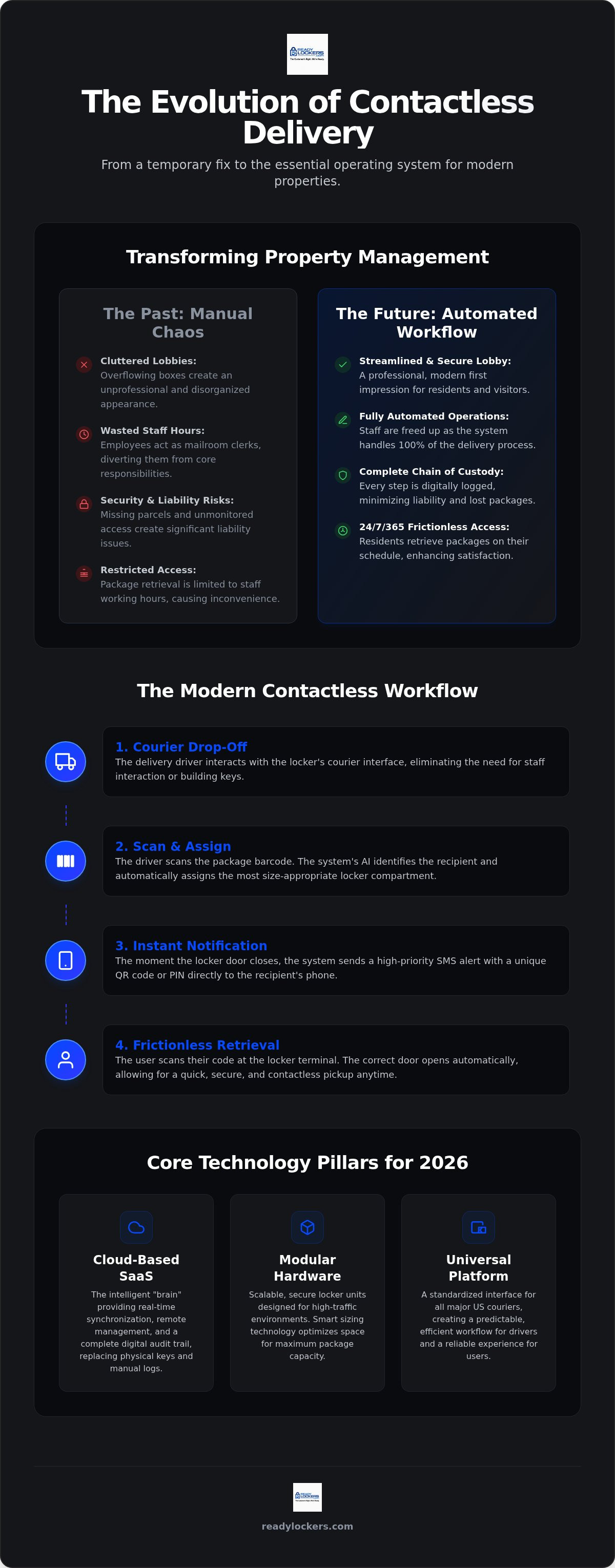
The transition from a pandemic-era necessity to a permanent property utility is now complete. In previous years, contactless systems were a reactive solution to health concerns. Today, they're a proactive response to the massive volume of global e-commerce. Property managers and retail operators have moved away from "passive storage" models, where items sat indefinitely in a corner, toward "active logistics management." This shift ensures that every square foot of a facility is used efficiently, with automated reminders and dynamic slot allocation preventing the bottlenecks common in traditional mailrooms.
The concept of the Universal Platform has also taken hold across diverse sectors. Whether in a high-rise apartment, a suburban hospital, or a corporate campus, the underlying technology remains consistent. These systems provide a standardized experience for every major national US courier, creating a predictable workflow for drivers and a reliable retrieval process for recipients. This universality is what makes the platform a steady, dependable utility rather than a niche luxury.
Beyond the Lock: The Role of Cloud-Based SaaS
The hardware provides the security, but the software layer provides the intelligence. Cloud-based SaaS (Software as a Service) acts as the brain of the operation, coordinating the complex dance between couriers and recipients. By utilizing advancements in Parcel locker technology, these platforms ensure real-time synchronization across all devices. When a courier scans a package, the system immediately identifies the recipient, assigns a secure compartment, and generates a unique access credential. This digital interface has entirely replaced manual key systems, eliminating the risk of lost physical keys and the liability of unmonitored access logs.
Why 24/7 Access is the New Industry Standard
User expectations have shifted toward total flexibility. The demand for "pickup on my time" means that restricted office hours or staffed reception desks are no longer sufficient. Automated systems remove the need for 24-hour staffing, allowing recipients to retrieve items at midnight just as easily as at noon. For residential property owners, smart package lockers for apartments have become a baseline requirement to attract and retain residents. This constant availability provides peace of mind and reinforces the brand's commitment to modern convenience and frictionless operation.
How Modern Contactless Retrieval Systems Function
The operational efficiency of contactless delivery locker technology relies on a precise digital handshake between the courier and the management system. When a delivery driver arrives, they interact with a dedicated courier interface rather than seeking out building staff or managing physical keys. The driver simply scans the package barcode at the terminal. The system instantly verifies the recipient against the building’s database and triggers a secure compartment to open. This process ensures that the chain of custody is documented digitally from the moment of drop-off.
Space optimization is a core functional advantage of these systems. The software automatically identifies the most appropriate compartment size for each parcel, whether it's a small envelope or a large carton. This prevents the inefficient use of large lockers for small items, maximizing the total capacity of the installation. Once the door is closed, the system initiates the notification phase. In 2026, the industry has shifted away from easily missed emails toward high-priority SMS alerts and unique QR codes. These credentials are sent directly to the recipient’s mobile device, providing immediate confirmation that a package is ready for retrieval.
The pickup event itself is designed to be frictionless. A user approaches the unit, scans their QR code or enters a PIN, and the correct door pops open. There's no need for physical contact with screens or buttons if the system is configured for mobile-first access. This speed and security are major drivers behind the growth noted in recent Smart Locker Market research, which highlights the increasing demand for automated logistics in urban environments.
The Hardware Component: Modular and Secure
The physical structure of these systems must be both resilient and adaptable to fit diverse architectural footprints. Modular units allow property owners to configure the locker bank based on specific wall dimensions or floor plans, adding or removing columns as volume changes. In the context of commercial smart parcel lockers, modularity refers to the ability to scale capacity by connecting standardized hardware cabinets to a single primary controller. These units feature a professional, "Modern Efficiency Expert" aesthetic that complements contemporary building designs while providing robust protection against tampering.
The Software Component: Management and Analytics
While the hardware provides the shell, the software provides the oversight. Property managers use detailed usage analytics to monitor locker turnover and identify peak delivery times. This data is essential for preventing "locker squatting," where recipients leave items in compartments for extended periods. Automated reminders can be programmed to escalate notifications after a set duration, ensuring that doors are freed up for new arrivals. Advanced contactless delivery locker technology relies on professional smart locker management software to allow operators to maintain high throughput without manual intervention. If you're looking to streamline your building's logistics, exploring a customized locker solution can provide the necessary infrastructure to handle rising package volumes.
2026 Trends: The Shift Toward Intelligent Logistics Hubs
In 2026, the industry has moved past simple storage to the creation of intelligent logistics hubs. These hubs act as centralized points that manage the flow of goods with surgical precision. One of the most significant shifts is the perfection of multi-carrier integration. Modern contactless delivery locker technology now handles every major national US courier through a unified interface. This eliminates the need for separate systems for different delivery services, allowing a single locker bank to receive parcels from USPS, FedEx, UPS, and local gig-economy couriers simultaneously. This harmony ensures that the courier's experience is just as frictionless as the recipient's.
Retail convergence is another defining trend of the year. The rise of BOPIS (Buy Online, Pickup In-Store) has expanded far beyond the traditional retail environment. We now see these workflows integrated into corporate offices and residential complexes, where residents can receive pre-ordered goods or even facilitate returns without leaving the building. This is supported by data-driven logistics, where the system analyzes pickup patterns to predict future infrastructure needs. If a building's package volume consistently peaks on Tuesdays, the software can suggest dynamic slot reallocations or the addition of modular units to prevent overflow before it occurs.
Security has also undergone a massive upgrade. The industry has largely transitioned from simple PINs, which can be shared or stolen, to encrypted QR codes and unique SMS identifiers. These digital credentials are tied to a specific user and a specific delivery event, creating an unshakeable audit trail. This level of protection provides the peace of mind necessary for high-stakes environments where security is a non-negotiable requirement.
From Apartments to Hospitals: The Universal Application
The utility of these hubs has expanded into specialized sectors like healthcare and education. Hospitals now use contactless tech to manage the internal distribution of sensitive medical assets and personal items for staff. Similarly, universities utilize these systems to streamline student mail services, reducing the labor costs associated with manual sorting. Because they provide a secure, 24/7 solution for any environment, smart package lockers have officially become the gold standard for property owners who prioritize operational efficiency across all asset classes.
The Rise of the Frictionless Economy
The "frictionless economy" refers to the total elimination of wait times and human handoffs in the supply chain. This technology supports independent courier networks by providing a reliable drop-off point that doesn't require a building signature or a face-to-face interaction. It removes the "last-inch" delivery hurdles that previously caused delays and lost items. QR codes are the preferred 2026 retrieval method because they provide a unique, encrypted handshake that eliminates the need for physical screen interaction while ensuring near-instant verification. This speed allows users to complete a pickup in under ten seconds, reinforcing the standard of modern convenience.
Assessing Infrastructure: Implementing Contactless Tech
Implementing contactless delivery locker technology requires a methodical approach to ensure the system integrates seamlessly with existing property workflows. The first critical step involves a comprehensive audit of daily package volume. Property managers should analyze delivery logs from the past six months to determine the baseline number of modular units required. It's essential to account for peak periods, such as the year-end holiday season, to ensure the system can handle sudden surges without creating a backlog in the lobby.
Once the volume is established, the next priority is identifying high-traffic, secure locations. These areas must provide 24/7 access for recipients while remaining protected from the elements. From a technical standpoint, each installation site requires a dedicated 110V power outlet and a reliable internet connection. Whether using Ethernet or high-speed Wi-Fi, constant connectivity is non-negotiable for real-time cloud synchronization and immediate notification delivery. After hardware placement is finalized, operators must evaluate the SaaS capabilities of the platform. A high-performing system should offer a streamlined courier interface and demonstrate near-instant notification speeds to maintain the frictionless experience users expect.
The final stages of implementation focus on operational policy and user adoption. Establishing clear pickup windows, such as a 24-hour retrieval limit, ensures high compartment turnover and prevents "locker squatting." Launching the system with professional signage and a digital onboarding campaign helps users transition quickly from manual retrieval to the automated platform. To begin your property's transformation, you can request a custom locker quote tailored to your specific building requirements.
Space and Installation Requirements
Modular units are designed to accommodate diverse building footprints, allowing for vertical or horizontal scaling. These systems can start with a primary controller and a few cabinets, expanding as the resident or employee population grows. Modularity ensures that the initial investment remains relevant even as package volumes increase over time. For consistent quality across multiple sites, property owners should utilize national installation services. This ensures that every unit is anchored securely and configured correctly to the central management network, regardless of the property's location. Modern cloud-based lockers rely on these stable installations to provide the "Modern Efficiency Expert" aesthetic that defines contemporary logistics hubs.
Managing the Transition from Manual to Automated
The shift from manual logbooks to automated systems is a significant upgrade that requires proactive communication. Property managers should highlight the reduction in package liability as a primary benefit for all stakeholders. When packages are secured in a digital locker, the building staff is no longer responsible for lost or misplaced items. This transition provides immediate peace of mind for residents and employees, knowing their deliveries are protected by encrypted QR codes rather than sitting in an unmonitored mailroom. Emphasizing these security gains helps build trust and encourages rapid adoption of the new technology.
ReadyLockers: National Leaders in Smart Delivery Tech
ReadyLockers provides a universal platform that integrates robust hardware with a powerful SaaS management layer, setting the benchmark for contactless delivery locker technology. This comprehensive approach addresses the logistical challenges faced by property owners across the United States. Unlike regional providers, ReadyLockers offers national coverage, ensuring that high-density residential and commercial environments have access to the same high standard of automation. The synergy between the physical lockers and the cloud-based management platform creates a reliable chain of custody that protects every parcel from drop-off to retrieval.
The 24/7 contactless delivery locker technology is the cornerstone of the brand's identity. It functions as a proactive facilitator, removing the obstacles that typically lead to lobby congestion and staff distraction. By providing a secure, automated interface for both couriers and recipients, the system eliminates the need for manual oversight. This focus on modern efficiency ensures that property managers can focus on their core responsibilities while the logistics are handled by a dependable, automated utility.
Customizable Solutions for Every Industry
Versatility is a primary requirement for modern infrastructure. ReadyLockers units are designed for diverse applications, ranging from multifamily apartments to corporate offices and retail hubs. The modular hardware allows property owners to configure the system based on their specific spatial constraints and package volumes. You can select the door counts and cabinet sizes that best fit your footprint, ensuring that the system scales as your needs evolve. We invite you to explore the combination of durable hardware and Locker Management Software that provides the most efficient workflow for your specific asset class.
The ReadyLockers Advantage: Security and Reliability
Trust is built through consistent, secure performance. ReadyLockers reinforces this through high-priority SMS and QR code notifications that keep recipients informed at every step. The secure courier interface simplifies the delivery process for drivers, reducing the time spent on-site and ensuring that packages are placed in the correct compartments every time. This level of reliability removes the stress of package theft and liability, offering a secure environment for all parties involved. It's time to transition away from outdated mailroom practices and embrace a solution that anticipates the needs of a digital-first world. Modernize your property with ReadyLockers contactless technology today.
Modernizing Your Operational Infrastructure
The logistics landscape of 2026 requires more than simple storage; it demands an intelligent, automated ecosystem. Implementing modern contactless delivery locker technology ensures your property remains competitive by eliminating courier chaos and staff liability. These systems provide a universal platform that serves apartments, offices, and retail environments with equal precision. By integrating modular hardware with cloud-based management, you gain a scalable solution that anticipates user needs and optimizes high-traffic physical spaces. It's a transition that moves your operations from reactive package handling to proactive logistics management.
ReadyLockers provides the national US deployment and automated SMS or QR notifications necessary to streamline your building's workflow. Our modular hardware configurations are engineered to fit any footprint while offering the 24/7 access that today's recipients expect. Explore Contactless Delivery Solutions with ReadyLockers to secure your facility's future and provide the peace of mind your stakeholders deserve. Replacing manual logbooks with a high-tech, frictionless system is the final step in achieving modern operational efficiency.
Frequently Asked Questions
What is contactless delivery locker technology?
Contactless delivery locker technology is an automated system that facilitates the secure transfer of parcels between couriers and recipients without direct human interaction. The platform integrates durable physical cabinets with cloud-based management software to coordinate real-time notifications and encrypted access. This setup removes the need for building staff to handle deliveries, creating a more secure and efficient workflow for multifamily apartments, commercial offices, and retail locations across the country.
How do smart lockers prevent package theft in apartments?
Smart lockers eliminate the vulnerability of unmonitored lobbies by securing every parcel inside a heavy-duty steel compartment. Access is restricted to authorized recipients who receive a unique, encrypted QR code or PIN via SMS. Because the system generates a digital audit trail for every drop-off and pickup event, it provides an unshakeable record of custody. This transition from open-access mailrooms to secure digital interfaces significantly reduces the risk of porch piracy and misplaced items.
Can any courier use a contactless delivery locker system?
Yes, modern systems are designed with universal carrier interfaces that accommodate all major national US delivery services, including FedEx, UPS, USPS, and DHL. The software allows drivers to quickly scan barcodes and select appropriate compartment sizes without requiring building keys or staff assistance. This inclusivity ensures that every package, regardless of the carrier, is processed through the same secure automated workflow, maintaining a consistent experience for both drivers and property residents.
What happens if a recipient loses their pickup notification?
If a recipient loses their original SMS or QR notification, the locker management software allows property administrators to resend the credentials instantly through a centralized dashboard. Users can also often retrieve their packages by verifying their identity through the system terminal if configured by the property manager. This ensures that package retrieval remains frictionless even when digital communications are misplaced, maintaining the high standard of convenience expected from modern automated logistics solutions.
Do smart lockers require a dedicated internet connection?
A stable internet connection is essential for the real-time functionality of contactless delivery locker technology. The system requires connectivity, typically via Ethernet or high-speed Wi-Fi, to synchronize delivery data with the cloud and trigger immediate notifications to recipients. Without this connection, the management software cannot update locker availability or verify encrypted access codes. Constant connectivity ensures the system remains responsive and that property managers have access to accurate usage analytics at all times.
How does the software handle oversized packages or overflow?
The management software optimizes space by identifying the best compartment size for every parcel, but it also includes protocols for oversized items. When a package exceeds the dimensions of the largest modular unit, the courier interface can alert the driver to use a designated overflow area or contact building staff. Property managers can monitor these occurrences through the dashboard to determine if additional large-capacity modules are required to handle the building's specific delivery patterns.
What is the typical ROI for installing a smart locker system?
Businesses typically see a return on investment within 12 to 24 months of installation. For a 200-unit apartment complex, this transition can result in annual labor savings ranging from $18,000 to $30,000 by removing the need for staff to manually manage deliveries. Beyond direct financial gains, the system increases property value and resident retention by providing a modern amenity that solves the persistent problem of package theft and lobby clutter.
Is the pickup process accessible for users with disabilities?
Accessibility is a core component of modern smart locker design. The hardware and software are engineered to comply with ADA standards, ensuring that terminals and compartments are within reachable heights for all users. The digital interface often includes high-contrast displays and audio prompts to assist those with visual or hearing impairments. By prioritizing inclusive design, the system ensures that every resident or employee can benefit from the speed and security of automated package retrieval.

Frequently Asked Questions
What is contactless delivery locker technology?+
Contactless delivery locker technology is an automated system that facilitates the secure transfer of parcels between couriers and recipients without direct human interaction. The platform integrates durable physical cabinets with cloud-based management software to coordinate real-time notifications and encrypted access. This setup removes the need for building staff to handle deliveries, creating a more secure and efficient workflow for multifamily apartments, commercial offices, and retail locations across the country.
How do smart lockers prevent package theft in apartments?+
Smart lockers eliminate the vulnerability of unmonitored lobbies by securing every parcel inside a heavy-duty steel compartment. Access is restricted to authorized recipients who receive a unique, encrypted QR code or PIN via SMS. Because the system generates a digital audit trail for every drop-off and pickup event, it provides an unshakeable record of custody. This transition from open-access mailrooms to secure digital interfaces significantly reduces the risk of porch piracy and misplaced items.
Can any courier use a contactless delivery locker system?+
Yes, modern systems are designed with universal carrier interfaces that accommodate all major national US delivery services, including FedEx, UPS, USPS, and DHL. The software allows drivers to quickly scan barcodes and select appropriate compartment sizes without requiring building keys or staff assistance. This inclusivity ensures that every package, regardless of the carrier, is processed through the same secure automated workflow, maintaining a consistent experience for both drivers and property residents.
What happens if a recipient loses their pickup notification?+
If a recipient loses their original SMS or QR notification, the locker management software allows property administrators to resend the credentials instantly through a centralized dashboard. Users can also often retrieve their packages by verifying their identity through the system terminal if configured by the property manager. This ensures that package retrieval remains frictionless even when digital communications are misplaced, maintaining the high standard of convenience expected from modern automated logistics solutions.
Do smart lockers require a dedicated internet connection?+
A stable internet connection is essential for the real-time functionality of contactless delivery locker technology. The system requires connectivity, typically via Ethernet or high-speed Wi-Fi, to synchronize delivery data with the cloud and trigger immediate notifications to recipients. Without this connection, the management software cannot update locker availability or verify encrypted access codes. Constant connectivity ensures the system remains responsive and that property managers have access to accurate usage analytics at all times.
How does the software handle oversized packages or overflow?+
The management software optimizes space by identifying the best compartment size for every parcel, but it also includes protocols for oversized items. When a package exceeds the dimensions of the largest modular unit, the courier interface can alert the driver to use a designated overflow area or contact building staff. Property managers can monitor these occurrences through the dashboard to determine if additional large-capacity modules are required to handle the building's specific delivery patterns.
What is the typical ROI for installing a smart locker system?+
Businesses typically see a return on investment within 12 to 24 months of installation. For a 200-unit apartment complex, this transition can result in annual labor savings ranging from $18,000 to $30,000 by removing the need for staff to manually manage deliveries. Beyond direct financial gains, the system increases property value and resident retention by providing a modern amenity that solves the persistent problem of package theft and lobby clutter.
Is the pickup process accessible for users with disabilities?+
Accessibility is a core component of modern smart locker design. The hardware and software are engineered to comply with ADA standards, ensuring that terminals and compartments are within reachable heights for all users. The digital interface often includes high-contrast displays and audio prompts to assist those with visual or hearing impairments. By prioritizing inclusive design, the system ensures that every resident or employee can benefit from the speed and security of automated package retrieval.