Medical Facility Package Handling: A Secure, Efficient Guide
Master medical facility package handling with this guide. Learn how to secure incoming parcels, reduce delivery handoffs, and optimize smart locker workflows.

What if the main challenge with incoming deliveries isn’t volume, but uncertainty about who is responsible for each package next? In a medical facility, unclear handoffs can leave parcels misplaced, delayed, or sitting in shared areas while staff search for recipients. Medical facility package handling needs a defined route, a clear owner at each step, and boundaries for items that require specialized care.
These challenges are familiar to teams managing deliveries across departments and shifts. A consistent process can make receipt and pickup easier to track without adding unnecessary calls or coordination. Smart lockers may support the workflow for appropriate nonclinical parcels, but they aren’t suitable for every item or facility requirement.
This guide explains how to organize incoming packages, assign responsibility, and reduce avoidable handoffs. It covers how locker workflows can connect courier access, recipient notifications, and pickup records, as well as what to assess before choosing a solution. Use the steps to evaluate package types, facility space, user needs, and delivery patterns, then confirm security, privacy, accessibility, and IT requirements with the appropriate facility stakeholders.
Key Takeaways
- Medical facility package handling works best when eligible deliveries, responsible staff, and recipient handoffs are clearly defined.
- Compare staffed reception, shared holding areas, and smart lockers to find the right balance of access, accountability, and staff effort.
- Use a delivery audit to assess package volume, busy periods, parcel sizes, user groups, and potential locker placement.
- Evaluate whether courier access controls, notifications, modular capacity, and usage analytics fit your facility’s workflow and requirements.
- Keep specialized or temperature-sensitive items outside a locker process unless facility stakeholders confirm the solution is suitable.
Medical Facility Package Handling: Why the Delivery Workflow Matters
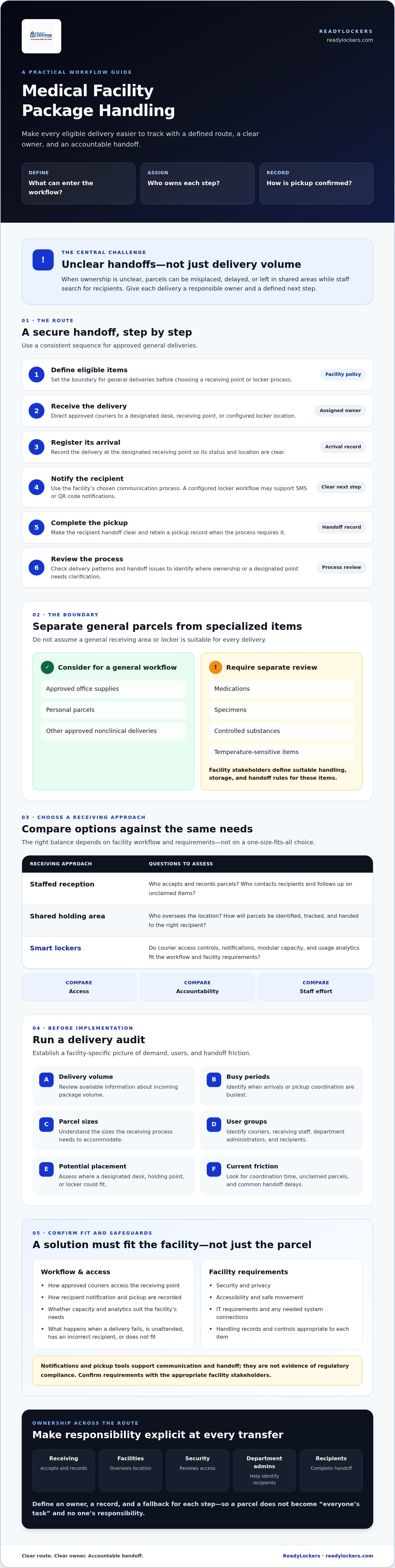
Medical facility package handling covers each step from a courier’s arrival to the handoff with the intended recipient. A defined workflow clarifies who accepts a delivery, where its arrival is recorded, how the recipient is contacted, and what happens if no one is available. Without those decisions, parcels may be left unattended, staff may make repeated calls, and responsibility can become unclear when shifts change.
Responsibility often crosses several teams. Receiving may accept deliveries, facilities may oversee the designated location, security may review access, department administrators may identify recipients, and recipients complete the handoff. Assign an owner to each step so a parcel doesn’t become “everyone’s task” and no one’s responsibility. For items requiring heightened tracking, the facility may also need records of handling and transfers. The general concept of a chain of custody can help teams think through documentation, but facility personnel should define the controls appropriate to each item.
Ordinary parcel workflows are for approved general deliveries; clinical items need handling rules established for their specific risks. Set this boundary before choosing a receiving point or locker process.
Which facility deliveries belong in a general package workflow?
Facilities can consider approved office supplies, personal parcels, and other nonclinical deliveries for a general workflow. Medications, specimens, controlled substances, and temperature-sensitive items need separate review before any storage or handoff method is selected. Don’t assume a general receiving area or locker is suitable for them. With the relevant facility stakeholders, define which items are accepted through the general process, which are restricted pending review, and which must be redirected to a designated recipient or procedure.
Where manual receiving processes create avoidable friction
Map the route a parcel actually takes: courier arrival, receiving point, department or holding location, recipient notification, and final pickup. At each transfer, ask who records the parcel, who contacts the recipient, and who follows up if it remains unclaimed. If answers vary by department or shift, delays and interruptions can follow, and packages may be difficult to locate. Before changing the process, establish a facility-specific baseline using available information, such as delivery volume, time spent coordinating pickups, unclaimed parcels, and common handoff delays. Use the findings to identify where a clear owner or designated handoff point could help.
How a Secure Medical Facility Package Workflow Operates
A reliable workflow gives every eligible parcel an owner and a next step. Medical facility package handling can follow a straightforward sequence: define eligible items, receive the delivery, register its arrival, notify the recipient, complete pickup, and review the process. Each step should match facility policy and the needs of the people handling packages.
A secure handoff connects an approved delivery, a designated receiving point, a verified recipient, and a record of pickup. Smart lockers and a courier access interface can support this process by directing approved couriers to a defined location and managing access according to facility settings. Confirm how access will work in the intended workflow. Don’t assume a locker system integrates with existing delivery or identity systems.
From courier arrival to recipient notification
Document which couriers may use the receiving point and how they’ll gain access. When a parcel is placed in an assigned locker or accepted at a designated desk, register the delivery and notify the recipient. Depending on the configured workflow, a locker management platform may support SMS or QR code notifications. These functions support communication and pickup; they aren’t evidence of regulatory compliance. Facility stakeholders should assess privacy, security, accessibility, and IT requirements. Keep safe movement and handling in view, guided by facility procedures and resources on worker safety in healthcare facilities.
Written policy should also cover exceptions: a failed delivery, an unattended parcel, an incorrect recipient, or a package that doesn’t fit. Specify who takes ownership, where the item goes, and how the recipient or sender is contacted. A clear fallback helps staff avoid improvising under pressure.
Recipient pickup, records, and exception handling
For contactless pickup, the recipient receives a notification with the information needed to retrieve the parcel, such as a QR code or access code where supported. The recipient uses it at the designated point to access the assigned compartment without arranging a direct handoff. Facility policy should explain how codes are protected, what to do if a message reaches the wrong person, and how access is corrected or revoked.
Set escalation steps before launch. Decide who handles expired pickups, damaged parcels, full locker capacity, and recipient disputes, and define when an item returns to a staffed process. A platform may provide usage analytics, but facilities should confirm which events are recorded, how long records are retained, and which roles may review them. This helps teams assess whether the workflow is operating as intended. To explore how locker access and management software could fit a designated handoff process, review smart package locker workflows.
Medical Facility Package Handling Options: Staffed Desk, Holding Area, or Lockers
The right approach depends on what arrives, who needs to receive it, and when recipients can access it. A staffed desk offers direct coordination, a shared holding area provides a place to stage parcels, and smart lockers provide assigned compartments with managed access. None removes the need for clear ownership, facility policy, and exception handling.
Use the comparison as a starting point for approved general deliveries. Items requiring clinical, temperature-controlled, or specialist handling need separate review before being assigned to any option.
| Option | Strengths | Limitations | Staffing needs | Suitable categories |
|---|---|---|---|---|
| Staffed reception | Supports direct inspection, questions, and recipient coordination. | Access and handoff depend on staff coverage; ownership must be explicit. | Staff receive, record, store, and contact recipients. | Deliveries that need personal coordination or facility-approved inspection. |
| Shared holding area | Provides a central staging point with a straightforward process. | Parcels can be harder to distinguish or track without controls and assigned oversight. | Staff must monitor the area and manage notifications or follow-up. | Approved parcels with clear labeling and a defined pickup process. |
| Smart lockers | Can assign access to designated recipients and support notifications and pickup records. | Requires suitable space, configuration, recipient access, and a fallback for exceptions or full capacity. | Staff oversee the workflow, review exceptions, and manage system requirements. | Recurring, suitable nonclinical parcels for designated recipients. |
When staffed receiving or a designated holding area may fit
Choose a staffed process when a parcel needs direct inspection, personal coordination, or review by a designated specialist. A holding area may suit deliveries that can be staged while recipients collect them through an established process. For either option, set access rules, storage limits, assigned ownership, and steps for damaged, unclaimed, or misdirected items. Confirm how staffing coverage affects receipt and pickup.
When a managed locker workflow may fit
Lockers may suit facilities with recurring nonclinical parcels, predictable pickup patterns, designated recipients, and appropriate placement space. Courier access management and SMS or QR notifications can reduce manual coordination, but staff oversight is still needed. A locker can add work if every delivery requires extra registration or recipients have difficulty accessing it. Direct handoff may remain preferable for unusual, urgent, oversized, or sensitive deliveries.
Compare locker options by modular configuration, management software, access controls, notification methods, usage analytics, technical support, and capacity for future volume. Confirm facility-specific security, privacy, accessibility, and IT requirements before selection. Treat analytics as a way to assess workflow activity, not as a guarantee of reduced workload or improved security.
How to Plan Medical Facility Package Handling Before Implementation
Start with a delivery audit, not a hardware decision. Review available receiving logs and staff feedback to understand package volume, busy periods, parcel dimensions, recipient groups, and current handoff delays. Note where deliveries arrive, how they move between locations, and which exceptions require staff attention. These details help determine whether a new workflow is needed and where a designated receiving point could fit.
Next, assess the location and system requirements. Confirm available space, courier access, recipient routes, and the facility’s security, IT, privacy, accessibility, and facilities requirements. A professional smart locker installation guide can help teams consider implementation factors alongside the delivery workflow.
Set facility requirements and handling boundaries
Write down which package categories are accepted, excluded, or redirected, then assign responsibility for intake, notifications, unclaimed items, and escalation. Define pickup windows and the staff roles authorized to resolve exceptions. If SMS or QR access is under consideration, ask security and privacy stakeholders to review how recipient information and access will be handled. Qualified facility personnel should assess applicable HIPAA, HHS, ADA, and internal policy requirements; don’t treat a locker feature as proof of compliance.
Before choosing a configuration, compare expected package dimensions and peak volume with the proposed placement and capacity. Modular locker layouts can be one evaluation point, but confirm that the specific setup fits the site, intended users, and approved parcel types. Document what happens if a delivery doesn’t fit, a recipient can’t access a compartment, or the system is unavailable.
Pilot, train, and measure the workflow
Test the process with a defined user group and approved package categories before expanding it. Keep instructions concise and specific to each role:
- Couriers: Explain the approved delivery point, access steps, and what to do when a parcel can’t be placed.
- Recipients: Show how to use the notification, retrieve a parcel, and request help if access fails.
- Staff: Clarify intake, exception ownership, escalation, and record-review responsibilities.
Compare pilot results with the audit baseline. Track delivery volume, completed pickups, exceptions, and staff feedback, then review where parcels stalled or instructions caused confusion. Adjust the workflow before wider rollout. For facilities assessing a locker process, explore smart package locker options alongside these operational requirements.
Choosing a Medical Facility Package Handling Solution
The right solution should fit the facility’s approved parcel categories, receiving process, and recipient needs. Evaluate the complete workflow, not just the locker hardware. Medical facility package handling may benefit from lockers for suitable nonclinical parcels, but confirm that the configuration and platform meet facility requirements before selecting or deploying them.
Use these questions to compare vendors and clarify what a proposed system can support:
- Capacity and layout: Can modular configurations accommodate your parcel volume, dimensions, available placement space, and expected changes?
- Courier access: How do approved couriers reach the receiving interface, and how are access permissions managed?
- Recipient notifications: Are SMS or QR notifications available, and how does the facility manage incorrect contact details or failed pickup?
- Reporting: Which usage records and analytics are available, and what administrative roles can access them?
- Technical and operational fit: What data-handling practices, IT needs, support processes, and facility security requirements should stakeholders review?
Questions to ask locker and software providers
Ask providers to explain the proposed configuration using your delivery audit and site constraints. Confirm how the software handles access, notifications, records, and administrative permissions. Clarify what support is available for technical issues and routine workflow questions. Identify any integration requirements rather than assuming existing systems will connect. Facility security, privacy, accessibility, IT, and facilities stakeholders should review suitability before implementation.
For a closer look at platform considerations, consult the smart locker management software guide.
Where ReadyLockers may fit in the facility workflow
ReadyLockers offers modular smart package lockers and locker management software that may support designated intake and recipient pickup for approved nonclinical parcels. The platform includes courier access management, SMS or QR notifications, contactless pickup, and usage analytics. Assess these functions against the facility’s workflow, but don’t treat them as proof of suitability for every package type or regulatory compliance.
ReadyLockers does not provide courier or delivery services, and refrigerated storage lockers aren’t offered. Don’t route medications, specimens, controlled substances, or temperature-sensitive items through a locker workflow without specific facility validation. Confirm intended package types, security and privacy requirements, accessibility, and IT fit with qualified stakeholders before choosing a configuration.
Once those requirements are clear, explore ReadyLockers smart package lockers as a potential option for your facility’s approved parcel workflow.
Build a Clearer Delivery Workflow for Your Facility
Effective medical facility package handling starts with clear boundaries: decide which deliveries fit a general process, assign responsibility at each handoff, and set an escalation path for exceptions. Then compare staffed receiving, holding areas, and lockers against your facility’s package patterns, available space, and user needs.
A locker workflow may support approved nonclinical parcels through modular configurations, courier access management, SMS or QR recipient notifications, contactless pickup, and usage analytics. These features are evaluation points, not a substitute for confirming package suitability or reviewing security, privacy, accessibility, and IT requirements with qualified facility stakeholders.
With a defined workflow and pilot plan in place, your team can assess whether a locker solution fits its operational needs. Discuss your facility's package handling requirements with ReadyLockers and explore how smart package lockers and management software may support designated intake and pickup. A well-planned process gives staff and recipients clearer next steps and can help your facility work toward more consistent package handling.
Frequently Asked Questions
How can medical facilities manage incoming packages more efficiently?
Assign clear ownership for intake, screening, recipient notification, pickup, and exceptions. Medical facility package handling is easier to track when staff know which deliveries are eligible, where they should go, and who follows up if a recipient doesn’t collect one. Record a facility-specific baseline for delivery volume, delays, and coordination effort, then review whether the process reduces avoidable handoffs without bypassing facility rules.
Are smart lockers suitable for hospitals and other medical facilities?
Smart lockers may suit approved, nonclinical parcels when the facility has a defined receiving and pickup workflow. Before selecting a system, confirm that its configuration, access process, and notification options fit the intended users and parcel types. Facility stakeholders should validate security, privacy, accessibility, IT, and operational requirements. Don’t assume a locker is appropriate for clinical or sensitive items without specific review.
Can medical facilities use package lockers for medications or laboratory specimens?
Don’t assume package lockers are suitable for medications, laboratory specimens, controlled substances, or temperature-sensitive items. These categories may require handling, storage, or oversight that a general parcel workflow isn’t designed to provide. Check facility policies and have qualified clinical, security, and compliance personnel assess the item and proposed process. Use a separate approved procedure unless stakeholders confirm the locker workflow is suitable.
How do package lockers notify medical facility staff or recipients?
Depending on the configured platform, recipients may receive an SMS or QR code notification with information for retrieving a parcel. Confirm who receives the notice, how contact details are managed, and what happens if the wrong person is notified or a message isn’t received. Don’t assume notifications connect to a facility’s existing systems. Verify integration needs and privacy requirements with the appropriate facility teams.
Do smart lockers make a medical facility HIPAA compliant?
No. Installing smart lockers doesn’t establish HIPAA compliance or prove that a facility’s package workflow meets applicable requirements. Compliance depends on the facility’s circumstances, policies, and safeguards, which must be reviewed by qualified personnel. Before using a locker process for any item involving sensitive information, ask facility privacy and compliance stakeholders to assess the workflow, data handling, access controls, and applicable obligations.
What should a hospital consider before installing package lockers?
Assess package volume, busy delivery periods, parcel dimensions, recipient groups, and available placement space. Then review courier and recipient access, security, privacy, accessibility, IT requirements, and support processes. Define which package categories are eligible and where restricted items must go. Facility stakeholders should confirm the proposed configuration and workflow meet site requirements before implementation, including how staff will handle exceptions or capacity constraints.
How can a medical facility measure whether its package handling process is working?
Set a facility-specific baseline before changing the workflow, then compare results during a pilot and after rollout. Track delivery volume, completed pickups, unclaimed parcels, exceptions, and staff feedback. Review where delays or handoff problems occur, and whether notification and access steps are clear to couriers and recipients. Usage analytics may help assess activity, but interpret them alongside staff observations and facility-defined goals.

Frequently Asked Questions
Which facility deliveries belong in a general package workflow?+
Facilities can consider approved office supplies, personal parcels, and other nonclinical deliveries for a general workflow. Medications, specimens, controlled substances, and temperature-sensitive items need separate review before any storage or handoff method is selected. Don’t assume a general receiving area or locker is suitable for them. With the relevant facility stakeholders, define which items are accepted through the general process, which are restricted pending review, and which must be redirected to a designated recipient or procedure.
How can medical facilities manage incoming packages more efficiently?+
Assign clear ownership for intake, screening, recipient notification, pickup, and exceptions. Medical facility package handling is easier to track when staff know which deliveries are eligible, where they should go, and who follows up if a recipient doesn’t collect one. Record a facility-specific baseline for delivery volume, delays, and coordination effort, then review whether the process reduces avoidable handoffs without bypassing facility rules.
Are smart lockers suitable for hospitals and other medical facilities?+
Smart lockers may suit approved, nonclinical parcels when the facility has a defined receiving and pickup workflow. Before selecting a system, confirm that its configuration, access process, and notification options fit the intended users and parcel types. Facility stakeholders should validate security, privacy, accessibility, IT, and operational requirements. Don’t assume a locker is appropriate for clinical or sensitive items without specific review.
Can medical facilities use package lockers for medications or laboratory specimens?+
Don’t assume package lockers are suitable for medications, laboratory specimens, controlled substances, or temperature-sensitive items. These categories may require handling, storage, or oversight that a general parcel workflow isn’t designed to provide. Check facility policies and have qualified clinical, security, and compliance personnel assess the item and proposed process. Use a separate approved procedure unless stakeholders confirm the locker workflow is suitable.
How do package lockers notify medical facility staff or recipients?+
Depending on the configured platform, recipients may receive an SMS or QR code notification with information for retrieving a parcel. Confirm who receives the notice, how contact details are managed, and what happens if the wrong person is notified or a message isn’t received. Don’t assume notifications connect to a facility’s existing systems. Verify integration needs and privacy requirements with the appropriate facility teams.
Do smart lockers make a medical facility HIPAA compliant?+
No. Installing smart lockers doesn’t establish HIPAA compliance or prove that a facility’s package workflow meets applicable requirements. Compliance depends on the facility’s circumstances, policies, and safeguards, which must be reviewed by qualified personnel. Before using a locker process for any item involving sensitive information, ask facility privacy and compliance stakeholders to assess the workflow, data handling, access controls, and applicable obligations.
What should a hospital consider before installing package lockers?+
Assess package volume, busy delivery periods, parcel dimensions, recipient groups, and available placement space. Then review courier and recipient access, security, privacy, accessibility, IT requirements, and support processes. Define which package categories are eligible and where restricted items must go. Facility stakeholders should confirm the proposed configuration and workflow meet site requirements before implementation, including how staff will handle exceptions or capacity constraints.
How can a medical facility measure whether its package handling process is working?+
Set a facility-specific baseline before changing the workflow, then compare results during a pilot and after rollout. Track delivery volume, completed pickups, unclaimed parcels, exceptions, and staff feedback. Review where delays or handoff problems occur, and whether notification and access steps are clear to couriers and recipients. Usage analytics may help assess activity, but interpret them alongside staff observations and facility-defined goals.