Ways to compare fees, pickup, and storage for 24/7 secure package access
Compare fees, pickup rules, storage, tracking, and access hours to find 24/7 secure package access that fits your routine and avoid unexpected costs at pickup.

The headline fee isn't the whole measure of package access. To spot potential hidden charges, compare what each option includes for pickup, storage, recipient checks, and access, rather than looking at one fee in isolation. For 24/7 secure package access, the practical choice also depends on how recipients are notified and how they retrieve a parcel.
It makes sense to want a clear view of costs before deciding where packages should go. This guide explains how to compare fees alongside recipient identification, workplace delivery policies, tracking, access hours, and secure storage. You’ll also see how staffed pickup points, parcel lockers, and smart locks differ, so you can assess what fits your delivery routine and where extra steps or restrictions may affect pickup.
Key Takeaways
- Compare the full cost structure, including any charges tied to pickup, storage, or access, so the headline fee doesn’t obscure what the option involves.
- Choose a pickup process that clearly identifies the recipient and delivers usable arrival notifications, then consider how missed alerts are handled.
- Check how package tracking connects with locker pickup, and account for size limits that may send oversized parcels to a front counter.
- Distinguish extended access, such as 6 a.m. to 10 p.m., from access available any time, day or night, 365 days a year.
- Compare secure storage methods by who can access the package and how delivery personnel can place it inside.
1. Pickup notifications and recipient identification
Start with the delivery notice: it connects the parcel’s arrival to its pickup instructions. Package delivery text alerts can notify recipients when a delivery arrives, while carrier tracking records help identify the parcel and its status. Keep the message until collection, and compare its recipient name, location, and pickup details with the parcel you expect.
Automated notifications make pickup easier when recipients know which message to use. Enable delivery alerts, keep the tracking number accessible, and read the instructions before travelling. Some carriers also let recipients schedule delivery windows for times when they’re home. A scheduled window may suit a parcel requiring a signature, while a secure pickup location can help when signing in person isn’t possible.
Recipients who can’t sign for a delivery may collect packages at a carrier’s secure location. Some retail stores also offer in-store delivery. UPS Access Point is one example of a carrier pickup location: follow the shipment’s current instructions and bring the required recipient information. When a retailer offers in-store pickup, select that option at checkout and follow the store’s collection instructions.
Recipient checks connect the parcel to the person collecting it. A pickup notice may include an access code or QR code; present the requested credential at the designated location. Don’t forward a personal code casually, since anyone with valid access details could collect the parcel. A signature requirement provides a different control: it prevents packages from being left unattended, but requires someone to receive the delivery.
For workplace deliveries, first review the employer’s personal-delivery policy. A staffed workplace may receive a parcel promptly, but the policy determines whether personal packages are accepted and where they’re held. Neighbors can also coordinate a shared drop-off point or neighborhood package hub. Agree on the recipient, handoff method, and notification step in advance, so pickup doesn’t depend on guesswork.
If a locker code expires, use the delivery notice or tracking record to follow the access-code recovery process before travelling. If a package is missing or damaged, document its status and condition, retain the packaging, and report the issue through the sender’s or carrier’s claim channel.
3. Locker integration with package tracking systems
Tracking and locker records serve different purposes, so compare how each connects a delivery to collection. Carrier tracking follows the shipment through delivery, while locker records can show whether a parcel has been deposited and collected. A convenient process links the parcel identifier, delivery status, recipient notification, and pickup credential. If those details are spread across separate systems, recipients may need to match them manually before travelling.
Map the delivery journey: a carrier marks the parcel delivered, the locker system records its placement, and the recipient receives pickup instructions. Check that updates identify the correct location and parcel, not just that a delivery occurred. For example, an apartment resident receiving several parcels needs each notice to identify the right compartment and access method. Clear records make deliveries easier to reconcile if a recipient has questions.
Management visibility matters as much as recipient access. Property staff need a practical way to see which compartments are occupied, which parcels await pickup, and which spaces are available. This helps staff identify uncollected parcels without relying on separate notes or repeated manual checks. When comparing systems, test the management screen against routine scenarios: a new delivery, a completed pickup, and a parcel that still appears stored after collection.
Authenticated access should connect recipients to their parcels without exposing other stored items. A one-time code or QR credential can guide a recipient to the correct locker; the system should link that credential to the intended pickup. Registration establishes recipient delivery details and connects them to the relevant property or pickup location. Before enrolling, gather the required contact information and follow the location’s setup steps. Keep notification details current so instructions reach the right person.
Size limits determine whether a parcel can be collected from a locker or needs another pickup point. Packages larger than the largest locker’s stated dimensions must be picked up at the front counter. Compare parcel dimensions with available locker sizes before relying on locker collection, especially for bulky orders. The tracking record should make the alternate collection point clear, so recipients don’t travel to a locker that cannot hold the parcel.
Use a simple comparison: match carrier status to locker status, confirm recipient authentication, review occupancy visibility, and identify the oversized-parcel route. That gives property teams a practical basis for evaluating connected pickup workflows. For a property planning a more coordinated parcel process, explore parcel tracking and pickup workflows as part of the system comparison.
4. 24/7 Access compared with standard and extended hours
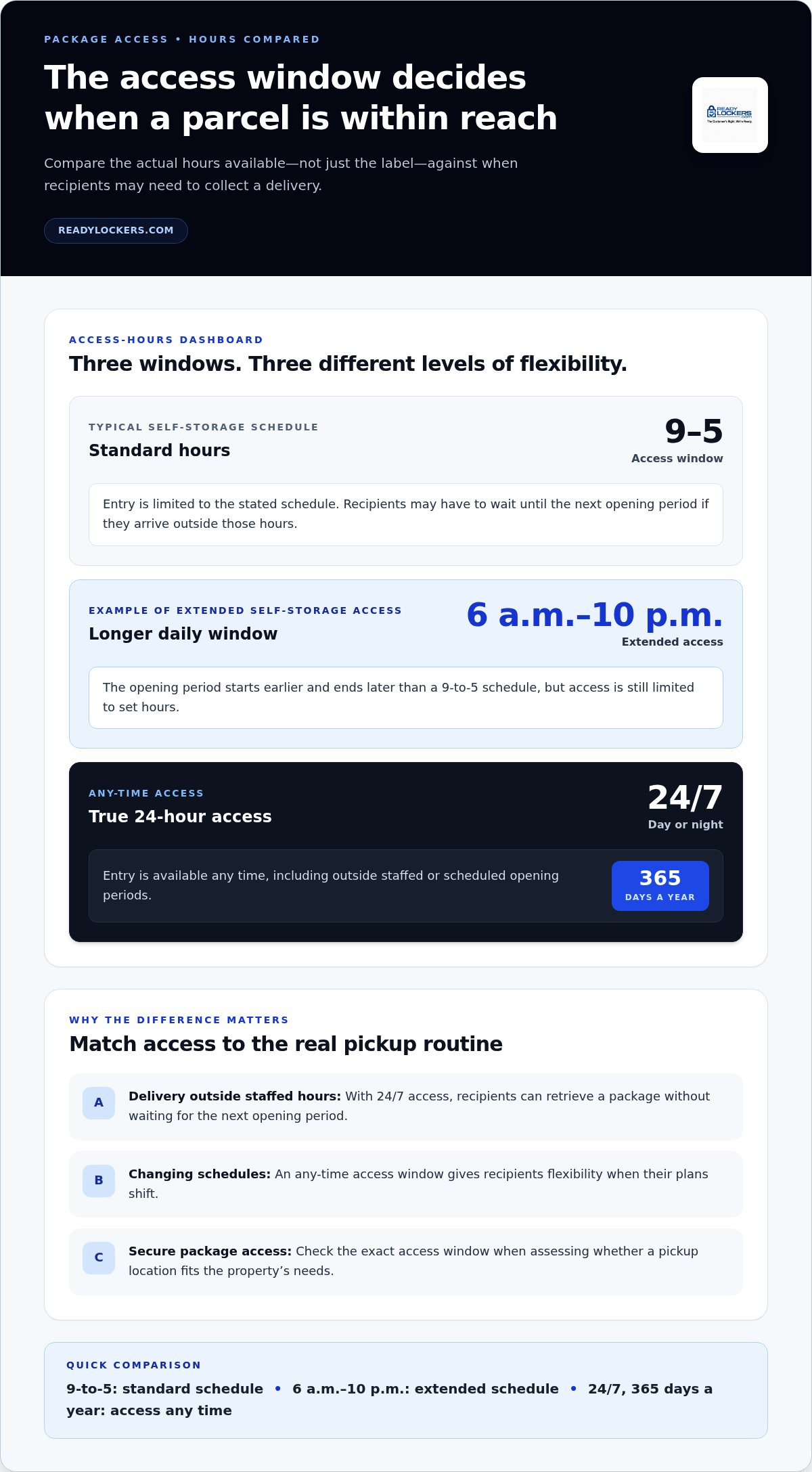
Compare the access window with the hours you actually need to retrieve a parcel. A typical self-storage schedule is 9-to-5, while an example of extended self-storage access runs from 6 a.m. to 10 p.m. Both leave periods when a recipient can’t enter. True 24-hour access means entry any time, day or night, 365 days a year.
That difference matters when a delivery arrives outside staffed hours or a recipient’s schedule changes. With 24/7 access, the recipient can retrieve the package without waiting for the next opening period. For a property where recipients need 24/7 secure package access, compare the actual access window, not just labels such as “extended” or “after hours.”
How do 24/7 package lockers compare with parcel rooms, PO boxes, and staffed pickup locations? Lockers provide individual compartments and access credentials; parcel rooms offer a shared indoor collection area, while PO boxes use a postal address. Staffed pickup locations depend on their posted opening hours, so recipients may need to collect during operating times.
Access hours describe the site, but not necessarily every step in pickup. A recipient may need an active credential, an accessible entrance, and a package already placed inside. Before choosing, trace a realistic example: a parcel arrives after the office closes, and its recipient returns later that evening. The access arrangement should cover both arrival and retrieval without depending on an employee being present.
For a multi-tenant property, compare how residents enter the building and reach the package area at different times. A locker beside a locked entrance is not practically accessible if the resident cannot enter the site. Conversely, a room open around the clock still needs a clear way to identify and retrieve the correct parcel. Evaluate the entire route from the entrance to the package, not just the locker’s schedule.
Holiday hours are another point to compare. A facility’s usual schedule may change on holidays, so confirm holiday access hours with its on-site manager. This matters especially when a delivery is expected during a holiday closure. Record the access window, entry method, and pickup location together to distinguish continuous access from a schedule that changes on certain days.
Use a simple decision test: list the times recipients need access, compare them with the posted schedule, then follow the route to the parcel. A 9-to-5 option suits pickups during those hours; 6 a.m. to 10 p.m. extends the window; access any time, day or night, 365 days a year removes scheduled closing periods. The value of 24/7 secure package access depends on when recipients can actually retrieve packages.
5. Smart locks and secure package storage
A smart lock can let delivery personnel enter a secure package storage area, such as a garage. The key question is what the lock protects: a designated parcel space or a larger area containing other belongings. Map the route from the delivery entrance to the storage point. If a courier must pass through an occupied room, that differs from access to a separate garage area.
A lockable porch storage box is another option. It gives carriers a secure place to leave packages, with access limited to someone who can unlock it. Before choosing one, identify where the box will sit and how a carrier can place a parcel inside. For example, a box beyond a locked gate won’t help if the carrier can’t reach the porch.
Smart locks shift the access question from a physical key to controlled entry. Consider who can unlock the secure area, which delivery personnel need access, and how recipients retrieve their parcels afterward. In a garage setup, a lock can enable delivery to a protected space rather than leaving a package outside. The arrangement still depends on a clear path and defined handoff process.
Package lockers use a different storage model: each parcel is placed in a designated compartment for recipient pickup. Compare this contained approach with a lockable porch box or garage area. Ask which arrangement keeps the package in a specific space and limits access to the intended user. A Smart Package Locker can suit properties that need assigned parcel storage rather than access to a broader room.
Make a simple access record for each storage option. Note the delivery entrance, who can unlock it, where the carrier leaves the parcel, and how the recipient retrieves it. A garage setup, for example, needs a delivery route and recipient handoff, while a porch box centers on the box and its key. These details reveal gaps before a parcel arrives.
Security also depends on where the package goes after delivery. A parcel inside a locked area is different from one left beside the door because the carrier couldn’t reach the storage point. Walk the route as a courier would, then as a recipient would. Check whether the intended destination is accessible and whether collection requires entering spaces unrelated to pickup.
For access any time, day or night, 365 days a year, the storage method must pair availability with controlled entry. Compare who can open the space, where packages sit inside, and how the recipient completes pickup. The clearest choice is the one with a defined delivery point, an appropriate access boundary, and a straightforward retrieval process.
5. Which package lockers and pickup services offer 24/7 access in the United States?
In the United States, access depends on the specific pickup location and its operating arrangement. A locker-based system can support access any time, day or night, 365 days a year, when the pickup area is available around the clock. The label “package locker” alone doesn’t tell you its hours. Compare the location’s access window with the hours recipients actually need.
Start with where the parcel will be held. A locker at a residential property serves a different pickup routine from one inside a store or community building. Local stores, libraries, and community centers are potential package pickup locations, but their presence doesn’t mean recipients can enter at every hour. Match the pickup point’s stated access to the parcel’s expected collection time.
Carrier secure locations and retail pickup counters offer another option when recipients can’t sign for delivery. These connect a parcel with a designated collection location, but visits depend on that location’s hours. A staffed counter provides an in-person handoff; an access-controlled locker allows retrieval without staff interaction. Compare the actual collection method, not just the service category.
Parcel rooms and lockers also differ in how recipients find their packages. A room provides a shared collection area, while a locker assigns the parcel to a compartment. Either setup needs clear delivery instructions and a practical route to the storage point. For a package expected after the workday, check whether the entrance and pickup area remain accessible together.
Use these steps to compare options in your area:
- Identify the exact pickup location, such as a property locker, store, library, or community center.
- Compare its access hours with the times you expect to collect parcels.
- Trace the route from the public entrance to the package storage area.
- Determine whether collection uses a staff handoff, a designated room, or an individual locker.
For a true around-the-clock option, the recipient needs access to the pickup area, not simply a notification that a parcel arrived. A locked building entrance can interrupt access even when a locker itself remains available. Consider a resident returning late: the recipient must be able to enter the property, reach the locker, and retrieve the parcel using the assigned pickup method.
The practical approach is to compare locations, access hours, and retrieval methods together. A locker with continuous site access can serve recipients who need pickup at any hour. Local stores, libraries, and community centers offer other pickup options, while staffed locations follow their operating schedules. This comparison shows which option fits a recipient’s actual routine.
ReadyLockers: Smart Package Lockers
ReadyLockers helps properties organize package delivery and recipient pickup through Smart Package Lockers. Couriers place packages in secure lockers, and recipients receive SMS or QR code notifications with pickup details. Its Contactless Pickup System lets recipients collect packages without a face-to-face handoff, with pickups available 24/7. This can help reduce missed deliveries and package theft.
For properties comparing access options, ReadyLockers’ Locker Management Software and Courier Access Interface support locker-based deliveries. This setup suits locations seeking a designated place for incoming packages and convenient recipient collection, rather than relying only on unattended doorstep drop-offs.
To discuss a package locker setup for your property, contact ReadyLockers.
Plan a package workflow that fits your property
Make the next step a practical one: map how a parcel moves from courier handoff to recipient collection. Identify the storage point, the people who need access, and how recipients should retrieve packages. This gives your property team a clear basis for deciding whether 24/7 secure package access fits its daily operations and how to shape a smoother package experience.
ReadyLockers offers Smart Package Lockers, Locker Management Software, and a Contactless Pickup System for property package handling. Consider how these offerings fit your location’s layout, delivery flow, and recipient needs. A defined workflow helps your team move from comparing access options to planning a solution around the property.
Contact ReadyLockers to discuss your options and take the next step toward a more organized pickup process.
Frequently Asked Questions
Are There Any Hidden Fees?
Compare the complete terms, not just the advertised access charge. Check what the arrangement covers, including package storage, collection, and any restrictions that could require a different pickup method. For a property solution, distinguish the hardware purchase from software access and see how each is described in the proposal. A written breakdown makes the scope easier to understand before choosing.
Can I drop off any size package?
No. Locker capacity depends on the compartment sizes available at that location. Packages larger than the largest locker’s stated dimensions must be picked up at the front counter. Before ordering a bulky item, compare its dimensions with the location’s posted limits and consider whether another delivery arrangement is more practical. A parcel’s weight or shape may also affect whether it fits safely inside a compartment.
How Do You Keep Your Packages Protected On Your Porch?
A lockable porch storage box can give carriers a secure place to leave a parcel, with access limited to whoever can unlock it. Position it where a carrier can reach it without exposing the parcel to passersby. For a garage delivery setup, a smart lock can let delivery personnel access the secure storage area. The key is to define the drop-off space and control entry.
How do parcel lockers work?
A parcel locker uses electronically locked compartments to hold deliveries until recipients collect them. With ReadyLockers, couriers place packages in lockers, and recipients receive SMS or QR code notifications. Recipients can use a PIN or QR code at the kiosk, so the mobile app isn’t required. This gives delivery and collection a designated storage point instead of relying on a doorstep handoff.
Is 24/7 Access a Standard Feature or an Upgrade?
It depends on the specific locker arrangement. ReadyLockers pickups are available 24 hours a day, 7 days a week, so recipients can collect packages outside conventional office hours. For other pickup locations, access may follow the building’s entry arrangements or the site’s operating schedule. Compare the recipient’s route to the locker as well as the locker’s availability, since access to the compartment requires access to the pickup area.
What Influences the Price?
ReadyLockers provides custom quotes upon request. The property’s layout, delivery volume, and locker configuration shape the proposed solution. ReadyLockers offers three commercial models: purchase, partnership, and licensing. Consider hardware and software requirements together, then describe the property’s parcel workflow in your quote request. That context helps align the proposed setup with how packages arrive and recipients collect them.
What happens if I don't pick up my package?
An uncollected package remains subject to the pickup location’s storage and return process. Use the original notification to identify the parcel and collection location, then follow the shipment’s instructions. For a workplace or shared property, the site’s package-handling procedure can determine what happens next. Keep tracking details available to distinguish a delayed pickup from a parcel that has moved to another location.
How do 24/7 package lockers verify identity and control access?
Access can be tied to a recipient credential, such as a PIN or QR code, rather than an open room anyone can enter. ReadyLockers recipients can use a PIN or QR code at the kiosk, and the mobile app is optional. Its electronically locked compartments connect pickup to controlled access. For properties using badge access, ReadyLockers also supports HID badge readers.

Frequently Asked Questions
Are There Any Hidden Fees?+
Compare the complete terms, not just the advertised access charge. Check what the arrangement covers, including package storage, collection, and any restrictions that could require a different pickup method. For a property solution, distinguish the hardware purchase from software access and see how each is described in the proposal. A written breakdown makes the scope easier to understand before choosing.
Can I drop off any size package?+
No. Locker capacity depends on the compartment sizes available at that location. Packages larger than the largest locker’s stated dimensions must be picked up at the front counter. Before ordering a bulky item, compare its dimensions with the location’s posted limits and consider whether another delivery arrangement is more practical. A parcel’s weight or shape may also affect whether it fits safely inside a compartment.
How Do You Keep Your Packages Protected On Your Porch?+
A lockable porch storage box can give carriers a secure place to leave a parcel, with access limited to whoever can unlock it. Position it where a carrier can reach it without exposing the parcel to passersby. For a garage delivery setup, a smart lock can let delivery personnel access the secure storage area. The key is to define the drop-off space and control entry.
How do parcel lockers work?+
A parcel locker uses electronically locked compartments to hold deliveries until recipients collect them. With ReadyLockers, couriers place packages in lockers, and recipients receive SMS or QR code notifications. Recipients can use a PIN or QR code at the kiosk, so the mobile app isn’t required. This gives delivery and collection a designated storage point instead of relying on a doorstep handoff.
Is 24/7 Access a Standard Feature or an Upgrade?+
It depends on the specific locker arrangement. ReadyLockers pickups are available 24 hours a day, 7 days a week, so recipients can collect packages outside conventional office hours. For other pickup locations, access may follow the building’s entry arrangements or the site’s operating schedule. Compare the recipient’s route to the locker as well as the locker’s availability, since access to the compartment requires access to the pickup area.
What Influences the Price?+
ReadyLockers provides custom quotes upon request. The property’s layout, delivery volume, and locker configuration shape the proposed solution. ReadyLockers offers three commercial models: purchase, partnership, and licensing. Consider hardware and software requirements together, then describe the property’s parcel workflow in your quote request. That context helps align the proposed setup with how packages arrive and recipients collect them.
What happens if I don't pick up my package?+
An uncollected package remains subject to the pickup location’s storage and return process. Use the original notification to identify the parcel and collection location, then follow the shipment’s instructions. For a workplace or shared property, the site’s package-handling procedure can determine what happens next. Keep tracking details available to distinguish a delayed pickup from a parcel that has moved to another location.
How do 24/7 package lockers verify identity and control access?+
Access can be tied to a recipient credential, such as a PIN or QR code, rather than an open room anyone can enter. ReadyLockers recipients can use a PIN or QR code at the kiosk, and the mobile app is optional. Its electronically locked compartments connect pickup to controlled access. For properties using badge access, ReadyLockers also supports HID badge readers.