Smart Locker ROI for Facility and Operations Teams
A guide to calculating ROI on smart lockers 2026: compare total costs, payback, and measurable staff-time and facility-space savings before you invest.

A smart locker’s return is only as useful as the objective behind it. Calculating ROI on smart lockers in 2026 means comparing measurable benefits, such as staff time saved or space recovered, with the system’s total costs; ROI is net benefit divided by total cost, multiplied by 100.
It’s reasonable to want a clear payback estimate before investing in a facility system. A credible calculation starts by defining the operational problem and recording a baseline, then measuring whether smart lockers change the costs or outcomes that matter.
This guide explains how to set measurable objectives, account for upfront and ongoing costs, and estimate payback and ROI without relying on generic savings claims. You’ll also learn how to build an evaluation around your facility’s package volume, labor, space, and operating priorities, so the results support a practical investment decision.
Key Takeaways
- Build a complete cost picture that includes acquisition, ongoing operations, internal labor, and change management.
- Separate upfront investment, total cost of ownership, payback period, and ROI to make each measure useful for decisions.
- Calculate benefits from operational baselines, such as package-handling time and space use, rather than relying on broad savings assumptions.
- Set measurable objectives before choosing a system so you can track whether it improves the facility’s specific operations.
What belongs in smart locker total cost of ownership?
Total cost of ownership includes the full expense of acquiring, implementing, and operating a locker system. A useful business case compares those costs with measurable operational savings and any planned revenue opportunities.
Acquisition and Implementation Costs
In 2026, upfront costs include hardware, installation, wiring, network connectivity, signage, and integration. The total depends on system size, site conditions, and the facility’s existing technology. Include implementation work alongside the hardware estimate, rather than treating the purchase as the complete investment. For a facility, list each cost once and identify whether it is a one-time expense or a recurring charge.
Operating and Internal Costs
Ongoing costs can include software, support, maintenance, and internal time spent managing exceptions or adapting workflows. Include staff training and the time required to move from manual package handling. Industry and facility size affect ROI because package volume, labor rates, and available space differ. A 300-unit apartment community receiving about 90 packages daily has different operational demands from a smaller site.
Establish a baseline before estimating benefits. Record package volume, staff time spent handling each package, labor costs, storage space, delivery exceptions, and current service expenses. One apartment example estimates five minutes of staff handling per package; use your own time records to calculate the actual labor opportunity. Track the same measures before and after installation.
Separate direct savings from potential revenue in your business case. Less manual intake and retrieval may free staff time, while reclaimed space may reduce occupancy costs. Apartment communities might also consider usage fees or premium delivery services. Count revenue only if the facility plans to offer the service and track its uptake.
Compare total costs with quantified benefits over the same period. Include one-time integration and change-management costs, recurring operating expenses, and internal labor. This gives a fuller ROI estimate than counting the locker hardware alone.
Distinguishing initial investment, total cost of ownership, payback, and ROI
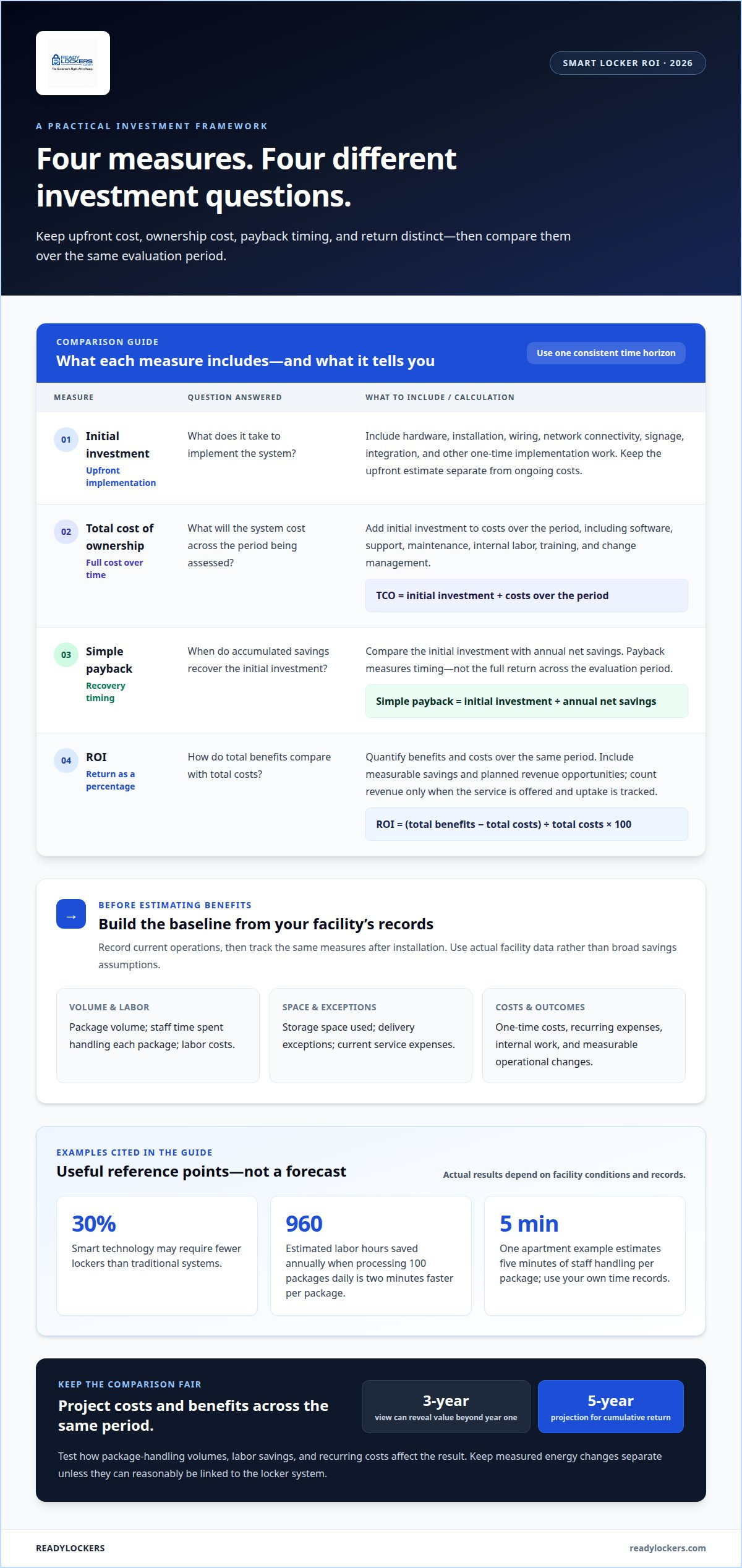
These measures answer different investment questions. Use a consistent time horizon so projected savings, costs, and returns can be compared fairly.
Investment and Ownership Cost Measures
Initial investment covers the costs required to implement the system. Total cost of ownership (TCO) also includes operating and internal costs over the period being assessed. The distinction matters: a purchase-only estimate leaves out later costs that affect the business case.
For a useful estimate, define the evaluation period first, then add one-time implementation costs and recurring expenses. Include internal work required to support the system. Keep the upfront quote separate from projected ongoing costs so decision-makers can see what drives the total.
Payback and Cumulative Return
The payback period estimates when accumulated savings recover the initial investment.
Payback measures timing, not the full return. Track cumulative benefits and costs across the entire evaluation period to see whether savings continue after the initial investment is recovered. A three-year view can reveal value that a first-year comparison misses.
ROI Formulas and Long-Term Projections
Use these formulas consistently: TCO = initial investment + costs over the period. Simple payback = initial investment ÷ annual net savings. ROI = (total benefits − total costs) ÷ total costs × 100. Multiply the final ROI figure by 100 to express it as a percentage.
Treat this as an example, not a forecast. Test how handling volumes, labor savings, and recurring costs change the result. Locker management software is one operating cost to include when building a complete projection.
How to Calculate the ROI of a Smart Locker System?
Start with measurable operational savings, subtract ongoing costs from quantified benefits, and compare the result with the initial investment over a consistent period.
Purchase and Installation Savings
Estimate upfront savings by comparing the traditional locker requirement with the smart locker requirement. Multiply the difference in locker numbers by the cost per traditional locker. Smart technology may require 30% fewer lockers than traditional systems. For teams calculating ROI on smart lockers in 2026, include installation and integration in the initial investment, and compare equivalent project scopes.
Base the comparison on your facility’s requirements. Package capacity, site preparation, and installation scope all affect the result.
Automation-Related Labor Savings
Measure baseline staff time spent receiving, sorting, notifying, and retrieving packages. Multiply time saved per package by package volume and labor cost. Processing 100 packages daily two minutes faster per package is estimated to save 960 labor hours annually.
Count only staff time that can be redirected to other work or removed from operating costs. Productivity gains have a financial effect when they change staffing needs or free staff for other tasks.
Investment and Savings Modeling
Build an annual model that covers the initial investment, recurring costs, and quantified savings. Extend projections across five years to show cumulative return, not just first-year results. Use facility records to estimate package-handling labor, and compare utility bills with the pre-installation energy baseline.
Keep energy savings separate unless measured changes can reasonably be linked to the locker system. Record other facility changes that could affect consumption, then update projections with actual results. This keeps calculating ROI on smart lockers in 2026 grounded in operating evidence.
Tax Credits, Grants, and Depreciation
No specific U.S. tax credit, grant, or depreciation benefit for smart locker purchases in 2026 is included in this operational calculation. Model tax treatment separately, since eligibility and value depend on the purchase and taxpayer circumstances.
Keep the core calculation clear: subtract total costs from quantified benefits, divide by total costs, and multiply by 100 for percentage ROI. A separate tax analysis can show how incentives or depreciation affect the investment decision.
Defining measurable smart locker objectives
A strong ROI case starts with a defined operational outcome, not a locker count. Choose a measurable objective, record the current baseline, assign an owner, and set a review period before deployment. For example, track staff time spent handling packages, storage space used, delivery exceptions, or resident satisfaction. Each measure should connect to a cost, service outcome, or facility priority.
Set objectives that match the site. A workplace might target fewer traditional lockers or less floor space tied up in storage. Smart technology can require 30% fewer lockers than traditional systems. An apartment community may also track package handling and resident satisfaction, then assess whether the amenity supports retention and renewals. Keep these secondary outcomes separate from cash savings unless they can be quantified financially.
Define each metric precisely. For labor, record the task, staff time, and volume handled. For space, measure the area currently used and identify its alternative use. For service, count missed deliveries or complaints using the same process before and after installation. Smart lockers may reduce failed delivery attempts by up to 40%, but use a conservative estimate tied to your facility’s actual baseline.
Assign responsibility for ongoing measurement. Operations teams can track handling time and exceptions, facilities teams can record storage use, and property teams can collect satisfaction feedback. Review the same measures at consistent intervals, noting changes in occupancy, package volume, or staffing that could affect results. This context helps separate locker-related improvements from other operational changes.
Turn each objective into a decision rule: what changes, how it is measured, and why the change matters. A clear target makes the return calculation more credible and gives teams a way to judge progress. Plan a measurable locker deployment around the outcomes that matter to your facility.
ReadyLockers: Smart Package Lockers
ReadyLockers helps facility and operations teams put their ROI objectives into a practical package-handling workflow. Smart Package Lockers, Locker Management Software, a Contactless Pickup System, and a Courier Access Interface support secure package drop-off and recipient pickup.
Recipients receive SMS or QR code notifications, and pickups are contactless and available 24/7. For an ROI assessment, connect these operating steps to the metrics that matter at your site, such as staff time spent handling packages, missed deliveries, and storage demands. This creates a clear basis for tracking actual operational results against your baseline.
If your objectives point to a smart locker system, contact ReadyLockers to discuss a package-handling setup aligned with your facility’s needs.
Make the Investment Case Useful Over Time
ROI should guide more than the approval decision. Use it as an operating reference to assess whether the system continues to support facility priorities as package patterns, staffing, and space needs change. A consistent review process also helps finance and operations teams explain results using the same measures.
A disciplined approach to calculating ROI on smart lockers in 2026 connects the original business case with evidence gathered after deployment. Set a review cadence, assign responsibility for maintaining the data, and record operational changes that could affect results. If actual outcomes differ from the estimate, update the assumptions and use the findings to inform future facility decisions.
ReadyLockers can help translate package-handling needs into a practical locker setup for your facility. Discuss your project with ReadyLockers and take the next step toward a clearer operational plan.
Frequently Asked Questions
Can Smart Lockers Generate Revenue Too?
A property can generate revenue by charging for optional package services when that fits its operating model. For example, an apartment community might consider usage fees or premium delivery services. Treat these as projected income only if the property plans to offer them and can track uptake. Keep revenue separate from avoided labor costs to prevent counting the same benefit twice.
How Do Smart Lockers Reverse These Costs?
Smart lockers don’t automatically reverse or erase expenses; they may help offset costs by making package handling more efficient. If staff currently sort deliveries and notify recipients, for example, automation can reduce those manual tasks. The facility can then assess whether staff time supports other work or reduces actual labor expense. The financial effect depends on whether the operational change produces a measurable saving.
How do you calculate upfront ROI (return on investment)?
Compare the benefits expected during the chosen initial period with the investment and costs for that same period. Subtract those costs from the benefits, divide the result by the costs, then multiply by 100 for percentage ROI. Keep one-time implementation separate from recurring expenses, and avoid counting labor savings as cash savings unless staffing costs or paid hours actually change.
What About Long-Term ROI?
Long-term ROI shows whether cumulative benefits continue to outweigh cumulative costs as operations change. Compare actual package volume, staff effort, software expenses, maintenance, and any revenue with the original assumptions. Test different operating conditions, such as lower package activity or staffing changes. This reveals which assumptions have the greatest effect on return and where ongoing tracking needs attention.
What should a smart locker business case contain?
A practical business case identifies the operational problem, the teams affected, the current process, and the expected measurable outcomes. Include a cost model, benefit assumptions, a defined evaluation period, and someone responsible for tracking results. Add a conservative scenario alongside the expected case so decision-makers can see how changes in package volume or labor availability might affect the investment.
Why are traditional lockers less cost effective long-term?
Traditional lockers may require more manual coordination if staff manage access, organization, and user questions without an automated workflow. They may also take up space a facility could use differently. That doesn’t make every traditional setup uneconomical: compare actual staffing tasks, space use, and package needs with the smart locker alternative. The long-term difference depends on how the facility operates.

Frequently Asked Questions
Can Smart Lockers Generate Revenue Too?+
A property can generate revenue by charging for optional package services when that fits its operating model. For example, an apartment community might consider usage fees or premium delivery services. Treat these as projected income only if the property plans to offer them and can track uptake. Keep revenue separate from avoided labor costs to prevent counting the same benefit twice.
How Do Smart Lockers Reverse These Costs?+
Smart lockers don’t automatically reverse or erase expenses; they may help offset costs by making package handling more efficient. If staff currently sort deliveries and notify recipients, for example, automation can reduce those manual tasks. The facility can then assess whether staff time supports other work or reduces actual labor expense. The financial effect depends on whether the operational change produces a measurable saving.
How do you calculate upfront ROI (return on investment)?+
Compare the benefits expected during the chosen initial period with the investment and costs for that same period. Subtract those costs from the benefits, divide the result by the costs, then multiply by 100 for percentage ROI. Keep one-time implementation separate from recurring expenses, and avoid counting labor savings as cash savings unless staffing costs or paid hours actually change.
What About Long-Term ROI?+
Long-term ROI shows whether cumulative benefits continue to outweigh cumulative costs as operations change. Compare actual package volume, staff effort, software expenses, maintenance, and any revenue with the original assumptions. Test different operating conditions, such as lower package activity or staffing changes. This reveals which assumptions have the greatest effect on return and where ongoing tracking needs attention.
What should a smart locker business case contain?+
A practical business case identifies the operational problem, the teams affected, the current process, and the expected measurable outcomes. Include a cost model, benefit assumptions, a defined evaluation period, and someone responsible for tracking results. Add a conservative scenario alongside the expected case so decision-makers can see how changes in package volume or labor availability might affect the investment.
Why are traditional lockers less cost effective long-term?+
Traditional lockers may require more manual coordination if staff manage access, organization, and user questions without an automated workflow. They may also take up space a facility could use differently. That doesn’t make every traditional setup uneconomical: compare actual staffing tasks, space use, and package needs with the smart locker alternative. The long-term difference depends on how the facility operates.