Future of Package Delivery in Commercial Buildings: How Delivery Options Work
The future of package delivery in commercial buildings: coordinate couriers, secure storage, notifications, and holiday pickups with lockers and workflows.

Holiday delivery peaks test building operations, not just courier capacity. The future of package delivery in commercial buildings depends on coordinating couriers, secure storage, recipient notifications, and pickup in a clear process. Buildings can combine staffed handoffs, smart lockers, dedicated package rooms, and digital management systems to keep deliveries moving as volume rises.
A delivery surge can crowd lobbies, add work for building teams, and leave packages waiting longer for pickup. A reliable plan matches each delivery method to the property’s space, staffing, access needs, and typical arrival patterns.
This guide explains how connected systems support multi-tenant buildings during holiday peaks, when manual handoffs still make sense, and how lockers and package rooms provide secure storage. It also covers how digital coordination can help teams prepare for surges and keep pickups organized.
Key Takeaways
- Plan for holiday surges by matching package volume, available space, and staffing to the building’s delivery workflow.
- Connect lockers, cameras, and access points to support secure handoffs and clearer package movement.
- Choose between staffed handoffs, lockers, and smart rooms based on how residents collect deliveries and how the property handles arrivals.
- Use digital delivery systems to organize courier access, notify recipients, and prepare for busy periods.
1. Delivery management for residential, commercial, and mixed-use properties
Residential, office, and mixed-use properties need delivery plans that fit their entrances, staffing, and storage. Arrivals often cluster in the morning, evening, and on weekends, creating bottlenecks when couriers share lobby space. Map routes from loading areas to handoff or storage points to keep deliveries moving during busy periods.
A good pickup process accounts for different recipient needs. A staffed desk, for example, can handle oversized parcels, while lockers let recipients collect routine deliveries independently. During rollout, explain the process in move-in materials, lobby signage, and direct notices. Include pickup instructions, notification methods, and a contact for misplaced packages.
Accessibility and building requirements depend on the property’s location and use. Plan an accessible route to the package area, then review its layout and access points against the rules that apply to the property.
Locker capacity, site conditions, installation scope, and ongoing software needs all affect project cost. ReadyLockers offers purchase, partnership, and licensing models, with custom quotes based on the project.
Security planning should address unauthorized entry, package theft, personal information, and responsibility for handoffs. Security.org’s 2025 Package Theft Report puts annual U.S. Limit package records to operational needs, control staff and courier access, and define how teams document exceptions.
U.S. parcel volume reached 23.1 billion shipments in 2025 and is projected to reach 31 billion shipments by 2031. Offices, apartments, and mixed-use buildings must plan for varied delivery patterns, from office supplies during business hours to resident parcels outside them.
Digital arrival records and notifications can reduce manual logging and prompt timely pickup. Predictive logistics may help teams plan storage and staffing, while automated sorting can reduce manual handling. Mailroom technology can also support waste-reduction efforts, such as greener packaging practices.
2. IoT-connected lockers, cameras, and access points
Connected delivery systems can link locker access with camera coverage and building entry systems. A courier uses an authorized access point, places a parcel in a designated compartment, and records the handoff. The system can then send the recipient a pickup code or QR code. This creates a traceable sequence from delivery to collection.
Security depends on assigning access by role. Couriers need entry to the delivery area, while recipients need access only to their own pickup. Building staff may need management permissions for exceptions, such as a parcel placed in the wrong compartment. PIN codes or facial recognition can restrict retrieval to authorized residents, while cameras can help document activity around entry points.
Privacy needs deliberate design, too. Keep tenant access separate so recipients cannot view one another’s package details or pickup credentials. Limit camera coverage to relevant entrances and locker areas, and restrict delivery records to staff who need them for operations. A notification, for instance, can tell a resident where to collect a parcel without revealing another tenant’s delivery information.
For commercial properties, connected lockers can support access to supplies outside staffed handoff hours. Parcel lockers can provide construction professionals with access to supplies 24/7/365, allowing teams to collect items around varied work schedules. Access controls can separate supply retrieval from general building entry, while delivery tracking records when items arrive and leave.
Before deployment, map courier routes, recipient access, staff permissions, camera views, and notification steps. Test each access role with a sample delivery, then adjust permissions if a courier can reach tenant areas or a recipient can see another person’s information. To explore a connected approach, review package delivery system options.
3. Manual handoffs, lockers, smart rooms, and third-party services
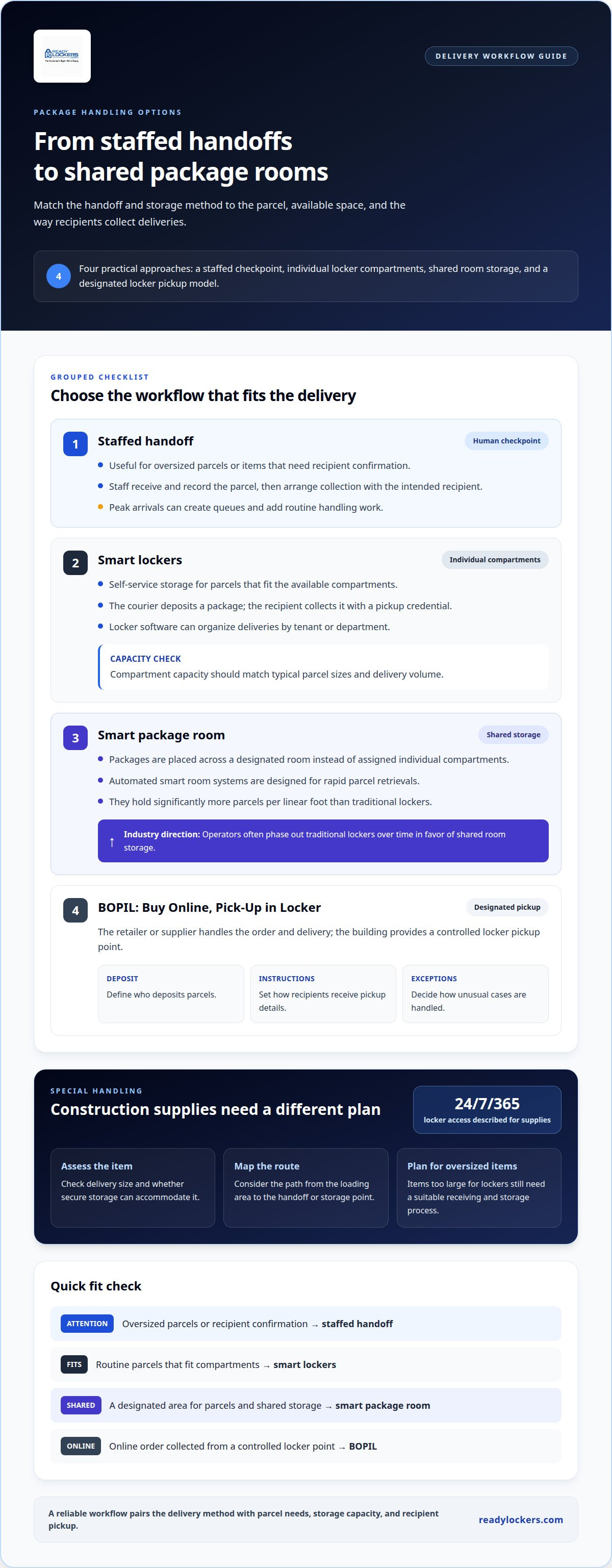
A staffed handoff suits deliveries that need attention, such as oversized parcels or items requiring recipient confirmation. Staff receive the parcel, record its arrival, and arrange collection with the intended recipient. This provides a human checkpoint, but peak arrivals can create queues and add routine handling work.
Smart lockers provide self-service storage for parcels that fit the available compartments. A courier deposits a package, and the recipient collects it using a pickup credential. Locker management software can keep deliveries organized by tenant or department. Lockers work best when compartment capacity matches the property’s typical parcel sizes and delivery volume.
Smart rooms provide shared storage where packages can be placed across a designated room rather than assigned individual locker compartments. Modern automated smart package room systems are designed for rapid parcel retrievals and hold significantly more parcels per linear foot than traditional lockers. Operators often phase out traditional lockers over time, reflecting a broader industry shift toward shared room storage.
Bulky construction supplies need a different handoff plan from small parcels. Property teams can assess the delivery’s size, the route from the loading area, and whether secure storage can accommodate it. Parcel lockers can provide construction professionals access to supplies 24 hours a day, seven days a week, 365 days a year. Oversized items still need a suitable receiving and storage process.
Buy Online, Pick-Up in Locker, or BOPIL, connects an online purchase with collection from a designated locker. The retailer or supplier handles the order and delivery; the building provides a controlled pickup point. Before adopting this approach, define who deposits parcels, how recipients receive pickup instructions, and how exceptions are handled. This keeps third-party delivery responsibilities distinct from the property’s package operations.
4. Digital delivery management systems for multi-tenant buildings
A digital delivery system coordinates couriers, packages, recipient notifications, and building access in one workflow. That matters when office tenants, apartment residents, and visitors share entrances and elevators. A clear process tracks each parcel from courier arrival through recipient pickup, reducing confusion for property teams and delivery personnel.
Start with an arrival record. IoT sensors can log package arrivals and notify residents, reducing manual data entry. For example, a courier places a parcel in storage, the system records its arrival, and the recipient receives a pickup notification. RFID tags, sensors, and AI can also support real-time package tracking inside the building.
Historical delivery data helps managers prepare for busy periods. Review arrival patterns by day, time, tenant area, and storage location. If records show a recurring afternoon surge, managers can schedule staff coverage and clear storage space ahead of it. Real-time delivery updates can also help teams prepare mailrooms for incoming packages.
Integration can connect delivery records with access control, notifications, and building operations. Assign courier access to the delivery area, then keep tenant pickup credentials separate. AI-based systems can flag unusual patterns, including unauthorized access attempts or sudden delivery surges, and alert building management. These signals help teams respond to exceptions rather than manually reviewing every routine handoff.
Choose measures that show whether the workflow is improving: arrival logging time, uncollected parcels, resident inquiries, and access exceptions. Some properties have reduced digital delivery check-ins to 5 seconds. That figure illustrates how a streamlined check-in can transform the arrival process, while local results depend on the workflow and system setup. A digital locker management system can connect package records, notifications, and pickup processes in a single operational approach.
ReadyLockers: Smart Package Lockers
ReadyLockers helps commercial buildings organize package handoffs with Smart Package Lockers and connected digital tools. Couriers can place deliveries in secure lockers through a Courier Access Interface, while Locker Management Software supports the package workflow. Recipients receive instant SMS or QR code notifications and can collect parcels through a Contactless Pickup System, without coordinating each handoff at a staffed desk. Pickups are available 24/7, helping reduce missed deliveries and package theft.
This setup can suit multi-tenant properties that need a more organized way to receive and release routine packages, especially when staff handle competing building operations. It gives couriers a defined delivery point and recipients a direct pickup process. Contact ReadyLockers to discuss package management for your building.
Make Your Next Delivery Workflow More Resilient
The future of package delivery in commercial buildings will depend on decisions property teams make now: where deliveries enter, how recipients collect them, and which tasks need staff involvement. Let those priorities guide the next step. A well-matched process fits the property’s layout and tenant routines, while remaining practical to adapt as delivery patterns change.
For buildings looking to formalize package handling, ReadyLockers provides Smart Package Lockers, Locker Management Software, and a Contactless Pickup System. The system combines secure storage with digital management and recipient pickup. Start by defining the handoff process your building needs, then consider how technology can support it.
Discuss your building’s delivery workflow with ReadyLockers and identify a practical next step. Contact ReadyLockers to discuss delivery solutions, and move toward a package process designed around your property.
Frequently Asked Questions
What does multi-unit package delivery look like during peak holiday volume?
Peak delivery periods bring clustered arrivals, limited storage, and varied parcel sizes. A practical setup assigns routine parcels to self-service lockers, directs oversized deliveries to a separate holding area, and reserves staffed handoffs for exceptions. Clear courier routes and pickup instructions can keep recipients from crowding the lobby while deliveries are arriving.
What is a Delivery Management System for Multi-Tenant Environments?
A delivery management system coordinates package intake, records, recipient notifications, and collection across a multi-tenant property. It gives property teams a shared operational view while keeping each recipient’s package information separate. For example, an office manager can follow up on an unresolved delivery without exposing another tenant’s pickup details. Consistent procedures can then be applied across entrances, departments, or residential areas.
Why Is Logistics Complex in a High-Density Building?
High-density buildings bring multiple couriers, tenants, delivery destinations, and access needs into shared spaces. A courier may need a loading entrance, an elevator, and a secure drop-off point, while tenants expect quick access without disrupting building traffic. Package size adds another variable: a small envelope and bulky supply order need different handling. Coordinating those routes and handoffs is central to smooth daily operations.
How is package delivery in commercial buildings expected to change over the next 5-10 years?
The future of package delivery in commercial buildings will be shaped by rising parcel volume and better coordination of arrival data. U.S. parcel shipments are projected to reach 31 billion by 2031, increasing pressure to organize building-level delivery flows. Digital records and predictive logistics can help teams plan storage and staffing around expected arrivals, with workflows tailored to each property’s layout and tenant routines.
What technologies are shaping commercial building package delivery, including smart lockers, robotics, and AI?
The future of package delivery in commercial buildings will combine practical tools such as connected storage, access controls, sensors, and digital notifications. Automated systems can help flag patterns such as delivery surges or unusual access attempts. Robotics may assist with movement or sorting where a building uses that equipment, but its role depends on the site layout and operating needs. Integrations should simplify handoffs, not add disconnected steps.
How do smart package rooms, lockers, staffed mailrooms, and concierge delivery compare?
Lockers suit routine parcels that fit available compartments and can be collected independently. Package rooms allow flexible placement, while staffed mailrooms provide direct oversight and handle exceptions. Concierge handoffs add a personal receiving point but depend on staff procedures and coverage. A property can combine approaches, routing routine deliveries to self-service lockers and unusual or oversized items to a designated staff-managed process.

Frequently Asked Questions
What does multi-unit package delivery look like during peak holiday volume?+
Peak delivery periods bring clustered arrivals, limited storage, and varied parcel sizes. A practical setup assigns routine parcels to self-service lockers, directs oversized deliveries to a separate holding area, and reserves staffed handoffs for exceptions. Clear courier routes and pickup instructions can keep recipients from crowding the lobby while deliveries are arriving.
What is a Delivery Management System for Multi-Tenant Environments?+
A delivery management system coordinates package intake, records, recipient notifications, and collection across a multi-tenant property. It gives property teams a shared operational view while keeping each recipient’s package information separate. For example, an office manager can follow up on an unresolved delivery without exposing another tenant’s pickup details. Consistent procedures can then be applied across entrances, departments, or residential areas.
Why Is Logistics Complex in a High-Density Building?+
High-density buildings bring multiple couriers, tenants, delivery destinations, and access needs into shared spaces. A courier may need a loading entrance, an elevator, and a secure drop-off point, while tenants expect quick access without disrupting building traffic. Package size adds another variable: a small envelope and bulky supply order need different handling. Coordinating those routes and handoffs is central to smooth daily operations.
How is package delivery in commercial buildings expected to change over the next 5–10 years?+
The future of package delivery in commercial buildings will be shaped by rising parcel volume and better coordination of arrival data. U.S. parcel shipments are projected to reach 31 billion by 2031, increasing pressure to organize building-level delivery flows. Digital records and predictive logistics can help teams plan storage and staffing around expected arrivals, with workflows tailored to each property’s layout and tenant routines.
What technologies are shaping commercial building package delivery, including smart lockers, robotics, and AI?+
The future of package delivery in commercial buildings will combine practical tools such as connected storage, access controls, sensors, and digital notifications. Automated systems can help flag patterns such as delivery surges or unusual access attempts. Robotics may assist with movement or sorting where a building uses that equipment, but its role depends on the site layout and operating needs. Integrations should simplify handoffs, not add disconnected steps.
How do smart package rooms, lockers, staffed mailrooms, and concierge delivery compare?+
Lockers suit routine parcels that fit available compartments and can be collected independently. Package rooms allow flexible placement, while staffed mailrooms provide direct oversight and handle exceptions. Concierge handoffs add a personal receiving point but depend on staff procedures and coverage. A property can combine approaches, routing routine deliveries to self-service lockers and unusual or oversized items to a designated staff-managed process.