Automated Package Drop-Off Systems for Buildings and Their Costs
Explore an automated package drop-off system for buildings: compare lockers and package rooms, courier access, alerts, security, installation, and costs.

Oversized deliveries don’t have to rule out an automated package drop-off system for buildings. Smart lockers have fixed compartment sizes, so some packages won’t fit; a package room can handle a wider range of sizes. The key is matching the setup to the deliveries your building receives.
That distinction matters to residents and property teams. A smart locker system provides controlled courier access, secure package storage, and pickup notifications, but the process for oversized items also affects how smoothly deliveries move through the building. Available space, delivery volume, installation requirements, and ongoing management all matter when choosing a setup.
This guide explains how courier entry and package handoffs work, what happens when a delivery is oversized, and how alerts and security fit into the process. It also outlines the practical factors that influence installation and maintenance costs, so you can assess which setup makes sense for your building.
Key Takeaways
- Compare controlled courier entry and monitoring options to understand how package access can be managed securely.
- Assess how resident alerts connect a completed drop-off with convenient package pickup.
- Plan for oversized deliveries by considering package rooms alongside lockers with fixed compartment sizes.
- Match the system to your building’s space, delivery volume, and maintenance needs to weigh its practical fit and costs.
Access control, surveillance, and emergency response
Package lockers must meet applicable accessibility, fire-safety, and building-code requirements, which depend on the jurisdiction and installation location. Plan for accessible routes, exit paths, fire equipment, and building-specific approvals before selecting a location. Keep these constraints in mind when comparing lockers with a package room.
Space, power, internet, and access-control needs depend on the equipment and building layout. Identify a suitable footprint, nearby power, reliable network access, and any existing entry system the lockers need to work alongside. For example, map the courier route from the main entrance to the delivery area, then note where access credentials are required.
Access controls determine who can enter a package area and how entry is recorded. Couriers may use a PIN to enter an apartment package room, while video surveillance can provide visibility into the space. A Smart Package Room can use presence sensors for 24/7 monitoring, and residents can have secure, independent access 24/7. These controls reduce reliance on manual supervision, but managers still need a clear process for reviewing alerts and handling access issues.
Building automation systems use a feedback loop: sensors collect data, control logic evaluates it, and equipment responds. Occupancy sensors can inform lighting adjustments, while temperature, humidity, and air-quality sensors can help monitor indoor conditions. AI-enabled controls can analyze sensor patterns, but their practical value depends on the inputs and response rules configured for the building. Staff should know which dashboard to monitor and who handles an alert.
To choose and implement a system, assess delivery flow, room location, existing access controls, and staff responsibilities. Define response steps, including who receives alerts and how staff escalate equipment or access problems. Before regular use, test the access sequence with a courier scenario and a resident pickup. This ensures monitoring connects to a practical response, rather than leaving alarms without an owner.
Place lockers without obstructing accessible routes, exit paths, or fire equipment, and obtain the approvals required for the building and location. Applicable requirements vary by jurisdiction and installation site.
Automated resident notifications
When a courier deposits a package in a ReadyLockers locker, the recipient receives an instant SMS or email notification. They can use the one-time PIN or QR code at the kiosk to retrieve the delivery. For example, a resident can go to the designated area and scan the code at the kiosk. Clear pickup instructions help residents find and collect packages without searching multiple counters or storage areas.
Notification timing affects convenience and facility operations. A connected system can alert the recipient as soon as a delivery is recorded, rather than relying on staff to make contact manually. The cloud-based management dashboard provides real-time visibility, an audit trail, and usage reports, helping staff answer questions about package activity. Make pickup instructions easy to follow and tell residents how to proceed if a message is delayed.
Consider how residents will access their packages. ReadyLockers sends instant SMS and email notifications, and recipients can use a PIN or QR code at the kiosk without an app. A useful message identifies the pickup location and explains the next step. For instance, “Your package is ready in the mailroom; scan your code at the kiosk” is more actionable than a generic delivery notice.
Consolidated pickup may also support more efficient resident trips when collection fits into an existing trip through the building. Environmental impact depends on travel choices and building operations, so notifications alone don’t establish emissions savings. Property teams can improve the process by tracking uncollected deliveries, reviewing recurring message problems, and keeping pickup instructions current. A clear package notification workflow connects delivery records with resident action without adding unnecessary steps.
Courier access and package drop-off
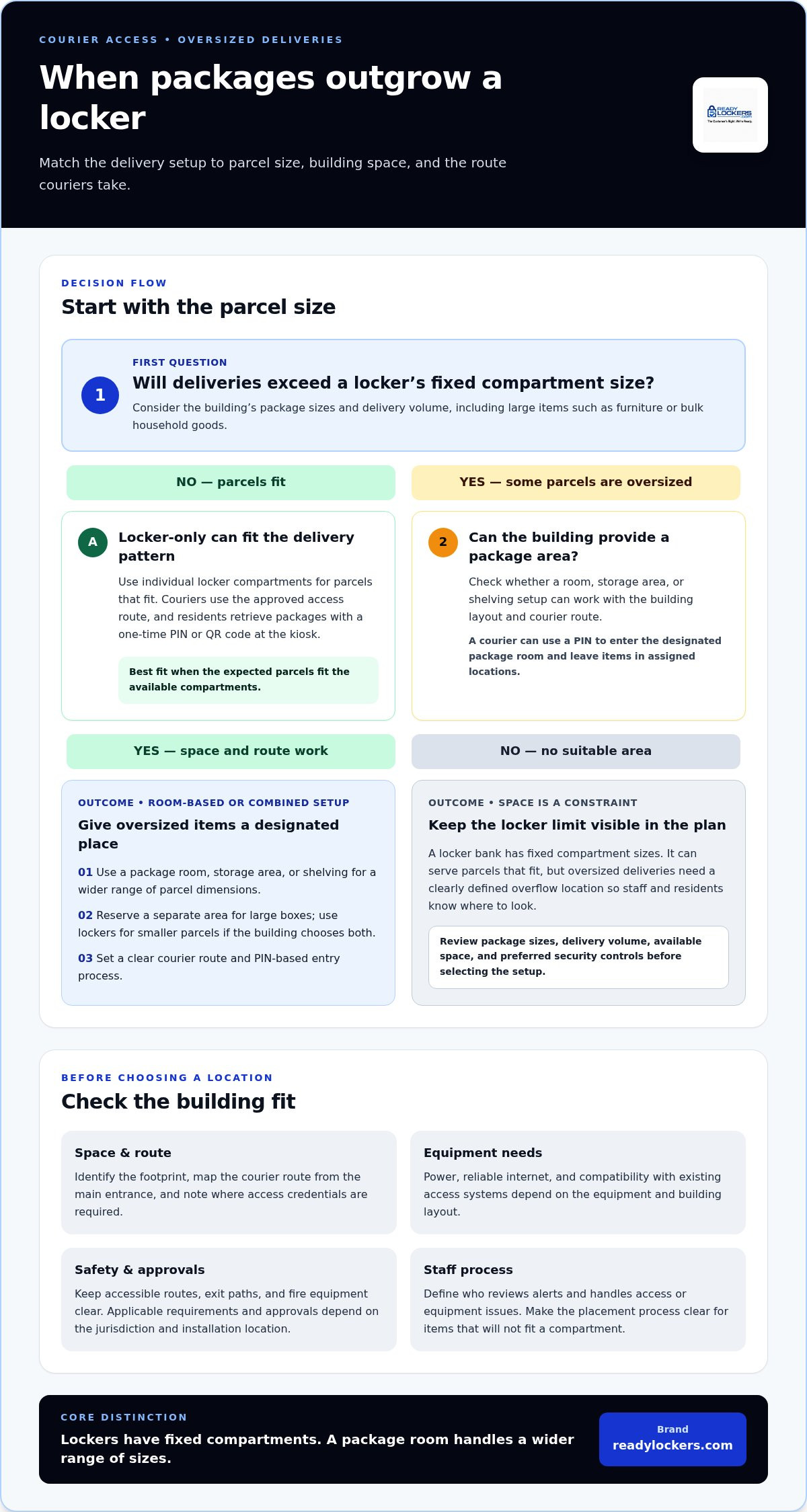
The critical question is what happens when a delivery exceeds a locker compartment. Smart lockers have fixed compartment sizes, so an oversized parcel may not fit. A package room offers a different approach: couriers can use a PIN to enter and leave packages in a designated space. Buildings can choose a room, storage area, or shelving setup that suits their layout and delivery flow.
Access should follow a clear route. A courier enters through the approved building access point, reaches the package area, and uses the assigned credentials. The courier then places each item in its designated location. For example, a property can reserve a separate area for large boxes and use lockers for smaller parcels. This keeps deliveries out of apartment doorways, where they may be at risk of theft.
PIN access makes courier entry controlled rather than unrestricted. A package room can accommodate different parcel dimensions, while a locker bank offers individual compartments but has a fixed capacity for each item. That distinction matters for furniture, bulk household goods, and other large deliveries. Owners should consider whether the building has room for a package area and whether couriers can reach it without disrupting residents.
For buildings using lockers, a courier access interface and cloud software connect courier access with the drop-off process. Make the expected steps clear, including where to place items that won’t fit in a compartment. A defined overflow location helps staff and residents know where to look. A straightforward process also makes it easier to address misdirected or uncollected deliveries.
Choose the setup by reviewing package sizes, delivery volume, available space, and the building’s preferred security controls. A locker-only layout suits parcels that fit its compartments; a room-based approach handles a wider range of sizes. StuyTown processes upwards of 400,000 package deliveries annually, illustrating why a predictable handoff process matters in high-volume properties. The takeaway: plan for oversized deliveries before selecting the drop-off layout.
What types of buildings benefit from automated package delivery systems?
Multifamily apartment buildings are a natural fit when residents receive frequent deliveries and shared entry creates exposure. Apartment residents are over three times more likely than single-family homeowners to have a package stolen. A managed pickup area gives residents a designated place to collect deliveries instead of relying on apartment-door drop-offs.
Large residential communities can benefit when package handling becomes a recurring operational task. StuyTown processes upwards of 400,000 package deliveries annually, showing the scale a large property may need to manage. For a property with busy delivery periods, consider how storage space, courier routes, and resident access work together.
Student housing and senior living properties may also benefit from centralized delivery. In student housing, residents may move frequently, so clear pickup instructions help prevent confusion about where parcels are stored. In senior living, a convenient package location can make collection simpler without requiring delivery to each individual unit.
Mixed-use buildings combine residences with offices or retail spaces, so different recipients and delivery routines may share one property. A designated package area helps separate residential parcels from business deliveries. For example, management can define distinct drop-off zones or access procedures for each tenant group, based on the building’s layout and operating needs.
Smaller properties should weigh available space and delivery patterns before choosing a setup. A compact building with limited common areas may favor a small locker footprint; a property receiving oversized parcels may need a room-based arrangement. Package rooms can provide residents 24/7 pickup access, while the right layout depends on the building’s space and access needs. Explore package delivery options for your property to consider how a system could fit your building.
ReadyLockers: Smart Package Lockers
ReadyLockers helps buildings coordinate package drop-off and resident pickup through Smart Package Lockers, Locker Management Software, a Contactless Pickup System, and a Courier Access Interface. These offerings suit properties seeking a managed handoff process, secure locker storage, and a way for couriers to access the drop-off point.
Residents receive SMS or QR code notifications, then collect packages through contactless pickup available 24/7. For properties comparing locker capacity with package-room needs, the right setup depends on delivery patterns, available space, and how residents and couriers move through the building.
To discuss package handling for your property, contact ReadyLockers.
Make package handling part of your building plan
Package operations work best when planned around resident experience, staff responsibilities, and available space. Before choosing an automated package drop-off system for buildings, define what a successful handoff should look like for residents, couriers, and property teams. That shared goal can guide decisions about the setup and how it fits daily operations.
ReadyLockers provides Smart Package Lockers, cloud-based Locker Management Software, and a Contactless Pickup System for buildings organizing package delivery and collection. The system brings secure storage, courier access, delivery records, and resident pickup notifications into one process.
If you’re planning a new package process or improving an existing one, take the next step with a discussion tailored to your building’s needs. Contact ReadyLockers to discuss your building and move toward a more organized package experience.
Frequently Asked Questions
What if packages don’t fit in lockers?
If a package is too large for a locker compartment, the building needs a separate handling plan. A designated package-room area can receive oversized items, with shelving or a clearly marked floor zone to keep parcels organized. Staff can record where each item was placed and include that location in the resident notification. This reduces confusion when a delivery can’t use the usual locker process.
What is a package delivery system?
A package delivery system is the process and setup a property uses to receive, organize, and hand over parcels. It may include a staffed mailroom, a package room, lockers, access controls, and resident notifications. For example, a building might log a delivery, store it in a designated location, and notify the recipient how to retrieve it. The right setup depends on the property’s space and operations.
What is an automated package drop-off system for buildings?
An automated package drop-off system for buildings coordinates courier delivery, secure storage, and recipient pickup through connected equipment and software. ReadyLockers Smart Lockers use electronically controlled compartments and cloud software to log deliveries. Recipients receive an instant SMS or email with a one-time PIN or QR code, then use it at the kiosk to access their package.
How do automated package lockers and package rooms work?
Smart lockers assign a delivery to a compartment and notify the recipient with pickup instructions. A package room instead provides a shared storage area where parcels can be organized by location or recipient. For properties using lockers, delivery records and compartment availability can help staff plan for overflow. Package rooms offer more flexibility for parcels that exceed compartment dimensions.
How do package delivery systems compare: lockers, smart package rooms, and staffed mailrooms?
Lockers secure parcels in individual compartments and organize pickup around assigned access. Package rooms provide shared storage with controlled entry and can accommodate a wider range of package sizes. Staffed mailrooms rely on personnel to receive, sort, and release deliveries. Compare these options based on available space, package dimensions, staff responsibilities, resident pickup patterns, and the level of access tracking needed.
How do residents and delivery carriers use an automated package drop-off system?
A carrier follows the building’s designated access process, places a parcel in an available locker, and records the delivery through the system. ReadyLockers works with major and regional carriers, as well as in-house staff. The resident receives an instant notification and retrieves the package using a PIN or QR code at the kiosk. The free mobile app is optional, so residents can collect packages without downloading it.

Frequently Asked Questions
What if packages don’t fit in lockers?+
If a package is too large for a locker compartment, the building needs a separate handling plan. A designated package-room area can receive oversized items, with shelving or a clearly marked floor zone to keep parcels organized. Staff can record where each item was placed and include that location in the resident notification. This reduces confusion when a delivery can’t use the usual locker process.
What is a package delivery system?+
A package delivery system is the process and setup a property uses to receive, organize, and hand over parcels. It may include a staffed mailroom, a package room, lockers, access controls, and resident notifications. For example, a building might log a delivery, store it in a designated location, and notify the recipient how to retrieve it. The right setup depends on the property’s space and operations.
What is an automated package drop-off system for buildings?+
An automated package drop-off system for buildings coordinates courier delivery, secure storage, and recipient pickup through connected equipment and software. ReadyLockers Smart Lockers use electronically controlled compartments and cloud software to log deliveries. Recipients receive an instant SMS or email with a one-time PIN or QR code, then use it at the kiosk to access their package.
How do automated package lockers and package rooms work?+
Smart lockers assign a delivery to a compartment and notify the recipient with pickup instructions. A package room instead provides a shared storage area where parcels can be organized by location or recipient. For properties using lockers, delivery records and compartment availability can help staff plan for overflow. Package rooms offer more flexibility for parcels that exceed compartment dimensions.
How do package delivery systems compare: lockers, smart package rooms, and staffed mailrooms?+
Lockers secure parcels in individual compartments and organize pickup around assigned access. Package rooms provide shared storage with controlled entry and can accommodate a wider range of package sizes. Staffed mailrooms rely on personnel to receive, sort, and release deliveries. Compare these options based on available space, package dimensions, staff responsibilities, resident pickup patterns, and the level of access tracking needed.
How do residents and delivery carriers use an automated package drop-off system?+
A carrier follows the building’s designated access process, places a parcel in an available locker, and records the delivery through the system. ReadyLockers works with major and regional carriers, as well as in-house staff. The resident receives an instant notification and retrieves the package using a PIN or QR code at the kiosk. The free mobile app is optional, so residents can collect packages without downloading it.