Hospital Staff Package Pickup Solutions: A 2026 Guide to Smart Lockers
Discover hospital staff package pickup solutions that fit shift work. Learn how smart lockers streamline parcel management and reduce reception bottlenecks.

A nurse finishing a night shift shouldn’t have to wait for reception to retrieve a personal parcel. Hospital staff package pickup solutions need to fit real shift patterns while keeping employee deliveries separate from clinical workflows. Smart lockers give staff a designated, contactless way to collect personal packages without relying on a staffed pickup window.
Packages left at reception, in mailrooms, or in shared work areas can create extra handling and interruptions for teams managing busy hospital operations. A self-service process gives employees more flexibility and reduces routine handoffs for reception and mailroom staff. When a parcel is ready, the recipient receives an SMS or QR code notification and can collect it at a time that suits their schedule.
This guide explains how hospitals can plan a practical staff parcel workflow, from choosing locker placement and capacity to setting access rules and handling exceptions. It also covers how configurable locker layouts, courier access management, and usage analytics can support an organized process built around shift work.
Key Takeaways
- Hospital staff package pickup solutions work best as a dedicated process for employees’ personal parcels, separate from clinical deliveries and patient care supplies.
- Compare staffed handoffs, informal holding areas, and lockers to see where self-service could reduce routine work for reception or mailroom teams.
- Plan the workflow by mapping current practices, estimating package patterns, assessing available space, and defining access rules.
- Account for day, evening, night, and weekend shifts so pickup arrangements fit how staff actually work.
- Configurable locker hardware and cloud-based management software can help hospitals organize courier access and review usage patterns.
Why Hospital Staff Package Pickup Needs a Dedicated Workflow
Personal deliveries can arrive at a hospital without being part of hospital operations. An employee’s online order or household parcel is different from a delivery intended for patient care. When both types enter the same informal process, staff may have to determine where an item belongs, who should handle it, and how the recipient will collect it. A dedicated workflow gives employee parcels a defined route rather than letting them accumulate wherever space is available.
The challenge is practical. A parcel may arrive during a shift change, when reception is answering questions and staff are moving between duties. If pickup depends on a staffed window, an employee on nights or working an extended shift may not be available before it closes. Items can remain at a shared desk or in a mailroom while someone tries to locate the recipient and arrange a handoff.
Each handoff may seem minor, but repeated interruptions can fragment reception, mailroom, and facilities work. Someone needs to receive or move the parcel, keep it identifiable, respond to pickup questions, and ensure it does not obstruct a shared area. A clear process defines responsibility and keeps personal deliveries from becoming an ad hoc task for whichever team happens to be nearby.
Definition: Hospital staff package pickup lockers are designated self-service storage for employees’ personal parcels. They are separate from medical courier routes and the handling of clinical supplies, specimens, or medications.
Which hospital deliveries belong in a staff pickup workflow?
Use the workflow for employees’ personal parcels and routine non-clinical deliveries. Keep specimens, medications, temperature-sensitive clinical materials, and patient care supplies outside it. Those items belong in their designated clinical or supply processes, not a staff parcel holding area. Clear categories help employees, couriers, reception, and mailroom teams recognize the intended route and reduce the chance of a personal delivery being mistaken for a clinical item, or vice versa.
Why do hospital shifts complicate package collection?
Rotating schedules don’t align neatly with a single staffed pickup period. A day-shift employee may pass reception regularly, while a night-shift employee may be on duty when the mailroom is closed. Even when a parcel is ready, leaving a clinical or operational responsibility to retrieve it may not be practical. Pickup arrangements should account for these schedule differences without interrupting duties or suggesting that a parcel system can address clinical staffing needs.
That’s why Hospital staff package pickup solutions should be treated as a staff logistics workflow, not an extension of medical delivery operations. Hospitals can define eligible parcel types, identify where employee packages should go, and communicate the process to staff and delivery personnel. Smart lockers support that separation by providing a designated place for personal parcels and a self-service collection option. The hospital sets its parcel policies and determines how the workflow fits its site.
Starting with clear boundaries makes later decisions easier: which employees use the process, where personal parcels are directed, and how pickup fits the facility’s working patterns. It also gives reception and mailroom teams a shared reference point, rather than leaving each parcel to be handled differently.
How Hospital Staff Package Pickup Works with Smart Lockers
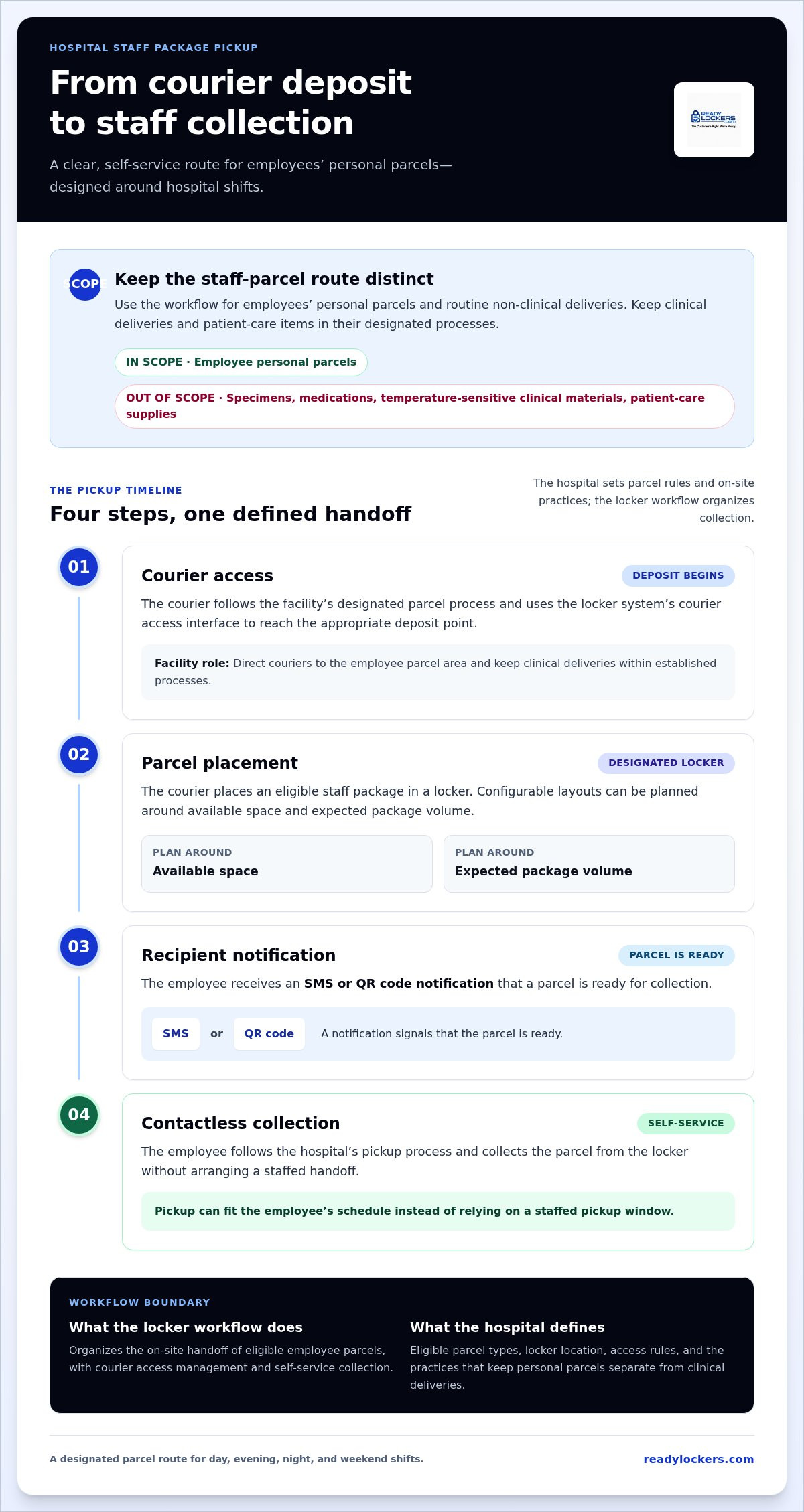
A smart locker workflow gives a personal parcel a clear path from courier deposit to employee collection. The hospital defines which packages belong in the process and how the site will manage them. ReadyLockers provides configurable locker hardware and cloud-based management software, including courier access management. Delivery companies transport packages to the facility; the locker workflow organizes the on-site handoff to employees.
The sequence is straightforward:
- Courier access: The courier follows the facility’s designated parcel process and uses the locker system’s courier access interface to reach the appropriate deposit point.
- Parcel placement: The courier places an eligible staff package in a locker. Configurable layouts can be planned around available space and expected package volume.
- Recipient notification: The employee receives an SMS or QR code notification that a parcel is ready for collection.
- Contactless collection: The employee follows the hospital’s pickup process to collect the parcel from the locker without arranging a staffed handoff.
What happens when a courier deposits a staff package?
Courier access management supports the deposit stage, while the hospital’s parcel rules define what belongs in the lockers and where they are located. The facility can plan locker capacity and layout around its space and package volumes. This is on-site parcel handling: delivery companies bring packages to the facility, and the locker workflow organizes their handoff to employees.
Clear on-site instructions matter. For example, the hospital can direct couriers to use the designated employee parcel area and keep clinical deliveries within established processes. That distinction helps prevent personal parcels from being mixed with specimens, medications, or patient care supplies. The locker system supports the defined workflow, while the hospital sets its parcel policies and operational practices.
How do employees receive and collect package notifications?
After a parcel is placed, an SMS or QR code notification tells the intended recipient it is ready. Staff can then collect it through the hospital’s established process, without waiting for reception or mailroom personnel to coordinate a direct handoff. The contactless delivery locker technology guide explores how this self-service approach supports parcel collection.
Notifications connect a deposited parcel with the employee who needs to retrieve it, even when their work schedules differ. The smart locker management software guide explains how platform functions can support oversight of the workflow. Hospital staff package pickup solutions can combine configurable hardware, courier access management, and recipient notifications while leaving delivery arrangements and parcel rules under hospital control.
To put the workflow in place, align locker placement and configuration with the facility layout and staff parcel volumes. Explore ReadyLockers smart package lockers to organize employee parcel pickup around your site’s operating practices.
Smart Lockers vs. Staffed Mailrooms and Reception Handoffs
Each pickup method creates a different balance between access and staff involvement. A staffed mailroom or reception handoff gives employees someone to ask, but collection depends on staffing and opening hours. Informal holding at a shared desk may seem simple, yet it can leave teams to sort, store, and explain parcels without a consistent process. Lockers add a defined sequence: deposit, notify, collect. Whether that approach is useful depends on parcel volume, shift patterns, available space, and the time currently spent coordinating handoffs.
| Method | Access | Staff effort | Workflow consistency |
|---|---|---|---|
| Staffed mailroom or reception | Linked to staffed pickup hours | Staff receive and hand over parcels | Clear when hours and responsibilities are defined |
| Informal shared holding area | Depends on local access and parcel location | May involve locating items and answering pickup questions | Can vary by desk, team, or shift |
| Smart lockers | Contactless pickup can extend beyond staffed windows | Shifts routine collection away from a person-to-person handoff | Uses a designated deposit and collection process |
When can staffed pickup or a mailroom remain practical?
A staffed approach can fit a lower-volume workflow, a site with established mailroom coverage, or a process that requires direct coordination. It can also work where the hospital deliberately limits collection to controlled hours. The trade-off is that employees on evening or night shifts may have fewer convenient opportunities to collect parcels, while reception teams continue to handle routine handoffs during open hours.
What does a locker-based process change?
With lockers, recipient notifications connect a parcel deposit to employee collection, and contactless pickup reduces the need to coordinate a direct handoff. ReadyLockers provides 24/7 pickup, giving staff an option outside staffed pickup windows. The 24/7 parcel pickup lockers guide covers how around-the-clock access can fit self-service collection.
Lockers do introduce a new process. Staff need to know where packages go, how notifications work, and which deliveries are eligible. The process may be useful when reception or mailroom teams repeatedly pause other tasks to locate recipients, store parcels, or manage handoffs. It is not a substitute for clear procedures. Assess whether a defined self-service route better fits the facility’s parcel patterns and staffing model.
Compare hospital staff package pickup solutions against the work they replace, not just the steps they add. Map who currently receives parcels, how employees learn an item has arrived, and how collection works across shifts. Then consider whether designated locker space and recipient notifications create a more consistent routine than the current approach. Explore ReadyLockers smart package lockers to organize that workflow.
How to Plan a Hospital Staff Package Pickup Solution
A useful plan starts with the parcel workflow, not a cabinet size. Map how employee packages arrive and move through the facility today, then identify where waiting, extra handling, or inconvenient pickup hours occur. Hospital staff package pickup solutions should fit the site’s layout, parcel patterns, and operating rules while staying separate from clinical deliveries.
Use this planning sequence to turn those observations into practical requirements:
- Map the current process. Record where personal parcels arrive, who handles them, where they are held, and how employees learn they can collect them. Include perspectives from reception, mailroom, facilities, and staff.
- Estimate package patterns. Review the volume and general size of employee parcels over a representative operating period. Consider busier days and whether arrivals cluster around particular shifts or locations.
- Assess space and routes. Identify potential locker locations near appropriate delivery access and practical employee routes. Consider whether staff can reach the pickup point without crossing clinical work areas or creating congestion.
- Define access and operating rules. Decide which personal deliveries are eligible, who may use the process, and how the hospital will handle exceptions or uncollected parcels. Plan for day, evening, night, and weekend shifts.
What should facilities assess before selecting a locker layout?
Compare delivery arrival points with the paths employees already use, then choose a collection location that is convenient without interfering with facility operations. Space and package volume both matter: a compact site with modest parcel demand has different layout needs from a facility with more deliveries or several collection areas. Configurable locker layouts can be planned around these requirements. Keep staff parcel storage distinct from clinical materials and temperature-sensitive items.
Turn the assessment into a simple site plan. Mark the proposed locker location, delivery approach, and employee access route. Include facilities and mailroom teams in the review so the placement works with daily operations, not just the available floor space. The smart locker installation guide provides further context for planning locker implementation.
Which operating rules make pickup clearer for staff?
Write concise instructions that identify eligible personal parcels, the designated drop-off location, and who may collect them. Set an internal procedure for exceptions and parcels that remain uncollected, rather than assuming software will manage every case. Share the same pickup steps with employees, couriers, reception, mailroom, and facilities teams so each group understands its role.
Before launch, test the instructions against different schedules. Could an employee finishing a night shift understand where to go and what to do? Would a weekend courier know the designated parcel area? Clear answers help make the workflow usable across shifts. ReadyLockers provides configurable locker hardware and cloud-based management software for hospital environments. Plan a staff package pickup workflow with ReadyLockers around facility space and parcel volume.
ReadyLockers for Hospital Staff Package Pickup: Put the Workflow in Place
A staff parcel process works when the equipment and operating rules match the hospital’s needs. ReadyLockers provides configurable smart package locker hardware and cloud-based management software for properties including hospitals. The system supports a defined employee pickup workflow, while the hospital sets parcel policies and coordinates how staff and delivery personnel use it. Personal packages remain distinct from clinical logistics, medications, specimens, and temperature-sensitive materials.
Which ReadyLockers capabilities support the staff workflow?
Locker layouts can be configured around facility space and package volume, helping teams plan for the location and capacity their workflow requires. Courier access management supports the deposit stage, and recipients receive SMS or QR code notifications when parcels are ready. Employees can collect packages through contactless pickup, including outside staffed windows. The cloud platform also provides usage analytics to help the hospital review how the locker process is being used.
These capabilities support a parcel workflow, while the hospital defines how it operates. Facilities decide which personal deliveries are eligible, where the lockers belong, and how instructions reach employees and couriers. ReadyLockers provides the locker system and software, and delivery companies bring parcels to the facility. Keeping responsibilities clear helps staff understand that the lockers are intended for employee parcels.
What are the next steps for a hospital team?
Bring facilities, mailroom, operations, and employee representatives into planning early. Each team sees a different part of the process: facilities can assess placement, mailroom staff understand current parcel handling, and employees can explain how shift schedules affect collection. Together, they can define a practical workflow before choosing a layout or communicating new instructions across the hospital.
- Define the use case: Specify that the workflow is for employees’ personal packages and identify excluded clinical deliveries.
- Set delivery rules: Establish where eligible parcels should be deposited and how exceptions or uncollected items will be handled.
- Plan the space: Match the locker configuration to the available location, employee routes, and expected parcel volume.
- Explain collection: Give couriers and employees clear instructions for deposits, notifications, and contactless pickup.
After launch, the hospital can use platform usage analytics to inform its operational review and consider whether the setup still fits its parcel patterns. The aim is a well-defined staff service that makes collection easier to understand and reduces reliance on repeated manual handoffs, without confusing personal parcels with patient care workflows.
Ready to explore a staff parcel setup for your facility? Explore ReadyLockers smart package locker solutions and consider how configurable hardware and management software can support your hospital’s pickup workflow.
Make the Next Step a Clear One
A better staff parcel experience starts with one decision: define who the process serves and what convenient pickup looks like across the hospital’s shifts. From there, facilities and operations teams can turn that goal into a practical plan, with clear ownership and expectations for employees and delivery personnel.
Hospital staff package pickup solutions work best when they fit the facility’s day-to-day routines rather than add another unclear task. Use the planning work to focus on the pickup location, staff communication, and how the process will be managed over time. A well-defined approach gives employees a straightforward way to collect personal parcels while helping teams keep responsibilities clear.
Ready to explore a setup for your hospital? Explore ReadyLockers smart package locker solutions and take the next step toward a more organized staff pickup workflow.
Frequently Asked Questions
Can hospital staff pick up packages outside regular business hours?
Yes. A 24/7 locker pickup workflow lets employees collect eligible parcels beyond staffed pickup windows, including before or after a shift. Staff should follow the facility’s package rules and the instructions in their SMS or QR code notification. The hospital determines where the workflow applies and how employees are directed to use it.
Do employees need to download an app to retrieve a package?
ReadyLockers recipients receive SMS or QR code notifications about package pickup. These notifications let employees know when a parcel is ready and direct them to the facility’s pickup instructions. Hospitals can explain the process in staff communications, such as an onboarding note or mailroom notice, so employees know what to expect.
Can a smart package locker be used for medications or medical specimens?
No. A staff parcel locker workflow is for employees’ personal packages, not clinical materials. Hospitals should keep medications, specimens, and temperature-sensitive items within their separate clinical handling and storage procedures. Clear labeling and staff instructions help distinguish the employee parcel process from clinical supply workflows.
Can couriers deliver staff packages without handing them to reception?
A locker workflow can allow a courier to place an eligible staff parcel using the system’s courier access management, rather than handing it directly to reception. The recipient then receives an SMS or QR code notification. The hospital defines its delivery rules and communicates them to relevant personnel, so the locker deposit process fits the facility’s parcel-handling practices.
What should a hospital do when an employee does not collect a package promptly?
The hospital should establish an internal policy for uncollected parcels before the workflow begins. Define who is responsible for follow-up, how long items may remain under the facility’s rules, and how exceptions are escalated. Share the policy with employees, reception, mailroom, and facilities teams so they know what action to take. Make responsibilities explicit in local procedures.
Can one hospital locker setup serve employees across different departments and shifts?
It can be planned to support employees across departments and shifts. Configurable locker layouts can reflect facility space and package volume, while the hospital sets the delivery and access procedures. For example, staff communications can explain the same collection process to day, evening, night, and weekend teams. Hospital staff package pickup solutions work most clearly when departments share consistent instructions and understand which personal parcels belong in the workflow.
Does ReadyLockers deliver packages to hospitals?
No. ReadyLockers provides smart locker hardware and a cloud-based management platform. Hospitals arrange parcel transport through their chosen delivery process. The locker system supports the on-site handoff: couriers deposit eligible parcels, and employees receive pickup notifications and collect them. Keeping these roles distinct helps facility teams direct delivery questions to the appropriate carrier and use locker procedures for deposit and recipient pickup.

Frequently Asked Questions
Which hospital deliveries belong in a staff pickup workflow?+
Use the workflow for employees’ personal parcels and routine non-clinical deliveries. Keep specimens, medications, temperature-sensitive clinical materials, and patient care supplies outside it. Those items belong in their designated clinical or supply processes, not a staff parcel holding area. Clear categories help employees, couriers, reception, and mailroom teams recognize the intended route and reduce the chance of a personal delivery being mistaken for a clinical item, or vice versa.
Why do hospital shifts complicate package collection?+
Rotating schedules don’t align neatly with a single staffed pickup period. A day-shift employee may pass reception regularly, while a night-shift employee may be on duty when the mailroom is closed. Even when a parcel is ready, leaving a clinical or operational responsibility to retrieve it may not be practical. Pickup arrangements should account for these schedule differences without interrupting duties or suggesting that a parcel system can address clinical staffing needs. That’s why Hospital staff package pickup solutions should be treated as a staff logistics workflow, not an extension of medical delivery operations. Hospitals can define eligible parcel types, identify where employee packages should go, and communicate the process to staff and delivery personnel. Smart lockers support that separation by providing a designated place for personal parcels and a self-service collection option. The hospital sets its parcel policies and determines how the workflow fits its site. Starting with clear boundaries makes later decisions easier: which employees use the process, where personal parcels are directed, and how pickup fits the facility’s working patterns. It also gives reception and mailroom teams a shared reference point, rather than leaving each parcel to be handled differently. A smart locker workflow gives a personal parcel a clear path from courier deposit to employee collection. The hospital defines which packages belong in the process and how the site will manage them. ReadyLockers provides configurable locker hardware and cloud-based management software, including courier access management. Delivery companies transport packages to the facility; the locker workflow organizes the on-site handoff to employees. The sequence is straightforward:
What happens when a courier deposits a staff package?+
Courier access management supports the deposit stage, while the hospital’s parcel rules define what belongs in the lockers and where they are located. The facility can plan locker capacity and layout around its space and package volumes. This is on-site parcel handling: delivery companies bring packages to the facility, and the locker workflow organizes their handoff to employees. Clear on-site instructions matter. For example, the hospital can direct couriers to use the designated employee parcel area and keep clinical deliveries within established processes. That distinction helps prevent personal parcels from being mixed with specimens, medications, or patient care supplies. The locker system supports the defined workflow, while the hospital sets its parcel policies and operational practices.
How do employees receive and collect package notifications?+
After a parcel is placed, an SMS or QR code notification tells the intended recipient it is ready. Staff can then collect it through the hospital’s established process, without waiting for reception or mailroom personnel to coordinate a direct handoff. The contactless delivery locker technology guide explores how this self-service approach supports parcel collection. Notifications connect a deposited parcel with the employee who needs to retrieve it, even when their work schedules differ. The smart locker management software guide explains how platform functions can support oversight of the workflow. Hospital staff package pickup solutions can combine configurable hardware, courier access management, and recipient notifications while leaving delivery arrangements and parcel rules under hospital control. To put the workflow in place, align locker placement and configuration with the facility layout and staff parcel volumes. Explore ReadyLockers smart package lockers to organize employee parcel pickup around your site’s operating practices. Each pickup method creates a different balance between access and staff involvement. A staffed mailroom or reception handoff gives employees someone to ask, but collection depends on staffing and opening hours. Informal holding at a shared desk may seem simple, yet it can leave teams to sort, store, and explain parcels without a consistent process. Lockers add a defined sequence: deposit, notify, collect. Whether that approach is useful depends on parcel volume, shift patterns, available space, and the time currently spent coordinating handoffs.
When can staffed pickup or a mailroom remain practical?+
A staffed approach can fit a lower-volume workflow, a site with established mailroom coverage, or a process that requires direct coordination. It can also work where the hospital deliberately limits collection to controlled hours. The trade-off is that employees on evening or night shifts may have fewer convenient opportunities to collect parcels, while reception teams continue to handle routine handoffs during open hours.
What does a locker-based process change?+
With lockers, recipient notifications connect a parcel deposit to employee collection, and contactless pickup reduces the need to coordinate a direct handoff. ReadyLockers provides 24/7 pickup, giving staff an option outside staffed pickup windows. The 24/7 parcel pickup lockers guide covers how around-the-clock access can fit self-service collection. Lockers do introduce a new process. Staff need to know where packages go, how notifications work, and which deliveries are eligible. The process may be useful when reception or mailroom teams repeatedly pause other tasks to locate recipients, store parcels, or manage handoffs. It is not a substitute for clear procedures. Assess whether a defined self-service route better fits the facility’s parcel patterns and staffing model. Compare hospital staff package pickup solutions against the work they replace, not just the steps they add. Map who currently receives parcels, how employees learn an item has arrived, and how collection works across shifts. Then consider whether designated locker space and recipient notifications create a more consistent routine than the current approach. Explore ReadyLockers smart package lockers to organize that workflow. A useful plan starts with the parcel workflow, not a cabinet size. Map how employee packages arrive and move through the facility today, then identify where waiting, extra handling, or inconvenient pickup hours occur. Hospital staff package pickup solutions should fit the site’s layout, parcel patterns, and operating rules while staying separate from clinical deliveries. Use this planning sequence to turn those observations into practical requirements:
What should facilities assess before selecting a locker layout?+
Compare delivery arrival points with the paths employees already use, then choose a collection location that is convenient without interfering with facility operations. Space and package volume both matter: a compact site with modest parcel demand has different layout needs from a facility with more deliveries or several collection areas. Configurable locker layouts can be planned around these requirements. Keep staff parcel storage distinct from clinical materials and temperature-sensitive items. Turn the assessment into a simple site plan. Mark the proposed locker location, delivery approach, and employee access route. Include facilities and mailroom teams in the review so the placement works with daily operations, not just the available floor space. The smart locker installation guide provides further context for planning locker implementation.
Which operating rules make pickup clearer for staff?+
Write concise instructions that identify eligible personal parcels, the designated drop-off location, and who may collect them. Set an internal procedure for exceptions and parcels that remain uncollected, rather than assuming software will manage every case. Share the same pickup steps with employees, couriers, reception, mailroom, and facilities teams so each group understands its role. Before launch, test the instructions against different schedules. Could an employee finishing a night shift understand where to go and what to do? Would a weekend courier know the designated parcel area? Clear answers help make the workflow usable across shifts. ReadyLockers provides configurable locker hardware and cloud-based management software for hospital environments. Plan a staff package pickup workflow with ReadyLockers around facility space and parcel volume. A staff parcel process works when the equipment and operating rules match the hospital’s needs. ReadyLockers provides configurable smart package locker hardware and cloud-based management software for properties including hospitals. The system supports a defined employee pickup workflow, while the hospital sets parcel policies and coordinates how staff and delivery personnel use it. Personal packages remain distinct from clinical logistics, medications, specimens, and temperature-sensitive materials.
Which ReadyLockers capabilities support the staff workflow?+
Locker layouts can be configured around facility space and package volume, helping teams plan for the location and capacity their workflow requires. Courier access management supports the deposit stage, and recipients receive SMS or QR code notifications when parcels are ready. Employees can collect packages through contactless pickup, including outside staffed windows. The cloud platform also provides usage analytics to help the hospital review how the locker process is being used. These capabilities support a parcel workflow, while the hospital defines how it operates. Facilities decide which personal deliveries are eligible, where the lockers belong, and how instructions reach employees and couriers. ReadyLockers provides the locker system and software, and delivery companies bring parcels to the facility. Keeping responsibilities clear helps staff understand that the lockers are intended for employee parcels.
What are the next steps for a hospital team?+
Bring facilities, mailroom, operations, and employee representatives into planning early. Each team sees a different part of the process: facilities can assess placement, mailroom staff understand current parcel handling, and employees can explain how shift schedules affect collection. Together, they can define a practical workflow before choosing a layout or communicating new instructions across the hospital. After launch, the hospital can use platform usage analytics to inform its operational review and consider whether the setup still fits its parcel patterns. The aim is a well-defined staff service that makes collection easier to understand and reduces reliance on repeated manual handoffs, without confusing personal parcels with patient care workflows. Ready to explore a staff parcel setup for your facility? Explore ReadyLockers smart package locker solutions and consider how configurable hardware and management software can support your hospital’s pickup workflow. A better staff parcel experience starts with one decision: define who the process serves and what convenient pickup looks like across the hospital’s shifts. From there, facilities and operations teams can turn that goal into a practical plan, with clear ownership and expectations for employees and delivery personnel. Hospital staff package pickup solutions work best when they fit the facility’s day-to-day routines rather than add another unclear task. Use the planning work to focus on the pickup location, staff communication, and how the process will be managed over time. A well-defined approach gives employees a straightforward way to collect personal parcels while helping teams keep responsibilities clear. Ready to explore a setup for your hospital? Explore ReadyLockers smart package locker solutions and take the next step toward a more organized staff pickup workflow.
Can hospital staff pick up packages outside regular business hours?+
Yes. A 24/7 locker pickup workflow lets employees collect eligible parcels beyond staffed pickup windows, including before or after a shift. Staff should follow the facility’s package rules and the instructions in their SMS or QR code notification. The hospital determines where the workflow applies and how employees are directed to use it.
Do employees need to download an app to retrieve a package?+
ReadyLockers recipients receive SMS or QR code notifications about package pickup. These notifications let employees know when a parcel is ready and direct them to the facility’s pickup instructions. Hospitals can explain the process in staff communications, such as an onboarding note or mailroom notice, so employees know what to expect.
Can a smart package locker be used for medications or medical specimens?+
No. A staff parcel locker workflow is for employees’ personal packages, not clinical materials. Hospitals should keep medications, specimens, and temperature-sensitive items within their separate clinical handling and storage procedures. Clear labeling and staff instructions help distinguish the employee parcel process from clinical supply workflows.
Can couriers deliver staff packages without handing them to reception?+
A locker workflow can allow a courier to place an eligible staff parcel using the system’s courier access management, rather than handing it directly to reception. The recipient then receives an SMS or QR code notification. The hospital defines its delivery rules and communicates them to relevant personnel, so the locker deposit process fits the facility’s parcel-handling practices.
What should a hospital do when an employee does not collect a package promptly?+
The hospital should establish an internal policy for uncollected parcels before the workflow begins. Define who is responsible for follow-up, how long items may remain under the facility’s rules, and how exceptions are escalated. Share the policy with employees, reception, mailroom, and facilities teams so they know what action to take. Make responsibilities explicit in local procedures.
Can one hospital locker setup serve employees across different departments and shifts?+
It can be planned to support employees across departments and shifts. Configurable locker layouts can reflect facility space and package volume, while the hospital sets the delivery and access procedures. For example, staff communications can explain the same collection process to day, evening, night, and weekend teams. Hospital staff package pickup solutions work most clearly when departments share consistent instructions and understand which personal parcels belong in the workflow.
Does ReadyLockers deliver packages to hospitals?+
No. ReadyLockers provides smart locker hardware and a cloud-based management platform. Hospitals arrange parcel transport through their chosen delivery process. The locker system supports the on-site handoff: couriers deposit eligible parcels, and employees receive pickup notifications and collect them. Keeping these roles distinct helps facility teams direct delivery questions to the appropriate carrier and use locker procedures for deposit and recipient pickup.