Hospital Mailroom Management System: 2026 Guide to Staff Pickup Solutions
Discover how a modern hospital mailroom management system uses smart lockers for 24/7 staff pickup. Our 2026 guide shows how to reduce liability and lost pac...

Last Tuesday, a head nurse at a busy facility finished a 12-hour shift only to find the mailroom doors locked and her urgent package missing from the lobby. In the high-pressure environment of healthcare, a traditional hospital mailroom management system often fails to keep pace with the 24/7 reality of its staff. You likely recognize the daily friction of overwhelmed clerks, cluttered hallways, and the constant risk of lost parcels. It's a logistical bottleneck that drains productivity and creates unnecessary stress for your medical teams.
This 2026 guide explores how to transform that chaos into a streamlined, secure operation. You'll discover how integrating a smart package locker platform eliminates the "last inch" delivery gap while providing full chain-of-custody tracking for every item. We'll examine the shift toward contactless pickup systems that offer doctors and nurses 24/7 access to their deliveries without increasing your mailroom headcount. By the end of this article, you'll have a clear roadmap for reducing liability and implementing a frictionless logistics solution tailored for modern healthcare facilities.
Key Takeaways
- Learn how a modern hospital mailroom management system replaces manual logging with automated chain-of-custody tracking to ensure every parcel is accounted for.
- Discover how 24/7 smart locker access empowers night-shift staff to collect packages at their convenience without relying on restricted mailroom hours.
- See how automated SMS and QR code notifications eliminate time-consuming manual alerts and streamline the entire delivery notification process.
- Understand the benefits of modular hardware that scales to fit complex hospital floor plans while maintaining high standards for security and durability.
- Identify the clear ROI path created by reducing package liability and reclaiming hundreds of hours of staff time through logistics automation.
What is a Hospital Mailroom Management System?
A hospital mailroom management system is a specialized logistical framework that combines modular hardware with cloud-based tracking software. It represents a significant evolution from the traditional Digital Mailroom, specifically engineered to meet the rigorous demands of a 24/7 medical environment. This system replaces outdated paper logs with a digital chain-of-custody, ensuring every parcel is tracked from the moment a courier arrives until the recipient retrieves it.
In a healthcare setting, the stakes are higher than in a standard office building. Deliveries often include sensitive equipment or personal items for staff who work unconventional hours. Transitioning to an automated workflow isn't just about convenience; it's about maintaining operational integrity. Contactless systems help preserve sterile environments by reducing unnecessary foot traffic in sensitive areas while keeping hallways clear for patient transport and emergency response.
The Crisis of Hospital Mailroom Congestion
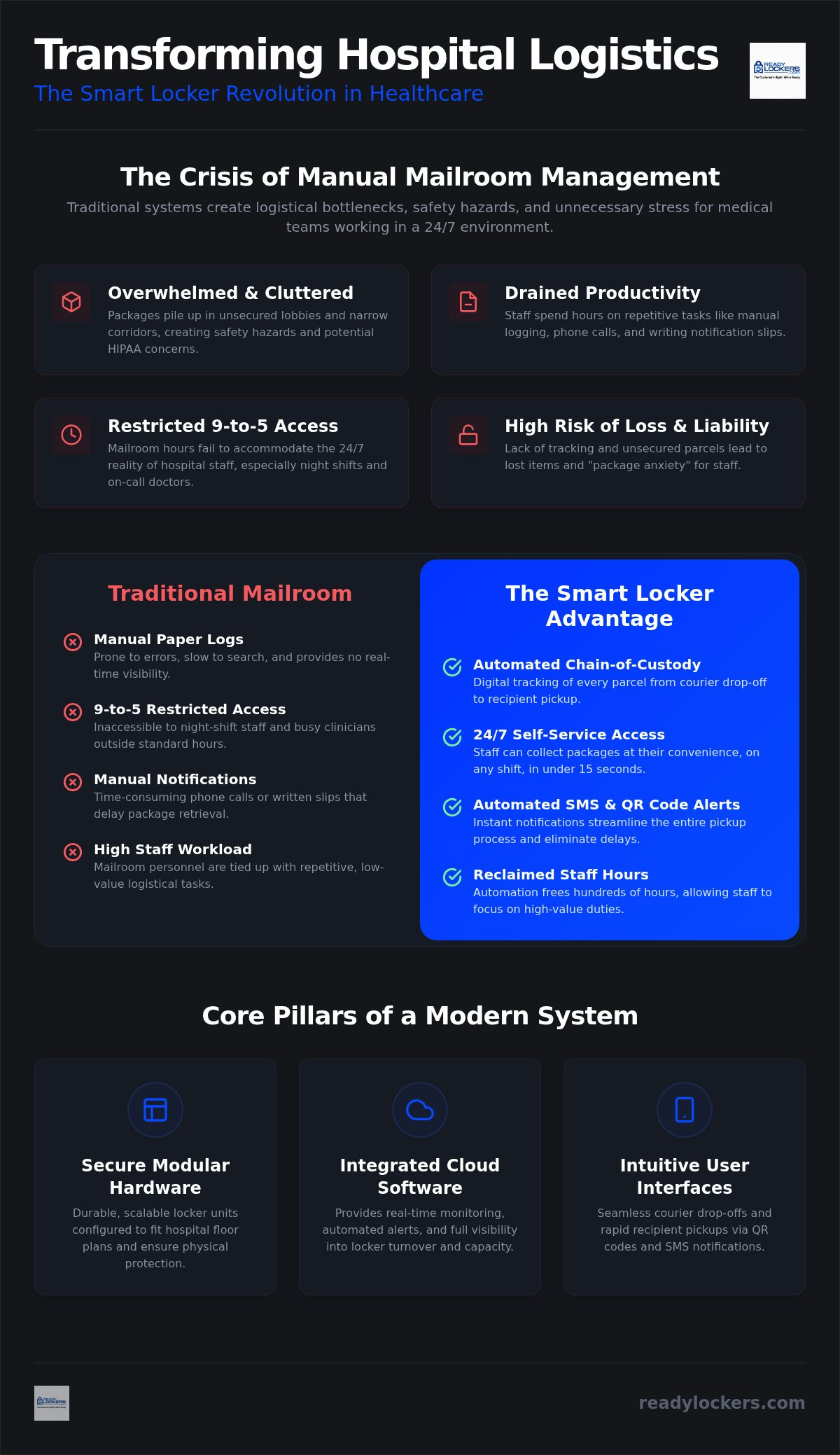
The rise of e-commerce has flooded hospital mailrooms with a volume of packages they weren't built to handle. When mailroom staff are overwhelmed, packages often pile up in unsecured lobbies or narrow corridors. This creates immediate safety hazards for both patients and staff. Unsecured parcels can also lead to HIPAA concerns if sensitive recipient information is exposed in public areas.
There's a significant hidden cost to manual management. Mailroom personnel often spend hours every week making phone calls or writing manual notification slips. These repetitive tasks drain hospital budgets and pull staff away from higher-value logistical duties. It's a drain on resources that modern automation effectively eliminates.
Key Components of a Modern System
A high-functioning system relies on three core pillars to ensure frictionless operation. First, secure modular locker units provide the physical protection necessary for a high-traffic environment. These units are built for durability and can be configured to fit specific hospital floor plans.
Second, integrated locker management software serves as the brain of the operation. This SaaS platform provides real-time monitoring and automated alerts, giving facility managers full visibility into locker turnover and capacity. Finally, intuitive courier and user interfaces allow for rapid drop-offs and seamless pickups. Using QR codes or SMS notifications, medical staff can collect their items in seconds. This allows them to return to patient care without the delay of waiting for mailroom windows to open.
Hospital Staff Package Pickup Solutions: The Smart Locker Advantage
A hospital mailroom management system is only as effective as its accessibility. While software can track a parcel to the building, the final hand-off to a nurse or surgeon is often where the process breaks down. Traditional mailrooms operate on a schedule that ignores the reality of healthcare; they are frequently closed when the night shift begins or when on-call doctors finally find a moment to breathe. Smart lockers solve this physical access problem by providing a secure, automated bridge between the mailroom and the medical professional.
This transition reduces "package anxiety," a common distraction where staff worry about the security of deliveries left in unsecured lobbies or open hallways. When clinicians know their items are protected, they can maintain their focus where it belongs: on patient care. In a competitive hiring market, providing these modern conveniences acts as a premium staff benefit. It demonstrates that the administration values the time and security of its workforce.
24/7 Accessibility for All Shifts
The logistical nightmare of a 9-to-5 mailroom is a significant hurdle for a 24-hour facility. Staff members shouldn't have to adjust their sleep schedules or stay late just to collect a delivery. Smart lockers offer self-service retrieval that fits into any shift. Most staff can scan a code and retrieve their items in under 15 seconds. This speed is essential in high-pressure environments where every minute matters.
Strategic placement is key to maximizing this efficiency. By installing modular units in staff-only areas, near locker rooms, or close to main exits, hospitals eliminate the need for long walks to a central mailroom. This decentralized approach ensures that the hospital mailroom management system serves the staff rather than forcing the staff to serve the system's limitations.
Contactless Retrieval and Safety
Maintaining a clean and organized environment is a non-negotiable requirement for healthcare facilities. Moving packages into secure kiosks immediately clears lobbies and corridors of clutter, which reduces trip hazards and maintains a professional appearance. It also eliminates the need for person-to-person contact during the pickup process, a vital consideration for infection control and staff safety.
Modern systems utilize QR codes sent directly to a staff member's smartphone. This technology removes the need for shared touchscreens or physical keys, which are difficult to sanitize and easy to lose. Implementing smart package lockers ensures your facility remains a leader in both care and employee satisfaction by providing a frictionless, secure, and hygienic pickup experience.
Optimizing Operations with Smart Locker Management Software
The hardware provides the security, but the software provides the intelligence. A modern hospital mailroom management system relies on cloud-based SaaS to bridge the gap between physical storage and digital tracking. This integration ensures that every delivery is logged, monitored, and completed without manual intervention. By centralizing these tasks, the platform acts as a digital nervous system for your facility's logistics.
Automated Notification Workflows
Manual notifications are a primary source of labor drain in healthcare logistics. When a courier uses the interface to deposit a parcel, the system generates an instant QR code. This notification is sent via SMS or email directly to the recipient. You can customize the frequency of these alerts to ensure that staff collect their items promptly. This automated loop eliminates the need for mailroom staff to manage spreadsheets or place phone calls. For a deeper look at these features, you can explore our guide on smart locker management software.
Usage Analytics and Capacity Planning
Facility managers often struggle with capacity because they lack visibility into locker turnover. High-efficiency software provides real-time analytics that track exactly how long packages remain in the system. By identifying peak delivery times, you can optimize your mailroom staffing levels and adjust your logistics strategy based on hard data.
Monitoring "stale" packages is equally important. If a parcel sits for more than 48 hours, the system alerts managers to intervene. This keeps the workflow moving and ensures that lockers remain available for new incoming deliveries. Data-driven capacity planning allows you to scale your modular units based on actual usage patterns rather than vague estimates.
Standardizing courier access minimizes the time external delivery personnel spend navigating your facility. A universal interface provides:
- Standardized drop-off protocols for all national and local carriers.
- Instant authentication to prevent unauthorized locker access.
- Reduced foot traffic in sensitive medical wards and staff-only areas.
Security remains the top priority. The cloud-based platform ensures that all data is encrypted and compliant with the hospital's digital ecosystem. Access logs provide a complete audit trail, identifying exactly who opened a locker and when. This transparency is essential for protecting the chain of custody within the hospital mailroom management system.
Scalable Hardware Specs for High-Volume Medical Facilities
While software manages the data, the physical hardware serves as the frontline of your hospital mailroom management system. High-volume medical centers require specialized infrastructure that can withstand constant use in high-traffic public or staff corridors. These units are constructed with heavy-duty materials designed to resist wear and tear, ensuring long-term reliability in demanding clinical environments. It's a standard of durability that standard office lockers simply can't match.
An effective hardware strategy relies on customizable configurations. Hospitals receive a diverse range of items, from small envelopes to large medical equipment components. By mixing small, medium, and large locker sizes within a single bank, facility managers can maximize space efficiency. Every unit requires dedicated power and a stable internet connection to maintain seamless cloud syncing. This ensures that status updates and notifications occur in real-time without lag.
Modular Design for Campus Integration
One of the greatest challenges in healthcare logistics is the evolving nature of the facility itself. Modular smart locker units allow for easy expansion as package volume grows or as new wings are added to the campus. This flexibility ensures that your initial investment remains viable for years. You can start with a core set of lockers and add additional columns as staff adoption increases. For details on planning your layout, see our guide on smart locker installation services.
Multi-building campuses often require a mix of indoor and outdoor hardware. Indoor units are ideal for staff breakrooms or main lobbies, while weather-resistant outdoor kiosks can be placed near parking structures or secondary entrances. This decentralized approach reduces the travel time for staff members, allowing them to retrieve items closer to their specific work area. It's a simple way to give time back to your medical teams.
Courier Access and Interface Reliability
The universal courier interface is designed to simplify the drop-off process for all major carriers, including UPS, FedEx, and DHL. A single, intuitive touchpoint allows delivery personnel to authenticate their identity and deposit parcels in seconds. This speed is critical for couriers who are on tight schedules and helps prevent delivery bottlenecks at your loading docks or reception desks.
System reliability is non-negotiable in a 24-hour environment. The digital locker management platform is engineered for 99.9% uptime, ensuring that staff can always access their property. Beyond digital stability, physical security features like anti-pry doors and integrated sensors prevent unauthorized access or tampering. If you're ready to upgrade your facility's infrastructure, you can view our smart package lockers to find the right fit for your floor plan.
Implementing ReadyLockers: A Modern Efficiency Framework
Choosing the right partner for your facility's logistics is a strategic decision that impacts every department. ReadyLockers stands as the definitive choice for hospital logistics managers because it bridges the gap between hardware durability and software intelligence. Implementing this hospital mailroom management system allows your administration to reclaim hundreds of labor hours previously lost to manual package handling. It's a proactive shift that turns a chaotic mailroom into a streamlined, self-service utility.
The return on investment is immediate and measurable. By reducing the need for dedicated mailroom staff to manage personal deliveries, you can reallocate resources to clinical support roles. This automation also eliminates the physical clutter that often leads to workplace safety violations. You aren't just buying lockers; you're installing a permanent solution to a growing logistical burden.
Reducing Liability and Lost Items
Unsecured packages in a hospital lobby represent a significant liability. ReadyLockers mitigates this risk by establishing a rigorous digital chain of custody. Every transaction requires a digital signature or a unique QR code scan, and the system captures photo proof of pickup for every item. This level of transparency protects both the recipient and the facility management team from claims of lost or stolen property.
Security teams and property managers benefit from a significantly lower liability burden. When every parcel is housed within a secure, monitored kiosk, the risk of theft is virtually eliminated. For a deeper dive into the technical specifications and security protocols available, you should review our smart package lockers 2026 buyers guide. This resource helps you understand how physical protection and digital tracking work in tandem.
The ReadyLockers Implementation Process
Transitioning from a manual mailroom to an automated system is a methodical process. It begins with a comprehensive site assessment where our experts analyze your floor plan and staff traffic patterns. We then coordinate a professional installation that minimizes disruption to your daily operations. Our team ensures the SaaS platform integrates seamlessly with your existing hospital directories, making staff onboarding instant and frictionless.
The final phase involves staff training and system optimization. We provide your facility directors with the tools they need to monitor usage analytics and scale the system as demand grows. Ready to see the platform in action? Request a demo of our hospital staff package pickup solutions to discover how we can customize a configuration for your specific medical campus.
Modernizing Hospital Logistics for a 24/7 Workforce
The evolution of healthcare logistics demands a shift from manual oversight to automated precision. By implementing a high-efficiency hospital mailroom management system, your facility can eliminate the friction of package retrieval while protecting the chain of custody for every parcel. Modular smart lockers provide a scalable answer to increasing delivery volumes, ensuring that your infrastructure grows alongside your medical campus without requiring additional square footage.
Integrating this technology offers immediate benefits for your team. You provide 24/7 staff accessibility that honors the schedules of night-shift and on-call professionals. Contactless QR code pickup ensures a hygienic, secure experience that keeps medical staff focused on patient outcomes rather than mailroom hours. This modern efficiency framework reduces liability and reclaims valuable labor hours for your administration, creating a safer and more organized environment.
It's time to replace logistical bottlenecks with a reliable, tech-driven utility. Secure your hospital's logistics with ReadyLockers today to experience a frictionless delivery environment. Building a more efficient workplace starts with the right tools.
Frequently Asked Questions
How do smart lockers improve hospital staff productivity?
Smart lockers eliminate the need for medical staff to visit the mailroom during restricted business hours. Nurses and doctors can retrieve their items in under 15 seconds at any time of day, which prevents shift disruptions. By automating notifications and pickups, the system reduces "package anxiety" and allows clinicians to maintain their focus on patient care. It also saves mailroom personnel hours previously spent on manual logging and phone calls.
Can a hospital mailroom system handle high-volume deliveries from multiple couriers?
Yes, the universal courier interface is designed specifically for high-volume environments. It provides a standardized drop-off protocol for UPS, FedEx, DHL, and local delivery services. This prevents bottlenecks at loading docks and reception desks. The hospital mailroom management system tracks every parcel from entry to exit, ensuring that even during peak delivery windows, the workflow remains organized, secure, and entirely frictionless.
Are smart lockers secure enough for sensitive medical documents or equipment?
Smart lockers provide high-level physical and digital security for valuable assets. Every locker is constructed with heavy-duty materials and features anti-pry doors to prevent tampering. Digitally, the system creates a full audit trail with photo proof of pickup and digital signatures. This ensures a secure chain of custody for medical equipment and administrative documents. While they don't replace specialized pharmaceutical storage, they are ideal for non-refrigerated clinical supplies.
What happens if a staff member loses their QR code for pickup?
The system is designed for rapid recovery without compromising security. Staff members can request a new code through the locker management software interface or via their initial notification link. Administrators also have the ability to verify identities and manually trigger locker doors if necessary. Because the platform syncs in real-time, any lost or expired codes are immediately deactivated once a replacement is issued, maintaining the integrity of the pickup process.
How much space is required for a hospital smart locker installation?
The required space depends on your specific package volume and available floor plan. Because the hardware is modular, units can be configured in various shapes to fit into existing corridors, lobbies, or staff lounges. A standard starter bank typically requires a small footprint of about 6 to 10 linear feet. Our team conducts site assessments to ensure the layout maximizes storage capacity without obstructing patient transport or emergency movement.
Is the locker management software HIPAA compliant?
The platform is built with data security as the primary priority. While the lockers themselves are for physical parcel storage, the cloud-based SaaS platform utilizes industry-standard encryption for all recipient data. It doesn't store sensitive patient health information, focusing instead on logistical tracking for staff. We recommend reviewing your specific internal data protocols to ensure the system integrates securely with your hospital's existing digital ecosystem and privacy requirements.
Can we track personal packages separately from professional hospital deliveries?
Yes, the software allows for clear categorization of all incoming parcels. Administrators can use the management interface to distinguish between professional medical supplies and personal staff deliveries. This transparency helps facility managers monitor usage patterns and ensures that high-priority items are processed quickly. It also helps the hospital maintain clear boundaries for liability and insurance purposes regarding the storage of personal property on the medical campus.
What is the typical ROI for an automated hospital mailroom system?
The ROI is generated through significant labor savings and a reduction in package liability. By automating notifications and pickups, hospitals often reclaim hundreds of hours of mailroom labor per year. Additionally, the digital chain of custody reduces the cost associated with lost or stolen items. over time, the hospital mailroom management system pays for itself by streamlining logistics and allowing staff to return to patient-facing duties much faster.

Frequently Asked Questions
How do smart lockers improve hospital staff productivity?+
Smart lockers eliminate the need for medical staff to visit the mailroom during restricted business hours. Nurses and doctors can retrieve their items in under 15 seconds at any time of day, which prevents shift disruptions. By automating notifications and pickups, the system reduces "package anxiety" and allows clinicians to maintain their focus on patient care. It also saves mailroom personnel hours previously spent on manual logging and phone calls.
Can a hospital mailroom system handle high-volume deliveries from multiple couriers?+
Yes, the universal courier interface is designed specifically for high-volume environments. It provides a standardized drop-off protocol for UPS, FedEx, DHL, and local delivery services. This prevents bottlenecks at loading docks and reception desks. The hospital mailroom management system tracks every parcel from entry to exit, ensuring that even during peak delivery windows, the workflow remains organized, secure, and entirely frictionless.
Are smart lockers secure enough for sensitive medical documents or equipment?+
Smart lockers provide high-level physical and digital security for valuable assets. Every locker is constructed with heavy-duty materials and features anti-pry doors to prevent tampering. Digitally, the system creates a full audit trail with photo proof of pickup and digital signatures. This ensures a secure chain of custody for medical equipment and administrative documents. While they don't replace specialized pharmaceutical storage, they are ideal for non-refrigerated clinical supplies.
What happens if a staff member loses their QR code for pickup?+
The system is designed for rapid recovery without compromising security. Staff members can request a new code through the locker management software interface or via their initial notification link. Administrators also have the ability to verify identities and manually trigger locker doors if necessary. Because the platform syncs in real-time, any lost or expired codes are immediately deactivated once a replacement is issued, maintaining the integrity of the pickup process.
How much space is required for a hospital smart locker installation?+
The required space depends on your specific package volume and available floor plan. Because the hardware is modular, units can be configured in various shapes to fit into existing corridors, lobbies, or staff lounges. A standard starter bank typically requires a small footprint of about 6 to 10 linear feet. Our team conducts site assessments to ensure the layout maximizes storage capacity without obstructing patient transport or emergency movement.
Is the locker management software HIPAA compliant?+
The platform is built with data security as the primary priority. While the lockers themselves are for physical parcel storage, the cloud-based SaaS platform utilizes industry-standard encryption for all recipient data. It doesn't store sensitive patient health information, focusing instead on logistical tracking for staff. We recommend reviewing your specific internal data protocols to ensure the system integrates securely with your hospital's existing digital ecosystem and privacy requirements.
Can we track personal packages separately from professional hospital deliveries?+
Yes, the software allows for clear categorization of all incoming parcels. Administrators can use the management interface to distinguish between professional medical supplies and personal staff deliveries. This transparency helps facility managers monitor usage patterns and ensures that high-priority items are processed quickly. It also helps the hospital maintain clear boundaries for liability and insurance purposes regarding the storage of personal property on the medical campus.
What is the typical ROI for an automated hospital mailroom system?+
The ROI is generated through significant labor savings and a reduction in package liability. By automating notifications and pickups, hospitals often reclaim hundreds of hours of mailroom labor per year. Additionally, the digital chain of custody reduces the cost associated with lost or stolen items. over time, the hospital mailroom management system pays for itself by streamlining logistics and allowing staff to return to patient-facing duties much faster.