Student Housing Parcel Management: A 2026 Operations Guide
Master student housing parcel management in 2026. Streamline package delivery, cut staff workload, and improve student pickup with smart lockers and data.

What if student package pickup didn’t depend on a crowded mailroom or an open front desk? Student housing parcel management works best when each handoff, from courier delivery to student collection, follows a clear process. When packages pile up, staff spend more time sorting and storing them, while students may miss notifications or find it difficult to collect deliveries around office hours.
Adding storage alone won’t solve those challenges. Housing teams need a coordinated workflow that helps couriers make secure deliveries, gives students clear pickup instructions, and makes parcel status easier to review. A well-planned process can reduce manual handling while keeping security and visibility central.
This guide explains how to build that process around campus operations. You’ll learn how smart lockers, courier access, SMS or QR code notifications, and usage analytics can support delivery and pickup. It also covers how to plan locker layouts around different buildings and package volumes. The goal is a reliable student experience and a manageable workload for housing staff.
Key Takeaways
- Map delivery patterns and package sizes before planning locker capacity or placement.
- Define each handoff, from courier delivery through student pickup, to make parcel status easier to follow.
- Compare staffed package rooms and lockers by staffing needs, access, visibility, space, and exception handling.
- Student housing parcel management works best when access rules and staff responsibilities match campus operations.
- Use operational data to review performance and identify where the process needs adjustment.
Why student housing parcel management needs a defined process
Packages pass through several hands and spaces before students collect them. A courier arrives, staff receive and sort deliveries, parcels are stored, recipients are notified, and pickup is recorded. If any handoff is unclear, staff may have to retrace their steps while students wait or make repeated trips. A defined student housing parcel management process keeps each stage visible, secure, and manageable.
Campus demand also changes with the academic calendar. Move-in periods and the start of term can bring a wave of deliveries, while holidays and breaks may shift staffing and pickup patterns. A process designed only for an ordinary day can leave teams without clear procedures for busy periods, full storage areas, or reduced staffing. Plan for routine delivery flow as well as predictable peaks.
Where the student package process breaks down
Problems can start when courier access procedures are unclear or deliveries are left without a reliable record. Sorting creates another opportunity for mistakes: a parcel may go to the wrong storage area, or staff may not know which recipient to notify. Collection is also harder to verify when the final handoff depends on memory or an informal log.
Routine deliveries follow a predictable path, but exceptions need their own instructions. These include parcels with unclear recipient details, items that don’t fit available storage, and periods when storage is full. Staff-only pickup hours can also conflict with lectures, labs, work, and other student commitments. A clear process explains what to do in each situation instead of leaving decisions to whoever is on duty.
What students and housing teams need from parcel management
Students need a clear notice that a parcel is ready, simple pickup instructions, and a collection process that fits their schedules. Housing teams need fewer manual handoffs, useful parcel status records, secure storage, and a manageable way to resolve exceptions. These needs apply whether deliveries are handled in a staffed room, with lockers, or through a combination of both.
A parcel locker is a self-service option: parcels are placed in secure compartments for recipients to collect. But storage hardware alone doesn’t make an operation successful. Set responsibilities for courier arrival, deposit, notification, pickup, and exceptions, then choose tools that support each step. A well-run process lets staff trace a delivery through to collection and helps students know what to do and where to go.
How student housing parcel management works from delivery to pickup
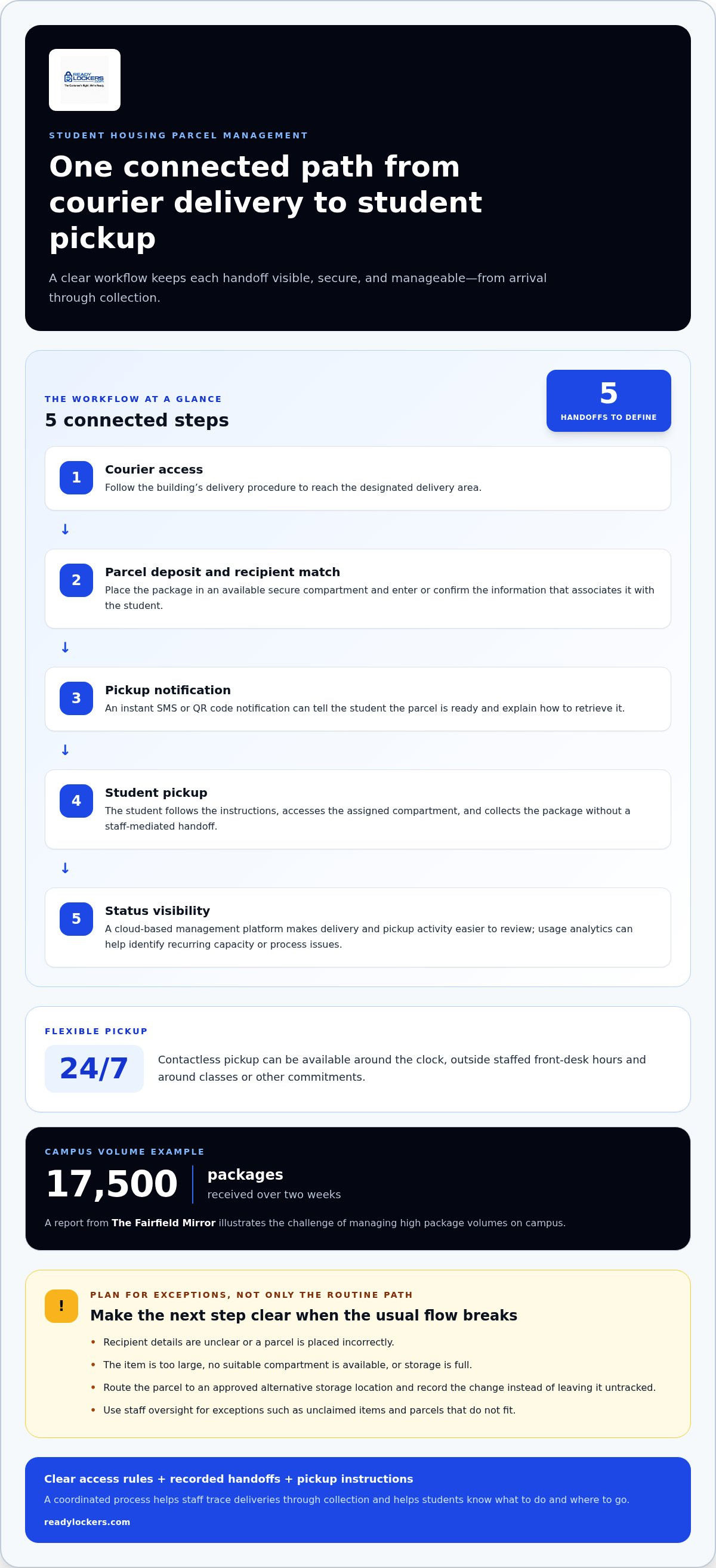
A reliable parcel workflow connects five steps: courier access, parcel deposit, recipient notification, student pickup, and status visibility. Give each step a clear owner or system action. That way, routine deliveries can move forward without staff having to coordinate every handoff manually.
In a locker-based workflow, a courier uses controlled access to place a package in a secure compartment. The intended recipient receives pickup details, and activity is recorded through collection. This approach connects delivery and pickup in one process.
What happens when a courier delivers a package
The courier follows the building’s delivery procedure to reach the designated delivery area. After identifying the recipient, the courier places the parcel in an available compartment and enters or confirms the information needed to associate it with that student. The compartment holds the parcel securely until pickup.
Exception procedures matter as much as the routine path. If a parcel is placed incorrectly, recipient details are unclear, the item is too large, or no suitable compartment is available, staff need a defined way to handle it. For example, they can route the item to an approved alternative storage location and record the change instead of leaving it somewhere untracked.
Volume can test even a well-designed process. A report from The Fairfield Mirror illustrates the challenges of managing high package volumes on a campus, including 17,500 packages received over two weeks. Defined access, placement, and overflow procedures help teams respond consistently when deliveries surge.
How students receive and collect their packages
After a parcel is deposited and associated with its recipient, an instant SMS or QR code notification can tell the student it’s ready and explain how to retrieve it. At pickup, the student follows the instructions to access the assigned compartment and collect the package without a staff-mediated handoff. Contactless pickup can be available 24/7, so students can collect parcels outside staffed front-desk hours and around classes or other commitments.
The workflow still needs staff oversight. A cloud-based management platform makes delivery and pickup activity easier to review, while usage analytics can help housing teams spot recurring capacity or process issues. Staff can focus on exceptions, such as unclaimed items or parcels that don’t fit, rather than manually coordinating every standard delivery.
For housing teams mapping this process, ReadyLockers parcel management connects courier access, recipient notifications, and contactless pickup in a coordinated workflow.
Staffed package rooms vs. locker-based student parcel management
Staffed package rooms and parcel lockers organize deliveries differently. A staffed room gives team members direct control over intake and handoff, while lockers let students collect routine deliveries themselves. Student housing parcel management doesn’t require the same approach for every parcel. Choose a setup based on delivery volume, staff capacity, building space, and the exceptions the housing team needs to handle.
| Consideration | Staffed package room | Locker-based process |
|---|---|---|
| Staffing | Staff receive, sort, and release parcels. | Staff oversee the process and resolve exceptions; routine deposit and collection can be self-service. |
| Pickup access | Usually tied to room procedures and staffed hours. | Contactless pickup can be available 24/7, supporting varied student schedules. |
| Visibility | Depends on consistent logs and handoff records. | Management software can record activity and help staff review parcel status. |
| Space | Uses room space, which can accommodate parcels that don’t fit compartments. | Uses configured compartments; capacity and parcel size need to be planned. |
| Exceptions | Staff can directly assess unusual deliveries and assist recipients. | Staff need a clear route for oversized, unidentified, or unplaced parcels. |
When a staffed package room may be the better fit
A staffed room can work well when parcel volume is manageable and an established team already handles intake and collection. Direct support is useful for unusual deliveries, parcels needing special handling, or students who need help locating an item. A consistent tracking process still matters: recording receipt, storage location, and release makes handoffs easier to review, even when staff manage each one.
When parcel lockers can reduce routine handling
Lockers can move standard storage and collection out of repeated front-desk interactions. A courier uses the designated access process to deposit a parcel, the student receives a pickup notification, and the student collects it independently. SMS or QR code instructions clarify the handoff, while 24/7 pickup access can suit schedules that don’t align with staffed hours.
Automation doesn’t remove staff oversight; it changes where staff attention is most useful. Define who manages courier access, how parcels are assigned, and what happens when compartments are full or an item won’t fit. With clear responsibilities and exception procedures, routine deliveries can follow a consistent self-service process while staff focus on cases that need a decision or personal assistance.
How to plan student housing parcel management for campus operations
Build the process around how packages actually move through each building. Before deciding on locker capacity or placement, account for delivery patterns, parcel sizes, courier routes, student traffic, and staff responsibilities. A setup that works in a residence hall may not suit a central mailroom or a building with limited delivery access.
Use this planning sequence to connect operational needs with the right setup:
- Map volume: Review delivery patterns during ordinary weeks, move-in, term starts, holidays, and other campus peaks. Note when volume rises and how long parcels typically occupy storage.
- Define the workflow: Specify who handles courier arrival, parcel acceptance, recipient notification, pickup, and exceptions.
- Plan space: Assess the package-size mix and available building space before determining locker configuration. Consider courier access, student foot traffic, visibility, and clear circulation around the pickup area.
- Configure access: Establish distinct access roles for couriers, recipients, and authorized housing staff.
- Review results: Use available activity records and usage analytics to identify capacity issues, pickup patterns, and process bottlenecks.
Plan capacity, placement, and access
Look beyond average delivery volume. A building may handle a steady flow of everyday parcels as well as concentrated peaks around move-in or the start of term. Assess package dimensions as well as counts. A compartment layout should reflect the mix of items staff actually receive, and a clear overflow route can help manage parcels that don’t fit.
Placement affects every handoff. Consider how couriers reach the delivery point, whether students can find it easily, and how pickup traffic interacts with entrances and shared spaces. Configurable locker layouts can be tailored to different building footprints and parcel volumes. For broader context on how property needs can vary, see this guide to multi-family parcel locker systems.
Set operating rules and measure the workflow
Document what happens from acceptance to collection, including how staff handle unclear recipient details, full capacity, oversized parcels, and other exceptions. Define who can access each part of the process and how changes in parcel status are recorded. Clear roles make automation easier to operate because routine tasks and staff interventions have distinct paths.
Review platform activity regularly. Usage analytics can help teams see when lockers are occupied, how collection patterns change, and where parcels or handoffs create delays. For more on the operational role of digital tools, read the smart locker management software guide. To put the plan into practice, see how configurable parcel locker systems can support campus building needs.
Streamline student parcel pickup with ReadyLockers
Student housing parcel management depends on more than secure storage. Housing teams need a connected process that guides a parcel from courier access to student pickup, while keeping routine activity visible and exceptions manageable. ReadyLockers provides configurable smart package lockers and cloud-based management software to support that workflow.
What a managed locker workflow can support
Courier access management helps organize how deliveries reach the lockers. Once a parcel is placed for its intended recipient, an instant SMS or QR code notification can tell the student it’s ready and provide pickup instructions. The student can then collect it through contactless access, without coordinating a routine handoff at the front desk.
Pickup is available 24/7, giving students more flexibility around classes, work, and other commitments. For housing staff, platform records and usage analytics offer a way to review delivery and pickup activity, identify recurring congestion, and see where a process may need adjustment. Analytics inform operational decisions; they don’t guarantee a particular staffing or cost reduction.
Move from parcel challenges to a workable system
Each residence hall, mailroom, or shared campus facility has its own layout and delivery patterns. ReadyLockers’ configurable locker layouts can be tailored to building space and parcel volume, helping teams plan placement around courier access, student movement, and the package sizes they commonly receive. A considered configuration supports secure handoffs and convenient collection without assuming that every building operates the same way.
The aim is a process students can follow and staff can oversee: couriers have a defined access path, recipients receive clear pickup information, and housing teams can review activity and manage exceptions. This combination supports visibility and convenience while keeping staff involved where judgment or assistance is needed.
See how ReadyLockers parcel management can support a configuration matched to your property and delivery workflow.
Build a parcel process that works across campus
Reliable student housing parcel management depends on a complete workflow, not storage alone. Clear steps for courier access, parcel deposit, student notification, pickup, and exceptions help teams maintain visibility from delivery through collection. Planning for package volume, parcel sizes, and each building’s layout makes the process more adaptable to everyday operations and busy campus periods.
ReadyLockers combines configurable smart locker layouts with cloud-based management, courier access controls, SMS or QR code notifications, and usage analytics. Students can collect parcels through contactless pickup 24/7, while housing teams can review activity and address exceptions. These tools support a coordinated process while retaining the staff oversight campus operations need.
Explore a ReadyLockers locker configuration designed around your property and delivery workflow. Explore ReadyLockers parcel management.
Frequently Asked Questions
How does parcel management work in student housing?
Student housing parcel management coordinates courier access, parcel deposit, student notification, pickup, and status records. A courier follows the building’s delivery process and places an item in designated secure storage. The recipient receives pickup instructions, often by SMS or QR code. Staff can review activity and handle exceptions such as unclear recipient details, oversized parcels, or full storage. Defining each handoff keeps routine deliveries traceable from arrival through collection.
What is the best way to manage packages in a dorm or student apartment?
A strong approach combines a clear delivery process, secure storage, timely notifications, and a defined plan for exceptions. First, assess delivery patterns and package sizes, including busy periods such as move-in. Then set courier and staff responsibilities, decide how students will be notified, and make pickup instructions easy to follow. Smart lockers can support routine self-service collection, while staff handle parcels that need extra attention.
Can students pick up packages from lockers after the front desk closes?
Yes. A locker system that supports 24/7 pickup lets students collect parcels after the front desk closes. Once a courier deposits a package and it’s assigned to the recipient, the student follows the pickup instructions to access the compartment. Contactless collection can fit around classes, work, and other commitments. Housing teams should communicate where lockers are located and how students can retrieve their items.
How do parcel lockers notify students that a delivery has arrived?
Parcel locker systems can send an instant SMS or QR code notification after a courier deposits a package and records its recipient. The message tells the student the parcel is ready and provides pickup information. A clear notice should identify the collection location and explain the next step. This direct handoff helps students act without waiting for a separate front-desk update and gives staff a record to review.
What happens if a student package is too large for a locker?
A parcel that doesn’t fit a compartment needs a defined alternative, such as storage in an approved staffed area under the housing team’s process. The courier or staff member should record where the item was placed and how the recipient will be notified. Planning for oversized parcels before selecting locker layouts helps avoid untracked overflow. Teams should also set procedures for full capacity and unclear recipient details.
Do student housing parcel lockers reduce work for front-desk staff?
Lockers can reduce repetitive coordination for routine parcels by allowing couriers to deposit items and students to collect them through self-service pickup. Notifications and parcel activity records can also make handoffs easier to track. Lockers don’t eliminate staff oversight: housing teams still need to manage exceptions, monitor the process, and assist when a parcel is oversized, unclaimed, or incorrectly placed. The impact depends on how well the workflow fits the property.
How should a campus choose where to place parcel lockers?
Choose a location by considering the courier’s approach, student foot traffic, visibility, and the space needed for safe, convenient circulation. The pickup point should be easy for residents to find without disrupting entrances or shared areas. Review delivery patterns and package-size mix first, then match locker capacity and layout to each building. Clear access for couriers, students, and authorized staff helps the location support the full delivery-to-pickup process.

Frequently Asked Questions
How does parcel management work in student housing?+
Student housing parcel management coordinates courier access, parcel deposit, student notification, pickup, and status records. A courier follows the building’s delivery process and places an item in designated secure storage. The recipient receives pickup instructions, often by SMS or QR code. Staff can review activity and handle exceptions such as unclear recipient details, oversized parcels, or full storage. Defining each handoff keeps routine deliveries traceable from arrival through collection.
What is the best way to manage packages in a dorm or student apartment?+
A strong approach combines a clear delivery process, secure storage, timely notifications, and a defined plan for exceptions. First, assess delivery patterns and package sizes, including busy periods such as move-in. Then set courier and staff responsibilities, decide how students will be notified, and make pickup instructions easy to follow. Smart lockers can support routine self-service collection, while staff handle parcels that need extra attention.
Can students pick up packages from lockers after the front desk closes?+
Yes. A locker system that supports 24/7 pickup lets students collect parcels after the front desk closes. Once a courier deposits a package and it’s assigned to the recipient, the student follows the pickup instructions to access the compartment. Contactless collection can fit around classes, work, and other commitments. Housing teams should communicate where lockers are located and how students can retrieve their items.
How do parcel lockers notify students that a delivery has arrived?+
Parcel locker systems can send an instant SMS or QR code notification after a courier deposits a package and records its recipient. The message tells the student the parcel is ready and provides pickup information. A clear notice should identify the collection location and explain the next step. This direct handoff helps students act without waiting for a separate front-desk update and gives staff a record to review.
What happens if a student package is too large for a locker?+
A parcel that doesn’t fit a compartment needs a defined alternative, such as storage in an approved staffed area under the housing team’s process. The courier or staff member should record where the item was placed and how the recipient will be notified. Planning for oversized parcels before selecting locker layouts helps avoid untracked overflow. Teams should also set procedures for full capacity and unclear recipient details.
Do student housing parcel lockers reduce work for front-desk staff?+
Lockers can reduce repetitive coordination for routine parcels by allowing couriers to deposit items and students to collect them through self-service pickup. Notifications and parcel activity records can also make handoffs easier to track. Lockers don’t eliminate staff oversight: housing teams still need to manage exceptions, monitor the process, and assist when a parcel is oversized, unclaimed, or incorrectly placed. The impact depends on how well the workflow fits the property.
How should a campus choose where to place parcel lockers?+
Choose a location by considering the courier’s approach, student foot traffic, visibility, and the space needed for safe, convenient circulation. The pickup point should be easy for residents to find without disrupting entrances or shared areas. Review delivery patterns and package-size mix first, then match locker capacity and layout to each building. Clear access for couriers, students, and authorized staff helps the location support the full delivery-to-pickup process.