2026 Efficiency Guide: Government Package Lockers
Enhance facility security with our 2026 guide to secure package lockers for government buildings. Learn to automate logistics, meet ADA standards, and save s...

What if your facility's most persistent security gap isn't a cyber threat, but the unverified delivery personnel currently standing deep in your lobby? For public agencies, the constant influx of packages creates more than just physical clutter. It introduces significant risks to building integrity and consumes valuable staff time through manual logging. Implementing secure package lockers for government buildings isn't just about storage; it's a strategic move toward modernizing facility logistics and protecting the perimeter.
You likely recognize that the traditional mailroom model is no longer sustainable in a high-security environment. This 2026 guide demonstrates how smart locker technology eliminates lobby congestion and automates the chain of custody for sensitive assets. We'll explore the latest NIST cybersecurity guidelines, the April 2026 ADA digital interface requirements, and the specific ways cloud-based management software provides real-time visibility. By the end of this article, you'll understand how to replace manual processes with a frictionless, self-service system that enhances both security and accessibility for every department.
Key Takeaways
- Eliminate lobby congestion and unauthorized personnel entry by centralizing all deliveries into a single, software-controlled logistics hub.
- Secure the chain of custody for sensitive documents and IT assets with automated tracking and real-time usage analytics.
- Ensure full compliance when installing secure package lockers for government buildings by following the latest 2026 ADA and digital accessibility standards.
- Transition from manual mailroom logging to a frictionless, 24/7 contactless pickup system that saves hours of staff time each week.
- Leverage cloud-based SaaS platforms to maintain remote oversight and provide secure SMS or QR code notifications for every transaction.
Modernizing Public Facility Logistics with Smart Lockers
Modern public buildings face a logistical crisis. The volume of incoming parcels has outpaced the capacity of traditional mailrooms. Smart lockers serve as secure, software-controlled logistics hubs that solve this challenge. They replace manual logging with an automated, self-service retrieval process. This shift allows staff to focus on mission-critical tasks while ensuring that every item is accounted for from the moment it enters the facility. By utilizing Parcel locker technology, agencies can transition from a reactive delivery model to a proactive, streamlined operation.
The Problem with Manual Package Management
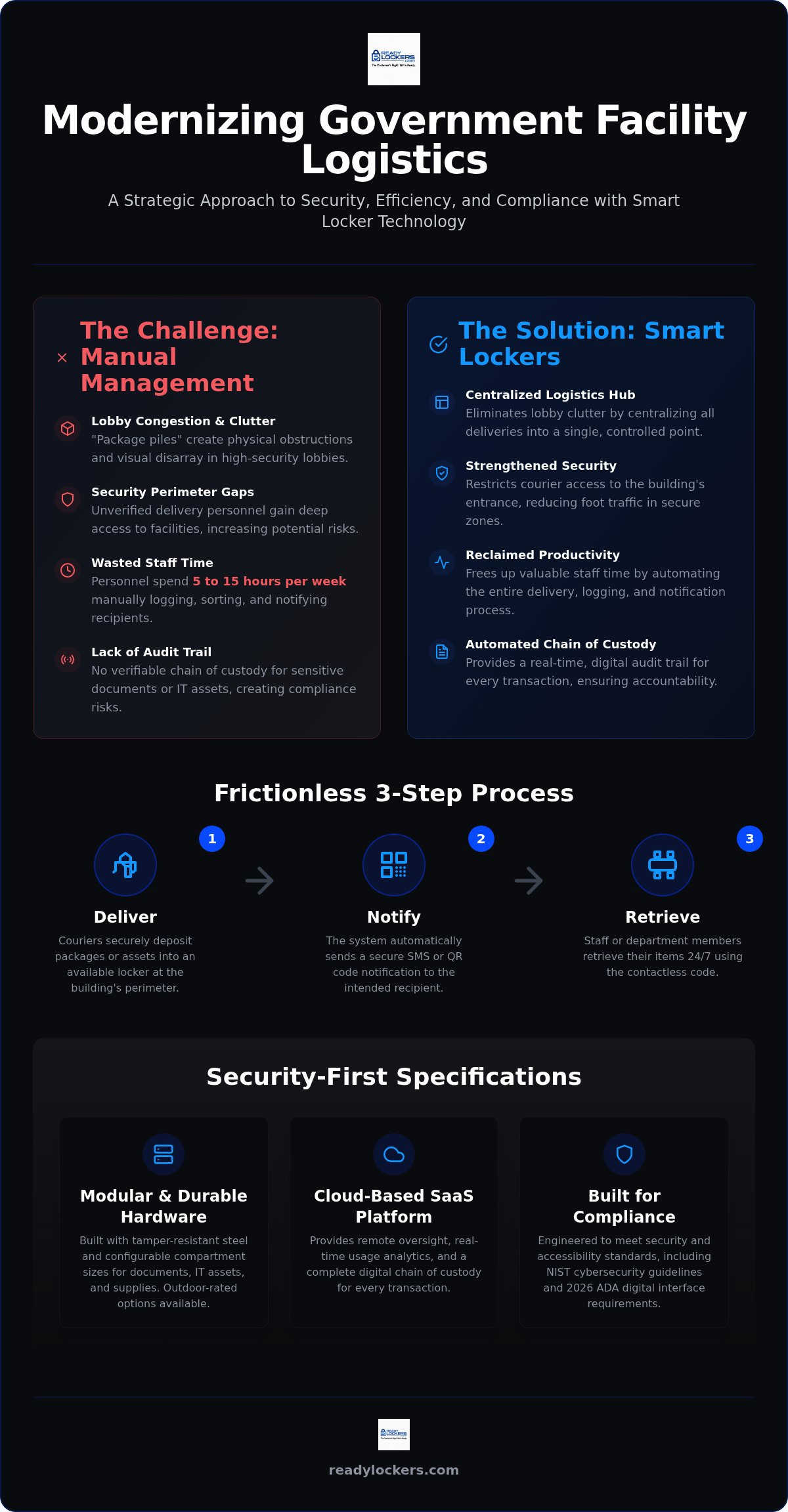
Manual management is inherently inefficient and carries hidden risks. "Package piles" in high-security lobbies create physical obstructions and visual clutter. They also present a security vulnerability because unverified items sit in public areas for extended periods. Traditional drop-boxes fail to solve this because they don't provide a verifiable chain of custody or digital audit trail. When administrative staff act as de facto mail clerks, the agency loses significant productivity. Industry data indicates that managing parcels manually can consume 5 to 15 hours of staff time per week. These hidden costs mount quickly as personnel spend their day sorting, logging, and notifying recipients instead of performing their primary duties.
Smart Lockers as a Security Perimeter
Building security relies on controlling who enters sensitive zones. Installing secure package lockers for government buildings creates a vital security buffer. By placing these systems in the lobby or a designated perimeter zone, agencies limit courier access to the entrance. This reduces foot traffic from unverified personnel in deep-office areas. Contactless delivery technology ensures that couriers can drop off items without interacting with staff or entering the building's interior. It's a frictionless process that maintains a strict separation between public-facing delivery points and private government operations. This setup provides peace of mind for security teams and a professional experience for visitors.
Modern work environments also demand flexibility. With staggered shifts and hybrid schedules, employees often need to retrieve items outside of standard office hours. Smart lockers provide 24/7 access, allowing staff to pick up equipment or documents whenever they are on-site. The system remains active and secure at all times, providing a consistent service level regardless of the hour. This transition to a universal logistics platform ensures that government buildings operate with the same efficiency as a modern tech enterprise, maintaining security without sacrificing convenience.
Security-First Hardware and Software Specifications
Government agencies require infrastructure that withstands high-traffic use while maintaining absolute data integrity. Smart locker systems for public facilities aren't just storage cabinets; they're sophisticated security nodes. These units are built with tamper-resistant materials and heavy-duty steel to ensure long-term durability in demanding environments. By integrating these systems, agencies can better align with federal mail security requirements, ensuring that every parcel is protected from drop-off to pickup. This hardware is designed to integrate with existing access control systems, creating a unified security posture across the entire building.
Modular Hardware for Diverse Building Layouts
One size doesn't fit every agency. Modular configurations allow for precise tailoring, whether for a small local field office or a massive federal center. Managers can specify a mix of compartment sizes to handle a wide range of agency needs, including:
- Standard legal envelopes and sensitive document folders
- Small electronic devices and peripherals
- Oversized IT equipment like monitors or laptops
- Bulk office supplies and maintenance parts
For facilities with limited interior space, outdoor-rated lockers provide a weather-resistant solution that maintains functionality in extreme temperatures and high-humidity environments. This flexibility ensures that secure package lockers for government buildings integrate seamlessly into any architectural plan. The modularity also means the system can grow alongside the agency, adding new columns as delivery volumes increase over time.
SaaS Platform and Digital Chain of Custody
The intelligence behind the hardware lies in its digital interface. Utilizing advanced smart locker management software provides administrators with a real-time audit trail for every transaction. This cloud-based approach allows for remote updates and constant oversight without the need for on-site IT intervention. It simplifies the management of multiple locations through a single dashboard, providing a bird's-eye view of locker occupancy and system health.
Recipients receive encrypted notifications via SMS or email, containing a unique QR code for contactless access. This method ensures that only the intended recipient can open the specific compartment, creating a verifiable chain of custody that manual logs can't replicate. To maintain high security, the platform aligns with the June 2026 NIST SP 800-213 cybersecurity guidelines for connected devices. This digital layer protects sensitive recipient information while providing the usage analytics necessary for long-term facility planning. If you're looking to upgrade your building's logistics, exploring a contactless pickup system can provide the necessary foundation for automated asset management and improved employee satisfaction.
Beyond Mail: Asset Management and Chain of Custody
The utility of smart lockers extends far beyond simple parcel delivery. For public agencies, these systems function as high-security exchange points for internal assets and sensitive documentation. By implementing secure package lockers for government buildings, facility managers can establish a closed-loop system for items that never leave the premises. This approach aligns with federal mail management best practices by ensuring that every movement of an asset is recorded, time-stamped, and attributed to a specific user. It eliminates the ambiguity of manual signatures and provides 100% traceability for high-value items.
IT Equipment and Device Management
The shift toward hybrid and mobile government work has complicated the distribution of IT hardware. Issuing laptops, tablets, and specialized peripherals often requires coordinated meetings that disrupt schedules. Smart lockers automate this workflow. IT departments can deposit configured hardware into a secure compartment and send a digital credential to the employee for 24/7 pickup. This same system streamlines the "return for repair" process. Employees drop off malfunctioning equipment at their convenience, and the system automatically notifies the IT team that the asset is ready for service. This ensures that expensive hardware is never left unattended on a desk or in an unsecured mailroom.
Sensitive Document Handoffs
Inter-departmental paperwork often contains personally identifiable information or sensitive data that requires a strict chain of custody. Traditional internal mail systems can result in "lost in transit" issues that create significant liability. Smart lockers provide a secure "dead drop" environment for these handoffs. When a document is placed in a locker, the system creates an electronic record of the deposit. The recipient receives an immediate notification and must provide a unique QR code or SMS credential to access the compartment. This creates a permanent digital audit trail of who accessed the documents and exactly when the handoff occurred.
Automated usage analytics further reduce liability for facility managers. Instead of relying on paper logs that are easily misplaced or altered, administrators have access to real-time data regarding locker turnover and occupancy. These secure package lockers for government buildings don't just store items; they manage the entire lifecycle of agency property. This level of oversight ensures that assets are moving through the system as intended. It also provides the evidentiary data needed if a discrepancy ever arises, positioning the facility manager as a proactive facilitator of building security and operational efficiency.
Compliance, ADA Standards, and Installation Strategy
Implementing secure package lockers for government buildings requires more than just floor space and a power outlet. It demands a rigorous adherence to federal accessibility and safety standards. Compliance isn't a secondary consideration; it's a foundational requirement that ensures every citizen and employee can interact with the system without barriers. Beyond physical access, the digital landscape is also shifting. Public entities must ensure that their software interfaces meet Web Content Accessibility Guidelines (WCAG) 2.1 Level AA by April 2026. This includes high color contrast, audio feedback, and haptic options for users with visual or hearing impairments.
Meeting Accessibility Standards
Physical accessibility is governed by the 2010 ADA Standards for Accessible Design. At least 5% of all locker compartments must be compliant. This means that all operable parts, including touchscreens and handles, must be positioned between 15 and 48 inches from the floor. The system also requires a clear floor space of at least 30 by 48 inches in front of the unit to accommodate wheelchairs. Locks must be operable with one hand and shouldn't require tight grasping or twisting of the wrist. Non-compliance in public-facing government buildings carries significant legal and operational risks, making these specifications non-negotiable during the planning phase.
The 5-Step Installation Framework
A successful smart locker installation follows a methodical process to ensure the hardware integrates perfectly with building operations. This framework minimizes downtime and guarantees that security protocols remain intact throughout the transition.
- Step 1: Site Survey. Evaluate physical space, floor-load capacity for heavy-duty steel units, and proximity to power and data drops.
- Step 2: Workflow Definition. Determine if the lockers will serve the general public, internal staff, or a hybrid of both to establish access zones.
- Step 3: Hardware Configuration. Select modular units and compartment sizes based on the specific parcel volumes identified in the survey.
- Step 4: Software Integration. Align the locker management platform with existing agency security protocols and NIST SP 800-213 guidelines.
- Step 5: Onboarding. Conduct staff training and set up courier access interfaces to ensure a seamless transition from manual logging.
Preparing the building infrastructure is equally critical. Most systems require a standard 110V power source and a dedicated Ethernet connection, though some units can operate via secure Wi-Fi or cellular data. Because these units are modular and constructed from reinforced materials, verifying that the floor can support the concentrated weight of a full bank of secure package lockers for government buildings is an essential safety step. If you're ready to modernize your building's delivery management, you can schedule a facility assessment to determine the optimal configuration for your specific layout.
ReadyLockers: Scalable Security for Government Operations
ReadyLockers functions as a comprehensive platform for public sector logistics. It bridges the gap between hardware durability and digital oversight. By centralizing operations, agencies ensure that every parcel and internal asset follows the strict security protocols required for modern facility management. This system integrates the security and compliance requirements discussed previously into a single, cohesive interface. It allows managers to maintain absolute control over the perimeter while providing a high level of service to staff and the public alike.
The subscription-based SaaS model provides a solution for predictable budgeting. Government agencies often face challenges with fluctuating maintenance costs and unexpected hardware repairs. ReadyLockers eliminates this by including ongoing support and remote software updates within a fixed subscription. This allows managers to future-proof their operations without requesting additional capital for every technological advancement. Utilizing smart package lockers ensures your building remains at the forefront of logistical efficiency. It provides the peace of mind that comes from knowing your software is always compliant with the latest NIST and ADA standards.
Predictable ROI and Operational Savings
The financial impact of automated logistics is immediate. When secure package lockers for government buildings are installed, administrative staff reclaim 5 to 15 hours of productivity each week. These personnel no longer need to manually log arrivals or track down recipients. The system also significantly reduces the risk of theft-related liability. By providing a verifiable audit trail, the agency avoids the costs associated with replacing sensitive lost assets or legal documents. This creates a frictionless environment where both employees and visitors can retrieve items securely. It transforms the lobby from a cluttered waiting area into a high-tech, efficient entry point that reflects the agency's commitment to modern service standards.
Getting Started with a Scalable Solution
A modular approach is the most effective way to manage growth. Agencies don't need to over-engineer their initial setup or commit to a massive footprint on day one. You can start with a configuration that meets current volumes and add new columns as your delivery traffic increases. This scalability ensures that your investment remains relevant for years to come. ReadyLockers provides the expertise needed to navigate these transitions, acting as a proactive partner in your facility's evolution. We understand the intricacies of property management and logistics. If you are ready to eliminate lobby congestion and secure your chain of custody, Contact ReadyLockers for a tailored government facility assessment.
Advancing Government Facility Security through Automation
Modernizing public facility logistics requires a shift from manual mailrooms to automated, software-driven hubs. By implementing secure package lockers for government buildings, agencies achieve absolute control over their perimeter while eliminating the administrative burden of parcel management. These systems provide a verifiable chain of custody for sensitive documents and IT assets. This ensures that nothing is lost in transit. Adhering to the 2026 ADA and NIST standards is essential for maintaining a compliant and accessible environment for all personnel.
ReadyLockers offers a universal platform that combines 24/7 Secure Access with a Modular Hardware Design to fit any facility layout. Real-time Audit Trails provide the transparency necessary for high-security operations. This allows facility managers to focus on mission-critical tasks instead of logging deliveries. Transitioning to a smart logistics model doesn't just improve efficiency; it future-proofs your building against evolving security threats and delivery volumes.
Secure your building with ReadyLockers today and experience the benefits of a frictionless, automated logistics system. We look forward to helping you transform your facility into a modern efficiency benchmark.
Frequently Asked Questions
Are smart lockers for government buildings ADA compliant?
Smart lockers must meet both physical and digital accessibility standards to be fully compliant. At least 5% of all compartments must fall within the 15 to 48-inch reach range. By April 2026, all digital interfaces on public smart lockers must also adhere to WCAG 2.1 Level AA guidelines. This ensures that users with visual or motor impairments can interact with the touchscreen. ReadyLockers hardware and software are designed to meet these rigorous federal requirements.
How do couriers gain access to the secure locker system?
Couriers interact with a dedicated interface at the locker kiosk. They identify themselves using a pre-assigned PIN or by scanning a delivery manifest. The system then prompts them to select a recipient from the agency directory. Once a compartment size is chosen, the door opens automatically. This process creates a secure handoff without requiring the courier to enter the building's restricted zones or interact with administrative staff. It's an efficient, contactless delivery method.
Can smart lockers be used for sensitive or classified documents?
These systems are ideal for managing sensitive items like personally identifiable information or internal agency assets. However, classified materials typically require GSA-Approved Security Containers that meet specific federal storage specifications. While smart lockers provide a robust digital chain of custody and 24/7 security, they should be used for official yet unclassified document handoffs. Agencies should always verify their internal security protocols before using automated lockers for highly sensitive data or restricted materials.
What happens if a recipient loses their QR code or PIN?
If a recipient loses their notification, the Locker Management Software allows administrators to resend the digital credential instantly. Recipient information remains protected within the cloud-based platform. Staff can also use an administrative override to open a specific compartment if necessary. This failsafe ensures that important government assets are never stranded. The system logs every administrative action to maintain a complete and transparent record of who accessed the unit and why.
Do smart lockers require a dedicated internet connection?
Yes, a constant connection is required to facilitate real-time notifications and remote management. Most secure package lockers for government buildings use a dedicated Ethernet line for maximum reliability and security. Some modular units also support encrypted Wi-Fi or cellular data connections. This connectivity allows the SaaS platform to sync audit trails and push software updates automatically. It ensures the system remains functional and secure without requiring manual on-site maintenance or IT intervention.
How does the audit trail work for government asset management?
The audit trail functions as a digital ledger for every interaction with the hardware. It records the exact timestamp of the delivery, the identity of the courier, and the moment the recipient retrieves the item. For government asset management, this provides 100% traceability for equipment like laptops or sensitive files. Administrators can generate usage reports or filter logs by user to investigate discrepancies. This automated oversight reduces liability for facility managers and ensures total accountability.
Can smart lockers be installed outdoors at public facilities?
Smart lockers can be installed outdoors if they are specifically rated for environmental exposure. These units feature weather-resistant finishes and reinforced seals to protect internal components from moisture and temperature extremes. Placing secure package lockers for government buildings on the exterior perimeter is an effective strategy for limiting building access. It allows for 24/7 pickups while keeping all delivery traffic outside the main facility entrance. This setup enhances both convenience and building security.
What is the typical lifespan of smart locker hardware?
The heavy-duty steel hardware used in government smart lockers typically has a lifespan of 10 to 12 years. Because the system is modular, individual components like touchscreens or locks can be replaced without retiring the entire bank. The SaaS model ensures the software remains current through regular cloud-based updates. This combination of durable physical construction and evolving digital capabilities provides a long-term, scalable solution for public facility logistics and internal asset management.

Frequently Asked Questions
Are smart lockers for government buildings ADA compliant?+
Smart lockers must meet both physical and digital accessibility standards to be fully compliant. At least 5% of all compartments must fall within the 15 to 48-inch reach range. By April 2026, all digital interfaces on public smart lockers must also adhere to WCAG 2.1 Level AA guidelines. This ensures that users with visual or motor impairments can interact with the touchscreen. ReadyLockers hardware and software are designed to meet these rigorous federal requirements.
How do couriers gain access to the secure locker system?+
Couriers interact with a dedicated interface at the locker kiosk. They identify themselves using a pre-assigned PIN or by scanning a delivery manifest. The system then prompts them to select a recipient from the agency directory. Once a compartment size is chosen, the door opens automatically. This process creates a secure handoff without requiring the courier to enter the building's restricted zones or interact with administrative staff. It's an efficient, contactless delivery method.
Can smart lockers be used for sensitive or classified documents?+
These systems are ideal for managing sensitive items like personally identifiable information or internal agency assets. However, classified materials typically require GSA-Approved Security Containers that meet specific federal storage specifications. While smart lockers provide a robust digital chain of custody and 24/7 security, they should be used for official yet unclassified document handoffs. Agencies should always verify their internal security protocols before using automated lockers for highly sensitive data or restricted materials.
What happens if a recipient loses their QR code or PIN?+
If a recipient loses their notification, the Locker Management Software allows administrators to resend the digital credential instantly. Recipient information remains protected within the cloud-based platform. Staff can also use an administrative override to open a specific compartment if necessary. This failsafe ensures that important government assets are never stranded. The system logs every administrative action to maintain a complete and transparent record of who accessed the unit and why.
Do smart lockers require a dedicated internet connection?+
Yes, a constant connection is required to facilitate real-time notifications and remote management. Most secure package lockers for government buildings use a dedicated Ethernet line for maximum reliability and security. Some modular units also support encrypted Wi-Fi or cellular data connections. This connectivity allows the SaaS platform to sync audit trails and push software updates automatically. It ensures the system remains functional and secure without requiring manual on-site maintenance or IT intervention.
How does the audit trail work for government asset management?+
The audit trail functions as a digital ledger for every interaction with the hardware. It records the exact timestamp of the delivery, the identity of the courier, and the moment the recipient retrieves the item. For government asset management, this provides 100% traceability for equipment like laptops or sensitive files. Administrators can generate usage reports or filter logs by user to investigate discrepancies. This automated oversight reduces liability for facility managers and ensures total accountability.
Can smart lockers be installed outdoors at public facilities?+
Smart lockers can be installed outdoors if they are specifically rated for environmental exposure. These units feature weather-resistant finishes and reinforced seals to protect internal components from moisture and temperature extremes. Placing secure package lockers for government buildings on the exterior perimeter is an effective strategy for limiting building access. It allows for 24/7 pickups while keeping all delivery traffic outside the main facility entrance. This setup enhances both convenience and building security.
What is the typical lifespan of smart locker hardware?+
The heavy-duty steel hardware used in government smart lockers typically has a lifespan of 10 to 12 years. Because the system is modular, individual components like touchscreens or locks can be replaced without retiring the entire bank. The SaaS model ensures the software remains current through regular cloud-based updates. This combination of durable physical construction and evolving digital capabilities provides a long-term, scalable solution for public facility logistics and internal asset management.