Contactless Parcel Drop-Off Systems for Modern Properties
Discover how a contactless parcel drop off system enables secure delivery, resident alerts and smart locker handoffs for apartments and gated communities.

A parcel handoff shouldn’t depend on a resident being home. A contactless parcel drop-off system lets a courier leave a package in a designated secure location, where the resident can collect it without meeting the courier. Delivery notifications let residents know when a parcel is ready.
This is especially useful in apartment buildings and gated communities, where locked entrances, shared spaces, and busy schedules can complicate deliveries. The key is to make the handoff clear for couriers and collection straightforward for residents.
This article explains how contactless parcel drop-off works, what notifications residents receive, and how properties can organize handoffs across apartments and gated entrances. It also covers how smart lockers, courier access, and locker management software support a consistent process, and what to consider when choosing a setup for a property.
Key Takeaways
- Understand how delivery notifications, including SMS or QR codes, let residents know when a parcel is ready to collect.
- See how a clear courier access process and designated handoff point can simplify deliveries in apartments and gated communities.
- Compare doorstep, agreed-location, and smart-locker drop-offs to identify which approach fits a property’s layout and delivery needs.
- Learn what to consider when preparing a parcel, labeling it clearly, and using a designated drop-off point without a face-to-face handoff.
Customer notifications and real-time updates
A useful delivery update tells residents what happened and what to do next. ReadyLockers sends an SMS and email as soon as a parcel is deposited, with a one-time PIN or QR code for pickup. A resident who is away can see that the package is secure at the property and plan a convenient collection, rather than searching shared entrances.
Notification options vary by system, so residents should check how their delivery platform provides updates. A locker notification can identify the parcel and provide the information needed for collection. The resident should keep the message until pickup, while property staff can use delivery records to help resolve a misplaced parcel. A delivery photo can also serve as electronic proof for a doorstep drop-off.
Delivery notes help couriers find the right entrance or handoff point. A note such as “use the north gate, then leave parcels at the package area” is more useful than “deliver inside.” GPS pinning can help identify an exact location across a large property, but a clear written instruction remains useful when entrances look alike.
USPS, UPS, FedEx, Amazon, regional carriers, and in-house staff can use ReadyLockers. A smart locker provides a self-service handoff, while a staffed counter requires an employee to receive or release the parcel. A pickup point may also require the recipient to travel to a designated location. Each option changes where the handoff happens and whether staff need to be involved.
Parcel size, weight, packaging, and prohibited-item rules depend on the carrier and service. Locker dimensions may also limit which parcels fit, so oversized packages need another handoff arrangement. If a locker is full or a label will not scan, the parcel cannot complete that locker handoff; tracking and delivery records help identify its status. For a lost or damaged parcel, those records help distinguish what happened before and after delivery.
Security and accessibility depend on the property’s setup, including entry controls, locker placement, and collection instructions. Some locker pickups are available 24/7, allowing residents to collect parcels without meeting staff or couriers. Clear notifications, delivery notes, and an accessible collection point reduce confusion and avoid unnecessary face-to-face contact.
Apartment and gated-community handoffs
An apartment delivery can fail when a courier reaches a locked lobby without clear instructions. A property needs a defined handoff point, such as a package room, staffed desk, or secure locker area. For example, directing couriers to the lobby instead of individual apartment doors prevents confusion about which entrance or unit to approach. The chosen location should be easy for residents to find after delivery.
Gated communities add an access step. Couriers may need a gate code, call box instructions, or an approved route through a staffed entrance. Delivery notes should spell out the route, for example, “enter at the visitor gate and use the package room.” With ReadyLockers, couriers can access the locker system to deposit parcels, while residents collect them separately.
Keep the process consistent across buildings. A resident in Building C should not have to guess whether parcels go to the front desk or a shared room. Signs at the entrance and package area should use the same location name as the delivery instructions. If a property has separate entrances, identify each with a visible label rather than an informal description such as “the back door.”
Property teams should also decide how access works when staff are unavailable. A designated drop-off area can separate courier access from resident collection, while an access-controlled room can limit entry to authorized users. For example, couriers can be directed to a delivery point without being given access to residential floors. The right arrangement depends on the building layout, entry controls, and the volume and placement of parcels.
Before choosing a setup, map the courier’s route from the property entrance to the handoff point, then the resident’s route from home to collection. Note potential obstacles such as another gate, unclear signs, or a room hidden behind a service corridor. These practical details help apartment buildings and gated communities establish a clear, manageable handoff.
What types of contactless parcel drop-off options are available in the United States?
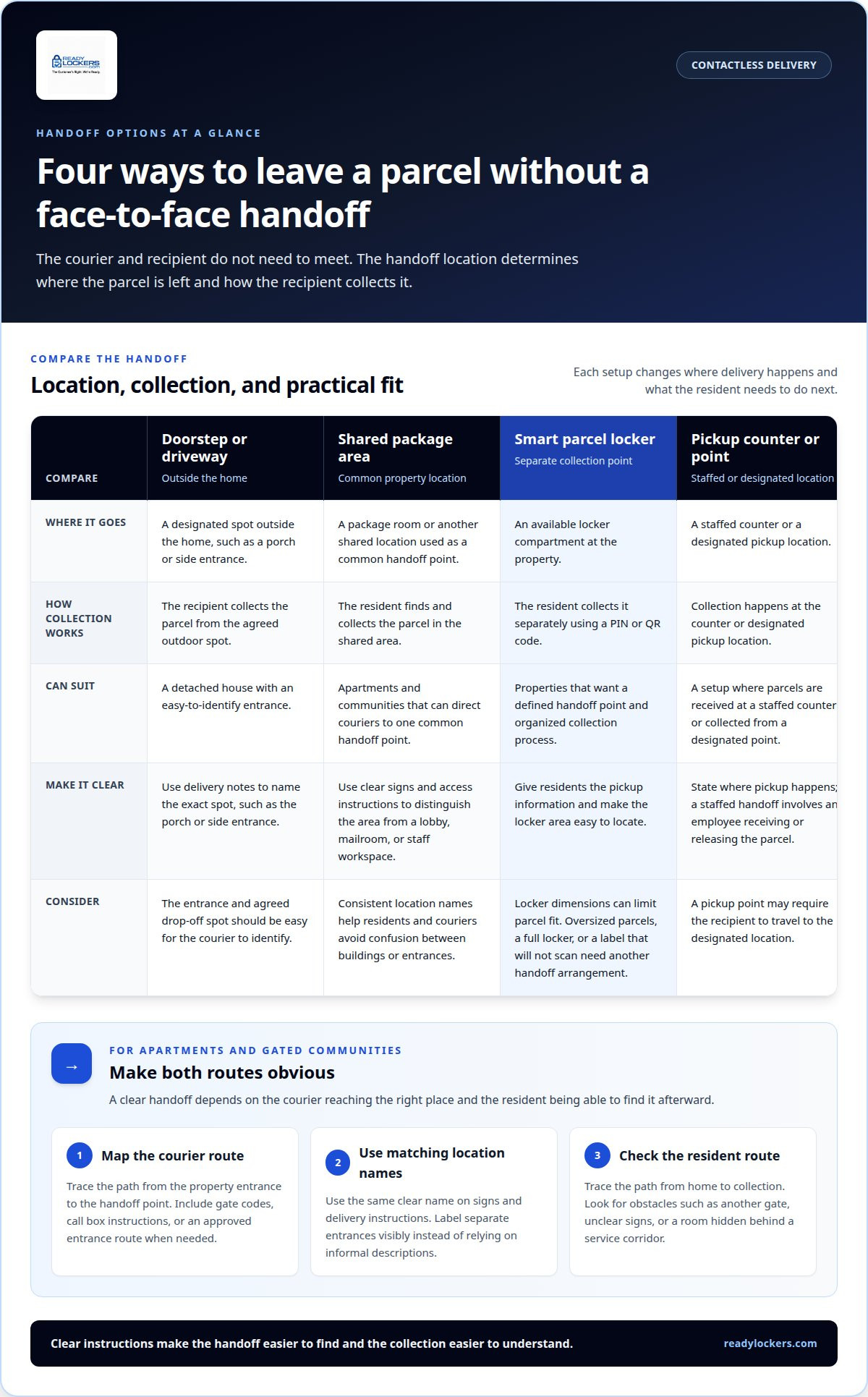
In the United States, contactless parcel delivery can use different handoff locations. A carrier may leave a package at a doorstep or another agreed location, while a smart locker provides a secure, separate collection point. The defining feature is that the courier and recipient do not need to meet, not that delivery must use one particular device. Each option affects how the recipient finds and retrieves the parcel.
Doorstep or driveway drop-off: A courier leaves the package at a designated spot outside the home. This can suit a detached house with an easy-to-identify entrance. A delivery note can specify a porch, side entrance, or other agreed location. The recipient then collects the parcel from that spot.
Shared package area: Apartments and communities may designate a package room or another shared location. This gives couriers a common handoff point instead of requiring delivery to individual units. Clear signs and access instructions distinguish the parcel area from a lobby, mailroom, or staff workspace.
Smart parcel lockers: A courier places a package in an available locker compartment, and the resident collects it separately using a PIN or QR code. This option gives properties a defined handoff point and an organized collection process. ReadyLockers configures locker systems to suit a property’s layout and delivery volume.
Pickup counter or collection point: Some parcels are left at a staffed counter or designated pickup location. A staffed handoff involves an employee, so the exchange may not be fully contactless. A smart locker allows the courier to deposit the parcel and the recipient to collect it separately, without meeting.
To compare options, consider property layout, courier access, parcel placement, and the resident’s route to collect. A house may use a marked porch, while a multi-building community may benefit from a central locker area. The best format makes the handoff location clear and gives recipients a practical way to retrieve parcels.
How do I prepare, label, and drop off a parcel without interacting with staff?
Prepare the parcel before taking it to a drop-off point. Use a sturdy box or mailer suited to the item, cushion fragile contents, and seal every opening. Keep the shipping label flat and visible. Avoid putting tape across the barcode, since folds or glare can make scanning difficult. Follow the carrier’s instructions for the shipment and destination.
- Pack the contents. Secure the item so it won’t shift inside the box. Separate fragile pieces with cushioning, and remove old labels that could confuse identification.
- Check the address. Make sure the recipient’s name and complete delivery address are legible. Include the return address, and compare the label with the shipping details before sealing the parcel.
- Attach the label. Place it on the largest flat surface. Keep the barcode unobstructed, and avoid wrapping it around an edge or placing it over a seam.
- Choose the handoff point. Use the designated locker, drop box, or unattended parcel area. Check posted instructions for accepted parcels and the available deposit process.
At a self-service locker, follow the kiosk prompts or the location’s instructions. If you’re asked to scan a label, hold the barcode steady in the marked area. If scanning fails, check for a crease, glare, or poor placement, then try again. Don’t leave a parcel beside the locker unless the instructions tell you to.
For a driveway or doorstep handoff, use the agreed location and keep the parcel clear of walkways. A note such as “place beside the side entrance” clarifies the spot without requiring a conversation. Keep the shipment receipt or tracking details after drop-off so you can follow its progress and refer to the delivery record if questions arise.
Use a sturdy box or mailer suited to the item, cushion fragile contents, secure them so they cannot shift, and seal every opening. Follow the carrier’s instructions and the drop-off location’s rules for accepted parcels.
ReadyLockers: Smart Package Lockers
ReadyLockers helps properties establish a defined parcel handoff and collection process with Smart Package Lockers. For apartments and gated communities managing deliveries across shared entrances, Locker Management Software supports operations, and a Courier Access Interface enables couriers to access the locker system. Residents collect parcels through the Contactless Pickup System, using a PIN or QR code at the kiosk.
This approach suits properties that need a consistent alternative to doorstep drops or staff-managed handoffs. It gives couriers a designated place to leave packages and residents a separate pickup process. The setup can help property teams organize parcel handling within the property’s delivery flow.
To explore how ReadyLockers could support your property’s parcel handoffs, visit readylockers.com.
Make the Next Property Delivery Easier to Manage
Use your next property review to decide how parcel handoffs should fit the building’s layout and residents’ routines. A contactless parcel drop-off system is most useful when its role is clear, from courier deposit to resident collection. Map the route, choose a well-marked handoff point, and consider how delivery volume and shared access affect the setup.
ReadyLockers offers Smart Package Lockers, Locker Management Software, and a Contactless Pickup System to support property parcel workflows. Together, these tools provide a designated handoff and pickup process that can be configured around a property’s layout and delivery volume.
Explore how these options could fit your property’s delivery plans and contact ReadyLockers to discuss your parcel handoff needs. A clearer process can make parcel handling easier to manage as your property moves forward.
Frequently Asked Questions
What is Contactless Delivery, and Why Does It Matter?
Contactless delivery means a parcel reaches its recipient without a face-to-face handoff. A courier may leave it at an agreed spot, such as a porch or designated package area. The approach became prominent during the COVID-19 pandemic, when reducing physical interactions mattered. It can also make delivery more convenient when residents are away or property access makes direct handoffs difficult.
What is a contactless parcel drop-off system and how does it work?
A contactless parcel drop-off system lets a courier deposit a package at a designated location for collection without meeting the recipient. In a smart locker setup, the courier places the parcel in a compartment, and the recipient uses a pickup credential to retrieve it. ReadyLockers recipients can use a PIN or QR code at the kiosk; the free mobile app is optional.
How can I get a receipt and track a parcel dropped off contactlessly?
Keep the carrier’s drop-off receipt or tracking number, then use the carrier’s tracking tool to follow shipment scans. For a parcel deposited in a property locker, retain the delivery notification as a separate record of the handoff. For example, if tracking shows delivery but you haven’t collected the package, compare the carrier’s status with the locker notification before contacting the carrier or property team.

Frequently Asked Questions
What is Contactless Delivery, and Why Does It Matter?+
Contactless delivery means a parcel reaches its recipient without a face-to-face handoff. A courier may leave it at an agreed spot, such as a porch or designated package area. The approach became prominent during the COVID-19 pandemic, when reducing physical interactions mattered. It can also make delivery more convenient when residents are away or property access makes direct handoffs difficult.
What is a contactless parcel drop-off system and how does it work?+
A contactless parcel drop-off system lets a courier deposit a package at a designated location for collection without meeting the recipient. In a smart locker setup, the courier places the parcel in a compartment, and the recipient uses a pickup credential to retrieve it. ReadyLockers recipients can use a PIN or QR code at the kiosk; the free mobile app is optional.
How can I get a receipt and track a parcel dropped off contactlessly?+
Keep the carrier’s drop-off receipt or tracking number, then use the carrier’s tracking tool to follow shipment scans. For a parcel deposited in a property locker, retain the delivery notification as a separate record of the handoff. For example, if tracking shows delivery but you haven’t collected the package, compare the carrier’s status with the locker notification before contacting the carrier or property team.