Mixed-Use Development Parcel Solutions: A Practical Planning Guide
Discover effective mixed-use development parcel solutions. Learn how to plan smart lockers, manage courier access, and streamline multi-tenant deliveries.

What if a parcel room designed for residents creates a bottleneck for office couriers and retail deliveries? Mixed-use development parcel solutions work best when they reflect each property's access patterns, rather than forcing every delivery into one workflow. Residents may collect packages around personal schedules, while office, retail, and hospitality teams need a clear handoff that does not turn shared lobbies or onsite staff into a delivery desk.
One development can have different couriers, recipients, delivery points, and peak periods. A coordinated system can still make operations easier. Modular smart lockers, a courier access interface, and cloud-based locker management software can support separate delivery and pickup workflows, with SMS or QR code notifications and contactless pickup for recipients.
This guide explains how to plan parcel delivery across residential, office, retail, and hospitality spaces. You will learn how to assess locker location and capacity, define courier and recipient access, and assign property-team responsibilities. The goal is a practical parcel workflow that reduces manual handling while remaining straightforward for couriers and occupants to use.
Key Takeaways
- Map how residential, office, retail, and hospitality occupants receive and collect deliveries before selecting a shared or separate workflow.
- Trace the courier-to-recipient process, from access and package placement to SMS or QR code notification and pickup.
- Compare parcel rooms, staffed receiving, and lockers against the development’s space, access, and property-team requirements.
- Estimate capacity using property-specific package volumes, then verify dimensions and installation needs during site planning.
- Mixed-use development parcel solutions can accommodate varied workflows when modular configurations are paired with clear access rules and assigned responsibilities.
Why Mixed-Use Development Parcel Solutions Need More Than One Workflow
A residential tower, office, retail space, and hotel may share one address, but they do not share one delivery routine. Mixed-use development brings different uses together within a property or connected area. Its parcel plan needs to coordinate how distinct occupant groups receive, access, and collect packages without assuming that every delivery belongs in the same place.
Mixed-use development parcel solutions are coordinated delivery and pickup arrangements designed around the needs of multiple occupant groups. A unified management approach can help property teams oversee activity, but access rules and handoff processes may still need to differ by use. Before selecting a setup, identify which groups share a delivery point and which need separate locations or instructions.
Which occupant groups does a mixed-use parcel plan need to serve?
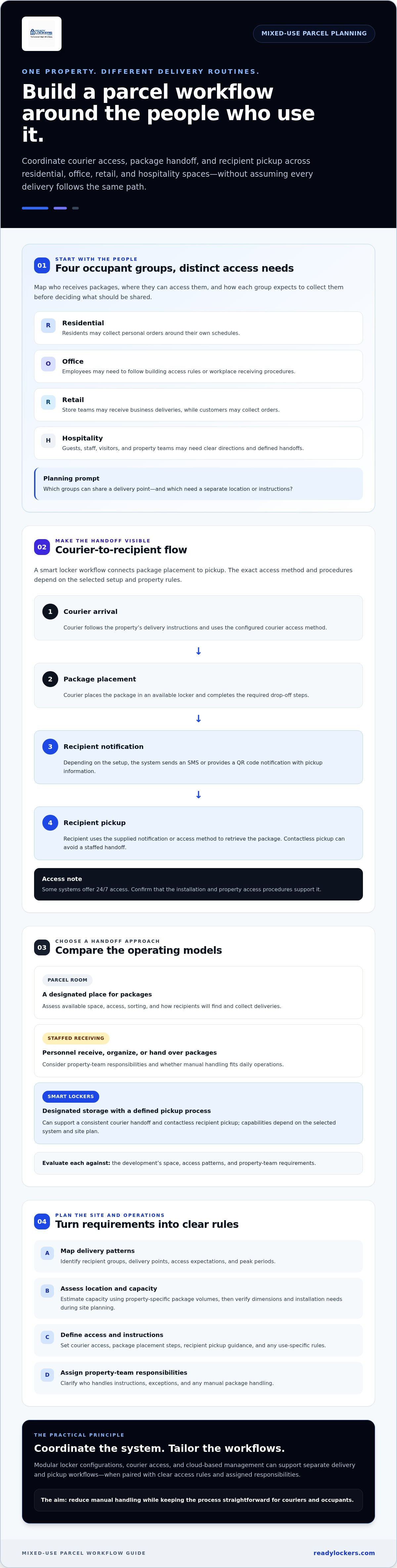
Start by listing who receives packages and how each group needs to access them. Residents may collect personal orders on their own schedules. Office employees may rely on building access rules or workplace receiving procedures. Retail recipients could include store teams receiving business deliveries as well as customers collecting orders. Hotel guests, staff, visitors, and property management bring further needs, from finding a pickup point to directing couriers and resolving exceptions.
These groups can differ in delivery timing, package frequency, pickup habits, and access expectations. Some recipients may be authorized to enter a common area; others may need a location closer to their workplace or a way to collect without entering restricted spaces. Map these distinctions before choosing shared infrastructure. A common locker area can serve multiple uses only if users can reach it and understand which process applies to them.
What problems can parcel lockers address in shared properties?
Unattended packages can take over lobbies, reception desks, back-of-house areas, or other shared space. Manual sorting and handoffs also draw staff away from other responsibilities, while unclear pickup instructions can leave recipients unsure where to go. Designated parcel storage gives couriers a consistent handoff point and recipients a clear collection process, reducing the need for staff to manage each package directly.
A parcel locker is a secure, designated storage point where a courier deposits a package for recipient pickup; a staffed package room relies on personnel to receive, organize, or hand over packages. Smart lockers can support contactless pickup, and some systems offer 24/7 access. Verify these capabilities against the selected system, site access, and operating plan rather than assuming they are automatic. Clear courier instructions, recipient notifications, and defined responsibilities remain essential, especially when several property uses share parcel infrastructure.
How Smart Parcel Lockers Coordinate Couriers and Recipients
A smart locker workflow connects courier access, package placement, recipient notification, and pickup in a defined sequence. For mixed-use development parcel solutions, locker management software can coordinate that sequence while access rules reflect the property’s different occupant groups. The locker system supports the handoff; it does not provide the courier or delivery service.
What happens from package delivery to recipient pickup?
A typical workflow follows these steps. The exact access method and procedures depend on the selected setup and property rules.
- Courier arrival: The courier follows the property’s delivery instructions and uses the configured courier access method.
- Package placement: The courier places the package in an available locker and completes the required drop-off steps.
- Recipient notification: The system sends an SMS or provides a QR code notification, according to the setup, so the recipient knows a package is ready and how to proceed.
- Pickup: The recipient uses the supplied notification or access method to retrieve the package. Contactless pickup can avoid a staffed handoff, and 24/7 access may be available when the installation and property access procedures support it.
Before launch, confirm how couriers will find the lockers, what instructions they will follow, and what recipients should do if a notification is unclear or pickup does not go as planned. These details turn system functions into a usable property workflow.
How can one platform support different property uses?
One management platform can help property teams oversee locker activity across residential, office, retail, and hospitality spaces. Courier access management helps define how couriers use the system, while SMS or QR code notifications give recipients a clear pickup prompt. Usage analytics can help teams monitor locker activity and inform operational decisions.
Shared infrastructure still needs clear boundaries. Decide which occupants can use each locker area, where couriers should deliver for each use, and who handles exceptions. A resident’s pickup instructions, for example, may differ from those given to an office employee or retail team. Set these rules before configuring workflows so a shared system does not create confusion or grant access to the wrong area.
For a closer look at the management layer, see this smart locker management software guide. If you are comparing hardware and software for a property, explore ReadyLockers solutions for smart lockers, courier access management, and recipient notifications.
How to Evaluate Parcel Solutions for a Mixed-Use Development
Compare options against the property’s layout and operating needs, not just the number of occupants. Mixed-use development parcel solutions may combine parcel rooms, staffed receiving, smart lockers, or different approaches in separate areas. The right choice depends on who needs access, how much staff involvement is practical, and whether the site can accommodate the delivery and pickup process.
Which site and capacity factors should teams assess?
Begin with a site review. Check available indoor or outdoor space, circulation around the proposed location, visibility for couriers and recipients, and proximity to the groups it will serve. Confirm that the location works with property access procedures and will not obstruct other building activity.
Estimate package volume separately for residential, office, retail, and hospitality uses. Use property-specific delivery records or estimates, and account for occupancy changes, tenant mix, and expected changes in how spaces are used. Before selecting equipment or a location, verify dimensions, accessibility, power, network needs, and installation requirements for the site. Modular locker configurations can be adjusted to property layouts and volume requirements, but site conditions and capacity assumptions still need to be checked.
How should teams compare manual and automated parcel handling?
Use the questions below to identify trade-offs. A staffed process may offer direct assistance, but it requires people and space for receiving and handoffs. Smart lockers can support self-service pickup and digital management, but property teams still need to define courier instructions, monitor activity, and resolve exceptions.
| Criteria | Questions to ask | Site-specific considerations |
|---|---|---|
| Access | Can couriers and intended recipients reach the parcel area under the property’s procedures? | Check entrances, circulation, visibility, and access boundaries for each use. |
| Staff time | How much receiving, sorting, notification, and handoff work will the process require? | Identify which team handles deliveries and exceptions, and when that support is available. |
| Space and capacity | Can the site accommodate delivery storage without disrupting shared areas? | Compare available space with package-volume estimates by occupant group. |
| Recipient experience | How will recipients know a parcel is ready and understand how to collect it? | Review notification options, pickup location, and the clarity of instructions. |
| Management and records | What activity needs oversight or review? | Consider whether locker management software and usage analytics fit the property team’s needs. |
Automation can reduce manual handoffs, but property teams still need clear ownership for oversight and unusual situations. For broader selection criteria, consult the smart locker buyer guide.
Planning Installation and Daily Operations Across Uses
A locker installation works best when the physical setup and daily process are planned together. For mixed-use development parcel solutions, account for distinct occupant groups, property access policies, site conditions, and the people responsible for keeping deliveries on track. Treat planning as a sequence, with decisions at each stage informing the next.
What should happen before lockers are installed?
Begin with a needs assessment. Gather input from residential, office, retail, and hospitality stakeholders, then identify expected use, package-volume assumptions, and candidate locations. A site review should confirm that the proposed area fits the property’s circulation and access needs, along with the physical and technical requirements of the selected configuration.
Bring property management, facilities, security, and technology teams into the review before finalizing the setup. Their input can surface practical constraints early, such as whether intended couriers and recipients can access the location or whether property policies call for separate access between residential and commercial areas. Confirm dimensions, power, network needs, installation scope, and other site-specific requirements with the responsible project team.
Then configure the lockers and define the workflow before launch. Modular configurations can be tailored to a property’s layout and package volumes, but check the selected setup against verified site measurements and delivery estimates.
How can property teams prepare occupants and couriers?
Assign clear ownership for the ongoing process. Identify who maintains courier instructions, communicates pickup steps to occupants, responds to exceptions, and reviews locker activity. A shared system still needs access rules that match the building: specify which groups can use each area and where couriers should go for each type of delivery.
Keep instructions concise and easy to find. They should explain:
- Where couriers should access the lockers and how to complete a drop-off.
- How recipients will receive an SMS or QR code notification and collect a package.
- Which property contact can help if a package cannot be placed or retrieved as expected.
- What process applies when a parcel does not fit the chosen locker configuration.
After launch, review usage analytics periodically. Look for verified patterns in locker activity, recurring exceptions, or confusion in the instructions, then adjust procedures where the evidence points to a need. For more detail on implementation considerations, read the smart locker installation guide.
Ready to plan a parcel workflow around your property’s layout and operating needs? Explore ReadyLockers solutions.
Choosing a Mixed-Use Parcel Solution That Can Adapt Over Time
A parcel setup should fit the property’s current workflows and leave room to respond as occupancy, tenant needs, or delivery patterns change. Modular locker configurations can be tailored to a site’s layout and package volumes, while cloud-based management can help teams oversee activity across different uses. Shared infrastructure is not automatically simpler: property teams need clear access rules and responsibilities to make it work.
Before selecting a solution, validate the site’s capacity assumptions, locker configuration, installation requirements, software functions, subscription terms, and support arrangements. Ask providers to clarify what is included and what the property team must coordinate. Confirm dimensions and technical requirements for the actual location rather than relying on a generic configuration.
What questions should a property team ask a provider?
Connect proposed capabilities to documented site needs. Ask how the locker configuration can accommodate the layout and estimated package volume for each occupant group. Clarify which software functions are available, including SMS or QR code notifications, courier access management, and usage analytics. Then confirm who is responsible for installation, what subscription terms apply, and how ongoing support is arranged. Get clear answers before comparing options.
When is ReadyLockers worth considering?
ReadyLockers may be worth evaluating if your property needs modular smart package lockers and cloud-based locker management for residential, office, or retail workflows. Its platform includes courier access management, SMS or QR code notifications, and usage analytics. Assess these features against the needs you have identified; they do not mean every building requires the same hardware or access setup.
Consider whether one shared locker area can serve your groups effectively or whether distinct access arrangements are needed. Compare the proposed configuration with verified site dimensions, estimated package volumes, and property procedures. A site-specific discussion can help clarify fit without assuming a universal setup or result.
Use these questions to guide your selection and verify the details that affect daily operations. Discuss a parcel solution for your property.
Build a Parcel Workflow That Fits Your Property
Effective Mixed-use development parcel solutions start with the people and spaces they serve. Define distinct delivery and pickup workflows for residential, office, retail, and hospitality occupants, then assess site access, package volume, and staff responsibilities before selecting a setup.
Modular smart locker configurations can be planned around property layouts and package-volume requirements. A cloud platform can support the workflow with SMS or QR code notifications, courier access management, and usage analytics. Shared infrastructure may simplify oversight, but clear access rules and an assigned process for exceptions remain essential.
Match your property’s requirements to a practical parcel plan. Discuss a parcel solution for your property and explore how the hardware and management platform may fit your site. Careful planning can help your team create a parcel process that is easier to use and manage as the development evolves.
Frequently Asked Questions
What is a parcel solution for a mixed-use development?
A parcel solution for a mixed-use development is a coordinated plan for receiving, storing, notifying, and handing off packages to different occupant groups. It may use parcel rooms, staffed receiving, smart lockers, or a combination, depending on site needs. Mixed-use development parcel solutions should account for residents, employees, retail teams, visitors, and property staff, with access rules and pickup instructions suited to each group.
Can one parcel locker system serve apartments, offices, and retail spaces?
Yes, one system can serve apartments, offices, and retail spaces if its configuration and access procedures fit the property. Modular lockers can be planned around site layouts and estimated package volumes, while management software can support courier access management and recipient notifications. A shared system still needs clear rules about who can use each area, where couriers should deliver, and how exceptions are handled.
How do smart parcel lockers notify recipients that a package has arrived?
Smart parcel lockers can notify recipients by SMS or QR code when a package is ready for pickup. The notification gives the recipient information to identify or access the parcel according to the system’s setup. Property teams should confirm how notifications are configured, what details recipients receive, and where to direct questions. Clear instructions help occupants understand the steps from alert to retrieval.
Where should parcel lockers be placed in a mixed-use property?
Place lockers where intended recipients and couriers can reach them without disrupting building circulation. Assess available space, visibility, proximity to the residential, office, or retail groups being served, and access boundaries between areas. Also verify site dimensions, accessibility needs, power, network availability, and installation requirements before choosing a location. Placement depends on the actual layout and property procedures, not a generic floor plan.
How do couriers access parcel lockers in a mixed-use building?
Couriers use the access method configured for the locker system and follow the property’s delivery instructions. A courier access interface and management tools can help property teams define how couriers use the lockers. Before launch, specify the correct entrance, delivery location, and drop-off steps for each property use. Confirm who maintains these instructions and how couriers should proceed if the locker area or placement process is unavailable.
What should property managers consider before installing parcel lockers?
Property managers should assess package volumes by occupant group, candidate locations, site dimensions, access rules, and installation requirements. Coordinate facilities, security, property, and technology stakeholders before finalizing a setup. Confirm the locker configuration, power and network needs, notification options, courier access management, software terms, and support arrangements. Build clear procedures for recipient communication and packages that do not fit the selected configuration, then verify site assumptions with the responsible project team.
Can parcel lockers reduce staff involvement in package handling?
Parcel lockers can reduce the need for staff to receive, sort, and hand over every package because couriers can place parcels in designated lockers and recipients can collect them directly. The amount of staff involvement depends on the property’s workflow and responsibilities. Teams still need to manage instructions, monitor activity, address exceptions, and support recipients who need help. Lockers can streamline handling, but they do not eliminate onsite oversight.

Frequently Asked Questions
Which occupant groups does a mixed-use parcel plan need to serve?+
Start by listing who receives packages and how each group needs to access them. Residents may collect personal orders on their own schedules. Office employees may rely on building access rules or workplace receiving procedures. Retail recipients could include store teams receiving business deliveries as well as customers collecting orders. Hotel guests, staff, visitors, and property management bring further needs, from finding a pickup point to directing couriers and resolving exceptions. These groups can differ in delivery timing, package frequency, pickup habits, and access expectations. Some recipients may be authorized to enter a common area; others may need a location closer to their workplace or a way to collect without entering restricted spaces. Map these distinctions before choosing shared infrastructure. A common locker area can serve multiple uses only if users can reach it and understand which process applies to them.
What problems can parcel lockers address in shared properties?+
Unattended packages can take over lobbies, reception desks, back-of-house areas, or other shared space. Manual sorting and handoffs also draw staff away from other responsibilities, while unclear pickup instructions can leave recipients unsure where to go. Designated parcel storage gives couriers a consistent handoff point and recipients a clear collection process, reducing the need for staff to manage each package directly. A parcel locker is a secure, designated storage point where a courier deposits a package for recipient pickup; a staffed package room relies on personnel to receive, organize, or hand over packages. Smart lockers can support contactless pickup, and some systems offer 24/7 access. Verify these capabilities against the selected system, site access, and operating plan rather than assuming they are automatic. Clear courier instructions, recipient notifications, and defined responsibilities remain essential, especially when several property uses share parcel infrastructure. A smart locker workflow connects courier access, package placement, recipient notification, and pickup in a defined sequence. For mixed-use development parcel solutions, locker management software can coordinate that sequence while access rules reflect the property’s different occupant groups. The locker system supports the handoff; it does not provide the courier or delivery service.
What happens from package delivery to recipient pickup?+
A typical workflow follows these steps. The exact access method and procedures depend on the selected setup and property rules. Before launch, confirm how couriers will find the lockers, what instructions they will follow, and what recipients should do if a notification is unclear or pickup does not go as planned. These details turn system functions into a usable property workflow.
How can one platform support different property uses?+
One management platform can help property teams oversee locker activity across residential, office, retail, and hospitality spaces. Courier access management helps define how couriers use the system, while SMS or QR code notifications give recipients a clear pickup prompt. Usage analytics can help teams monitor locker activity and inform operational decisions. Shared infrastructure still needs clear boundaries. Decide which occupants can use each locker area, where couriers should deliver for each use, and who handles exceptions. A resident’s pickup instructions, for example, may differ from those given to an office employee or retail team. Set these rules before configuring workflows so a shared system does not create confusion or grant access to the wrong area. For a closer look at the management layer, see this smart locker management software guide. If you are comparing hardware and software for a property, explore ReadyLockers solutions for smart lockers, courier access management, and recipient notifications. Compare options against the property’s layout and operating needs, not just the number of occupants. Mixed-use development parcel solutions may combine parcel rooms, staffed receiving, smart lockers, or different approaches in separate areas. The right choice depends on who needs access, how much staff involvement is practical, and whether the site can accommodate the delivery and pickup process.
Which site and capacity factors should teams assess?+
Begin with a site review. Check available indoor or outdoor space, circulation around the proposed location, visibility for couriers and recipients, and proximity to the groups it will serve. Confirm that the location works with property access procedures and will not obstruct other building activity. Estimate package volume separately for residential, office, retail, and hospitality uses. Use property-specific delivery records or estimates, and account for occupancy changes, tenant mix, and expected changes in how spaces are used. Before selecting equipment or a location, verify dimensions, accessibility, power, network needs, and installation requirements for the site. Modular locker configurations can be adjusted to property layouts and volume requirements, but site conditions and capacity assumptions still need to be checked.
How should teams compare manual and automated parcel handling?+
Use the questions below to identify trade-offs. A staffed process may offer direct assistance, but it requires people and space for receiving and handoffs. Smart lockers can support self-service pickup and digital management, but property teams still need to define courier instructions, monitor activity, and resolve exceptions. Automation can reduce manual handoffs, but property teams still need clear ownership for oversight and unusual situations. For broader selection criteria, consult the smart locker buyer guide. A locker installation works best when the physical setup and daily process are planned together. For mixed-use development parcel solutions, account for distinct occupant groups, property access policies, site conditions, and the people responsible for keeping deliveries on track. Treat planning as a sequence, with decisions at each stage informing the next.
What should happen before lockers are installed?+
Begin with a needs assessment. Gather input from residential, office, retail, and hospitality stakeholders, then identify expected use, package-volume assumptions, and candidate locations. A site review should confirm that the proposed area fits the property’s circulation and access needs, along with the physical and technical requirements of the selected configuration. Bring property management, facilities, security, and technology teams into the review before finalizing the setup. Their input can surface practical constraints early, such as whether intended couriers and recipients can access the location or whether property policies call for separate access between residential and commercial areas. Confirm dimensions, power, network needs, installation scope, and other site-specific requirements with the responsible project team. Then configure the lockers and define the workflow before launch. Modular configurations can be tailored to a property’s layout and package volumes, but check the selected setup against verified site measurements and delivery estimates.
How can property teams prepare occupants and couriers?+
Assign clear ownership for the ongoing process. Identify who maintains courier instructions, communicates pickup steps to occupants, responds to exceptions, and reviews locker activity. A shared system still needs access rules that match the building: specify which groups can use each area and where couriers should go for each type of delivery. Keep instructions concise and easy to find. They should explain: After launch, review usage analytics periodically. Look for verified patterns in locker activity, recurring exceptions, or confusion in the instructions, then adjust procedures where the evidence points to a need. For more detail on implementation considerations, read the smart locker installation guide. Ready to plan a parcel workflow around your property’s layout and operating needs? Explore ReadyLockers solutions. A parcel setup should fit the property’s current workflows and leave room to respond as occupancy, tenant needs, or delivery patterns change. Modular locker configurations can be tailored to a site’s layout and package volumes, while cloud-based management can help teams oversee activity across different uses. Shared infrastructure is not automatically simpler: property teams need clear access rules and responsibilities to make it work. Before selecting a solution, validate the site’s capacity assumptions, locker configuration, installation requirements, software functions, subscription terms, and support arrangements. Ask providers to clarify what is included and what the property team must coordinate. Confirm dimensions and technical requirements for the actual location rather than relying on a generic configuration.
What questions should a property team ask a provider?+
Connect proposed capabilities to documented site needs. Ask how the locker configuration can accommodate the layout and estimated package volume for each occupant group. Clarify which software functions are available, including SMS or QR code notifications, courier access management, and usage analytics. Then confirm who is responsible for installation, what subscription terms apply, and how ongoing support is arranged. Get clear answers before comparing options.
When is ReadyLockers worth considering?+
ReadyLockers may be worth evaluating if your property needs modular smart package lockers and cloud-based locker management for residential, office, or retail workflows. Its platform includes courier access management, SMS or QR code notifications, and usage analytics. Assess these features against the needs you have identified; they do not mean every building requires the same hardware or access setup. Consider whether one shared locker area can serve your groups effectively or whether distinct access arrangements are needed. Compare the proposed configuration with verified site dimensions, estimated package volumes, and property procedures. A site-specific discussion can help clarify fit without assuming a universal setup or result. Use these questions to guide your selection and verify the details that affect daily operations. Discuss a parcel solution for your property. Effective Mixed-use development parcel solutions start with the people and spaces they serve. Define distinct delivery and pickup workflows for residential, office, retail, and hospitality occupants, then assess site access, package volume, and staff responsibilities before selecting a setup. Modular smart locker configurations can be planned around property layouts and package-volume requirements. A cloud platform can support the workflow with SMS or QR code notifications, courier access management, and usage analytics. Shared infrastructure may simplify oversight, but clear access rules and an assigned process for exceptions remain essential. Match your property’s requirements to a practical parcel plan. Discuss a parcel solution for your property and explore how the hardware and management platform may fit your site. Careful planning can help your team create a parcel process that is easier to use and manage as the development evolves.
What is a parcel solution for a mixed-use development?+
A parcel solution for a mixed-use development is a coordinated plan for receiving, storing, notifying, and handing off packages to different occupant groups. It may use parcel rooms, staffed receiving, smart lockers, or a combination, depending on site needs. Mixed-use development parcel solutions should account for residents, employees, retail teams, visitors, and property staff, with access rules and pickup instructions suited to each group.
Can one parcel locker system serve apartments, offices, and retail spaces?+
Yes, one system can serve apartments, offices, and retail spaces if its configuration and access procedures fit the property. Modular lockers can be planned around site layouts and estimated package volumes, while management software can support courier access management and recipient notifications. A shared system still needs clear rules about who can use each area, where couriers should deliver, and how exceptions are handled.
How do smart parcel lockers notify recipients that a package has arrived?+
Smart parcel lockers can notify recipients by SMS or QR code when a package is ready for pickup. The notification gives the recipient information to identify or access the parcel according to the system’s setup. Property teams should confirm how notifications are configured, what details recipients receive, and where to direct questions. Clear instructions help occupants understand the steps from alert to retrieval.
Where should parcel lockers be placed in a mixed-use property?+
Place lockers where intended recipients and couriers can reach them without disrupting building circulation. Assess available space, visibility, proximity to the residential, office, or retail groups being served, and access boundaries between areas. Also verify site dimensions, accessibility needs, power, network availability, and installation requirements before choosing a location. Placement depends on the actual layout and property procedures, not a generic floor plan.
How do couriers access parcel lockers in a mixed-use building?+
Couriers use the access method configured for the locker system and follow the property’s delivery instructions. A courier access interface and management tools can help property teams define how couriers use the lockers. Before launch, specify the correct entrance, delivery location, and drop-off steps for each property use. Confirm who maintains these instructions and how couriers should proceed if the locker area or placement process is unavailable.
What should property managers consider before installing parcel lockers?+
Property managers should assess package volumes by occupant group, candidate locations, site dimensions, access rules, and installation requirements. Coordinate facilities, security, property, and technology stakeholders before finalizing a setup. Confirm the locker configuration, power and network needs, notification options, courier access management, software terms, and support arrangements. Build clear procedures for recipient communication and packages that do not fit the selected configuration, then verify site assumptions with the responsible project team.
Can parcel lockers reduce staff involvement in package handling?+
Parcel lockers can reduce the need for staff to receive, sort, and hand over every package because couriers can place parcels in designated lockers and recipients can collect them directly. The amount of staff involvement depends on the property’s workflow and responsibilities. Teams still need to manage instructions, monitor activity, address exceptions, and support recipients who need help. Lockers can streamline handling, but they do not eliminate onsite oversight.