Automated Parcel Distribution Lockers: Costs and Convenience
Explore automated parcel distribution lockers: costs, setup, software, and benefits for secure, convenient self-service package pickup at your property.

Automated parcel distribution lockers don’t have one fixed cost. The total depends on the system configuration, site preparation, installation, and management software. ReadyLockers provides custom quotes based on the property’s needs, with purchase, partnership, and licensing models available.
It’s reasonable to focus on the upfront investment, but cost is only part of the decision. A well-planned locker system gives recipients a secure, self-service way to collect packages without coordinating a handoff with a courier or staff member.
This article explains how automated parcel lockers work, what influences network costs and deployment timelines, and where self-service pickup can simplify deliveries. You’ll also see how site needs, package volume, courier access, and locker management affect the design of a system, so you can assess what matters before planning a deployment.
Key Takeaways
- Understand how courier access, delivery notifications, and secure pickup work together in an automated locker system.
- Identify the site, capacity, installation, and software factors that shape a locker network’s budget and deployment schedule.
- See how controlled access and self-service collection can help reduce missed deliveries and improve package security.
- Learn what to consider when deciding whether a smart locker system fits your property and delivery needs.
What Are Automated Parcel Lockers & How Do They Work?
Automated parcel distribution lockers are self-service terminals for receiving and collecting packages. They give couriers a designated drop-off point and recipients a way to retrieve deliveries without coordinating a handoff.
Courier Delivery and Resident Pickup
A courier accesses the locker system, selects the recipient, and places the package in an available compartment. The recipient then uses a PIN or QR code to open it. This process is useful in apartments, offices, and other facilities where packages might otherwise pass through a lobby, reception desk, or leasing office.
A locker system combines physical compartments with software that manages deliveries and recipient access. ReadyLockers provides smart locker hardware and a cloud-based management platform. Together, they create a central package collection point instead of requiring separate door-to-door handoffs.
Delivery Notifications and Package Retrieval
After a package is deposited, the system notifies the recipient and provides pickup details. ReadyLockers sends an instant SMS or email with a one-time PIN or QR code. The recipient enters or scans the code at the kiosk to open the assigned compartment. The mobile app is optional.
Clear pickup instructions connect the delivery record to the correct package and reduce uncertainty about where it was left. Recipients can collect deliveries 24/7, so pickup does not depend on meeting a courier at home or waiting for staffed reception.
Traditional courier delivery may require someone to answer the door or accept a package at a staffed desk. If nobody is available, the courier may leave the package in a lobby, reception area, or leasing office. Lockers offer a defined, secure drop-off point, but compartment size limits what they can hold. Oversized items, such as furniture, need another delivery arrangement.
That makes locker placement and package suitability important for buildings and facilities. A terminal can support routine parcels, while deliveries too large for its compartments still need another handoff method. The locker workflow is most useful when couriers can access the terminal and recipients can use the notification code to retrieve their packages.
Locker network costs and deployment timelines
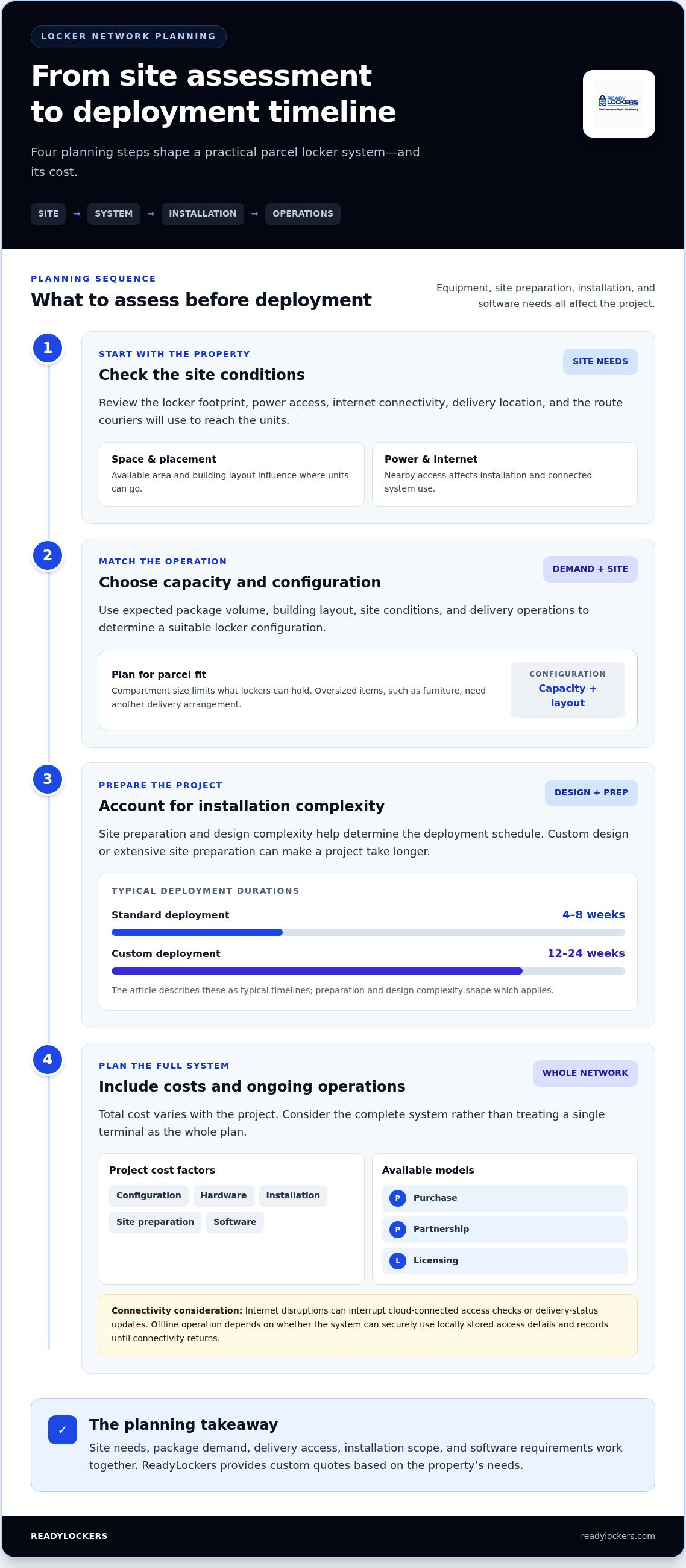
Network cost and timing depend on the equipment, site, installation, and software requirements. In the United States, deployment can take longer when a project needs custom design or extensive site preparation.
Space, Power, Internet, and Site Needs
Assess the locker footprint, power access, internet connectivity, and delivery location. These factors affect installation and everyday courier access. Review the available space, nearby power and network access, and the route couriers will take to reach the units. The building layout and expected package volume help determine a suitable configuration.
Choosing and Installing a Locker System
Choosing a system means matching its capacity and configuration to package demand, site conditions, and delivery operations. This helps owners plan a practical installation rather than selecting equipment in isolation. Standard deployments typically take 4-8 weeks, while custom deployments typically take 12-24 weeks. Site preparation and design complexity shape which timeline applies.
Costs depend on the project’s configuration, hardware, installation, site preparation, and software needs. ReadyLockers provides custom quotes based on these requirements. Planning the complete system, rather than focusing on a single terminal, helps account for how packages will be managed across the property.
Internet disruptions can interrupt cloud-connected access checks or delivery-status updates. Offline operation depends on whether a system can securely use locally stored access details and records until connectivity returns. This capability affects whether couriers can deposit orders and recipients can retrieve packages during a disruption.
Parcel locker brands and networks vary by country, including how terminals connect with courier operations. A carrier-agnostic network is designed to accept deliveries from multiple couriers, rather than relying on one carrier’s network. Compare these operating models alongside site needs and deployment scope. For a project-specific view of locker system planning, explore locker network planning.
Why parcel lockers are such a revolutionary advancement?
A locker system places each package in a locked compartment instead of an open lobby. Security depends on the physical unit, the access process, and how the property manages pickup.
Locker Security and Theft Prevention
Parcel lockers help reduce opportunities for theft by keeping deposited packages inside locked compartments until collection. Some systems also include cameras to help property managers monitor access. Electronic locking mechanisms are described as rated for more than 100,000 cycles, supporting repeated use. That rating indicates operating durability, not that a locker can prevent every theft or accommodate every parcel.
Access Control, Notifications, and Monitoring
Access control connects a package to an authorized pickup code, while a notification tells the recipient when collection is ready. Together, these steps reduce the chance that someone takes a parcel from a shared room. Monitoring can add visibility into terminal access, especially when cameras are included. Digital security also depends on how a system protects access information, handles records, and applies relevant privacy requirements.
Lockers Compared with Staffed Package Rooms
Staffed mailrooms rely on personnel to receive, organize, and hand over packages; lockers let recipients collect parcels themselves. A staffed room can handle items that do not fit compartments and provide direct assistance. Lockers reduce the need for staff to manage each handoff, but recipients must use the assigned PIN or QR code and collect packages from the designated terminal.
Benefits and Drawbacks of Automated Lockers
The main benefits are controlled access, self-service collection, and a record of package placement and pickup. These features can make parcel handling more orderly than leaving deliveries in an open lobby. Consider the limitations too: oversized packages may not fit, and pickup relies on a functioning system. Include connectivity, power, and support procedures in the planning process.
Convenience of self-service parcel collection
Self-service collection lets recipients retrieve packages without arranging a handoff. For a retail order, a locker can connect order fulfillment, an electronic notification, and pickup in one workflow.
Self-Service Collection and Dispatch
Self-service collection uses an access code or barcode so recipients can open the assigned compartment themselves. This removes the need to coordinate a collection time with a courier or staff member. Dispatch is a separate workflow: where a system supports outgoing parcels, users follow its designated drop-off process. That distinction helps property teams set clear expectations for incoming deliveries and returns.
Parcel Collection and Storage Workflows
A typical collection workflow begins when a courier deposits a package and the system notifies the recipient. The parcel remains in its assigned compartment until the recipient enters or scans the pickup code. This creates a clear sequence from delivery to storage to collection, helping property teams organize packages instead of relying on a shared pile.
Retail click-and-collect adds an order fulfillment step before pickup: the retailer prepares the order, places it in a locker, and notifies the customer. Locker orders are typically ready within 2-4 hours, compared with 2-3 days for traditional shipping. That timing can make self-service collection useful for customers who want to collect a purchase during an existing visit.
Flexible Parcel Collection
Flexible collection allows recipients to retrieve parcels at a time that suits their schedule. Some locker systems let customers schedule specific collection dates and times, subject to applicable local restrictions. A clear notification and access code tell the recipient how to complete pickup. This flexibility can help residents, office users, and retail customers collect packages around work, travel, or other commitments.
For properties planning a smoother pickup experience, explore a contactless parcel pickup system as part of the collection workflow.
ReadyLockers: Smart Package Lockers
ReadyLockers brings secure package storage and self-service pickup together for properties managing on-site deliveries. Its Smart Package Lockers work alongside Locker Management Software, a Contactless Pickup System, and a Courier Access Interface to coordinate the handoff from courier deposit to recipient collection.
ReadyLockers says pickups are contactless and available 24/7, helping to prevent package theft and missed deliveries. This setup can help property teams reduce missed handoffs and keep packages out of shared, open areas. It’s a practical option when a property needs a more organized delivery and pickup process.
Visit readylockers.com to discuss how a ReadyLockers system could support your property’s delivery workflow.
Plan a smoother delivery experience
Start by defining what a better delivery process should look like at your property. Consider how couriers will reach the lockers, where recipients will collect packages, and how the system should fit existing building operations. These decisions make automated parcel distribution lockers a practical part of the site’s daily workflow, not just a hardware purchase.
Plan for package volume, user access, delivery instructions, and how property teams will oversee incoming parcels. Clear expectations for couriers and recipients help the system work as intended and make the transition easier for everyone who uses it.
ReadyLockers can help property teams assess a smart locker approach for on-site package handling. Contact ReadyLockers about your locker network to discuss the needs of your property and the next steps toward a more organized pickup experience.
Frequently Asked Questions
How much do automated package lockers cost?
Costs depend on the locker capacity, configuration, site preparation, installation, and management software. A property handling frequent deliveries may need a different setup from a small office with occasional parcels. For ReadyLockers, quotes are customized to the project, and commercial options include purchase, partnership, and licensing models. Planning should account for both initial equipment and ongoing platform needs.
What are automated parcel distribution lockers and how do they work?
Automated parcel distribution lockers are electronically controlled compartments that let couriers leave deliveries for later collection. A courier places a parcel in a compartment, and the system gives the recipient a pickup credential. At a ReadyLockers kiosk, recipients use a PIN or QR code; the mobile app is optional. This approach suits properties that need a clear record of package access.
What types of automated parcel locker systems are available in the United States?
In the United States, systems can be designed for shared property use, retail order pickup, or public collection points. Some are configured for a single building, while others are intended to support multiple courier operations. Indoor and outdoor installations are also possible. ReadyLockers supports outdoor installations with weather-sealed enclosures and climate control, making site conditions part of the system choice.
How much do automated parcel lockers cost to buy, install, and maintain?
Hardware, installation, and ongoing platform access are parts of a project’s total cost. The scope depends on the property layout, delivery volume, chosen configuration, installation work, and software needs. ReadyLockers offers purchase, partnership, and licensing models, with custom quotes for projects. Before budgeting, consider how the selected model fits the property’s equipment and management needs.
Which companies provide parcel locker systems for apartments, businesses, and public locations?
ReadyLockers provides smart locker systems for apartments, offices, warehouses, hotels, hospitals, schools, and retail locations. The system works with major carriers, including USPS, UPS, FedEx, and Amazon, as well as regional carriers and in-house staff. This flexibility helps properties manage deliveries from different networks through one system.
How do residents and carriers use automated parcel lockers for deliveries and pickups?
Couriers use the system to place packages in compartments, then recipients receive a pickup notification and access code. With ReadyLockers, recipients open the kiosk using a PIN or QR code, without installing the optional mobile app. The system can also integrate Genetec video surveillance and HID badge access, connecting parcel handling with supported building security tools.

Frequently Asked Questions
How much do automated package lockers cost?+
Costs depend on the locker capacity, configuration, site preparation, installation, and management software. A property handling frequent deliveries may need a different setup from a small office with occasional parcels. For ReadyLockers, quotes are customized to the project, and commercial options include purchase, partnership, and licensing models. Planning should account for both initial equipment and ongoing platform needs.
What are automated parcel distribution lockers and how do they work?+
Automated parcel distribution lockers are electronically controlled compartments that let couriers leave deliveries for later collection. A courier places a parcel in a compartment, and the system gives the recipient a pickup credential. At a ReadyLockers kiosk, recipients use a PIN or QR code; the mobile app is optional. This approach suits properties that need a clear record of package access.
What types of automated parcel locker systems are available in the United States?+
In the United States, systems can be designed for shared property use, retail order pickup, or public collection points. Some are configured for a single building, while others are intended to support multiple courier operations. Indoor and outdoor installations are also possible. ReadyLockers supports outdoor installations with weather-sealed enclosures and climate control, making site conditions part of the system choice.
How much do automated parcel lockers cost to buy, install, and maintain?+
Hardware, installation, and ongoing platform access are parts of a project’s total cost. The scope depends on the property layout, delivery volume, chosen configuration, installation work, and software needs. ReadyLockers offers purchase, partnership, and licensing models, with custom quotes for projects. Before budgeting, consider how the selected model fits the property’s equipment and management needs.
Which companies provide parcel locker systems for apartments, businesses, and public locations?+
ReadyLockers provides smart locker systems for apartments, offices, warehouses, hotels, hospitals, schools, and retail locations. The system works with major carriers, including USPS, UPS, FedEx, and Amazon, as well as regional carriers and in-house staff. This flexibility helps properties manage deliveries from different networks through one system.
How do residents and carriers use automated parcel lockers for deliveries and pickups?+
Couriers use the system to place packages in compartments, then recipients receive a pickup notification and access code. With ReadyLockers, recipients open the kiosk using a PIN or QR code, without installing the optional mobile app. The system can also integrate Genetec video surveillance and HID badge access, connecting parcel handling with supported building security tools.