Smart Locker Hardware Comparison: The 2026 Manufacturer Checklist
Use our 2026 smart locker hardware comparison to find durable, modular units. Our checklist helps you vet manufacturers and deploy a future-proof solution.

The physical locker you install today is no longer just a storage box; it is a critical piece of connected operational infrastructure that dictates your property's efficiency for the next decade. You likely recognize that a system failing under the weight of high courier volumes or requiring expensive, proprietary repairs is a liability your team cannot afford. This smart locker hardware comparison provides a definitive framework to evaluate durability, technical specifications, and modularity across the industry's leading manufacturers.
Our goal is to replace the confusion surrounding proprietary versus universal systems with clear, actionable hardware standards. We examine the 2026 manufacturer landscape to identify which units offer the modularity, door cycle-testing reliability, and courier interface accessibility required for constant use. You'll gain a comprehensive checklist to vet manufacturers, an understanding of long-term maintenance costs, and the confidence to deploy a solution that supports frictionless 24/7 contactless pickup. By the end of this guide, you'll know exactly which technical specifications separate a temporary fix from a permanent asset.
Key Takeaways
- Understand why smart locker hardware has evolved into active logistical infrastructure that directly impacts package liability and courier efficiency.
- Identify the critical technical specifications, such as heavy-duty steel construction and advanced authentication panels, that prevent premature system failure.
- Utilize our 2026 smart locker hardware comparison checklist to verify manufacturer modularity and universal compatibility with all major delivery carriers.
- Prepare for a successful implementation by conducting site surveys for power termination and ensuring all installations meet ADA-compliant clearance standards.
- Discover how combining industrial-grade hardware with cloud-based management software creates a secure, 24/7 contactless pickup environment for any property type.
Beyond the Cabinet: Why Smart Locker Hardware is Critical Infrastructure
The evolution of lockers has reached a pivotal stage in 2026. What used to be passive metal cabinets are now active, connected logistical hubs. These systems manage sensitive data, authenticate users, and communicate with global couriers in real-time. When you perform a smart locker hardware comparison, you must look past the aesthetic finish. The physical components are the foundation of your contactless pickup system. If the hardware fails, your digital interface becomes useless. This leads to package liability, courier frustration, and a total breakdown in property efficiency.
Modern hardware must support a frictionless 24/7 contactless pickup experience without constant manual oversight. Reliability is the only way to maintain the trust of your residents or customers. At ReadyLockers, our philosophy centers on hardware that adapts to the property. We provide modular smart locker units that scale alongside your needs, ensuring your logistical infrastructure remains a permanent asset rather than a temporary fix.
The High Cost of Substandard Locker Hardware
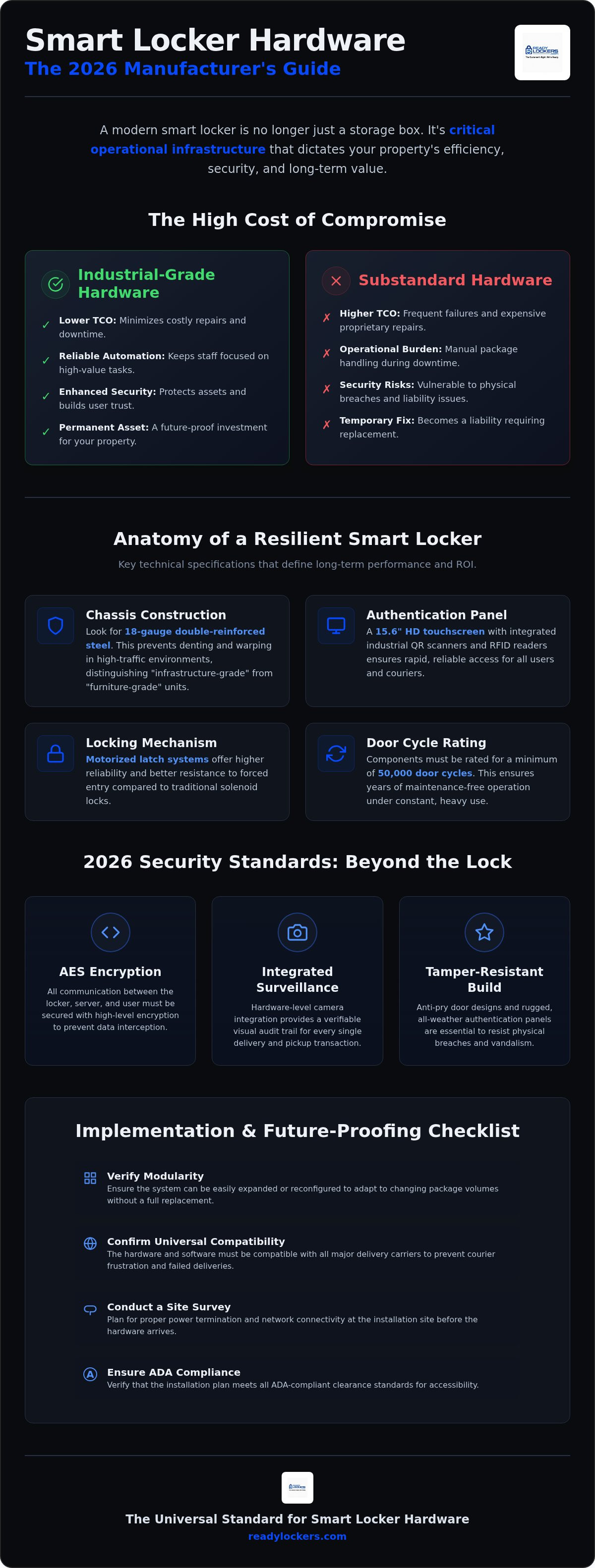
Choosing "cheap" units often leads to a significantly higher total cost of ownership (TCO). Physical failure points typically start at the hinges and locks. These components bear the brunt of hundreds of daily door cycles. If a touchscreen loses responsiveness or a lock jams, the resulting downtime forces property managers to handle packages manually. This shifts the labor burden back to your team, negating the primary benefits of automation. High-quality hardware minimizes these disruptions, keeping your staff focused on high-value tasks instead of troubleshooting mechanical errors.
Security Standards for 2026 Smart Lockers
Security is the primary driver of user trust in any automated system. Modern hardware must feature tamper-proof materials and anti-pry door designs to resist physical breaches. Beyond the steel frame, the "smart" element requires rigorous digital and physical integration:
- AES Encryption: All smart lock communication must use high-level encryption to prevent signal interception or unauthorized access.
- Integrated Surveillance: Hardware-level camera integration provides a verifiable visual audit trail for every transaction.
- Tamper-Resistant Panels: Authentication interfaces must be rugged enough to withstand heavy use and environmental stressors.
A thorough smart locker hardware comparison highlights that security isn't just about the lock. It's about the synergy between industrial-grade materials and secure digital interfaces. By prioritizing these standards, you protect the property from liability and ensure that every package remains secure until the moment of pickup.
The Anatomy of a Smart Locker: Technical Specs to Compare
Evaluating the physical build of a system requires looking past the powder coating to the engineering beneath. A comprehensive smart locker hardware comparison begins with the chassis. High-traffic environments demand 18-gauge double-reinforced steel to prevent denting and warping over time. While lightweight alternatives might reduce initial shipping costs, they often fail under the mechanical stress of hundreds of weekly deliveries. As the Smart Locker Market expands, the distinction between "furniture-grade" and "infrastructure-grade" hardware has become the primary factor in long-term ROI.
Authentication panels serve as the primary user interface and must remain functional in all conditions. High-definition 15.6-inch touchscreens provide the best visibility for couriers and residents, but they must be paired with industrial QR scanners and RFID readers for rapid access. Internal locking mechanisms also vary significantly. Motorized latch systems generally offer higher reliability than traditional solenoid locks, as they provide positive engagement and better resistance to forced entry. You should verify that any manufacturer you consider uses components rated for at least 50,000 door cycles to ensure years of maintenance-free operation.
Modular Smart Locker Units and Scalability
Modularity is the most critical hardware feature for future-proofing your property. Your delivery volume in 2026 will likely look different by 2030, and your hardware must adapt without a full system replacement. Modular smart locker units allow you to add additional banks as your needs grow. When planning your layout, consult our guide on indoor smart parcel lockers to understand how to calculate clearance for expanding locker banks while maintaining ADA compliance. This flexibility ensures your initial investment remains viable as package density increases.
Connectivity and Power Redundancy
A smart locker is only smart if it stays online. While hardwired Ethernet is the gold standard for stability, integrated cellular modules provide a vital failover if the local network drops. This dual-path connectivity ensures notifications reach users immediately. Power redundancy is equally vital. Your system should include a backup battery spec that allows for several hours of operation during a grid failure. For extended outages, ensure the hardware includes a secure manual override that allows authorized staff to access compartments without damaging the locking sensors. Protecting these sensitive electronic components with dedicated surge protection is a non-negotiable requirement for any professional installation. If you are ready to upgrade your property infrastructure, you can explore our modular smart locker units to find a configuration that fits your specific floor plan.
The Smart Locker Hardware Manufacturer Checklist
Selecting a provider requires a rigorous smart locker hardware comparison that goes beyond the sales brochure. As the Automated Smart Locker System Market continues to mature, the gap between premium manufacturers and budget vendors has widened. You need a partner that treats hardware as a long-term property asset. Use the following criteria to evaluate potential manufacturers during your selection process:
- Modular configurations: Does the manufacturer offer flexible layouts to fit your specific property footprint?
- Courier compatibility: Is the hardware interface designed to work seamlessly with all major carriers, including UPS, FedEx, Amazon, and DHL?
- Component durability: Are the electronic locks and door hinges rated for a cycle-life of at least 50,000 openings?
- Protective finishes: Are the units treated with high-durability or anti-microbial powder coating to withstand heavy use and maintain hygiene?
Industry standards for 2026 dictate that any system failing to meet these benchmarks is a liability. High-volume environments can reach thousands of door cycles in a single year, making industrial-grade components a requirement for operational stability.
The Courier Access Interface Test
A system is only effective if couriers actually use it. The Courier Access Interface is the hardware bridge between delivery and security. If the drop-off workflow takes longer than 15 seconds, drivers will likely bypass the system and leave packages in unsecured areas. You should prioritize hardware that features high-speed QR scanners and intuitive touchscreens to facilitate rapid drop-offs. Accessibility is also an essential legal and operational requirement. Ensure the hardware interface is positioned at a height that complies with ADA standards, allowing every user to interact with the screen and compartments without obstruction.
Manufacturer Support and Warranty Terms
Hardware will eventually require maintenance. You must determine if the manufacturer provides on-site repair capabilities or if they rely on a "ship-back" model for faulty components. Ship-back requirements result in unacceptable downtime that frustrates residents and staff. In 2026, the industry standard for hardware warranties typically covers one to three years, but the availability of replacement parts is the more critical metric. Manufacturers like ReadyLockers ensure that replacement modules for modular smart locker units are stocked and ready for rapid deployment. This proactive approach to support prevents your logistical hub from becoming a row of unusable cabinets due to a single mechanical failure.
Implementation Requirements: Planning for Smart Locker Hardware
Planning the physical placement of your system is just as critical as the hardware selection itself. A detailed smart locker hardware comparison reveals that even the most durable units fail to deliver value if the installation site is poorly prepared. To avoid costly delays, you must follow a methodical implementation process that prioritizes both technical connectivity and physical accessibility.
- Step 1: Conduct a site survey. Identify power and data termination points early. Most systems require a standard 120v outlet and a dedicated Ethernet drop. While cellular modules provide failover, a hardwired connection remains the gold standard for consistent 24/7 uptime.
- Step 2: Calculate clearance. Ensure there is sufficient space for locker doors to swing fully open without obstructing ADA-compliant paths. ADA standards typically require a 30-by-48-inch clear floor space and specific reach ranges for authentication panels.
- Step 3: Evaluate floor load capacity. Heavy-duty steel locker banks carry significant weight. You must verify that your floor can support the concentrated load of multiple units. This is particularly important for high-density configurations in older buildings or multi-story retail environments.
Successful deployment depends on aligning your hardware choice with smart locker installation services. These experts ensure that structural mounting and electrical work meet local building codes, preventing liability issues down the road.
Indoor vs. Outdoor Hardware Specifications
Outdoor kiosks require higher NEMA ratings to protect internal electronics from moisture, dust, and ice. If your property lacks a secure indoor lobby, you must choose hardware with integrated climate control systems. These units use internal fans or heaters to maintain functionality during extreme temperature swings. Security also becomes a higher priority for exterior placements. Anti-vandalism features, reinforced authentication panels, and integrated lighting are necessary to prevent physical tampering and ensure user safety in public-facing areas.
Retrofitting vs. New Build Hardware Selection
Integrating lockers into new developments allows for seamless architectural planning. Units can be recessed into walls or built into dedicated mailrooms for a flush, high-end finish. For existing properties, modularity is the key to solving space constraints. You can implement parcel locker systems for small business within limited lobby footprints by selecting vertical modular configurations. This hardware flexibility allows you to retrofit modern logistical hubs into oddly shaped spaces without major structural renovations. If you need assistance determining the best layout for your site, our team can help you select the right smart package lockers for your specific environment.
ReadyLockers: The Universal Standard for Smart Locker Hardware
ReadyLockers provides the definitive answer to the complex logistical challenges identified in this smart locker hardware comparison. We combine industrial-grade physical durability with a sophisticated cloud-based management platform to create a high-performance operational environment. Our systems serve more than eight distinct property types, including multifamily apartments, high-volume retail hubs, and industrial warehouses. This universal application ensures that your hardware becomes a standard requirement for your environment rather than a specialized luxury niche.
Our contactless pickup system is engineered for speed, security, and 24/7 reliability. We prioritize the courier experience through an intuitive interface that reduces drop-off times to under 15 seconds. This hardware-software synergy prevents package backlogs and maintains high satisfaction for recipients. Because our units feature modular configurations, your investment scales naturally as your property package volume increases. You don't need to replace entire locker banks; you simply add the specific modules required to meet your new capacity demands.
Seamless Software-Hardware Integration
Our cloud platform drives the intelligence of our hardware through constant communication and data synchronization. This system manages every aspect of the delivery lifecycle, from secure courier authentication to automated recipient SMS and QR code alerts. Real-time hardware status monitoring allows our team to identify and resolve technical issues before they cause system downtime. By integrating smart locker management software, you gain a transparent view of your entire logistical hub. This visibility ensures that every compartment remains secure, functional, and available for immediate use.
Why National Property Managers Choose ReadyLockers
National property managers require a universal solution that functions reliably across diversified portfolios. ReadyLockers acts as a "Modern Efficiency Expert," removing the friction from package management through standardized hardware and centralized reporting. We provide authoritative support that begins at the initial site survey and continues through long-term maintenance. This proactive partnership anticipates property needs and removes obstacles before they impact your onsite staff. By choosing a system grounded in practical utility and bold innovation, you protect your property from hardware obsolescence. You ensure a secure, frictionless experience for every user while maintaining complete control over your building's logistical infrastructure.
Securing Your Long-Term Investment in Smart Hardware
Selecting the right logistical hub requires moving beyond surface-level aesthetics to prioritize industrial-grade durability and modularity. This smart locker hardware comparison highlights that technical specifications, such as reinforced steel construction and high-cycle electronic locks, are the true indicators of a system's longevity. By focusing on these standards, you ensure that your property remains efficient as delivery volumes continue to rise through 2026 and beyond.
The transition from manual package handling to an automated, connected infrastructure is a standard requirement for any modern environment. You now have the checklist needed to vet manufacturers based on physical reliability, courier accessibility, and implementation requirements. Choosing a partner that understands these intricacies allows you to remove operational friction and provide a superior experience for every recipient. A reliable system protects your property from liability while ensuring frictionless access for couriers and residents alike.
Upgrade your property with ReadyLockers’ modular smart locker hardware today. Our solution provides secure 24/7 contactless pickup and modular designs for any property layout, all supported by national installation and support. Take the first step toward a more efficient, reliable future for your property.
Frequently Asked Questions
What is the difference between smart locker hardware and a traditional locker?
Smart locker hardware integrates electronic locks, sensors, and an authentication interface with cloud-based software. Unlike traditional lockers that rely on physical keys or manual combinations, these systems automate the delivery notification process. This hardware allows for real-time tracking, remote management, and secure contactless pickup. It transforms a passive storage box into an active logistical hub capable of verifying couriers and alerting recipients via SMS or QR code instantly.
Can smart locker hardware be installed outdoors in cold climates?
Yes, but you must select hardware specifically engineered with high NEMA ratings and internal climate control systems. Professional outdoor units feature integrated heaters and fans to maintain the functionality of touchscreens and electronic locks during extreme temperature swings. A thorough smart locker hardware comparison should check for weatherproofing standards that prevent moisture and ice from compromising the internal circuitry or mechanical door latches in public-facing exterior areas.
Is smart locker hardware ADA compliant?
Professional smart locker systems are designed to meet ADA accessibility standards. This includes placing the authentication panel and touchscreens within specific reach ranges, typically between 15 and 48 inches from the ground. Manufacturers also ensure that the clear floor space in front of the lockers allows for easy maneuvering. Compliance ensures that all users, regardless of physical ability, can safely interact with the contactless pickup system and retrieve their packages without obstruction.
How much power does a smart locker system typically require?
A standard smart locker bank typically operates on a dedicated 120v/15-amp electrical circuit. The power consumption is generally low, similar to a desktop computer or a small appliance. However, the system must be hardwired to ensure constant availability for the electronic locks and authentication panel. It is essential to include surge protection to safeguard the sensitive internal electronics from power spikes, ensuring the system remains online for 24/7 operations.
Do couriers need a special key or code to access smart locker hardware?
No, couriers interact with a dedicated courier access interface that uses universal scanning technology. Drivers from major carriers like UPS, FedEx, and Amazon simply scan the package barcode at the locker kiosk. The system verifies the tracking number and automatically opens an appropriately sized compartment. This frictionless workflow eliminates the need for property keys or manual logbooks, allowing couriers to complete secure deliveries in under 15 seconds.
What happens to the hardware during a power or internet outage?
High-quality hardware includes backup battery systems and manual override options to prevent downtime. During a power failure, the internal battery keeps the locks and authentication panel functional for several hours. If the internet goes down, many units utilize cellular failover modules to maintain connectivity. For extended outages, authorized property staff can use a secure physical override to access compartments, ensuring that recipients can always retrieve their items safely.
Can I add more lockers to my existing hardware bank later?
Yes, provided you invest in modular smart locker units from the start. Modularity allows you to expand your capacity by adding additional cabinets to your existing master controller as your property volume grows. This flexibility is a key factor in any smart locker hardware comparison, as it prevents the need for a full system replacement. You can scale your hardware footprint incrementally to match the specific needs of your residents or customers.
What is the typical lifespan of smart locker hardware in a high-traffic lobby?
Industrial-grade smart locker hardware is built to last 10 years or more with proper maintenance. The most critical factor is the cycle-life of the door hinges and electronic locks, which should be rated for at least 50,000 openings. Using 18-gauge double-reinforced steel prevents physical wear and tear in busy environments. Regular software updates and occasional hardware inspections ensure the system remains a reliable logistical asset for your property over the long term.

Frequently Asked Questions
What is the difference between smart locker hardware and a traditional locker?+
Smart locker hardware integrates electronic locks, sensors, and an authentication interface with cloud-based software. Unlike traditional lockers that rely on physical keys or manual combinations, these systems automate the delivery notification process. This hardware allows for real-time tracking, remote management, and secure contactless pickup. It transforms a passive storage box into an active logistical hub capable of verifying couriers and alerting recipients via SMS or QR code instantly.
Can smart locker hardware be installed outdoors in cold climates?+
Yes, but you must select hardware specifically engineered with high NEMA ratings and internal climate control systems. Professional outdoor units feature integrated heaters and fans to maintain the functionality of touchscreens and electronic locks during extreme temperature swings. A thorough smart locker hardware comparison should check for weatherproofing standards that prevent moisture and ice from compromising the internal circuitry or mechanical door latches in public-facing exterior areas.
Is smart locker hardware ADA compliant?+
Professional smart locker systems are designed to meet ADA accessibility standards. This includes placing the authentication panel and touchscreens within specific reach ranges, typically between 15 and 48 inches from the ground. Manufacturers also ensure that the clear floor space in front of the lockers allows for easy maneuvering. Compliance ensures that all users, regardless of physical ability, can safely interact with the contactless pickup system and retrieve their packages without obstruction.
How much power does a smart locker system typically require?+
A standard smart locker bank typically operates on a dedicated 120v/15-amp electrical circuit. The power consumption is generally low, similar to a desktop computer or a small appliance. However, the system must be hardwired to ensure constant availability for the electronic locks and authentication panel. It is essential to include surge protection to safeguard the sensitive internal electronics from power spikes, ensuring the system remains online for 24/7 operations.
Do couriers need a special key or code to access smart locker hardware?+
No, couriers interact with a dedicated courier access interface that uses universal scanning technology. Drivers from major carriers like UPS, FedEx, and Amazon simply scan the package barcode at the locker kiosk. The system verifies the tracking number and automatically opens an appropriately sized compartment. This frictionless workflow eliminates the need for property keys or manual logbooks, allowing couriers to complete secure deliveries in under 15 seconds.
What happens to the hardware during a power or internet outage?+
High-quality hardware includes backup battery systems and manual override options to prevent downtime. During a power failure, the internal battery keeps the locks and authentication panel functional for several hours. If the internet goes down, many units utilize cellular failover modules to maintain connectivity. For extended outages, authorized property staff can use a secure physical override to access compartments, ensuring that recipients can always retrieve their items safely.
Can I add more lockers to my existing hardware bank later?+
Yes, provided you invest in modular smart locker units from the start. Modularity allows you to expand your capacity by adding additional cabinets to your existing master controller as your property volume grows. This flexibility is a key factor in any smart locker hardware comparison, as it prevents the need for a full system replacement. You can scale your hardware footprint incrementally to match the specific needs of your residents or customers.
What is the typical lifespan of smart locker hardware in a high-traffic lobby?+
Industrial-grade smart locker hardware is built to last 10 years or more with proper maintenance. The most critical factor is the cycle-life of the door hinges and electronic locks, which should be rated for at least 50,000 openings. Using 18-gauge double-reinforced steel prevents physical wear and tear in busy environments. Regular software updates and occasional hardware inspections ensure the system remains a reliable logistical asset for your property over the long term.