Smart Locker Software Comparison: Choosing the Best Management Platform in 2026
Struggling with package chaos? Our 2026 smart locker software comparison reveals the best platforms to automate delivery, boost security, and simplify manage...

In 2026, the true value of a smart locker isn't found in the reinforced steel exterior, but in the digital intelligence orchestrating every handoff. Most property managers already recognize that a locker without robust management software is simply an expensive cabinet taking up valuable floor space. You've likely faced the mounting frustration of manual package logging, resident complaints regarding stolen deliveries, and couriers who refuse to engage with overly complex interfaces. These logistical bottlenecks don't just waste time; they create unnecessary liability for your staff and residents alike.
This smart locker software comparison provides a comprehensive framework to help you transition from package chaos to a 100% automated delivery-to-pickup workflow. We understand that modern logistics require more than just storage; they demand a frictionless, secure, and scalable solution that works across your entire portfolio. This guide will walk you through essential technical requirements, including the mandatory UL 365-2026 certification, while highlighting the features that ensure your system remains a reliable utility rather than a management burden. By the end of this analysis, you'll know exactly how to choose a platform that offers the security, automation, and ease of use your property requires to stay competitive.
Key Takeaways
- Focus on the software as a logistics orchestrator rather than just a physical storage unit to ensure long-term operational success.
- Utilize this smart locker software comparison to distinguish between delivery-first and storage-first architectures based on your specific traffic patterns.
- Identify the core automated components, such as SMS notification engines and courier interfaces, required to eliminate manual package logging.
- Evaluate how cloud-based SaaS platforms provide continuous security updates and remote firmware audits to meet 2026 regulatory standards.
- Determine the optimal software configuration for your property type, whether prioritizing resident convenience in apartments or internal distribution in corporate offices.
Evaluating Smart Locker Software: Why the Brain Matters More Than the Box
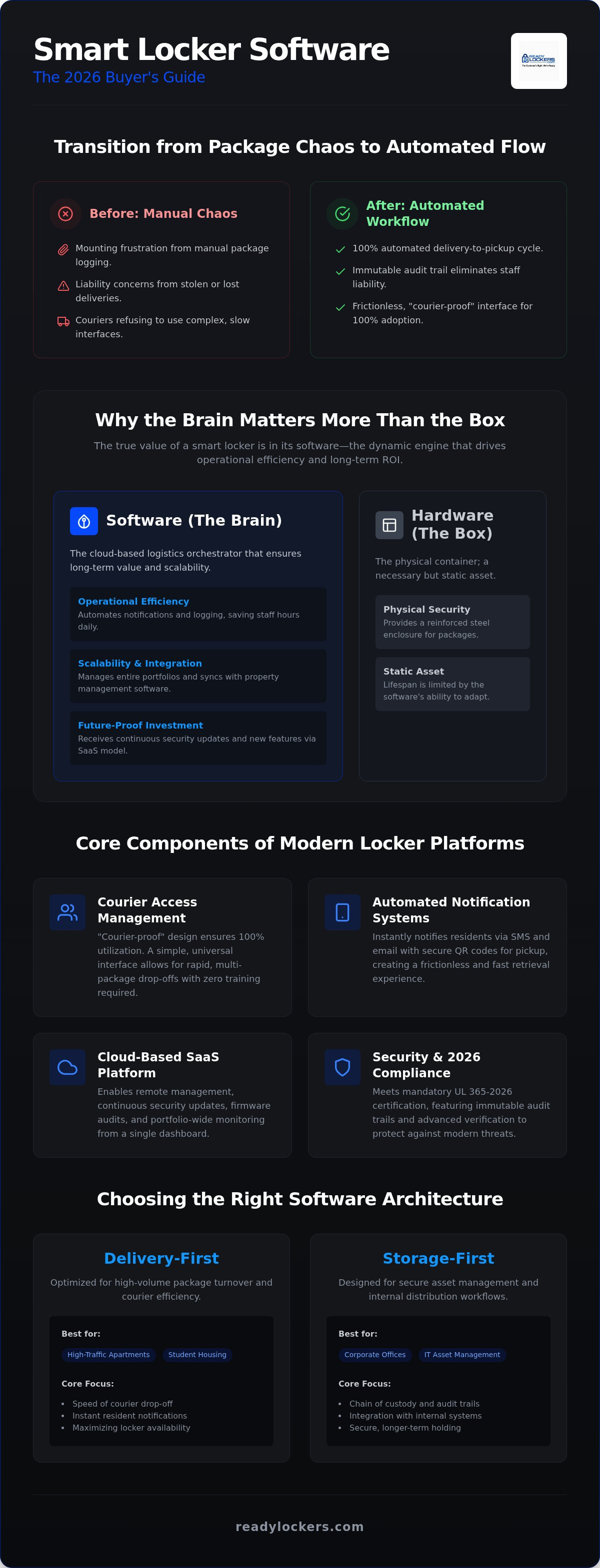
When conducting a smart locker software comparison, it's easy to get distracted by the gauge of the steel or the finish of the paint. While physical durability is necessary, the hardware is a static asset. The software is the dynamic engine that manages every transaction. In 2026, we define this software as a cloud-based logistics orchestrator. It doesn't just unlock a door. It validates courier credentials, triggers instant notifications, and maintains an immutable audit trail to eliminate liability for lost items.
We've moved past the era of hardware-centric digital locks. Early systems relied on local controls that required manual updates and physical intervention. Modern Smart locker technology has evolved into a SaaS-driven model. This shift is critical because the software determines the lifespan and scalability of your investment. A steel box can last twenty years, but if the software cannot integrate with new courier APIs or updated security protocols, the system becomes obsolete within months. High-performance software prevents package theft by ensuring that every delivery is logged and every pickup is authenticated.
Software vs. Hardware: Where the ROI Truly Lives
Hardware provides physical security, but software provides operational efficiency. This smart locker software comparison emphasizes that 'dumb' lockers with local-only software often fail in high-traffic environments. They lack the ability to handle 'ghost' deliveries or provide proactive maintenance alerts. The true ROI comes from a SaaS model that ensures continuous feature updates. This model allows property managers to scale their logistics across multiple sites without increasing headcount. By automating the delivery-to-pickup workflow, you remove the burden of manual package logging from your staff, immediately reclaiming hours of lost productivity every week.
The 2026 Standard for Smart Locker Connectivity
The 2026 standard has moved entirely away from local server installations in favor of secure cloud management. Modern property logistics require real-time synchronization. If you manage a multi-site portfolio, you need a single interface to monitor locker occupancy and courier performance across all locations. Integration capabilities are also mandatory. Your locker management platform must communicate directly with existing property management software to automate resident move-ins and move-outs. Beyond basic connectivity, software must now support the UL 365-2026 standard. This includes remote firmware security audits and infrared anti-tailgating verification to ensure your system remains secure against modern threats. This level of synchronization prevents the package chaos that occurs when systems operate in silos.
Core Components of Modern Locker Management Platforms
A rigorous smart locker software comparison requires looking beyond the login screen to examine the underlying architecture. While the physical structure provides the shell, the software components dictate the speed of your logistics cycle. According to a recent Global Strategic Business Report, the industry is moving rapidly toward platforms that prioritize workflow automation over simple storage. These systems must manage high-volume parcel turnover while maintaining an immutable record of every transaction.
Courier Access Management: Eliminating Delivery Friction
The courier interface is the most critical point of failure in any smart locker deployment. If a FedEx, UPS, or USPS driver finds the system cumbersome, they will likely leave packages in the lobby rather than using the lockers. Successful platforms utilize a "courier-proof" design that requires zero training. This involves a universal automated package receiving system that identifies the carrier instantly and allows for rapid, multi-package drop-offs. By removing this friction, you ensure 100% locker utilization and prevent the package chaos that typically plagues unmanaged buildings.
Automated Notification Systems: SMS and QR Technology
Speed is the primary metric for recipient pickup. SMS remains the gold standard for notifications because it bypasses the clutter of email and doesn't require the resident to download a proprietary app. A robust locker notification system sms qr reduces retrieval time by over 50% by putting the pickup key directly into the user's native messaging stream. QR codes further enhance this efficiency by facilitating a completely contactless experience. The recipient simply scans their code at the console, and the door opens automatically without any physical screen contact.
Recipient interfaces must also provide redundancy. While QR codes are the preferred modern method, manual PIN entry serves as an essential backup for accessibility. On the administrative side, dashboards must offer real-time occupancy tracking and usage analytics. These data points allow property managers to identify "ghost" deliveries or residents who leave packages in lockers for extended periods. If you are looking to optimize your property logistics, exploring a modular locker management platform can provide the granular data needed to scale your operations efficiently across multiple sites.
Comparing Delivery-First vs. Storage-First Software Architectures
A critical mistake in any smart locker software comparison is assuming all management platforms operate with the same logic. The software architecture determines whether your system acts as a high-speed logistics engine or a secure day-use storage bank. Selecting the wrong framework leads to immediate operational friction. A delivery-first system is built for a high-turnover "in-and-out" workflow, while a storage-first system focuses on long-term user assignments and personal asset security. You must align the software’s "brain" with your primary use case to avoid wasting your capital investment.
Package Logistics Logic: The Delivery-First Edge
Delivery-first software is engineered to solve the "last-inch" delivery crisis. It prioritizes the efficiency of the courier-to-recipient handoff above all else. This architecture includes specific protocols for handling overflow when locker banks reach 100% capacity. It allows couriers to log oversized items that don't fit into standard doors, maintaining a digital chain of custody even for items placed in a secure overflow room. This ensures that every parcel is tracked from the moment it enters the building until the recipient scans their QR code.
- Automated Reminders: The system sends escalating SMS notifications to recipients to ensure lockers are cleared quickly.
- Occupancy Time-outs: Administrative alerts flag packages that have been stagnant for over 48 hours to prevent "locker squatting."
- Chain of Custody: Digital signatures and QR logs provide a secure, auditable trail that reduces property liability for lost items.
Workplace Storage Logic: The Employee Experience
In corporate environments, the priority shifts toward employee convenience and facility management. Storage-first architectures are optimized for hot-desking, gym gear, and personal belongings. These platforms integrate directly with corporate directories and existing employee badges. This allows workers to access a locker using the same credentials they use for building entry, creating a frictionless workplace experience. It removes the need for staff to manage physical keys or separate digital accounts.
Facility managers rely on these platforms to optimize expensive office floor space. Detailed usage analytics reveal which locker banks are underutilized, allowing for data-driven decisions on office layouts and locker density. While these systems provide excellent security for personal assets, a smart locker software comparison shows they often lack the aggressive notification logic required for high-volume residential parcel delivery. Using a storage-first platform for a busy apartment complex will inevitably lead to "ghost" deliveries and resident frustration as lockers remain occupied by non-urgent items.
How to Choose Your Software Stack Based on Property Type
Selecting the right platform requires a deep understanding of your property's specific logistical flow. A generic smart locker software comparison often fails to account for the unique demands of different sectors. While a residential building prioritizes resident ease-of-use, a retail environment requires software that can handle customer-facing financial transactions. In 2026, the software stack must be tailored to solve the specific pain points of your tenants, employees, or customers.
- Corporate Offices: These environments require a balance between personal storage for hybrid workers and secure internal mail distribution.
- Retail and Click-and-Collect: Software must integrate with POS systems to facilitate rapid customer pickups and returns.
- Educational and Healthcare: These institutions demand a secure chain-of-custody for sensitive items like lab samples or student electronics.
Software Needs for Multi-Family and Luxury Apartments
In high-density residential settings, the primary goal is to eliminate package room chaos. Automated locker assignments ensure that every parcel has a designated spot the moment it arrives. Implementing smart package lockers for apartments directly increases property value by offering a premium amenity that residents now view as a standard requirement. Beyond basic delivery, the software must handle guest access and temporary delivery permissions. This allows residents to grant one-time codes to couriers or service providers, maintaining security while ensuring seamless logistics.
Data-Driven Logistics: Usage Analytics for Property Owners
Property managers often struggle to justify infrastructure expansions without concrete data. When you perform a smart locker software comparison, look for platforms that provide deep smart locker usage analytics. These tools transform raw delivery numbers into actionable insights. You can identify peak delivery times to optimize staff presence and use occupancy trends to plan for future locker expansions. These reports also allow you to hold couriers accountable by tracking delivery success rates and identifying carriers that consistently ignore locker protocols. This level of transparency ensures that your investment remains a high-performing utility for the long term.
Choosing the right stack ensures your logistics remain frictionless as your property grows. If you're ready to implement a scalable, cloud-based platform across your portfolio, you can explore our modular locker software solutions today.
ReadyLockers: A Unified SaaS Solution for 2026 Logistics
ReadyLockers provides the definitive answer to the challenges highlighted in this smart locker software comparison. Our cloud-based SaaS platform acts as a high-performance logistics orchestrator, built for zero downtime and effortless scalability. We don't just sell lockers; we provide a complete ecosystem where modular hardware meets intelligent automation. This universal solution serves apartments, corporate offices, and warehouses with the same level of precision. It's the standard requirement for any contemporary property seeking to eliminate package chaos while maintaining professional standards.
The synergy between our modular hardware and recurring SaaS value creates a sustainable logistics environment. You aren't just buying a box; you're investing in a system that grows with your needs. Our software manages the heavy lifting of courier authentication and resident notifications, allowing your team to focus on higher-value tasks. This approach reduces liability and ensures a 100% automated delivery-to-pickup workflow. By positioning ourselves as a Modern Efficiency Expert, we ensure that your property logistics remain frictionless from the first day of installation.
Simplified Management for Complex Portfolios
Property managers overseeing complex portfolios require centralized control. Our platform allows you to monitor locker occupancy and courier performance across multiple national sites from one interface. You can deploy new units without the need for extensive software reconfiguration. This streamlined installation process ensures your logistics operations remain uninterrupted during expansion. We've designed every component to handle the high-volume demands of the US market, providing a reliable utility that staff and residents can trust 24/7.
The ease of expansion is a core feature of our software architecture. As your delivery volume increases, you can add modular locker segments that the software recognizes instantly. This eliminates the need for manual database updates or hardware re-mapping. Our centralized dashboard provides real-time visibility into every site, allowing property owners to make data-driven decisions about their infrastructure needs. This level of oversight is essential for maintaining the security and efficiency of large-scale residential or commercial developments.
Future-Proofing Your Smart Locker Investment
A static locker bank quickly becomes obsolete without a proactive software partner. ReadyLockers utilizes a SaaS model to adapt to changing courier technologies and security requirements. This includes maintaining compliance with the latest UL 365-2026 standards through remote firmware audits and thermal runaway suppression monitoring. We prioritize a contactless, frictionless pickup experience to ensure your investment remains a valuable asset for years to come. Our commitment to continuous updates means your property will always lead in logistical efficiency.
Choosing a platform that evolves is the only way to protect your capital expenditure. We anticipate shifts in the logistics industry, such as the rise of Matter-over-Thread support and AI-driven delivery verification, and integrate these into our cloud platform. This ensures that your hardware remains relevant and functional regardless of how courier protocols change. Our goal is to provide a steady, dependable utility that offers peace of mind through reliability. Explore ReadyLockers’ software and hardware solutions today.
Modernizing Your Property Logistics for 2026
Choosing the right management platform is the single most important decision in your smart locker deployment. This smart locker software comparison demonstrates that the efficiency of your parcel workflow depends entirely on the digital intelligence behind the hardware. You now understand that a delivery-first architecture is essential for high-volume environments. Cloud-based SaaS models provide the necessary security and scalability for multi-site portfolios. By prioritizing automated notification engines and seamless courier interfaces, you eliminate manual logging and reduce liability across your organization.
ReadyLockers offers a unified solution that combines instant SMS and QR code notifications with 24/7 contactless retrieval. Our SaaS platform ensures your system receives continuous updates to meet evolving security standards and courier protocols. This proactive approach turns a standard locker bank into a high-performing utility that serves residents and employees with absolute reliability. It's time to move beyond package chaos and implement a frictionless logistics standard that works for your property. View the ReadyLockers Smart Management Platform today and experience the future of automated property logistics.
Frequently Asked Questions
Is cloud-based smart locker software more secure than on-premise solutions?
Cloud-based software is generally more secure because it allows for real-time security patches and remote firmware audits. Unlike on-premise systems that require manual intervention, cloud platforms receive automated updates to combat emerging digital threats. This centralized management ensures that every locker in your network meets the latest UL 365-2026 standards. It provides a level of protection that local servers simply cannot match without constant, expensive oversight from an IT team.
Can smart locker software integrate with my existing property management system?
Professional locker management platforms are designed to integrate seamlessly with major property management software via open APIs. This connection automates resident data synchronization, ensuring that move-ins and move-outs are reflected in the locker system instantly. By linking these platforms, you eliminate the need for manual data entry and reduce the risk of delivery errors. This integration is a core factor when conducting a smart locker software comparison for multi-family residential buildings.
How does the software handle couriers from different companies like FedEx or UPS?
The software utilizes a universal courier access interface that identifies the carrier and validates their credentials in seconds. Couriers from FedEx, UPS, and USPS use a streamlined touchscreen process to select recipients and assign lockers. This "courier-proof" logic ensures that drivers can complete multiple drop-offs without specific training. The system maintains a digital chain of custody for every carrier, providing property managers with clear visibility into courier performance and delivery success rates.
What happens if a resident loses their notification or QR code?
Residents can easily recover their pickup credentials through the system's self-service interface or by contacting property staff. The software allows administrators to resend SMS or email notifications with a single click from the management dashboard. Additionally, most modern consoles include an "I forgot my code" option that verifies the resident's identity through their registered phone number. This redundancy ensures that package retrieval remains frictionless even when a user loses their original digital notification.
Does smart locker software provide data on which residents use the system most?
Yes, the administrative dashboard provides granular usage analytics that identify high-volume users and occupancy trends. Property managers can track how long packages remain in lockers and identify residents who consistently delay retrievals. This data is essential for optimizing locker availability and planning for future modular expansions. By monitoring these patterns, you can implement targeted reminders or adjustments to your package policy to maintain a 100% automated delivery-to-pickup workflow across the site.
Are there recurring fees associated with smart locker management software?
Most enterprise-grade platforms operate on a SaaS model which involves a recurring annual or monthly fee. This fee covers cloud hosting, continuous security updates, and technical support. In any smart locker software comparison, it's important to view these fees as an investment in the system's longevity. This model ensures your lockers stay compatible with new courier technologies and regulatory standards without requiring expensive hardware replacements or manual, on-site software reconfigurations.
How does the software manage oversized packages that won’t fit in a standard locker?
The software includes an overflow management protocol specifically for oversized items. When a package exceeds standard locker dimensions, the courier can log the delivery into the system and place the item in a designated secure room. The recipient still receives an automated SMS or QR code notification, but the instructions direct them to the overflow area instead of a specific locker door. This maintains a digital chain of custody for every parcel regardless of size.
Can I manage multiple buildings from a single software dashboard?
Modern cloud-based platforms provide a centralized dashboard that allows property managers to oversee multiple locations from one interface. You can monitor locker occupancy, courier activity, and system health across your entire portfolio without visiting each site. This centralized control is particularly valuable for regional managers who need real-time data to optimize logistics. The software allows for global policy updates, ensuring consistent service standards across all your residential or commercial properties.

Frequently Asked Questions
Is cloud-based smart locker software more secure than on-premise solutions?+
Cloud-based software is generally more secure because it allows for real-time security patches and remote firmware audits. Unlike on-premise systems that require manual intervention, cloud platforms receive automated updates to combat emerging digital threats. This centralized management ensures that every locker in your network meets the latest UL 365-2026 standards. It provides a level of protection that local servers simply cannot match without constant, expensive oversight from an IT team.
Can smart locker software integrate with my existing property management system?+
Professional locker management platforms are designed to integrate seamlessly with major property management software via open APIs. This connection automates resident data synchronization, ensuring that move-ins and move-outs are reflected in the locker system instantly. By linking these platforms, you eliminate the need for manual data entry and reduce the risk of delivery errors. This integration is a core factor when conducting a smart locker software comparison for multi-family residential buildings.
How does the software handle couriers from different companies like FedEx or UPS?+
The software utilizes a universal courier access interface that identifies the carrier and validates their credentials in seconds. Couriers from FedEx, UPS, and USPS use a streamlined touchscreen process to select recipients and assign lockers. This "courier-proof" logic ensures that drivers can complete multiple drop-offs without specific training. The system maintains a digital chain of custody for every carrier, providing property managers with clear visibility into courier performance and delivery success rates.
What happens if a resident loses their notification or QR code?+
Residents can easily recover their pickup credentials through the system's self-service interface or by contacting property staff. The software allows administrators to resend SMS or email notifications with a single click from the management dashboard. Additionally, most modern consoles include an "I forgot my code" option that verifies the resident's identity through their registered phone number. This redundancy ensures that package retrieval remains frictionless even when a user loses their original digital notification.
Does smart locker software provide data on which residents use the system most?+
Yes, the administrative dashboard provides granular usage analytics that identify high-volume users and occupancy trends. Property managers can track how long packages remain in lockers and identify residents who consistently delay retrievals. This data is essential for optimizing locker availability and planning for future modular expansions. By monitoring these patterns, you can implement targeted reminders or adjustments to your package policy to maintain a 100% automated delivery-to-pickup workflow across the site.
Are there recurring fees associated with smart locker management software?+
Most enterprise-grade platforms operate on a SaaS model which involves a recurring annual or monthly fee. This fee covers cloud hosting, continuous security updates, and technical support. In any smart locker software comparison, it's important to view these fees as an investment in the system's longevity. This model ensures your lockers stay compatible with new courier technologies and regulatory standards without requiring expensive hardware replacements or manual, on-site software reconfigurations.
How does the software manage oversized packages that won’t fit in a standard locker?+
The software includes an overflow management protocol specifically for oversized items. When a package exceeds standard locker dimensions, the courier can log the delivery into the system and place the item in a designated secure room. The recipient still receives an automated SMS or QR code notification, but the instructions direct them to the overflow area instead of a specific locker door. This maintains a digital chain of custody for every parcel regardless of size.
Can I manage multiple buildings from a single software dashboard?+
Modern cloud-based platforms provide a centralized dashboard that allows property managers to oversee multiple locations from one interface. You can monitor locker occupancy, courier activity, and system health across your entire portfolio without visiting each site. This centralized control is particularly valuable for regional managers who need real-time data to optimize logistics. The software allows for global policy updates, ensuring consistent service standards across all your residential or commercial properties.