Smart locker fire code regulations for barriers and fire suppression
Explore fire code regulations for smart lockers, including egress, fire barriers, sprinkler coverage, and ways to assess compliance as layouts change safely.

A smart locker can affect more than package access: its placement may change how a building maintains fire protection and clear egress. Fire code regulations for smart lockers in the United States depend on the locally adopted code and the installation’s effect on fire barriers, emergency aisles, and sprinkler coverage. NFPA guidance addresses in-rack sprinklers for racks exceeding 20 feet in depth or 25 feet in height.
Compliance does not end when lockers are installed. Changes to the layout, stored items, or access routes can affect whether the original fire-safety plan still fits the space. Property managers need to understand the locally adopted code requirements and how the equipment interacts with the building’s fire-protection systems.
This article explains how NFPA fire-safety codes relate to smart lockers, what fire barriers and unobstructed aisles mean in practice, and how sprinkler and suppression requirements can vary with rack configuration. It also outlines the role of fire code analysis in identifying layout and protection issues, so you can plan for continued compliance as the site changes.
Key Takeaways
- Understand when corridor locker placement can be allowed and why preserving required egress width matters.
- Learn how fire barriers and clear emergency aisles affect locker placement and restocking access.
- See how rack design influences sprinkler coverage and the space needed around storage.
- Find out how fire code analysis can assess site layouts, alarms, exits, and fire protection as conditions change.
NFPA fire safety codes and locker compliance
NFPA fire-safety codes are relevant when lockers affect storage arrangements, fire protection, or access routes. Compliance depends on locally adopted requirements and the specific hazards of the installation.
NFPA 1 and NFPA 30 are among the codes considered in fire code analysis. Their relevance depends on the building, stored materials, and proposed layout, so a code review should assess the installation rather than assume one rule covers every site.
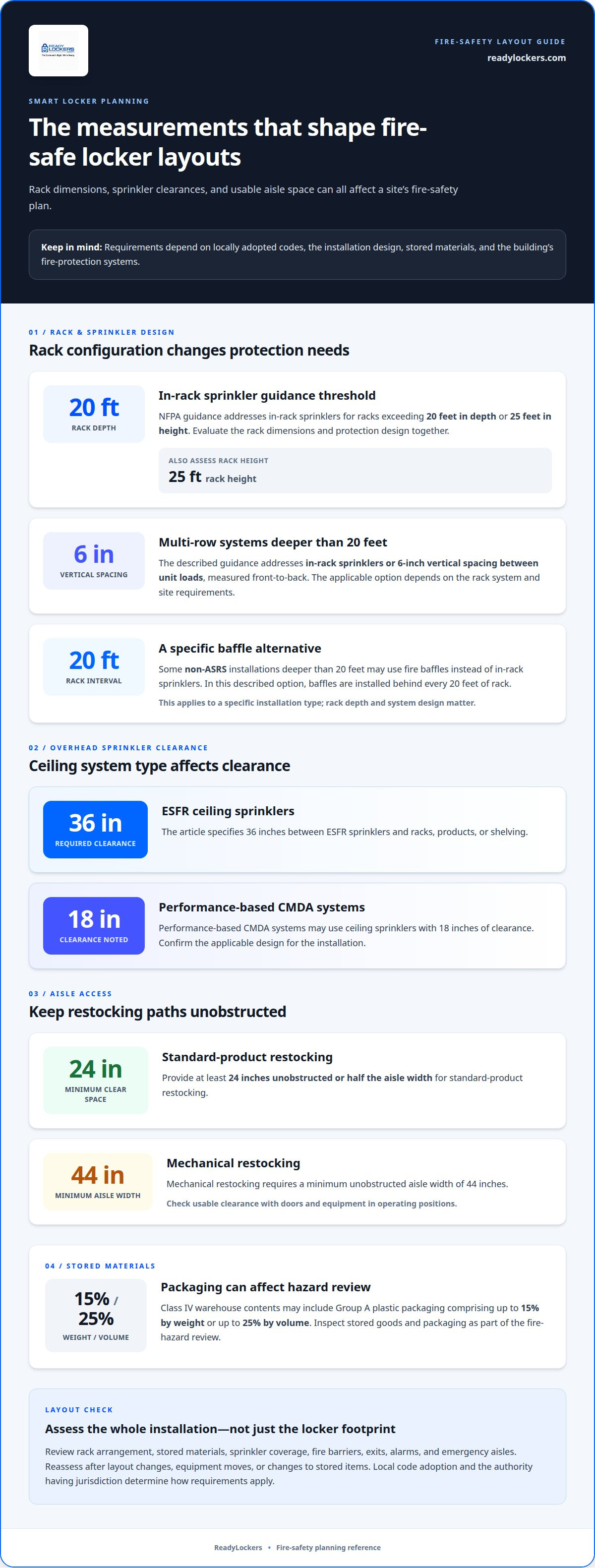
Rack depth and height can affect suppression design. NFPA guidance addresses in-rack sprinklers for racks exceeding 20 feet in depth or 25 feet in height. For multi-row rack systems deeper than 20 feet, the described guidance also addresses in-rack sprinklers or 6-inch vertical spacing between unit loads, front-to-back.
Materials matter, too. Class IV warehouse contents may include Group A plastic packaging comprising up to 15% by weight or up to 25% by volume. An inspection of stored goods and packaging helps identify whether the storage arrangement presents a fire hazard.
Fire-code analysis examines relevant protection features, including sprinklers, barriers, exits, and alarms. Electrical, wiring, and power-supply requirements depend on the installation design and locally adopted codes. Battery and charging-device rules also depend on the equipment and applicable requirements, so include them in the site’s fire-safety review.
Permits, Inspections, and Approvals
Permit and approval requirements depend on locally adopted codes and the scope of the installation. The applicable International Fire Code edition is determined locally by the jurisdiction in coordination with the fire department. A fire inspector can explain how relevant requirements apply to the proposed locker arrangement. Early review can identify whether the layout or protection plan needs changes before installation.
Compliance Roles and Verification
The authority having jurisdiction interprets and enforces applicable local requirements, while the property owner remains responsible for site conditions. Before installation, document the proposed layout, stored materials, rack dimensions, power equipment, and effects on exits and fire protection. A noncompliant arrangement may require corrective action and create liability exposure, especially if it obstructs access or compromises fire safety. Ongoing inspections can identify changes that may affect compliance.
Fire barriers and emergency access aisles
Locker placement can affect fire barriers, emergency routes, and access for firefighting. Warehouse high-piled storage requirements address these features together because obstructions can interfere with firefighting access or fire protection. Review the full layout, including doors, aisles, and barrier locations, rather than assessing each locker in isolation.
The 2021 International Fire Code prohibits storing clothing and personal effects in corridors and lobbies, subject to stated exceptions. Metal lockers may be permitted in corridors when the minimum required egress width remains clear. The corridor-storage exception also addresses approved automatic sprinklers under Section 903.3.1.1 and approved fire alarms under Section 907. These conditions don’t remove the need to preserve egress.
Restocking needs also affect aisle planning. Standard-product restocking requires at least 24 inches unobstructed or half the aisle width. Mechanical restocking requires a minimum unobstructed aisle width of 44 inches. Measure usable clearance with doors and equipment in operating positions; a route that looks open on a plan may narrow during handling.
Accessibility adds another consideration to placement. ADA guidelines address accessible height ranges, reachable operable parts, adequate maneuvering space, and appropriate signage. Users need to be able to approach a compartment and operate its controls within the applicable reach range. Both hardware placement and surrounding clearance matter.
Secure storage also depends on accountable access. Establish procedures that identify who can access compartments and how that access is recorded. Smart-locker audit trails can capture event timestamps, compartment identifiers, action types, and authenticated user identities. Records should be tamper-evident and exportable for inspections, with retention based on governing requirements.
Before installation, compare the proposed locker footprint with barriers, required egress, accessibility features, and restocking paths. Reassess clearances after layout changes, equipment moves, or changes to stored items. This helps identify blocked routes and access-control gaps before they disrupt daily operations.
Sprinkler systems and fire suppression
Sprinkler design depends on rack configuration, stored materials, and access for fire suppression. Adding lockers can change how goods are arranged beneath existing sprinklers. Assess the revised layout rather than assuming the previous protection plan still matches site conditions.
In-rack sprinklers address fire within rack storage, while ceiling-level sprinklers protect from above. NFPA guidance addresses in-rack sprinklers when racks exceed 20 feet in depth or 25 feet in height. For multi-row systems deeper than 20 feet, guidance also addresses in-rack sprinklers or 6-inch vertical spacing between unit loads, front-to-back.
Some non-ASRS installations deeper than 20 feet may use fire baffles as an alternative to in-rack sprinklers. The baffles are installed behind every 20 feet of rack. This option concerns a specific installation type, so rack depth and system design matter when evaluating it.
Ceiling sprinkler type affects required clearance. ESFR ceiling sprinklers require 36 inches between sprinklers and racks, products, or shelving. Performance-based CMDA systems may use ceiling sprinklers with 18 inches of clearance. Where sprinklers are absent, warehouse racks or inventory should have 24 inches of clearance from the ceiling.
Local codes may require ceiling-level sprinklers when rack configurations limit ground-level suppression access. Dense storage, for example, can obstruct water from reaching a fire at floor level. Sprinkler requirements therefore depend on the facility’s layout and suppression access, not simply on locker dimensions.
Plan an inspection after an addition or major rearrangement. Confirm that stored goods and locker placement preserve intended sprinkler clearances. Employees should keep packages and equipment out of protected spaces during daily handling. Record the layout reviewed, the sprinkler type, and any changes that could affect coverage. These details help determine when the fire-suppression arrangement needs reassessment.
Fire code analysis
Fire-code requirements vary according to locally adopted rules, building use, and locker layout. The applicable code edition can differ by jurisdiction and may not be the newest edition.
State and City Requirements
State and local requirements are the fire and building codes adopted for a property. The applicable International Fire Code edition is determined locally in coordination with the fire department. As a result, identical locker layouts may face different review criteria in different jurisdictions. The local fire department can clarify how adopted provisions apply to the proposed installation.
A fire-code analysis should identify the adopted editions before assessing the site. It can examine sprinklers, fire barriers, emergency exits, and alarms in relation to the planned locker footprint. This helps reveal whether an existing layout or proposed change affects fire protection or access. If inventory or storage arrangements change, update the analysis to reflect current conditions rather than relying on an outdated floor plan.
Building Type and Occupancy Requirements
Building type and occupancy describe how a property is used and the hazards its contents and operations create. A warehouse with high-piled combustible storage, for example, has different considerations from lockers in a building corridor. Under the International Fire Code, qualifying facilities with high-piled combustible rack storage require an operational permit.
Corridor rules also depend on the adopted edition and conditions. The 2021 International Fire Code generally prohibits storing clothing and personal effects in corridors and lobbies, subject to stated exceptions. Permitted corridor storage must preserve required egress width and meet applicable protection conditions. These distinctions matter when assessing whether a planned location fits the building’s use.
For a useful review, document the occupancy, locker location, stored materials, and any proposed additions. Then conduct an analysis against the locally adopted code and the site’s existing protection features. If the installation changes how an area is used or storage conditions exceed existing assumptions, the review should account for that change. Explore smart package lockers as part of planning a site-specific layout.
ReadyLockers: Smart Package Lockers
ReadyLockers provides Smart Package Lockers for properties planning a secure, convenient package pickup point. Once fire barriers, egress, accessibility, and sprinkler clearances have been assessed, property teams can consider how locker placement fits their operational needs. The building’s code review remains an essential part of planning.
ReadyLockers’ Locker Management Software supports the locker system, while its Contactless Pickup System lets recipients collect packages without a direct handoff. The Courier Access Interface enables couriers to use the lockers. Together, these offerings support package delivery and pickup workflows without replacing a property’s fire-safety review.
If you’re planning a locker installation or updating an existing package area, contact ReadyLockers to discuss your property’s needs.
Plan for compliance as the site evolves
Make fire safety part of every space-planning decision, not a final installation task. Renovations, new equipment, or changes in package volume can alter how a locker area functions. Revisit fire code regulations for smart lockers whenever the layout or building use changes.
Bring the proposed locker location into the property’s planning process early. This gives the project team a chance to consider operational needs alongside the site’s fire-safety review, before design decisions become difficult to change. Define the intended use clearly, and revisit the plan when site conditions shift.
ReadyLockers can help you explore a package-locker setup that fits your property’s workflow. Contact ReadyLockers to discuss your project and take the next step with a clear plan.
Frequently Asked Questions
How can property managers ensure ongoing compliance after installation?
To maintain compliance with fire code regulations for smart lockers, keep the approved layout and fire-safety review with the property’s records. Revisit them when site conditions change. New storage nearby, a revised delivery workflow, or a change in how an area is used can affect earlier assumptions. Document changes and include the locker area in the property’s established inspection process.
What fire codes apply to smart lockers in the United States, including NFPA and International Fire Code requirements?
The applicable fire code regulations for smart lockers may draw on NFPA fire-safety codes and the locally adopted International Fire Code. NFPA 1 and NFPA 30 are among the codes considered in fire code analysis. The International Fire Code edition is adopted locally, so the applicable edition may differ between jurisdictions. Qualifying facilities with high-piled combustible rack storage require an operational permit under that code.
Do smart lockers need to meet fire-resistance or flame-spread ratings?
No single fire-resistance or flame-spread rating applies to every smart-locker installation. The assessment depends on locally adopted codes, building occupancy, stored materials, and installation conditions. A locker in a corridor, for example, may raise different considerations from one in a designated storage area. Include locker materials and intended placement in the site’s fire-code analysis to assess relevant requirements.
What fire-code rules govern smart-locker placement in corridors, exits, and egress paths?
Locker placement must preserve required egress width and keep exit routes usable. Under the 2021 International Fire Code, corridor storage of clothing and personal effects is generally prohibited, subject to stated exceptions. Metal lockers may be allowed in corridors when required egress width is maintained. Whether an exception applies also depends on the corridor’s protection conditions and the code edition adopted locally.
Are there limits on smart-locker size, quantity, or occupancy in buildings?
There is no single size or unit-count limit that applies to every building. The assessment depends on local code adoption, occupancy, storage use, and effects on egress and fire protection. A group of lockers that reduces usable corridor width raises different concerns from lockers in a designated storage area. Qualifying facilities with high-piled combustible rack storage also require an operational permit.
Do smart lockers require sprinklers, smoke detection, or fire-rated enclosures?
Sprinkler needs depend on storage configuration and suppression access, not simply on whether the equipment is a smart locker. Rack depth and height can affect whether in-rack sprinklers are considered, while configurations that restrict ground-level suppression access may trigger ceiling-level sprinkler requirements under local codes. Assess detection and enclosure needs as part of the building’s fire-code analysis, taking into account existing alarms, occupancy, and the proposed locker location.

Frequently Asked Questions
How can property managers ensure ongoing compliance after installation?+
To maintain compliance with fire code regulations for smart lockers, keep the approved layout and fire-safety review with the property’s records. Revisit them when site conditions change. New storage nearby, a revised delivery workflow, or a change in how an area is used can affect earlier assumptions. Document changes and include the locker area in the property’s established inspection process.
What fire codes apply to smart lockers in the United States, including NFPA and International Fire Code requirements?+
The applicable fire code regulations for smart lockers may draw on NFPA fire-safety codes and the locally adopted International Fire Code. NFPA 1 and NFPA 30 are among the codes considered in fire code analysis. The International Fire Code edition is adopted locally, so the applicable edition may differ between jurisdictions. Qualifying facilities with high-piled combustible rack storage require an operational permit under that code.
Do smart lockers need to meet fire-resistance or flame-spread ratings?+
No single fire-resistance or flame-spread rating applies to every smart-locker installation. The assessment depends on locally adopted codes, building occupancy, stored materials, and installation conditions. A locker in a corridor, for example, may raise different considerations from one in a designated storage area. Include locker materials and intended placement in the site’s fire-code analysis to assess relevant requirements.
What fire-code rules govern smart-locker placement in corridors, exits, and egress paths?+
Locker placement must preserve required egress width and keep exit routes usable. Under the 2021 International Fire Code, corridor storage of clothing and personal effects is generally prohibited, subject to stated exceptions. Metal lockers may be allowed in corridors when required egress width is maintained. Whether an exception applies also depends on the corridor’s protection conditions and the code edition adopted locally.
Are there limits on smart-locker size, quantity, or occupancy in buildings?+
There is no single size or unit-count limit that applies to every building. The assessment depends on local code adoption, occupancy, storage use, and effects on egress and fire protection. A group of lockers that reduces usable corridor width raises different concerns from lockers in a designated storage area. Qualifying facilities with high-piled combustible rack storage also require an operational permit.
Do smart lockers require sprinklers, smoke detection, or fire-rated enclosures?+
Sprinkler needs depend on storage configuration and suppression access, not simply on whether the equipment is a smart locker. Rack depth and height can affect whether in-rack sprinklers are considered, while configurations that restrict ground-level suppression access may trigger ceiling-level sprinkler requirements under local codes. Assess detection and enclosure needs as part of the building’s fire-code analysis, taking into account existing alarms, occupancy, and the proposed locker location.