Senior Living Community Package Lockers: A 2026 Planning Guide
Plan senior living community package lockers effectively. Balance resident usability and staff workflows to guarantee seamless, secure delivery management.

What if the easiest package process for staff isn’t the easiest one for residents? Senior living community package lockers work best when resident usability and staff workflows are planned together. A defined pickup process can reduce the need for staff to receive, sort, store, and distribute every parcel, but it also needs to account for residents with different mobility, technology, and assistance needs.
Start by deciding where deliveries go, how couriers access the system, how residents receive pickup instructions, and what happens when a parcel isn’t collected. Smart locker hardware and management software can coordinate delivery and pickup, including courier access management and SMS or QR-code notifications. The setup still needs to fit the community’s routines and the people who use it.
This guide explains how to assess resident needs, map staff and courier workflows, and evaluate locker features, placement, procedures, and ongoing management. Use it to plan a secure, usable delivery process that supports resident convenience without overlooking day-to-day operations.
Key Takeaways
- Plan senior living community package lockers around resident needs and staff routines, not pickup convenience alone.
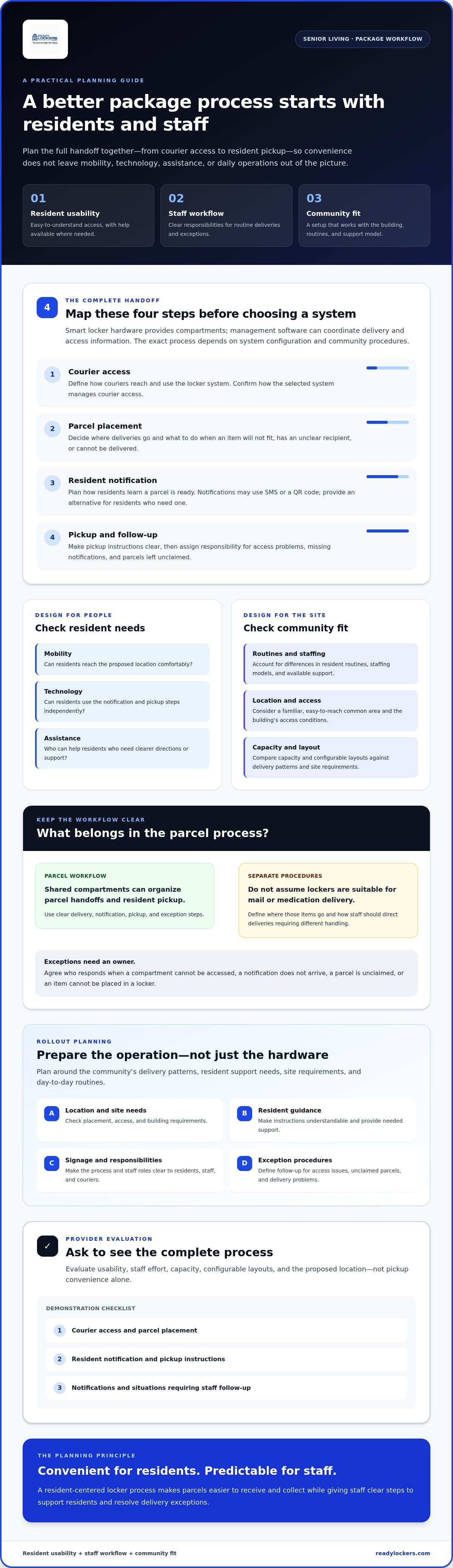
- Map courier access, parcel placement, resident notifications, and pickup before selecting a system.
- Compare options based on usability, staff effort, capacity, configurable layouts, and the proposed location.
- Plan the rollout around delivery patterns, resident support needs, site requirements, signage, and clear exception procedures.
- Ask providers to demonstrate the complete delivery-to-pickup process, including notifications and situations that need staff follow-up.
Why Senior Living Communities Need a Resident-Centered Package Process
Deliveries can create a steady stream of small tasks: receiving parcels, identifying recipients, keeping items organized, and arranging pickup. When packages gather in a lobby or at a staff desk, they can take attention away from other work and leave residents unsure where to collect their items. Senior living community package lockers provide shared parcel pickup infrastructure, with designated compartments where couriers can leave packages for residents to retrieve through a defined process.
Lockers are one way to organize parcel handoffs, not a replacement for a community’s assistance procedures. The broader parcel locker technology category includes systems that coordinate compartment access and pickup. In a senior living setting, the process also needs to account for who can use it independently, who may need help, and how staff will handle exceptions.
How package delivery needs vary across senior living settings
Independent living, assisted living, and other community settings can differ in resident routines, staffing models, building layouts, and available support. Some residents may prefer to collect a parcel themselves; others may need clear directions or staff assistance. A locker near a familiar, easy-to-reach common area may work better than one along a long corridor or inside a controlled-access space.
Keep parcel pickup separate from mail handling and medication delivery. Those processes may have different destinations, staff roles, or community procedures, so don’t assume a locker is suitable for every item. Define what belongs in the parcel workflow and how staff should direct deliveries that require different handling.
What residents and staff need from a package process
A usable process combines secure receipt with understandable notifications, convenient pickup, and enough staff visibility to resolve issues. Automated SMS or QR-code notifications can tell residents that a parcel is ready, but consider residents who don’t use a mobile phone or need help interpreting a message. Provide a clear alternative where needed, and make responsibilities known to residents, staff, and couriers.
Agree in advance who responds when a notification doesn’t arrive, a compartment can’t be accessed, or a parcel remains unclaimed. Without clear ownership, exceptions can return to the front desk as informal tasks and undermine the intended workflow.
A resident-centered locker process makes parcels easy to receive and collect while giving staff clear steps to support residents and resolve delivery exceptions. This keeps both sides of the experience in view: convenient resident access and predictable handling for the team.
How Senior Living Package Lockers Handle Delivery, Notifications, and Pickup
A locker workflow connects four steps: courier access, parcel placement, resident notification, and pickup. Smart locker hardware provides the compartments, while cloud-based management software coordinates delivery and access information. Since the specific steps depend on system configuration and community procedures, define the workflow before rollout.
What happens when a courier delivers a package
The courier uses the designated access process, places the parcel in an available compartment, and records or confirms the delivery according to the system’s workflow. Courier access management can help organize access to the locker interface, while the hardware provides a shared place for parcel handoff. The USPS® Smart Lockers page offers a carrier-specific example of smart lockers used for package delivery and returns. Confirm how your chosen system handles courier access.
Before launch, decide what staff and couriers should do when a parcel doesn’t fit, has an unclear recipient, or can’t be delivered. Configured layouts and access workflows can support the process, but the community still needs procedures for exceptions, such as redirecting an oversized item or contacting a recipient. Don’t assume every parcel can go into a compartment.
How residents receive and retrieve package notifications
Once a parcel is placed and its recipient is recorded, the system can send an automated notification. ReadyLockers supports SMS or QR-code notifications and contactless pickup. The resident follows the provided instructions to access the assigned compartment and retrieve the parcel. The exact notification and pickup steps depend on the system setup.
Not every resident uses text messages or wants to manage a QR code independently. Plan an alternative for residents who need staff assistance, and clarify who can help, how staff will know a parcel is waiting, and how support fits existing routines. To understand the software’s role in coordinating locker activity, see this smart locker management software guide.
Courier access starts the handoff, locker placement triggers a notification, and the resident or designated support person completes pickup. This sequence works best when the community establishes who handles exceptions and how residents can get help. Operators defining those requirements can also review ReadyLockers’ smart package locker platform as one option to evaluate.
How to Evaluate Locker Usability, Security, and Community Fit
A locker system should fit the people, routines, and physical layout of the community. Compare options based on resident usability, staff effort, parcel capacity, and placement, rather than compartment count alone. A practical configuration is one residents can understand and reach, staff can oversee, and couriers can use within established procedures.
Technology preferences can vary among residents, so don’t assume one digital process will suit everyone. PwC and the Urban Land Institute discuss changing expectations in senior living and real estate; their perspective on rising technology expectations among seniors can inform amenity planning, but resident preferences at your own community should guide the final decision.
Does the locker experience work for different residents?
Test the proposed pickup experience. Can residents understand the instructions, read the screen or signage, and complete the steps comfortably? Consider control and compartment reach, visibility of the locker area, lighting, and a clear route to and from it. Ask vendors to demonstrate common pickup tasks, then consider how the process works for residents who choose or need staff or caregiver assistance.
Accessibility and legal requirements should be verified before purchase or publication. Confirm which standards apply to the location and proposed installation using current authoritative guidance and qualified professionals. A general checklist is not proof of compliance.
What to compare in hardware and management features
Evaluate configurable hardware against expected parcel volume, available space, and the types of parcels the community intends to handle. Modular layouts can help align compartments with site needs, but the design should also preserve circulation and avoid creating a bottleneck. Review courier access controls, notification options, and usage analytics based on how staff will manage deliveries and follow up on exceptions.
- Resident use: Are instructions and notification choices clear, with a defined path to support?
- Staff effort: Can staff see relevant locker activity and identify deliveries that need follow-up?
- Site fit: Is the location convenient and visible, with a clear route to it?
- Security process: How are access, staff responsibilities, and exceptions managed?
Security depends on more than locker hardware. Controlled access, clear procedures, and consistent exception handling all matter. No system should be presented as an absolute guarantee. For broader selection criteria, consult the smart package locker buyer’s guide.
How to Plan a Senior Living Locker Rollout Without Disrupting Operations
A smooth rollout starts with understanding the current process, not choosing hardware first. Map typical parcel volumes and delivery patterns. Record who receives and sorts packages, where parcels wait, how residents are notified, and which tasks require staff follow-up. Include residents who may need reminders or pickup assistance. This baseline helps the community define what the system should improve and what work will still require staff attention.
Plan in phases: document current needs, assess possible locations, confirm site requirements, define procedures, then prepare residents, staff, and couriers. Avoid setting installation dates or budgets until providers have reviewed the site and scope.
Questions to resolve before selecting a location
Walk the proposed area during normal community activity. Check available space, visibility, lighting, routes for residents and visitors, and how couriers can reach the lockers without disrupting circulation. Consider whether the location is easy to find and close enough to staff for the level of oversight the community wants.
Confirm power, connectivity, and installation requirements with qualified providers. Review the actual building and proposed locker configuration during the site assessment rather than relying on assumptions from a floor plan alone.
Prepare residents, staff, and couriers for the new process
Before launch, agree on delivery instructions and make them easy to follow. Resident communications should explain how notifications work, where lockers are located, how pickup happens, and how to request help. Staff guidance should identify who handles missed notifications, access problems, parcels that don’t fit, and unclaimed items. Define the escalation path so exceptions don’t become informal tasks with no clear owner.
Use a practical readiness checklist:
- Operations: Confirm parcel patterns, staff responsibilities, and exception procedures.
- Site: Review circulation, visibility, lighting, power, connectivity, and signage.
- People: Prepare clear instructions for residents, staff, and couriers, including an assistance option.
- Launch: Walk through delivery and pickup steps, then clarify how staff will report issues.
Lockers can organize parcel handoffs, but they don’t eliminate every package-related task. A defined support process keeps the rollout aligned with community routines. For additional site-planning considerations, read the smart locker installation planning guide. Once your requirements are documented, review ReadyLockers smart package lockers as an option for your community.
Choosing a Package Locker Partner for Your Senior Living Community
Once your community has documented resident needs, staff responsibilities, and site constraints, use those requirements to compare providers. The strongest fit is not necessarily the system with the most features. Focus on whether the resident experience, configurable hardware, courier access, and management tools align with your delivery process.
Evaluate the physical lockers and recurring software services separately. Ask what hardware is included, how layouts can be configured, and what the software subscription covers. Confirm fees, terms, support arrangements, and ongoing responsibilities directly with each provider. This makes proposals easier to compare and helps surface assumptions before you commit.
Questions to ask a smart locker provider
Ask providers to show how the proposed configuration fits your property layout and anticipated delivery patterns. Then request a complete workflow demonstration, from courier access and parcel placement through notification and pickup. Include a parcel that doesn’t fit, a delivery with unclear recipient details, and a resident who needs assistance. A demonstration can reveal practical steps that a feature list may not explain.
- Configuration: How can locker layouts fit the available site and expected parcels?
- Management: What courier access controls, notification options, and usage analytics are available?
- Resident support: How can the community accommodate residents who don’t use texts or need help with pickup?
- Service terms: What support is included, and what are the software subscription terms and responsibilities?
Confirm that each claimed capability is included in the proposed configuration. ReadyLockers offers configurable smart locker hardware, cloud-based management software, courier access management, usage analytics, and automated SMS or QR-code notifications. Verify the specific functions and terms that matter to your community with the provider.
What to confirm before requesting a proposal
Prepare a concise requirements brief covering resident preferences and assistance needs, staff workflows, site conditions, and how you’ll judge success. Set practical measures, such as whether residents can follow pickup instructions and whether staff can identify parcels that require follow-up. This gives providers a consistent basis for responding.
Before selecting a system, verify accessibility, privacy, security, and integration claims for the proposed setup. Ask which claims are documented, which depend on configuration, and which require separate review by qualified advisers. Senior living community package lockers should be evaluated against the community’s actual requirements, not assumptions about what a system can do.
After setting your criteria, explore ReadyLockers package locker solutions and assess how the available hardware and management tools align with your documented needs.
Build a Package Process Residents Can Use
Senior living community package lockers work best when the system fits resident needs and staff procedures from the start. Define how deliveries move from courier access to pickup, provide a clear path for residents who need assistance, and make ownership of exceptions explicit. These steps help balance convenience, usability, and daily operations.
As you compare options, look beyond compartment capacity. Consider how configurable hardware fits the property and whether management tools support the community’s delivery workflow. ReadyLockers offers modular smart locker hardware alongside a cloud platform with SMS or QR-code notifications, courier access management, and usage analytics. Assess those capabilities against your documented requirements, and verify the configuration and terms directly with the provider.
Ready to explore a system for your community? Explore ReadyLockers smart package locker solutions and take the next step toward a more organized, resident-friendly delivery process.
Frequently Asked Questions
Are package lockers a good fit for senior living communities?
They can be useful when a community receives regular parcel deliveries and wants a defined process for receipt and pickup. Fit depends on resident needs, staffing, available space, and delivery patterns. Before choosing a system, review the full workflow, including how notifications reach residents and what assistance is available for people who don’t use self-service technology. Lockers should support, not replace, community-specific procedures.
How do senior living community package lockers work?
A courier places a package in an assigned compartment using the property’s delivery process. The system can then send the recipient a notification, such as an SMS or QR-code message when supported. The resident follows the pickup instructions to retrieve the parcel. Before launch, define courier access, assistance for residents who need it, how exceptions are handled, and what happens when a package remains uncollected.
Can residents receive help retrieving packages from lockers?
Yes. A community can establish staff-assisted pickup procedures alongside self-service access. The details depend on staffing policies, locker configuration, and the management platform. Before implementation, decide how residents request assistance, which staff members are authorized to help, and how access or handoffs are recorded. Don’t assume a locker system provides caregiving or package-delivery services. Explain the support process to residents and staff before the system is used.
Are package lockers accessible for residents with mobility limitations?
Accessibility depends on the locker location, configuration, routes, instructions, and available assistance. Assess the proposed setup in person and review applicable requirements with qualified professionals. Ask the provider to demonstrate pickup using the planned configuration, including the resident-facing steps. If a resident can’t comfortably use the lockers independently, establish an alternative process with clear staff responsibilities. Don’t assume a system is accessible without evaluating the specific installation and user experience.
What happens if a resident does not receive a locker notification?
The community should define a response for missed or undelivered notifications before launch. Staff can follow the approved procedure to check delivery status, verify the recipient’s contact details, and help with retrieval. Ask the provider what notification records and management tools are available, then confirm how staff can use them. Don’t promise that every message will arrive or that every delivery will generate a notification unless those outcomes have been verified.
Can package lockers handle medication or refrigerated deliveries?
Don’t assume standard package lockers are appropriate for medication, temperature-sensitive parcels, or other controlled deliveries. ReadyLockers does not offer refrigerated storage lockers. Keep specialized delivery procedures separate unless a suitable solution has been verified. Confirm appropriate handling and storage with qualified providers and the staff responsible for those deliveries. Define which items may use the package locker process and how couriers should handle items that fall outside it.
How should a senior living community choose a package locker system?
Start by documenting parcel volume, resident preferences, staff workflows, site constraints, and assistance needs. Compare hardware configuration, courier access, notification options, management tools, and provider support. Ask for a demonstration that covers routine delivery and pickup as well as exceptions and assisted pickup. Verify applicable requirements and each proposed capability before deciding. Choose a system based on the community’s actual workflow, not locker capacity alone.

Frequently Asked Questions
Are package lockers a good fit for senior living communities?+
They can be useful when a community receives regular parcel deliveries and wants a defined process for receipt and pickup. Fit depends on resident needs, staffing, available space, and delivery patterns. Before choosing a system, review the full workflow, including how notifications reach residents and what assistance is available for people who don’t use self-service technology. Lockers should support, not replace, community-specific procedures.
How do senior living community package lockers work?+
A courier places a package in an assigned compartment using the property’s delivery process. The system can then send the recipient a notification, such as an SMS or QR-code message when supported. The resident follows the pickup instructions to retrieve the parcel. Before launch, define courier access, assistance for residents who need it, how exceptions are handled, and what happens when a package remains uncollected.
Can residents receive help retrieving packages from lockers?+
Yes. A community can establish staff-assisted pickup procedures alongside self-service access. The details depend on staffing policies, locker configuration, and the management platform. Before implementation, decide how residents request assistance, which staff members are authorized to help, and how access or handoffs are recorded. Don’t assume a locker system provides caregiving or package-delivery services. Explain the support process to residents and staff before the system is used.
Are package lockers accessible for residents with mobility limitations?+
Accessibility depends on the locker location, configuration, routes, instructions, and available assistance. Assess the proposed setup in person and review applicable requirements with qualified professionals. Ask the provider to demonstrate pickup using the planned configuration, including the resident-facing steps. If a resident can’t comfortably use the lockers independently, establish an alternative process with clear staff responsibilities. Don’t assume a system is accessible without evaluating the specific installation and user experience.
What happens if a resident does not receive a locker notification?+
The community should define a response for missed or undelivered notifications before launch. Staff can follow the approved procedure to check delivery status, verify the recipient’s contact details, and help with retrieval. Ask the provider what notification records and management tools are available, then confirm how staff can use them. Don’t promise that every message will arrive or that every delivery will generate a notification unless those outcomes have been verified.
Can package lockers handle medication or refrigerated deliveries?+
Don’t assume standard package lockers are appropriate for medication, temperature-sensitive parcels, or other controlled deliveries. ReadyLockers does not offer refrigerated storage lockers. Keep specialized delivery procedures separate unless a suitable solution has been verified. Confirm appropriate handling and storage with qualified providers and the staff responsible for those deliveries. Define which items may use the package locker process and how couriers should handle items that fall outside it.
How should a senior living community choose a package locker system?+
Start by documenting parcel volume, resident preferences, staff workflows, site constraints, and assistance needs. Compare hardware configuration, courier access, notification options, management tools, and provider support. Ask for a demonstration that covers routine delivery and pickup as well as exceptions and assisted pickup. Verify applicable requirements and each proposed capability before deciding. Choose a system based on the community’s actual workflow, not locker capacity alone.