Package Room vs. Smart Lockers: The 2026 Property Manager's Guide
Deciding on a package room vs smart lockers? This 2026 guide compares security, ROI, and scalability to help you solve delivery chaos and reclaim staff hours.

Residential delivery demand has surged by 64% since 2020, turning once-quiet lobbies into chaotic distribution hubs that drain your staff's productivity. When you're evaluating a package room vs smart lockers, the choice involves more than just available square footage. It's a strategic decision to reclaim your common areas and shift liability away from your onsite team. You're likely dealing with the daily friction of logging boxes, managing clutter, and fielding resident complaints about misplaced items.
We recognize that manual package management is an outdated drain on your operational budget. This guide compares the security, scalability, and long-term ROI of both systems to find a definitive solution for your property's delivery chaos. We'll examine how modern automation creates a secure courier-to-recipient handshake that eliminates theft and slashes labor costs. You'll learn how to implement a frictionless, 24/7 pickup system that satisfies residents while allowing your staff to focus on higher-value management tasks.
Key Takeaways
- Smart lockers establish a precise 1:1 chain of custody. This shift in liability protects your property from the financial and reputational risks of stolen or misplaced items.
- Automating delivery workflows allows your team to stop acting as amateur couriers. You'll reclaim significant staff hours by eliminating manual logging and retrieval tasks.
- Deciding on a package room vs smart lockers requires balancing upfront costs against long-term scalability. This guide identifies which model best fits your specific property layout and package volume.
- Modern residents prioritize frictionless, 24/7 access to their deliveries. Implementing SMS and QR code notifications ensures a seamless pickup experience without any staff intervention.
- E-commerce volume is only increasing, so your infrastructure must be ready. Discover how modular hardware provides a future-proof solution that grows alongside your delivery needs through 2026.
The 2026 Package Management Landscape: Why Your Choice Matters
E-commerce volume has fundamentally altered property operations. Property managers are no longer just building supervisors; they're logistics coordinators. Deciding between a package room vs smart lockers is a strategic choice that defines how your property handles the "last inch" of delivery. Smart lockers utilize individual secure compartments for each recipient, while package rooms provide a centralized, access-controlled space equipped with shelving for high-volume storage. Both aim to solve the same problem, but their execution determines your staff's daily workload and your residents' satisfaction.
The rise of "bleisure" travel and remote work means residents receive professional equipment and personal goods at all hours. Residential delivery demand grew by 64% after 2020. This volume has transformed package management from a back-office task into a top-tier amenity. Modern tenants expect automated logistics, not a crowded storage closet. 2026 USPS policy changes, such as the adjusted dimensional weight divisor, continue to shift shipping habits. These external factors make a reliable, automated system a standard requirement for any contemporary environment.
The True Cost of Manual Package Handling
Manual handling is an expensive drain on your resources. Front desk staff can spend several hours every day logging, sorting, and retrieving items. This labor cost adds up quickly and pulls employees away from their primary duties. Beyond the payroll, lobby clutter creates a negative first impression for guests and potential residents. Concierge-only systems often fail during peak windows, such as holiday sales or major product launches. These bottlenecks lead to long queues, frustrated residents, and a higher risk of human error during the retrieval process.
Security and Liability in 2026
Security remains the primary driver for technological adoption. The "porch pirate" problem has moved beyond suburban doorsteps into multi-family and hotel environments. Once a courier completes a drop-off, the property often inherits the liability for stolen or misplaced items. This legal gray area creates unnecessary risk for management. Technology provides the solution through a verifiable audit trail. Automated systems log every delivery and retrieval event. This creates a transparent chain of custody that protects the property from liability claims while giving residents peace of mind. Effective systems include:
- Real-time SMS and QR code notifications for recipients.
- Courier access interfaces that track which driver entered the system.
- Cloud-based analytics to monitor usage and identify bottlenecks.
- Secure, contactless pickup that doesn't require staff intervention.
Smart Lockers: The Gold Standard for Individual Security
Smart lockers provide a 1:1 chain of custody that a shared space simply cannot match. This is the most significant differentiator when evaluating a package room vs smart lockers. Each parcel is isolated in its own secure compartment. Only the intended recipient receives the unique access credentials. This system eliminates the "fishing" through piles of boxes that often occurs in communal rooms. It provides total accountability from the moment the courier closes the locker door until the resident retrieves their item.
The user experience is built on frictionless, contactless retrieval. Recipients receive instant SMS and QR code notifications the moment a delivery is logged. They don't need to coordinate with staff or wait for front desk availability. Couriers also favor this model for its "Drop and Go" efficiency. A centralized courier access interface allows drivers to deposit dozens of packages in minutes. This speed ensures high compliance from delivery drivers, who are often under strict time constraints. High-quality commercial hardware is built for this constant cycle. Reinforced steel and industrial-grade locking mechanisms ensure these units remain functional through years of heavy use.
Modular Design and Scalability
Modern properties often have unique architectural constraints. Modular units solve this by fitting into narrow hallways, underutilized alcoves, or awkward lobby corners. You can start with a base configuration and scale your system as occupancy or delivery volume increases. This flexibility allows you to maintain modern lobby aesthetics while providing a necessary utility. Unlike fixed rooms, these systems grow with your property. If you need a solution that adapts to your specific floor plan, modular smart lockers provide the necessary versatility.
The Software Edge: SaaS and Notifications
Reliable hardware requires equally robust digital infrastructure. Utilizing advanced smart locker management software reduces recipient anxiety by providing real-time status updates. The system automates the entire notification cycle, which is vital for high-turnover hospitality guests or busy apartment residents. Property managers can monitor the entire network through a centralized digital interface. This software layer provides detailed usage analytics and manages courier access permissions, ensuring the system remains secure and organized without manual oversight.
Package Rooms: High-Volume Flexibility and Space Considerations
A smart package room operates as a centralized, access-controlled environment equipped with heavy-duty shelving. When comparing a package room vs smart lockers, the primary advantage of a room is its ability to handle irregular inventory. Large furniture, exercise equipment, and oversized boxes often exceed the dimensions of standard locker compartments. By converting an underutilized closet or basement space into a secure room, properties can accommodate these bulky deliveries without cluttering the main lobby.
However, the flexibility of an open room comes with hidden operational costs. While couriers appreciate the speed of delivering to a single location, they often leave items in disorganized piles. This creates "Package Mountain," a scenario where residents must sift through dozens of boxes to find their own. This lack of organization leads to frequent misplaced item inquiries, which your staff must then resolve. Unlike the automated precision of lockers, a package room often requires manual oversight to ensure shelves remain organized and accessible.
Access Control vs. Compartment Security
There is a fundamental difference between building access and individual item security. A package room uses a digital interface to grant couriers and residents entry, but once inside, every package is exposed. While high-definition cameras and digital audit trails help mitigate risk, they only record events rather than preventing them. The reality of "theft-by-neighbor" remains a concern in open-room environments. A resident might accidentally, or intentionally, walk away with a parcel that isn't theirs. This lack of individual compartment security is the trade-off for the room's higher storage capacity.
Managing High-Volume Logistics
Effective room management requires a strategic approach to shelving and layout. High-volume properties must implement clear labeling and zone-based organization to prevent total chaos during peak delivery hours. Even with these measures, rooms typically demand more frequent staff intervention than a fully automated locker system. Many property managers now favor a hybrid approach to balance these needs. By leveraging smart package lockers for apartments alongside a secure room, you can secure 80% of standard deliveries in individual compartments while reserving the room for overflow and oversized items. This strategy maximizes security for most parcels while maintaining the flexibility to handle the occasional large delivery.
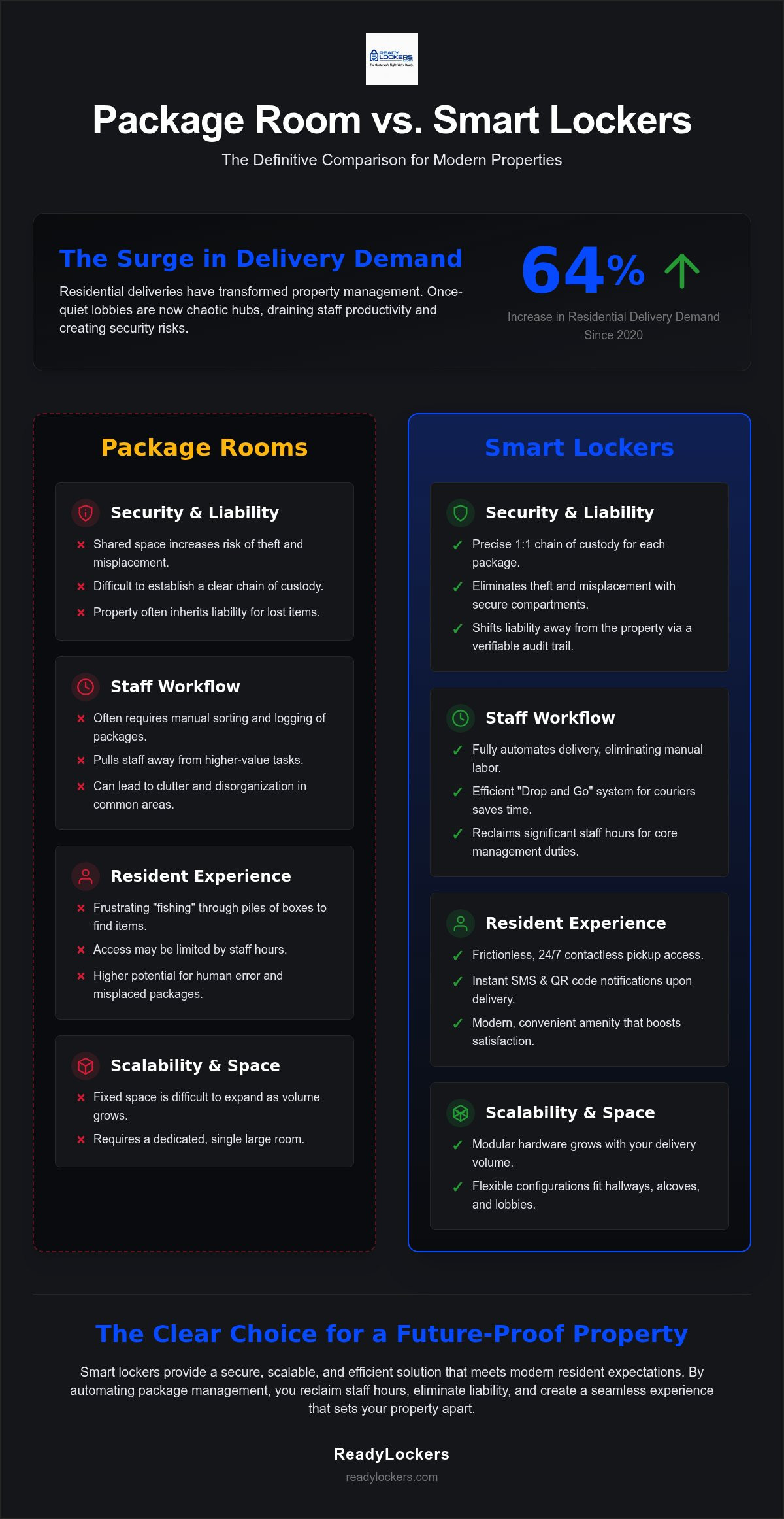
Package Room vs. Smart Lockers: A Side-by-Side Comparison
Choosing between a package room vs smart lockers often comes down to a trade-off between initial capital investment and long-term operational costs. A package room typically requires lower upfront expenditure because it utilizes existing square footage and basic shelving. However, the operational reality includes higher labor costs and increased liability risks. Smart lockers demand a higher initial investment but offer near-zero daily labor requirements. For properties focused on efficiency, the automation of lockers provides a faster return through reclaimed staff hours and the total elimination of misplaced item inquiries.
Security and user experience also diverge significantly. Individual compartments offer a premium experience where residents spend seconds retrieving their items. In contrast, shared rooms require residents to search through communal shelves, increasing retrieval time and the risk of accidental theft. Courier compliance is another critical factor. Delivery drivers are often tracked by precise GPS and time-per-stop metrics. They prefer the "Drop and Go" speed of a digital locker interface over the time-consuming process of organizing boxes in a room. This speed ensures that couriers actually use your system instead of leaving packages in the lobby.
Decision Matrix: Which is Right for Your Property?
Different property types have unique logistical demands. If you manage luxury apartments, smart lockers are the preferred choice for their prestige and individual security. They act as a high-end amenity that justifies premium rents. For high-volume hotels, lockers solve the "checked-out guest" dilemma. When a guest departs but their package arrives later, a locker keeps the item secure without cluttering the front desk or requiring staff to manage a storage log. Commercial offices benefit from the privacy lockers provide. Employees can receive personal deliveries without exposing their shopping habits to colleagues or security personnel in a shared room environment.
Calculating ROI and Property Value
Automated delivery systems do more than just store boxes; they increase overall property value and improve tenant retention. Modern residents view secure package handling as a non-negotiable service. By implementing a frictionless workflow, you reduce the friction that leads to resident dissatisfaction. Furthermore, eliminating tedious manual logging tasks helps reduce staff turnover. Your team stays focused on resident engagement rather than acting as unpaid mail clerks. To evaluate the specific hardware and software requirements for your next upgrade, consult the Smart Package Lockers: 2026 Buyer’s Guide for detailed procurement insights. Investing in a comprehensive smart locker platform ensures your property remains competitive in an e-commerce-driven market.
Implementing the Right Solution with ReadyLockers
ReadyLockers provides a universal platform that addresses the specific logistical challenges of apartments, hotels, and commercial offices. While the choice between a package room vs smart lockers depends on your property's specific footprint, our systems provide the flexibility to bridge that gap. We offer modular hardware that integrates into layouts where traditional, bulky systems fail. This adaptability ensures that no square foot is wasted; we turn awkward alcoves and narrow corridors into high-functioning distribution points.
Our platform combines industrial-grade hardware with a robust SaaS layer. This cloud-based suite manages the entire delivery lifecycle without requiring staff supervision. It provides automated SMS and QR code notifications to recipients. This ensures they have the information they need the moment a package arrives. For management, cloud-based analytics offer a transparent view of usage patterns and courier performance. This data-driven approach allows you to optimize your operations and anticipate future growth with precision.
Seamless Installation and Integration
Deploying a new system shouldn't disrupt your daily operations. We coordinate with professional smart locker installation services to ensure a smooth transition from your current workflow. Our software is designed to integrate with existing property management systems (PMS). This connection enables automated data synchronization. Your resident or guest lists remain up to date without any manual entry from your team.
This integration is the foundation of a future-proof building. As your occupancy rates change or delivery volumes fluctuate, our modular hardware scales accordingly. You can add additional units as needed. This ensures your infrastructure never becomes a bottleneck. This scalability protects your initial investment and provides long-term utility as e-commerce habits continue to evolve.
The Future of Frictionless Logistics
Adopting ReadyLockers positions your property as a "Modern Efficiency Expert." You're not just providing storage; you're facilitating a seamless, high-tech experience for the modern, contactless traveler and resident. This commitment to innovation enhances your brand's reputation for reliability and security. It signals to your tenants that you value their time and the safety of their property. Our systems provide 24/7 availability, meeting the needs of a global workforce that doesn't operate on a 9-to-5 schedule.
The era of lost packages and lobby clutter is over. By shifting the burden of logistics from your staff to an automated platform, you reclaim control over your environment. Ready to transform your delivery workflow? Schedule a consultation to optimize your package management and discover how our modular solutions can solve your specific delivery challenges today.
Reclaiming Your Lobby and Staff Productivity
The choice between a package room vs smart lockers hinges on your property's specific logistical needs and architectural footprint. Smart lockers provide a definitive chain of custody for standard parcels, while secure rooms offer the volume flexibility required for oversized items. By transitioning to an automated logistics model, you eliminate the liability of manual handling and reclaim valuable staff hours. Modern efficiency requires a system that operates independently of front desk schedules, providing residents with the secure, seamless convenience they demand.
ReadyLockers provides universal platforms featuring 24/7 automated contactless pickup and modular designs that adapt to any property footprint. Our cloud-based tracking and analytics suite delivers the transparency needed to manage high-volume e-commerce without the traditional lobby chaos. It's time to invest in infrastructure that grows alongside your property and residents. Streamline your property operations with ReadyLockers and secure your building's logistical future today.
Frequently Asked Questions
Is a package room or a smart locker system more secure?
Smart locker systems provide a higher level of security than a standard package room because they isolate each delivery in a private compartment. While a room uses access control for the door, the items inside remain exposed to everyone else in the space. Lockers establish a verifiable audit trail for every interaction. This individual chain of custody eliminates the risk of accidental theft and ensures that only the intended recipient can access their parcel.
How much space do I need for a smart locker installation?
Space requirements depend on your property's delivery volume and resident count, but modular units are designed to fit into diverse footprints. You don't need a massive dedicated area; these systems can utilize narrow hallways, lobby alcoves, or underutilized corners. Because the hardware is modular, you can start with a small configuration and scale upward as your needs grow. This versatility allows property managers to optimize existing square footage without undergoing major renovations.
Do couriers actually use package lockers correctly?
Couriers prioritize speed and efficiency, making them highly likely to use smart lockers correctly. The digital courier access interface streamlines the drop-off process, allowing drivers to secure multiple items in minutes. This "Drop and Go" workflow is significantly faster than hunting for shelf space in a crowded room or waiting for front desk staff. When evaluating a package room vs smart lockers, the higher courier compliance rates of lockers often lead to more reliable delivery outcomes.
Can smart lockers handle oversized packages or furniture?
Standard smart lockers are designed for common parcel sizes and cannot accommodate large furniture or extremely oversized items. For these bulky deliveries, many properties utilize a hybrid approach that combines lockers with a secure room or a designated overflow area. This strategy ensures that the majority of daily deliveries are secured in individual compartments, while the property maintains the flexibility to handle irregular inventory like mattresses or exercise equipment through its access-controlled room.
What happens if a guest doesn't pick up their package after check-out?
The locker management software provides real-time tracking that identifies packages left beyond their expected pickup window. If a hotel guest or apartment resident departs without their delivery, the system sends automated alerts to property managers. Staff can then use the administrative interface to open the compartment and move the item to a long-term storage area or handle it according to the property's specific policy. This digital oversight ensures that locker compartments remain available for new deliveries.
Are smart lockers compatible with my current property management software?
ReadyLockers utilizes a cloud-based SaaS platform that is designed for seamless integration with modern property management systems (PMS). This connection enables automated data synchronization, ensuring that your resident or guest lists are always current without manual entry. When a new tenant moves in or a guest checks out, the locker system updates automatically. This integration reduces administrative friction and ensures that notifications are always sent to the correct recipient via automated SMS or QR code alerts.
How long does it take to install a modular locker system?
The timeline for a modular locker installation typically ranges from a few days to a week, depending on the scale of the project and the property's electrical readiness. Professional installation services handle the physical assembly and software configuration to ensure the system is operational with minimal disruption. Because the units are modular, they arrive pre-configured for your specific layout. This streamlined implementation process allows you to transition to an automated logistics workflow quickly and begin reclaiming staff hours.
What are the recurring costs associated with smart package management?
Recurring costs for a smart package management system primarily involve SaaS subscription fees. These fees cover access to the cloud-based management platform, automated SMS and QR code notifications, and comprehensive usage analytics. While there is an initial investment in hardware, the ongoing software subscription ensures your system remains secure and updated with the latest features. These recurring costs are typically offset by the significant reduction in labor hours previously spent on manual package logging and retrieval tasks.

Frequently Asked Questions
Decision Matrix: Which is Right for Your Property?+
Different property types have unique logistical demands. If you manage luxury apartments, smart lockers are the preferred choice for their prestige and individual security. They act as a high-end amenity that justifies premium rents. For high-volume hotels, lockers solve the "checked-out guest" dilemma. When a guest departs but their package arrives later, a locker keeps the item secure without cluttering the front desk or requiring staff to manage a storage log. Commercial offices benefit from the privacy lockers provide. Employees can receive personal deliveries without exposing their shopping habits to colleagues or security personnel in a shared room environment.
Is a package room or a smart locker system more secure?+
Smart locker systems provide a higher level of security than a standard package room because they isolate each delivery in a private compartment. While a room uses access control for the door, the items inside remain exposed to everyone else in the space. Lockers establish a verifiable audit trail for every interaction. This individual chain of custody eliminates the risk of accidental theft and ensures that only the intended recipient can access their parcel.
How much space do I need for a smart locker installation?+
Space requirements depend on your property's delivery volume and resident count, but modular units are designed to fit into diverse footprints. You don't need a massive dedicated area; these systems can utilize narrow hallways, lobby alcoves, or underutilized corners. Because the hardware is modular, you can start with a small configuration and scale upward as your needs grow. This versatility allows property managers to optimize existing square footage without undergoing major renovations.
Do couriers actually use package lockers correctly?+
Couriers prioritize speed and efficiency, making them highly likely to use smart lockers correctly. The digital courier access interface streamlines the drop-off process, allowing drivers to secure multiple items in minutes. This "Drop and Go" workflow is significantly faster than hunting for shelf space in a crowded room or waiting for front desk staff. When evaluating a package room vs smart lockers, the higher courier compliance rates of lockers often lead to more reliable delivery outcomes.
Can smart lockers handle oversized packages or furniture?+
Standard smart lockers are designed for common parcel sizes and cannot accommodate large furniture or extremely oversized items. For these bulky deliveries, many properties utilize a hybrid approach that combines lockers with a secure room or a designated overflow area. This strategy ensures that the majority of daily deliveries are secured in individual compartments, while the property maintains the flexibility to handle irregular inventory like mattresses or exercise equipment through its access-controlled room.
What happens if a guest doesn't pick up their package after check-out?+
The locker management software provides real-time tracking that identifies packages left beyond their expected pickup window. If a hotel guest or apartment resident departs without their delivery, the system sends automated alerts to property managers. Staff can then use the administrative interface to open the compartment and move the item to a long-term storage area or handle it according to the property's specific policy. This digital oversight ensures that locker compartments remain available for new deliveries.
Are smart lockers compatible with my current property management software?+
ReadyLockers utilizes a cloud-based SaaS platform that is designed for seamless integration with modern property management systems (PMS). This connection enables automated data synchronization, ensuring that your resident or guest lists are always current without manual entry. When a new tenant moves in or a guest checks out, the locker system updates automatically. This integration reduces administrative friction and ensures that notifications are always sent to the correct recipient via automated SMS or QR code alerts.
How long does it take to install a modular locker system?+
The timeline for a modular locker installation typically ranges from a few days to a week, depending on the scale of the project and the property's electrical readiness. Professional installation services handle the physical assembly and software configuration to ensure the system is operational with minimal disruption. Because the units are modular, they arrive pre-configured for your specific layout. This streamlined implementation process allows you to transition to an automated logistics workflow quickly and begin reclaiming staff hours.
What are the recurring costs associated with smart package management?+
Recurring costs for a smart package management system primarily involve SaaS subscription fees. These fees cover access to the cloud-based management platform, automated SMS and QR code notifications, and comprehensive usage analytics. While there is an initial investment in hardware, the ongoing software subscription ensures your system remains secure and updated with the latest features. These recurring costs are typically offset by the significant reduction in labor hours previously spent on manual package logging and retrieval tasks.