The Property Manager’s Guide to Automated Package Receiving Systems in 2026
Eliminate delivery chaos. Our 2026 guide to the automated package receiving system shows property managers how to reduce liability and boost tenant satisfact...

If your building lobby currently resembles a disorganized transit hub rather than a professional residence, you're losing more than just floor space. You're losing tenant satisfaction and exposing your staff to unnecessary liability. Managing the relentless surge of e-commerce deliveries has become a full-time operational burden that pulls your team away from their core responsibilities. Integrating a modern automated package receiving system is no longer a luxury; it's the standard requirement for any contemporary environment. You likely recognize the daily friction of couriers obstructing hallways, the risk of package theft, and the hours spent manually logging boxes.
This guide will show you how to eliminate delivery chaos and reclaim your staff's time through modern hardware and cloud-based management. We'll examine the transition to 24/7 contactless pickups, seamless courier access interfaces, and scalable locker configurations. These tools provide a secure, frictionless bridge between couriers and residents while removing package liability from your personnel. By the end of this article, you'll understand how to implement a definitive solution that provides peace of mind and operational excellence for your property in 2026.
Key Takeaways
- Transitioning from manual logging to smart parcel endpoints eliminates staff liability and prevents lobby congestion.
- Integrating cloud-based SaaS with modular hardware enables 24/7 contactless pickup and automated SMS notifications for all recipients.
- Differentiating between industrial sorting and parcel-level commercial systems ensures your hardware scale matches your property's specific spatial needs.
- A successful implementation begins with a volume audit to ensure your automated package receiving system can handle peak delivery windows without friction.
- Automation significantly reduces operational overhead and enhances property value by reclaiming dozens of staff hours previously spent on manual sorting.
What is an Automated Package Receiving System?
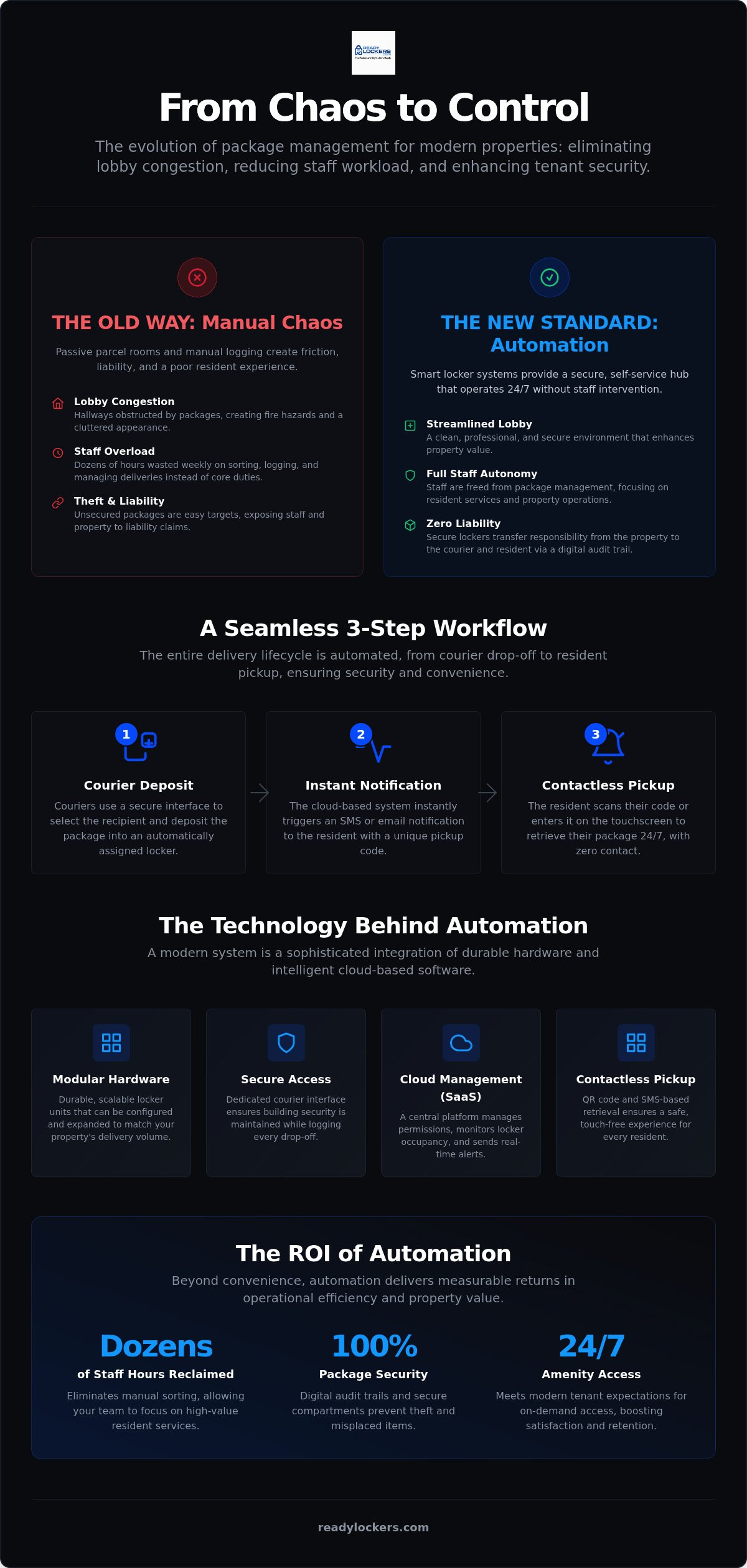
An automated package receiving system is a centralized logistical hub that manages the entire lifecycle of a delivery from the moment a courier enters the property until the resident retrieves their item. It's no longer just a designated area for boxes. It's a sophisticated integration of modular hardware and cloud-based software designed to handle the high-velocity e-commerce demands of 2026. This technology replaces manual logging and staff-led sorting with a self-service model that operates independently of office hours.
The Evolution of Inbound Logistics
The transition from open lobbies to secure courier interfaces marks a significant shift in property management standards. In the past, deliveries were often left in communal areas, creating a high risk for theft and clutter. Modern tenant expectations have evolved; they now demand 24/7 access to their belongings without waiting for staff assistance. This system serves as the definitive digital bridge between the courier's delivery and the resident's collection. Implementing a secure parcel locker environment ensures that every transaction is recorded, providing a clear audit trail that manual systems simply cannot match. Logistics in 2026 require a proactive stance that prioritizes security and immediate notification.
Why Managed Systems Outperform Passive Parcel Rooms
Traditional mailrooms and communal bins are prone to failure because they rely on "package hunting." This occurs when residents must search through dozens of boxes to find their own, which often leads to accidental damage or intentional theft. A managed automated package receiving system eliminates this friction by securing each delivery in an individual compartment. This shift reduces property manager liability and removes the burden of sorting from the site team. Passive rooms also suffer from a lack of visibility; if a box goes missing, there's no digital record of who accessed the space. Automated solutions solve this by utilizing secure access interfaces and real-time tracking. Key components of these systems include:
- Modular Hardware: Durable units that can be expanded as delivery volumes grow.
- Secure Access: Dedicated interfaces that allow couriers to drop off packages without property keys.
- Locker Management Software: A cloud-based platform that sends instant alerts to recipients.
- Contactless Pickup System: QR code or SMS-based retrieval that ensures zero physical contact with shared screens.
Automation addresses the security gap found in multi-family housing by ensuring that only the intended recipient can access the package. It transforms a chaotic lobby into a streamlined, professional environment that reflects the quality of the property management.
How Modern Receiving Systems Work: Hardware and SaaS
An automated package receiving system functions through a synchronized three-step process that eliminates human error and lobby clutter. It begins when a courier identifies the recipient at a secure terminal. After the system assigns a modular compartment, the courier deposits the item and secures the door. This action triggers an immediate notification to the resident, who then completes the final step by retrieving their package at their convenience. This workflow ensures that a parcel doesn't sit unattended in a hallway or common area where it's vulnerable to theft.
The Courier Interface and Access Control
Simplifying the delivery process for major carriers and local couriers is vital for operational flow. Modern systems utilize a dedicated courier access interface that grants entry without the need for physical keys or staff intervention. This secure authentication protects the building's perimeter while ensuring that every drop-off is logged digitally. You can explore the technical nuances of these interactions in our analysis of the locker notification system sms qr. By providing a clear, intuitive terminal, properties reduce the time couriers spend on-site and prevent delivery "dumping" in unauthorized areas.
Cloud Management and Real-Time Notifications
The central intelligence of the hardware is the cloud software that manages access permissions and monitors locker occupancy in real time. This software logic is particularly critical during high-volume periods, such as seasonal holidays, where it optimizes turnover to prevent system saturation. Data from the NMHC Renter Preferences Survey confirms that residents view secure package handling as a high-value amenity. Property managers can leverage smart locker management software to automate alerts and maintain a comprehensive audit trail of every transaction. This level of oversight removes the guesswork from property logistics and provides actionable data on delivery trends.
Durability is a non-negotiable requirement for hardware placed in high-traffic environments. Modular units allow properties to scale their capacity as e-commerce volumes continue to rise. Key hardware features include:
- Heavy-duty steel construction: Resistant to tampering and daily wear.
- Modular design: The ability to add lockers as tenant needs grow.
- Integrated cameras: Providing visual confirmation of all deliveries and pickups.
- Weather-resistant finishes: Ensuring longevity for both indoor and outdoor installations.
Contactless technology, including QR codes and SMS-based triggers, further streamlines the experience by removing the need for shared touchscreens or physical keys. This approach prioritizes both security and hygiene, creating a frictionless endpoint for the end-user. If you're looking to upgrade your current infrastructure, exploring a contactless pickup system can immediately modernize your property's operations.
Industrial vs. Commercial Receiving: Choosing the Right Scale
Choosing the correct scale for an automated package receiving system depends entirely on the nature of your property's intake. Industrial receiving centers focus on pallet-level throughput and utilize complex Warehouse Management Systems (WMS) to track bulk inventory. These environments require massive sorting docks and often employ autonomous mobile robots. Conversely, commercial and residential properties require parcel-level solutions that integrate with Building Management Systems (BMS). The primary goal here isn't just raw speed. It's secure, frictionless retrieval for the end-user. While a warehouse measures success by pallets per hour, a property manager measures it by the reduction in lobby congestion and the elimination of staff sorting time.
When to Scale Up to Enterprise Automation
Properties must identify the specific threshold where traditional mailrooms fail and modular hardware becomes a necessity. Data from March 2026 indicates that businesses using shipping automation reclaim over 20 hours per employee each week and save an average of 22% on operational costs. As delivery volumes increase, property managers should consult smart locker usage analytics to make data-driven scaling decisions. Modular designs allow for a cost-effective entry point for smaller properties, while large-scale developments can expand their locker footprint as occupancy rises. This flexibility prevents the over-investment often associated with rigid, industrial-scale sorting docks. With 3PL receiving costs per container rising to $500 in late 2025, bringing automation in-house is a strategic financial move for many commercial entities.
Why Commercial Properties Need Custom Configurations
Commercial properties require a high degree of customization that industrial warehouses don't need. A retail environment might require larger lockers for "buy online, pick up in-store" (BOPIS) orders, while a healthcare facility needs secure compartments for sensitive medical supplies. Aesthetic integration is also a priority for corporate offices and luxury residential lobbies. A system shouldn't just function well; it must complement the architectural design of the space. Utilizing a universal platform is essential for managing diverse courier networks. This ensures that every delivery service, from national carriers to local couriers, can navigate the interface without confusion. This tailored approach ensures the hardware remains a dependable utility rather than a bulky obstacle. It provides a standard requirement for any contemporary environment, ensuring that the technology is both a high-tech pioneer and a steady, dependable utility.
Implementing an Automated System: A 5-Step Strategy
Deploying an automated package receiving system is a strategic operation that requires precise execution to maximize return on investment. It isn't merely about placing hardware in a lobby. It's about re-engineering the flow of goods through your property. A methodical rollout ensures that both staff and residents adapt quickly to the new infrastructure. Success depends on moving from a reactive "pile and sort" model to a proactive, software-driven utility.
- Step 1: Audit current volume. Track incoming deliveries for at least 30 days to identify peak windows and average parcel sizes.
- Step 2: Design the layout. Match modular hardware configurations to the audited data and available floor space in high-traffic zones.
- Step 3: Synchronize SaaS platforms. Integrate the locker management software with your existing resident database to automate notifications and access.
- Step 4: Formalize courier access. Establish clear digital authentication protocols for all delivery personnel to ensure building security.
- Step 5: Execute the launch. Distribute registration links to residents and provide 24/7 technical support for the initial transition period.
Spatial Planning and Modular Setup
Measuring high-traffic zones is the first physical requirement for a successful installation. You must place lockers in areas that are easily accessible for couriers yet secure from public street traffic. If lobby space is limited, consider weather-resistant outdoor units that can withstand environmental exposure. Proper placement prevents bottlenecks during evening rush hours when pickup volume is at its highest. For detailed layout strategies and configuration examples, refer to our guide on smart package lockers for apartments. Selecting the right location ensures the hardware remains a convenient utility rather than an architectural obstacle.
Software Onboarding and Tenant Training
High adoption rates depend on an intuitive user experience. Utilizing QR code systems allows residents to retrieve items in seconds, reinforcing the value of the amenity. Automated registration is essential for seamless transitions, as it pulls resident data directly from your management software without requiring manual entry. Your team should also be prepared to handle "exception" deliveries, such as oversized furniture or heavy equipment that doesn't fit in standard compartments. Providing clear signage and instructional videos during the first week of operation reduces the learning curve for everyone involved. To begin your property's transformation, you can implement a contactless pickup system today to start reclaiming your lobby space and staff time.
The ROI of Automation: Why ReadyLockers is the Standard
The financial justification for an automated package receiving system extends far beyond simple lobby aesthetics. It is a strategic move that addresses the rising costs of property operations while simultaneously increasing the market value of the asset. In a landscape where 3PL fees and receiving costs have seen sharp increases, bringing efficient, automated logistics in-house is a necessity. By eliminating the manual sorting of parcels, properties can mitigate the risk of lost or stolen items, which often results in expensive liability claims and resident dissatisfaction. This technology provides a secure, auditable trail for every transaction, ensuring that the property is never responsible for a package once it enters the secure terminal.
Quantifying Staff Efficiency
Staff efficiency is the most immediate benefit of a modern receiving platform. When site teams are no longer required to act as mailroom clerks, they can refocus their energy on high-value property management tasks that drive revenue. We previously noted that automation can reclaim over 20 hours of labor per week; this time is better spent on tenant relations, leasing activities, and proactive maintenance. Property owners can utilize smart locker usage analytics to prove this operational value to stakeholders with concrete data. The hidden costs of manual management, such as constant workflow interruptions and the physical space required for overflow storage, are permanently removed from the balance sheet.
Future-Proofing for 2026 and Beyond
Handling the continued rise of "click and collect" and instant delivery trends requires a system that can grow with the property. Modular hardware ensures that your investment remains relevant as building occupancy increases or tenant shopping habits evolve. You don't need to replace the entire infrastructure to add capacity; you simply add locker modules as needed. This scalability is essential for maintaining a competitive edge in saturated markets where high-tech amenities are the deciding factor for prospective tenants. A secure, contactless endpoint is now a standard requirement for any contemporary environment, positioning your property as a leader in modern convenience. To see how these systems can transform your specific property, Explore ReadyLockers Solutions Today and reclaim your lobby from delivery chaos.
ReadyLockers stands as the universal platform that serves everything from residential complexes to corporate offices. It provides the peace of mind that comes with reliability and frictionless operation. By adopting this technology, you are not just solving a delivery problem; you are investing in a scalable, future-proof utility that enhances the daily experience of every person on your property.
Future-Proofing Your Property Logistics
The landscape of property management in 2026 demands a shift from manual oversight to high-tech utility. Implementing an automated package receiving system is the definitive answer to the logistical friction that currently drains staff productivity and compromises building security. By transitioning to a self-service model, you eliminate the risk of package theft and remove the burden of sorting from your site team. This evolution ensures your property remains a standard for modern convenience rather than a relic of disorganized mailrooms. It's a proactive step toward operational excellence that benefits both owners and residents.
Strategic automation provides a scalable foundation that adapts as delivery volumes continue to rise. You can now offer 24/7 contactless pickup through modular hardware that fits any property size, all managed via a secure cloud-based management platform. This investment secures your operational flow and enhances tenant retention by providing the frictionless experience modern residents expect. It's time to reclaim your lobby and focus on high-value management goals. Streamline your building's deliveries with ReadyLockers and secure your property's operational future today.
Frequently Asked Questions
How do couriers access an automated package receiving system?
Couriers access the system through a streamlined courier access interface located at the terminal. They authenticate their identity, select the recipient from the directory, and choose a suitable locker size. Once the package is deposited and the door is closed, the system automatically logs the transaction. This process bypasses the need for physical building keys or staff intervention, providing a professional and secure solution for all delivery personnel.
What happens if a package is too large for the smart locker?
When a package is too large for the modular compartments, couriers typically follow the property's specific exception protocols. The system allows couriers to log these oversized items as delivered to a secure overflow area or a designated package room. Residents still receive an automated notification, ensuring they're aware of the delivery even if the item is not stored within the physical locker hardware itself.
Is the software compatible with existing property management platforms?
The locker management software is fully compatible with most leading property management platforms. It utilizes secure APIs to synchronize resident data, which automates the registration process for new tenants and removes those who have moved out. This integration ensures that your automated package receiving system remains updated without any manual administrative effort. It creates a seamless operational environment where all resident information flows logically between systems.
Can residents receive notifications via both SMS and email?
Residents can receive delivery notifications through both SMS and email alerts simultaneously. These notifications include a secure QR code or a unique pickup PIN that grants access to their specific locker. Providing multiple notification methods ensures that tenants see the alert immediately, which promotes faster package retrieval. This rapid turnover is essential for maintaining locker availability during high-volume periods like sales events or the winter holiday season.
How secure are automated lockers against theft or vandalism?
These systems are highly secure, featuring heavy-duty steel construction and integrated cameras that record all interactions. Each locker remains locked until the recipient enters their unique authentication code or scans their QR code. This security model provides peace of mind by preventing unauthorized access and package theft. It offers a reliable alternative to open lobbies, ensuring that every parcel is protected from the moment of delivery until the final pickup.
What is the typical ROI period for a smart locker installation?
The typical ROI period is often achieved within 12 to 18 months, depending on the scale of the property and previous labor expenses. By reclaiming dozens of staff hours each week, properties significantly reduce their operational overhead. Additionally, the presence of a secure automated package receiving system often leads to higher tenant retention and increased property value. It represents a long-term investment in building efficiency that pays for itself through improved logistics.
Do automated systems require a dedicated internet connection?
A dedicated internet connection is essential for the cloud-based management platform to operate effectively. This connection enables the hardware to communicate with the software for real-time notifications, resident database updates, and remote troubleshooting. Most installations use a hardwired Ethernet connection or a secure cellular bridge to maintain 24/7 availability. This constant connectivity ensures that the system remains a dependable utility for both the property staff and the building residents.
Can the system be used for outgoing packages as well as incoming?
The platform is designed to handle both incoming deliveries and outgoing parcel returns. Residents can place their labeled packages into a secure compartment for courier collection, which simplifies the return process for e-commerce purchases. This functionality adds another layer of convenience for tenants and reduces the number of loose items sitting in common areas. It transforms the locker into a comprehensive logistical hub that manages the full lifecycle of a package.

Frequently Asked Questions
How do couriers access an automated package receiving system?+
Couriers access the system through a streamlined courier access interface located at the terminal. They authenticate their identity, select the recipient from the directory, and choose a suitable locker size. Once the package is deposited and the door is closed, the system automatically logs the transaction. This process bypasses the need for physical building keys or staff intervention, providing a professional and secure solution for all delivery personnel.
What happens if a package is too large for the smart locker?+
When a package is too large for the modular compartments, couriers typically follow the property's specific exception protocols. The system allows couriers to log these oversized items as delivered to a secure overflow area or a designated package room. Residents still receive an automated notification, ensuring they're aware of the delivery even if the item is not stored within the physical locker hardware itself.
Is the software compatible with existing property management platforms?+
The locker management software is fully compatible with most leading property management platforms. It utilizes secure APIs to synchronize resident data, which automates the registration process for new tenants and removes those who have moved out. This integration ensures that your automated package receiving system remains updated without any manual administrative effort. It creates a seamless operational environment where all resident information flows logically between systems.
Can residents receive notifications via both SMS and email?+
Residents can receive delivery notifications through both SMS and email alerts simultaneously. These notifications include a secure QR code or a unique pickup PIN that grants access to their specific locker. Providing multiple notification methods ensures that tenants see the alert immediately, which promotes faster package retrieval. This rapid turnover is essential for maintaining locker availability during high-volume periods like sales events or the winter holiday season.
How secure are automated lockers against theft or vandalism?+
These systems are highly secure, featuring heavy-duty steel construction and integrated cameras that record all interactions. Each locker remains locked until the recipient enters their unique authentication code or scans their QR code. This security model provides peace of mind by preventing unauthorized access and package theft. It offers a reliable alternative to open lobbies, ensuring that every parcel is protected from the moment of delivery until the final pickup.
What is the typical ROI period for a smart locker installation?+
The typical ROI period is often achieved within 12 to 18 months, depending on the scale of the property and previous labor expenses. By reclaiming dozens of staff hours each week, properties significantly reduce their operational overhead. Additionally, the presence of a secure automated package receiving system often leads to higher tenant retention and increased property value. It represents a long-term investment in building efficiency that pays for itself through improved logistics.
Do automated systems require a dedicated internet connection?+
A dedicated internet connection is essential for the cloud-based management platform to operate effectively. This connection enables the hardware to communicate with the software for real-time notifications, resident database updates, and remote troubleshooting. Most installations use a hardwired Ethernet connection or a secure cellular bridge to maintain 24/7 availability. This constant connectivity ensures that the system remains a dependable utility for both the property staff and the building residents.
Can the system be used for outgoing packages as well as incoming?+
The platform is designed to handle both incoming deliveries and outgoing parcel returns. Residents can place their labeled packages into a secure compartment for courier collection, which simplifies the return process for e-commerce purchases. This functionality adds another layer of convenience for tenants and reduces the number of loose items sitting in common areas. It transforms the locker into a comprehensive logistical hub that manages the full lifecycle of a package.