Smart Locker Usage Analytics: A Property Manager’s Guide to Data-Driven Logistics
Unlock your property's potential with smart locker usage analytics. Learn to analyze data, reduce dwell time, and optimize your system for maximum ROI and ef...

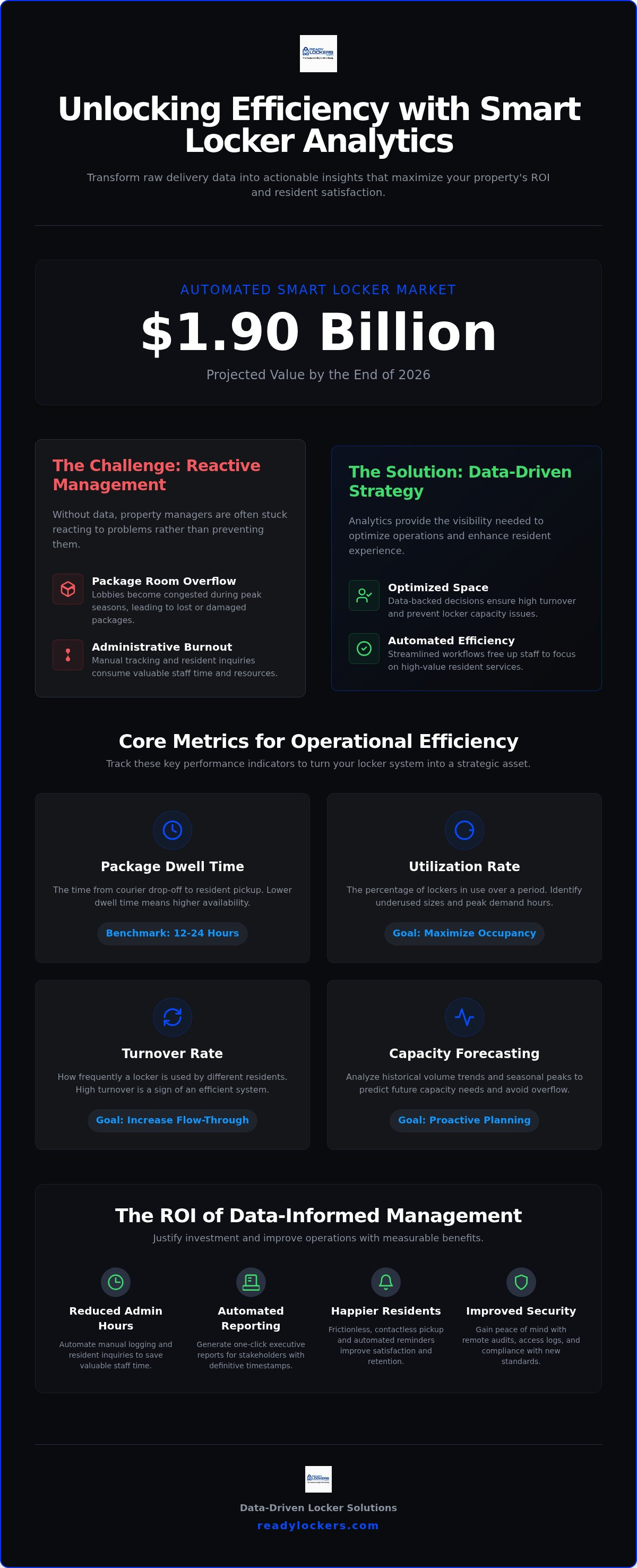
By the end of 2026, the automated smart locker market is projected to reach $1.90 billion, yet many property managers fail to utilize smart locker usage analytics to turn their delivery hubs into strategic assets. You've likely felt the pressure of package rooms overflowing during peak seasons and the exhaustion of manual tracking that leads to administrative burnout. It's difficult to prove the value of your infrastructure to stakeholders when you lack the hard data to back up your operational decisions. You deserve a system that works as hard as you do to maintain building efficiency and resident satisfaction.
This guide demonstrates how to transform raw delivery logs into actionable insights that maximize your property's ROI. We'll show you how to interpret turnover rates, utilization patterns, and courier logs to create a frictionless logistics experience. You'll learn the specific steps to reduce package dwell time, optimize your locker size distribution, and automate reporting for executive reviews. By moving from reactive management to a data-driven approach, you can ensure your property stays ahead of the new UL 365-2026 security standards while providing the modern convenience your residents expect.
Key Takeaways
- Discover how smart locker usage analytics transform raw sensor data into a clear roadmap for improving building logistics.
- Identify key efficiency metrics like package dwell time and utilization rates to eliminate package room overflow.
- Forecast future capacity needs by analyzing historical volume trends and seasonal delivery peaks.
- Implement data-driven strategies like automated pickup reminders to increase locker turnover and resident satisfaction.
- Streamline stakeholder communication with one-click executive reports generated directly from a cloud-based management dashboard.
The Strategic Value of Smart Locker Usage Analytics in 2026
Smart locker usage analytics are the aggregated data points generated by hardware sensors and cloud-based management software. These metrics provide a digital footprint of every package's journey within a building. In 2026, properties face unprecedented e-commerce volumes, with the automated smart locker market projected to reach $1.90 billion. Managing this influx requires a shift from passive storage to active asset management. Data-driven logistics ensure that an automated parcel locker functions as a high-performance hub rather than a static cabinet. By bridging the gap between courier delivery and final recipient retrieval, analytics provide the visibility needed to prevent operational bottlenecks and administrative burnout.
Moving Beyond Simple Package Tracking
A standard delivery log only tells you that a package arrived. A comprehensive usage report reveals how your infrastructure actually performs. Real-time data points allow property managers to identify when locker banks are approaching capacity before a crisis occurs. This visibility is essential for preventing lobby congestion and package room overflow. Modern property managers have transitioned into the role of logistics coordinators. They use smart locker usage analytics to monitor dwell times and ensure the seamless flow of goods through their buildings. This proactive approach replaces guesswork with precise, actionable intelligence that keeps operations running smoothly during peak seasons.
The ROI of Data-Informed Property Management
Justifying the cost of hardware and software subscriptions requires more than anecdotal evidence. Data provides the empirical proof needed for executive reviews. By utilizing smart locker management software, managers can document specific labor savings achieved through automation. These platforms provide smart locker usage analytics that help identify underutilized locker sizes or "dead" zones within a bank. Managers can then use these insights to reconfigure modular hardware to better match resident delivery patterns. Consider these measurable benefits:
- Reduced administrative hours spent on manual package logging and resident inquiries.
- Automated notification logs that provide definitive proof of delivery and pickup timestamps.
- Higher locker turnover rates that maximize the utility of existing square footage.
- Improved security through remote firmware audits and anti-tailgating verification.
Identifying the Core Metrics for Operational Efficiency
Data is only useful if you know which specific numbers to track. To move beyond basic storage, property managers must focus on performance indicators that define building efficiency. These metrics, provided through smart locker usage analytics, allow for a granular understanding of how space is consumed. By tracking variables like courier accuracy and compartment demand, you can identify "dead" zones where lockers sit empty or peak periods where residents are forced to wait. This level of insight is part of broader innovations in last-mile delivery that prioritize speed and transparency. High-performance logistics require a constant pulse on how your hardware interacts with daily traffic.
Dwell Time and Turnover Optimization
Dwell time measures the duration from courier drop-off to recipient pickup. It's the most critical metric for maintaining high turnover. If packages sit for days, they occupy valuable real estate and block new deliveries. Most high-efficiency buildings set a benchmark of 12 to 24 hours for acceptable residence times. You can use this data to refine your locker notification system sms qr frequency. For instance, if analytics show that a specific demographic consistently picks up items after work, you can schedule reminders for late afternoon to maximize impact. Reducing dwell time directly increases the capacity of your existing hardware without requiring additional floor space.
Capacity and Size Utilization Analysis
Identifying the right mix of compartment sizes is a common challenge for property managers. You might find that your large lockers are always full while small ones remain empty. Analyzing smart locker usage analytics allows you to see which sizes are in highest demand over a 30-day or 90-day period. Modular hardware provides the flexibility to act on this data by swapping out small compartments for larger ones as delivery trends shift. Over-capacity doesn't just frustrate residents; it lowers courier drop-off success rates. When a carrier finds no available lockers, they may leave packages in unsecured lobbies. This creates administrative chaos that a data-driven approach easily avoids.
Courier performance logs add another layer of accountability. These logs track which carriers are most accurate and how long they spend at your interface. If a specific courier consistently bypasses the system, you have the data to address the issue with the delivery service provider. Maintaining this level of control ensures a secure environment for all building occupants. To see how these metrics look in practice, you can explore our cloud-based reporting features to gain full visibility over your property's logistics. Reliable data is the definitive answer to modern logistical challenges.
How to Analyze Locker Data for Predictive Capacity Planning
Predictive planning separates modern properties from those struggling with administrative burnout. It starts with exporting historical volume data from your smart locker management software to identify long-term trends. This data provides the foundation for identifying seasonal peaks, such as the Q4 holiday rush or summer move-in cycles. Once you have this baseline, you can calculate the "Saturation Point" for your current configuration. This is the specific delivery volume where your lockers are consistently full, causing couriers to leave packages in unsecured areas. By simulating growth scenarios based on building occupancy increases or e-commerce growth rates, you can anticipate these bottlenecks months in advance.
Forecasting Seasonal Package Surges
Year-over-year data is your most reliable tool for preparing for "Prime" style events and holiday surges. Smart locker usage analytics allow you to see exactly when volume begins to ramp up and which day of the week sees the heaviest traffic. During these high-volume periods, you can adjust notification urgency to ensure faster resident pickups. If the data suggests a surge that exceeds your current capacity, you can plan for temporary overflow solutions before they become operational crises. This proactive stance maintains building order and protects the resident experience from the chaos of unmanaged deliveries.
Determining When to Expand Your Modular System
Reaching the "85% Rule" is a critical milestone in property logistics. If your smart locker usage analytics show that you consistently reach 85% capacity during peak hours, it's a clear signal that your current system is under-resourced. Because modular hardware allows for easy reconfiguration, you can act on this data by adding supplemental locker banks or swapping out smaller compartments for larger ones. Analyzing these reports helps you choose between increasing hardware or implementing stricter pickup rules to boost turnover. Using these detailed software reports to present expansion budgets to stakeholders turns a request for funds into a data-backed business case. It demonstrates a clear link between hardware investment and the continued reliability of your property operations.
Turning Analytics Into Action: Optimization Strategies
Data without execution is merely noise. Once you've identified your baseline metrics, the next step is applying smart locker usage analytics to refine daily operations. Optimization involves a dual focus on increasing hardware turnover and enhancing the user experience. By setting up data-triggered automated reminders, you can incentivize residents to retrieve items during off-peak hours. This proactive communication clears space for incoming deliveries before the next courier wave arrives. These strategies ensure that your smart package lockers for apartments remain a high-utility asset rather than a source of administrative friction.
Reducing package liability is a critical operational goal. Automated alerts for "stale" packages allow property staff to identify items that have exceeded acceptable dwell times. Instead of manually checking every locker, managers receive a concise list of compartments that require attention. This targeted approach minimizes the risk of lost or abandoned goods. It also allows you to optimize courier access windows. If traffic analytics show that 90% of deliveries occur before 2:00 PM, you can adjust staffing or security protocols to match these high-activity periods, ensuring a secure and efficient drop-off process.
Streamlining Courier Interactions
Not all delivery carriers interact with your system with the same level of precision. Using your cloud-based dashboard, you can identify specific couriers who consistently struggle with the interface. This data allows you to provide targeted training or adjust access permissions based on delivery reliability. Timestamped courier logs are also your best defense against "missed delivery" claims. When a carrier reports a failed attempt, you can verify the exact time they accessed the interface and whether lockers were available. This level of accountability protects your property's reputation and ensures that residents receive their orders without unnecessary delays.
Enhancing the Recipient Experience
The final stage of the logistics chain is the resident pickup. Analyzing pickup patterns helps you optimize the physical environment surrounding your locker banks. If smart locker usage analytics indicate a surge in retrievals after 6:00 PM, you can schedule increased lighting or security staffing during those hours. This focus on safety and convenience builds trust with your tenants. Additionally, monitoring QR code data ensures your contactless pickup systems are functioning smoothly across all mobile devices. When you tailor your communication based on how recipients prefer to receive notifications, you create a frictionless experience that residents value. To see how these optimization tools can work for your building, contact ReadyLockers for a platform walkthrough today. Providing a secure, reliable utility is the definitive answer to modern property management challenges.
Leveraging ReadyLockers’ Cloud-Based Management Platform
The ReadyLockers cloud-based management platform serves as the central nerve center for your property's logistical operations. It provides real-time visibility across all locations, allowing you to monitor the health of your delivery ecosystem from a single, intuitive interface. Instead of managing hardware in isolation, you gain a comprehensive view of how every locker bank performs. This high-level oversight is essential for maintaining the frictionless operation that modern residents expect. By centralizing smart locker usage analytics, you replace fragmented data with a unified strategy that scales with your building's needs.
Stakeholder communication is often a bottleneck for property managers. Building an "Executive Summary" to prove the value of your infrastructure shouldn't take hours of manual data entry. Our platform features custom reporting tools that generate professional summaries with one click. These reports highlight the key performance indicators discussed in previous sections, such as dwell time reductions and utilization peaks. Security and compliance are also built into the core of the system. The platform protects user privacy through encrypted data handling while maintaining the rigorous audit trails required for modern security standards. Because the software is cloud-based, automatic SaaS updates ensure your analytics capabilities stay ahead of 2026 trends without requiring manual hardware interventions.
Unified Management for Multi-Property Portfolios
Managing multiple buildings requires a level of consistency that manual systems can't provide. The ReadyLockers dashboard allows you to compare performance across different properties within a single view. You can easily identify "best practices" from high-performing buildings and apply those strategies to other sites in your portfolio. This unified approach allows you to centralize courier management and notification settings, ensuring a standard level of service regardless of the location. It turns individual locker banks into a cohesive network of high-performance delivery hubs.
Actionable Insights at Your Fingertips
Efficiency is driven by proactive alerts rather than reactive fixes. You can set up custom notifications for capacity thresholds, allowing you to address potential overflows before they impact resident satisfaction. The platform also identifies stale packages automatically, sending alerts to staff so they can clear space for new arrivals. Integration is seamless, as our smart locker usage analytics can sync with your existing property management software via a robust API. This creates a unified tech stack that simplifies administrative tasks and reduces the risk of data silos. Ready to optimize your building's logistics? Contact us for a demo of our analytics platform to see these tools in action. Providing a secure, reliable utility is the definitive answer to modern logistical challenges.
Future-Proofing Your Property with Data-Driven Logistics
The shift from passive package storage to active asset management is no longer optional for contemporary property managers. By mastering smart locker usage analytics, you gain the visibility needed to reduce administrative burnout and eliminate lobby congestion. You've seen how tracking dwell time and utilization rates allows for predictive capacity planning, ensuring your operations remain efficient even during seasonal surges. This transition from reactive troubleshooting to proactive optimization defines the modern efficiency expert.
ReadyLockers provides the definitive answer to these logistical challenges. Our cloud-based SaaS dashboard is included in your subscription, offering real-time courier and recipient logging for total accountability. Because our modular hardware is adaptable to your data, you can reconfigure your system as delivery trends evolve. This level of control provides peace of mind through reliability and frictionless operation. Request a Demo of ReadyLockers Analytics to transform your raw delivery data into a strategic operational asset. You have the tools to build a more efficient, data-driven environment for your residents today.
Frequently Asked Questions
What are the most important metrics to track in a smart locker system?
The most critical metrics include package dwell time, locker utilization rates, and compartment size demand. Dwell time measures the duration from courier drop-off to recipient pickup, while utilization rates identify peak usage periods and available capacity. Size demand data reveals which locker sizes are in highest demand by residents. Tracking these specific variables allows property managers to optimize their hardware configuration and maintain a frictionless flow of goods through the building.
How can usage analytics help reduce package theft in my building?
Analytics provide a complete audit trail of every interaction with the hardware. By monitoring courier access logs and recipient timestamps, you can identify precisely when a package was deposited and retrieved. If a discrepancy occurs, the data points to the exact moment of the incident. This accountability discourages unauthorized access and ensures that the contactless pickup system remains a secure environment, providing peace of mind for both staff and residents.
Can locker data help me decide if I need more large or small compartments?
Yes, the platform tracks the specific occupancy of each compartment size over time. If your smart locker usage analytics show that large lockers are consistently at 100% capacity while small units remain vacant, you've got empirical evidence for reconfiguration. ReadyLockers' modular hardware allows you to act on this data by swapping out underutilized units for those in higher demand. This level of insight prevents the overflow issues that lead to administrative burnout.
Is the data in smart locker analytics platforms real-time or delayed?
The data provided by the ReadyLockers cloud-based management platform is real-time. As soon as a courier completes a drop-off or a resident uses their QR code for pickup, the event is logged and visible in your dashboard. This immediacy allows property managers to react to capacity thresholds instantly rather than waiting for end-of-day reports. It ensures a constant flow of information for active asset management and reliable building logistics.
How do I use analytics to prove the ROI of a smart locker investment?
Proving ROI involves documenting labor savings and increased turnover. Use smart locker usage analytics to show the reduction in staff hours previously spent on manual package logging. Additionally, track the increase in package volume handled without additional square footage. By linking high turnover rates and low dwell times to resident satisfaction scores, you'll create a data-backed case for the system's financial value. It's the most effective way to justify infrastructure costs.
Does smart locker software track which courier made each delivery?
Every delivery interaction is recorded through the courier access interface. The software logs the specific carrier, the timestamp of the deposit, and the locker number assigned to the package. This granular logging allows property managers to hold carriers accountable for delivery accuracy and timing. If a courier consistently bypasses the system or leaves items in unsecured areas, the analytics provide the evidence needed to address the issue with the service provider.
Can I export usage reports for my property owner or board of directors?
The cloud-based management platform allows you to export comprehensive usage reports with one click. These documents serve as executive summaries for stakeholders, highlighting key performance indicators like delivery trends and capacity status. You can schedule these reports to be delivered automatically via email, ensuring that your board of directors or property owners remain informed about logistical efficiency. This automated reporting eliminates the need for manual data entry and reduces administrative burnout.
How does the analytics platform handle recipient privacy and data security?
Security is a fundamental component of the cloud-based platform. All recipient notification logs and access data are encrypted to protect user privacy. The system maintains rigorous audit trails while complying with modern digital security standards, including the remote firmware audits required by the new UL 365-2026 regulations. This ensures that while you have the visibility needed for management, resident personal information remains secure and protected from unauthorized access at all times.

Frequently Asked Questions
What are the most important metrics to track in a smart locker system?+
The most critical metrics include package dwell time, locker utilization rates, and compartment size demand. Dwell time measures the duration from courier drop-off to recipient pickup, while utilization rates identify peak usage periods and available capacity. Size demand data reveals which locker sizes are in highest demand by residents. Tracking these specific variables allows property managers to optimize their hardware configuration and maintain a frictionless flow of goods through the building.
How can usage analytics help reduce package theft in my building?+
Analytics provide a complete audit trail of every interaction with the hardware. By monitoring courier access logs and recipient timestamps, you can identify precisely when a package was deposited and retrieved. If a discrepancy occurs, the data points to the exact moment of the incident. This accountability discourages unauthorized access and ensures that the contactless pickup system remains a secure environment, providing peace of mind for both staff and residents.
Can locker data help me decide if I need more large or small compartments?+
Yes, the platform tracks the specific occupancy of each compartment size over time. If your smart locker usage analytics show that large lockers are consistently at 100% capacity while small units remain vacant, you've got empirical evidence for reconfiguration. ReadyLockers' modular hardware allows you to act on this data by swapping out underutilized units for those in higher demand. This level of insight prevents the overflow issues that lead to administrative burnout.
Is the data in smart locker analytics platforms real-time or delayed?+
The data provided by the ReadyLockers cloud-based management platform is real-time. As soon as a courier completes a drop-off or a resident uses their QR code for pickup, the event is logged and visible in your dashboard. This immediacy allows property managers to react to capacity thresholds instantly rather than waiting for end-of-day reports. It ensures a constant flow of information for active asset management and reliable building logistics.
How do I use analytics to prove the ROI of a smart locker investment?+
Proving ROI involves documenting labor savings and increased turnover. Use smart locker usage analytics to show the reduction in staff hours previously spent on manual package logging. Additionally, track the increase in package volume handled without additional square footage. By linking high turnover rates and low dwell times to resident satisfaction scores, you'll create a data-backed case for the system's financial value. It's the most effective way to justify infrastructure costs.
Does smart locker software track which courier made each delivery?+
Every delivery interaction is recorded through the courier access interface. The software logs the specific carrier, the timestamp of the deposit, and the locker number assigned to the package. This granular logging allows property managers to hold carriers accountable for delivery accuracy and timing. If a courier consistently bypasses the system or leaves items in unsecured areas, the analytics provide the evidence needed to address the issue with the service provider.
Can I export usage reports for my property owner or board of directors?+
The cloud-based management platform allows you to export comprehensive usage reports with one click. These documents serve as executive summaries for stakeholders, highlighting key performance indicators like delivery trends and capacity status. You can schedule these reports to be delivered automatically via email, ensuring that your board of directors or property owners remain informed about logistical efficiency. This automated reporting eliminates the need for manual data entry and reduces administrative burnout.
How does the analytics platform handle recipient privacy and data security?+
Security is a fundamental component of the cloud-based platform. All recipient notification logs and access data are encrypted to protect user privacy. The system maintains rigorous audit trails while complying with modern digital security standards, including the remote firmware audits required by the new UL 365-2026 regulations. This ensures that while you have the visibility needed for management, resident personal information remains secure and protected from unauthorized access at all times.