Investment property package solutions that fit your cash flow
Explore Investment property package solutions, compare rental income with costs, and assess vacancies, repairs, reserves, insurance, and risks before you buy.

A package with multiple properties can increase exposure as quickly as it increases opportunity. Investment property package solutions are most suitable when the property types, expected rental income, available reserves and tolerance for vacancies or repairs fit the investor’s financial position. The 2% rule suggests monthly rent should be at least 2% of the purchase price, but it is not a hard-and-fast test.
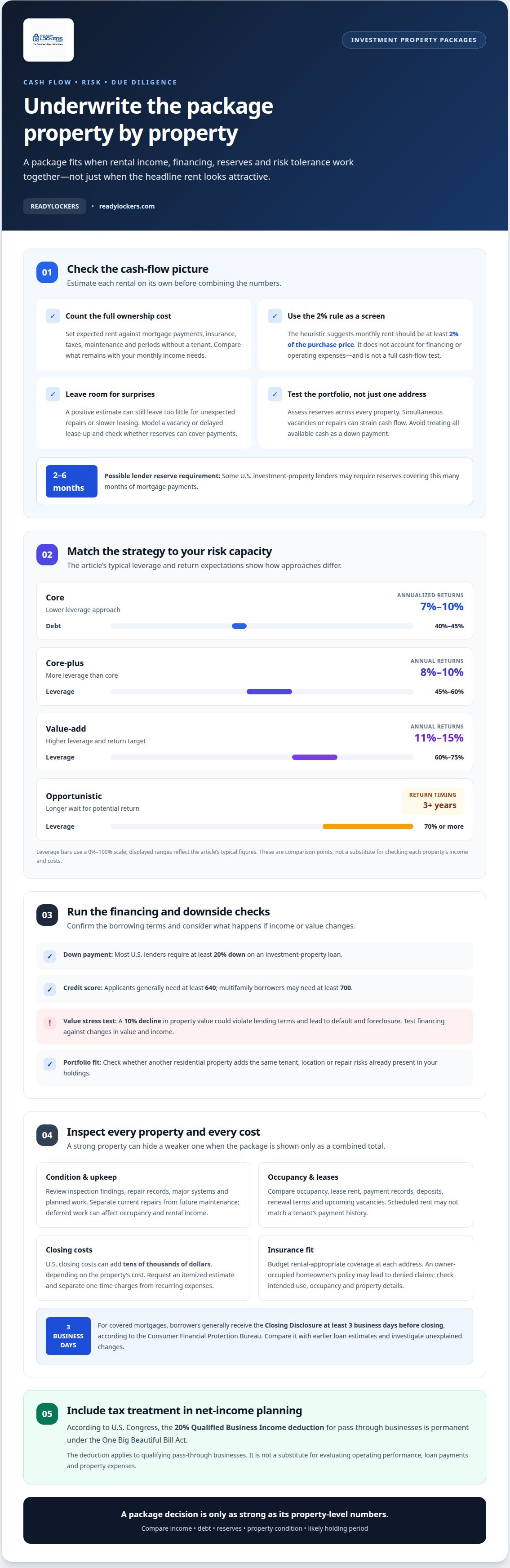
It makes sense to look beyond the headline rent: mortgage payments, operating costs and periods without tenants all affect the cash flow a property can deliver. Some U.S. investment-property lenders may require reserves covering two to six months of mortgage payments. This article explains which investors and property types may suit a package, how to assess cash flow and risk tolerance, and what costs and property risks to weigh before deciding.
Key Takeaways
- Compare expected rental income with financing and operating costs to understand whether a property package fits your cash-flow needs.
- Match property types and investment strategies to your risk tolerance, including how you would manage vacancies, repairs, and slower returns.
- Include closing costs and rental-appropriate insurance in your assessment, alongside ongoing expenses that can affect returns.
- Factor tax treatment into your planning: according to U.S. Congress, the 20% Qualified Business Income deduction for pass-through businesses is permanent.
Cash flow and risk tolerance
Estimate each rental’s income after expenses. Include rent, mortgage payments, insurance, taxes, maintenance, and periods without a tenant, then compare the remainder with your monthly income needs. A positive estimate can still leave little room for unexpected repairs or slower leasing.
The 2% rule offers one initial screen: monthly rent should equal at least 2% of the purchase price. It is a screening heuristic, not a full cash-flow calculation. That example does not account for financing or operating expenses, so compare rental income with the full cost of ownership.
Reserves help cover gaps between expenses and rental income. U.S. investment-property lenders may require enough to cover two to six months of mortgage payments. Set aside funds for vacancies, repairs, and other property expenses instead of treating all available cash as a down payment. For a portfolio, assess reserves across every property: simultaneous repairs or vacancies can strain cash flow.
Risk tolerance should shape the investment strategy, financing, and property type. Core investors typically use 40% to 45% debt and expect annualized returns of 7% to 10%. Core-plus investors typically use 45% to 60% leverage and expect annual returns of 8% to 10%. These approaches provide a useful comparison between lower leverage and higher-risk strategies, but the investor still needs to assess each property’s income and costs.
Value-add investors typically use 60% to 75% leverage and target annual returns of 11% to 15%. Opportunistic investments can take three or more years to generate a return, and investors in this category tend to use leverage of 70% or more. A longer wait and higher leverage can leave less room for a disruption. Match the strategy to your ability to manage delayed income and debt payments.
- Assess the subject property: Compare expected rent with the purchase price, mortgage payment, and operating expenses.
- Test lower income: Model a vacancy or delayed lease-up, then see whether available reserves can cover payments.
- Review financing: Most U.S. lenders require at least 20% down on an investment property loan. Applicants generally need a credit score of at least 640; multifamily borrowers may need at least 700.
- Compare portfolio exposure: Consider whether a new residential property adds the same tenant, location, or repair risks as existing holdings.
Tax treatment also affects net income. According to U.S. Congress, the One Big Beautiful Bill Act makes the 20% Qualified Business Income deduction for pass-through businesses permanent. Investors should include tax treatment in their cash-flow analysis, alongside loan payments and property expenses. The deduction applies to qualifying pass-through businesses, so it is not a substitute for evaluating the property’s operating performance.
Consider a buying decision where projected rent covers the mortgage but leaves little for repairs. That property may fit an investor with substantial reserves, but strain someone relying on immediate rental income. A 10% decline in property value could violate lending terms and lead to default and foreclosure. Stress-test the financing against changes in value and income before adding the property to a portfolio.
Investment property package solutions should match both the properties’ income potential and your capacity to absorb risk. Compare each property’s rental income, debt, reserves, and likely holding period. A strategy that fits one investor’s equity and payment capacity may not suit another’s credit position or portfolio goals.
Keep return expectations grounded in borrowing conditions. U.S. Bank mortgage sales supervisor Jenny Yuen said she had not seen property investors generate big profits since 2021, citing rising interest rates. Her observation reinforces the need to judge a property's cash flow on its own merits and avoid relying on hoped-for gains to offset weak income or limited reserves.
What risks and hidden fees should buyers check before purchasing a package?
A package of rental properties can hide uneven upkeep, weak leases, or costs that reduce net income. Review each property separately before judging the portfolio as a whole. A stronger property can mask a weaker one when figures are presented only as a combined total. Compare condition, occupancy, rent records, and operating expenses across every address.
Closing costs can add tens of thousands of dollars to a U.S. investment property purchase, depending on the property's cost. Treat them as part of the acquisition budget, not as an afterthought. Request an itemized estimate and distinguish one-time closing charges from recurring expenses. On covered mortgages, borrowers generally receive the Closing Disclosure at least 3 business days before closing, according to the Consumer Financial Protection Bureau. Compare it with earlier loan estimates and investigate any unexplained changes before signing.
Property condition can create costs that rental projections overlook. Review inspection findings, repair records, major systems, and planned work. Deferred maintenance may need attention before tenants can move in or remain comfortably, affecting occupancy and rental income. For a multi-property purchase, separate current repairs from future maintenance plans so one property’s needs are not lost in a package-wide estimate.
Insurance is another essential expense. Rental properties generally need coverage suited to rental use. An owner-occupied homeowner’s policy may lead to denied claims, leaving the investor responsible for losses. Review the intended use, occupancy, and property details against the policy. Budget for insurance at each address instead of assuming one policy or estimate fits every building.
Leases and tenant records also deserve close attention. Compare the rent listed in each lease with payment records, deposits, renewal terms, and upcoming vacancies. A lease may show scheduled rent, while payment history reveals late or missed payments. Check whether the seller’s occupancy figures align with signed agreements. For example, a unit shown as occupied but lacking a current lease can change expected income and future turnover work.
- Reconcile income: Match rent schedules to leases, payment records, and the appraisal’s information about average rents collected for similar nearby homes.
- Map expenses: Separate insurance, taxes, utilities, maintenance, management, and vacancy-related costs by property.
- Review documents: Compare inspection reports, repair invoices, leases, and seller-provided operating statements for gaps or conflicting details.
- Test assumptions: Model a vacancy, repair, or delayed lease renewal to see how it affects the package’s total income.
- Clarify included items: Identify which furnishings, equipment, or other assets transfer, and record their condition and ownership.
Operational details can matter in multifamily properties, too. A building with frequent deliveries needs a workable process for receiving and collecting packages. Unmanaged deliveries can create resident frustration and increase staff handling. Smart Package Lockers can organize secure package pickup at properties where delivery management is part of the operating plan. Review smart package lockers for apartment properties as one way to address that specific operational need.
Assess investment property package solutions property by property, not only by their combined projected return. Before purchase, reconcile the closing disclosure, insurance, leases, inspection findings, and expense records. This helps establish whether the package’s apparent income accounts for ownership costs and the work required to operate each property.
Before relying on a package-wide expense figure, request supporting records for each address. Ask for a breakdown of management, maintenance, utilities, taxes, insurance, and other included costs. Check whether each charge is recurring or one-time, who is expected to pay it, and whether the records support the amount. Get unclear fees and assumptions explained in writing, and compare terms across properties so a charge for one building is not obscured in the total. Separate completed work from costs that remain your responsibility, and keep those amounts distinct from projected rental income.
Check insurance terms against the intended rental use at each property. Rental properties generally need insurance appropriate for rental use, because an owner-occupied homeowner’s policy may lead to denied claims. Ask for the applicable policy details and cost for each address, and verify that the occupancy and property information used for the estimate is accurate. Before committing, reconcile the expense breakdown with leases, payment records, inspection findings, and the package documents. If a fee, repair allowance, or income assumption cannot be tied to a record or clear written term, treat it as unresolved in the purchase budget rather than assuming it will not affect the investment. Ensure the final figures reflect each property’s own costs, not just a reassuring package-wide average.
ReadyLockers: Smart Package Lockers
ReadyLockers helps property operators organize package deliveries with Smart Package Lockers. For multifamily buildings where deliveries create staff workload or collection friction, lockers provide a designated place for couriers to leave packages and residents to collect them. Recipients receive SMS or QR code notifications, and pickups are contactless. This can help reduce missed deliveries and package theft.
ReadyLockers also provides Locker Management Software, a Contactless Pickup System, and a Courier Access Interface. Together, these tools help organize delivery and pickup without requiring property investors to manage courier services themselves. They can be useful when planning property operations, assessing resident needs, or improving package handling across a building.
If package management is part of your property’s operational plan, contact ReadyLockers or visit readylockers.com.
Make property operations part of the plan
Investment property package solutions work best when the operating model supports the investment strategy. Before committing, consider how residents receive deliveries, how staff handle unclaimed packages, and whether the process fits the property’s layout. These decisions shape daily operations as well as the initial purchase analysis.
A clear package-handling plan can create a more organized resident experience and keep delivery tasks from becoming an informal burden on staff. Treat it as one part of the property’s operating design, alongside maintenance coordination and tenant communication. The right approach depends on the building and how it is managed.
ReadyLockers offers solutions for package handling, including Smart Package Lockers, Locker Management Software, and a Contactless Pickup System. If you’re planning operations for a property and want to explore how these options may fit, contact ReadyLockers to discuss your options.
Thoughtful planning can give your property a practical foundation for its next stage of ownership.
Frequently Asked Questions
What are investment property package solutions?
Investment property package solutions are ways to acquire or organize one or more properties as part of an investment plan. The term may describe a group of properties offered together or a strategy shaped by an investor’s goals, financing, and tolerance for operational demands. For example, an investor might compare a package of occupied rentals with a smaller purchase that needs renovation, then decide which better fits their timeline.

Frequently Asked Questions
What are investment property package solutions?+
Investment property package solutions are ways to acquire or organize one or more properties as part of an investment plan. The term may describe a group of properties offered together or a strategy shaped by an investor’s goals, financing, and tolerance for operational demands. For example, an investor might compare a package of occupied rentals with a smaller purchase that needs renovation, then decide which better fits their timeline.