How to Present Tangible Amenity Upgrades to Your HOA Board
Learn how to present amenity upgrades to HOA board with clear community needs, option comparisons, resident input, approval steps, and fair cost-sharing plans.

An amenity proposal is stronger when it connects a visible improvement to a clear community need. Knowing how to present amenity upgrades to an HOA board starts with comparing practical options, explaining who benefits, and outlining how costs could be shared between residents and visitors. A specific proposal is easier to assess than a broad request for something new.
Boards need to weigh more than an upgrade’s initial appeal. Residents also want to understand its ongoing value, how access would work, and whether the funding approach is fair. A concise, evidence-based presentation addresses these concerns without assuming every amenity should be funded the same way.
This article explains how to frame an upgrade proposal, compare options, set priorities, and outline a potential cost-sharing model. It also shows how to clarify a decision by connecting the amenity’s purpose, expected users, and operational needs.
Key Takeaways
- Compare upgrade options by community benefit, expected use, access, and ongoing operational needs to clarify which projects deserve priority.
- Use focused homeowner surveys to distinguish broad interest from specific needs and identify how residents expect an amenity to be used.
- Review the HOA’s governing documents and approval process to understand how a proposal should be considered and whether a homeowner vote may apply.
- Explain potential funding approaches, including how costs might be shared between residents and visitors, and consider smart package lockers when package handling is the amenity need.
How should HOA boards compare amenity upgrade options and prioritize projects?
Start by describing the need each proposed upgrade would address. An amenity can improve a shared space, support residents’ enjoyment, and contribute to the community’s value. Compare tangible options, such as a park, swimming pool, or community center, against a specific need. A proposal to improve pool access, for example, should explain who uses the pool and what problem the upgrade would solve.
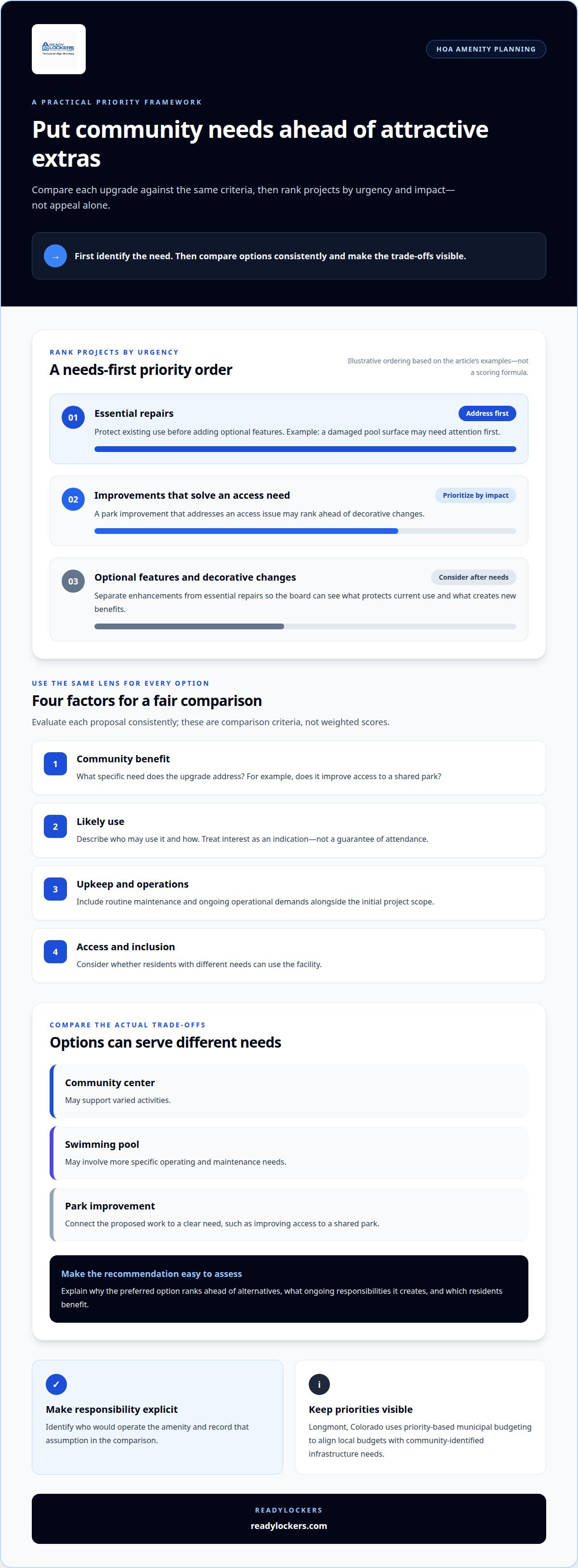
Assess each option using the same criteria. Consistent comparisons help board members distinguish a popular idea from a workable priority. Consider who benefits, how often the amenity may be used, what ongoing upkeep it requires, and whether access works for different residents. A community center may support varied activities, while a pool may involve more specific operating and maintenance needs.
Use a simple comparison table or scorecard with criteria such as:
- Community benefit: Identify the need addressed, such as improving access to a shared park.
- Likely use: Describe expected users and use patterns, without treating interest as guaranteed attendance.
- Upkeep: Include routine maintenance and operational demands alongside the initial project scope.
- Access and inclusion: Consider whether residents with different needs can use the facility.
Next, rank projects by urgency and impact. A damaged pool surface may need attention before optional features are added. A park improvement that addresses an access issue may rank above decorative changes. Separate essential repairs from enhancements so the board can see which proposals protect existing use and which create new benefits.
Present the preferred option with its trade-offs, not just its advantages. Explain why it ranks ahead of alternatives, what ongoing responsibilities it creates, and which residents benefit. A clear comparison helps the board discuss priorities on shared criteria. This structure also makes it easier to present amenity upgrades to an HOA board as practical decisions rather than open-ended requests.
When responsibility is unclear, identify who would operate the amenity and record that assumption in the comparison. The OpenStreetMap operator=* tag identifies the company or other entity in charge of a mapped amenity, which can help clarify responsibility when reviewing mapped facilities.
Boards can also frame rankings around needs residents have identified, rather than comparing projects only by appeal. Longmont, Colorado uses priority-based municipal budgeting to align local budgets with community-identified infrastructure needs. This approach connects project order to documented community priorities while keeping trade-offs visible.
What homeowner survey methods help assess demand for HOA amenity upgrades?
A survey can show which proposed upgrades address problems residents actually experience. Start with a neutral description of each option, such as improving a shared park, adding pool features, or creating a community gathering space. Explain the intended use without promotional language. This helps residents assess the proposal instead of reacting to a slogan or attractive rendering.
Offer an online survey and a paper version through the HOA’s usual communication channels. Giving residents different ways to respond makes the questions easier to access. Keep the choices consistent across formats. Ask residents to select a preferred project, say how they would use it, and describe any concerns about access or upkeep.
- Measure priorities: Ask residents to rank proposed upgrades, then name their top choice.
- Test actual use: Ask whether they would use a pool improvement for recreation, lessons, or another activity.
- Surface barriers: Invite residents to identify concerns such as location, accessibility, noise, or maintenance.
- Compare alternatives: Ask whether residents prefer a new feature, an improvement to an existing amenity, or no change.
Follow specific choices with open-ended prompts. For example, ask what would make the community park more useful to residents who currently avoid it. Answers may reveal details a yes-or-no question misses, such as shade, seating, or easier access. Keep questions focused so feedback can be grouped by project and practical need.
Pair survey responses with a discussion at an HOA meeting. A resident might support a pool upgrade but explain that current access times conflict with family schedules. That context helps the board distinguish general enthusiasm from a clear use case. Summarize response themes without suggesting that survey participation proves every homeowner agrees. Include the questions, options, and notable concerns in the proposal. This gives board members a transparent view of demand and shows how resident feedback shaped the recommendation.
What HOA governing documents and approval rules apply to amenity upgrades?
Start with the community’s declaration, bylaws, and current rules. These documents define how the association manages shared property and board decisions. Renovating a pool may follow a different process from adding a new facility. Identify the specific area affected before interpreting the approval process.
Next, find provisions covering common areas, board authority, owner approval, and association spending. The declaration may describe who controls a park or clubhouse. The bylaws may explain how the board conducts meetings and records decisions. Rules may address access or use after an upgrade. Read relevant provisions together, since one document may refer to another.
- Property authority: Determine whether the project changes a common area, such as a shared courtyard.
- Decision authority: Find language describing which matters the board can approve and which require owners.
- Meeting process: Review provisions covering agendas, notice, meeting records, and voting procedures.
- Funding process: Look for rules addressing budgets, spending limits, or special assessments.
Use the documents’ exact terms in the proposal. If the bylaws distinguish repairs from improvements, explain why a clubhouse renovation fits the applicable category. Do not treat routine maintenance and a new amenity as interchangeable. Their approval processes may differ under the community’s documents.
Prepare a concise approval summary for the board. Identify the relevant document and section, the proposed action, and the decision-maker. For example, state that the plan affects a shared park and cite the declaration’s common-area provision. This gives the board a clear basis for discussion and accurate recordkeeping.
HOA governing documents and state requirements vary, so do not assume a rule used by another community applies. If provisions conflict or leave the decision process unclear, the association can seek legal guidance before proceeding. A well-organized proposal connects the amenity, relevant document provisions, and requested board action without presenting an assumption as a binding rule.
When do HOA amenity upgrades require a homeowner vote or special assessment
A homeowner vote and a special assessment are separate decisions. The approval process may depend on the association’s governing documents. A special assessment is a way to fund association expenses. Depending on the HOA’s governing documents and available funds, an upgrade may require one, both, or neither.
Begin with the approval provisions that apply to the proposed work. The documents may give the board authority over some common-area improvements while reserving other decisions for homeowners. The project’s scope matters. Replacing worn playground equipment may be treated differently from adding a recreation facility or changing shared property.
Then identify how the association could fund the project. The board may consider an approved operating budget or reserve funds, if available for that purpose. If additional contributions are needed, the documents may explain whether the association can levy a special assessment and what approval process applies. Do not assume a large project automatically requires a vote or that the board can approve every assessment on its own.
- Board decision: Identify the board’s authority for the proposed type of improvement.
- Homeowner vote: Find provisions that require owner approval and specify the voting process.
- Funding source: Explain whether the proposal uses planned funds or requires additional contributions.
- Assessment process: State how the governing documents address assessment approval and notice.
For example, a clubhouse renovation might require board approval for the design and a separate funding decision if existing funds will not cover it. Present these as distinct steps. Show the project scope, proposed funding source, and required approval process so homeowners understand what decision they are being asked to make.
Keep the proposal aligned with the association’s documents and applicable state requirements. If a provision is unclear or conflicting, the association can seek legal guidance before scheduling a vote or collecting funds. For proposals addressing package access, explore a practical community upgrade option as part of the project discussion.
ReadyLockers
ReadyLockers can support HOA proposals when package access is a practical community need. Smart Package Lockers, Locker Management Software, a Contactless Pickup System, and a Courier Access Interface work together to support secure package drop-off and resident pickup. Recipients receive SMS or QR code notifications, and pickups are contactless and available 24/7.
Present package lockers as one possible amenity, not a fit for every community. They may be worth considering when residents want a dedicated way to receive packages in shared spaces. Include the proposed system alongside other upgrades, then compare its benefits, users, access, and operating needs with the HOA’s priorities and approval process.
Contact ReadyLockers to discuss a smart locker platform for your community.
Turn the proposal into a workable next step
Treat the board discussion as the start of implementation, not the finish line. A strong proposal can define what success looks like, who will oversee the amenity, and how residents can share feedback as plans develop. This forward plan gives the community a shared reference point after approval and helps align expectations as the project moves ahead.
Presenting amenity upgrades to an HOA board clearly means explaining how the project will work after approval. Define who will manage routine decisions, how residents can raise practical concerns, and which outcomes the board will review. A brief project record can capture those responsibilities and keep follow-up decisions connected to the original community need.
If package access is part of the community’s priorities, discuss a locker solution with ReadyLockers. With clear ownership and a defined next step, your proposal can move from a meeting discussion toward a more usable shared amenity.
Frequently Asked Questions
What information should an HOA amenity upgrade proposal include?
Include a defined project scope, a site plan or visual mockup, and a description of how the space will function after the change. For example, a playground proposal can show equipment placement, pathways, and areas affected during installation. Note dependencies such as access restrictions or landscaping changes, and include a phased alternative if the full project cannot proceed at once.
How to estimate costs and funding for HOA amenity upgrades?
Build an itemized estimate from the same project scope, separating equipment, site preparation, installation, and ongoing operating expenses. Identify assumptions and exclusions so estimates can be compared consistently. Then map possible funding sources, such as planned association funds or a special assessment, to the HOA’s documents and approval process. If visitors may contribute, explain the proposed arrangement and who would manage it.

Frequently Asked Questions
What information should an HOA amenity upgrade proposal include?+
Include a defined project scope, a site plan or visual mockup, and a description of how the space will function after the change. For example, a playground proposal can show equipment placement, pathways, and areas affected during installation. Note dependencies such as access restrictions or landscaping changes, and include a phased alternative if the full project cannot proceed at once.
How to estimate costs and funding for HOA amenity upgrades?+
Build an itemized estimate from the same project scope, separating equipment, site preparation, installation, and ongoing operating expenses. Identify assumptions and exclusions so estimates can be compared consistently. Then map possible funding sources, such as planned association funds or a special assessment, to the HOA’s documents and approval process. If visitors may contribute, explain the proposed arrangement and who would manage it.