Business Case for Smart Lockers: Examples of Security and Value
Explore the business case for smart lockers PDF using real pickup data to assess security, convenience, accountability, and operational value at your site.

Smart lockers make business sense when flexible access and better accountability solve a clear operational problem. A business case for smart lockers in PDF form should connect those benefits to customer behavior, security needs, and the limits of the current process. At East Tennessee State University, 32% of student locker packages were picked up after hours, and 96% were collected within 24 hours.
It’s reasonable to ask whether a locker system will do more than add equipment. A strong business case for smart lockers PDF explains how delivery and access patterns affect staffing and service, and where secure, self-service pickup can reduce friction.
Assess package access, recipient behavior, current handover options, and accountability for stored items. Use real-world examples as reference points, identify the evidence that matters to your operation, and consider how smart package lockers and management software fit the decision.
Key Takeaways
- Build the case around how secure, flexible pickup can address access needs, reduce missed handovers, and support a smoother customer experience.
- Use customer pickup patterns to assess whether self-service lockers fit your location and the way people collect deliveries.
- Compare alternatives by the value they provide in security, convenience, and operational fit, not by equipment alone.
- Show how controlled access to shared devices can improve accountability and help reduce time lost searching for equipment.
24/7 Locker availability and video surveillance
For U.S. sites, plan security, privacy, accessibility, and fire-safety reviews around the building and proposed locker location. Consider controlled access, camera placement that avoids unnecessary views into private areas, an accessible approach, and clear exit routes. Requirements depend on the site, so include facilities and safety teams in the design review.
East Tennessee State University offers a practical example. Its original smart lockers processed 364 deliveries through 140 doors in a 24-hour period. The situation was a steady flow of deliveries; the action was using locker doors for package handovers. The result demonstrates how unattended pickup can handle deliveries beyond staffed handover periods. Video surveillance can be considered as a separate layer, with camera coverage planned to support security while respecting privacy.
Hardware, installation, and software costs depend on the locker configuration and property requirements. ReadyLockers provides custom project quotes, with purchase, partnership, and licensing models. There is no universal payback period: assess ROI by comparing implementation and operating costs with measurable changes in staff time, handover delays, package handling, and losses.
Lockers can reduce labor by moving routine handovers to self-service pickup, freeing staff for other tasks. They can also limit repeated handling when recipients collect packages directly. Look for secure access, recipient notifications, management tools, and a courier access interface. Confirm how those functions fit existing delivery and property workflows; avoid assuming video surveillance is built into the locker system.
Start by assessing delivery demand and handover bottlenecks. Map the current process, choose a potential location, and plan access, privacy, accessibility, and fire-safety reviews. Define how couriers will deposit packages and recipients will retrieve them, including notification and support workflows. After installation, test each access step and track pickup activity, staff effort, and security incidents. These measures provide a practical basis for refining the business case.
Plan for controlled access, camera placement that avoids unnecessary views into private areas, an accessible approach, and clear exit routes. Requirements depend on the building and locker location, so involve facilities and safety teams in the design review.
Customer demographics and behavior
Locker demand depends on when recipients collect packages, not just how many arrive. At East Tennessee State University, 32% of student locker packages were picked up after hours. The average package stayed in a student locker for 5.5 hours, and 96% were collected within 24 hours. These patterns show why access hours and collection timing belong in the business case. They also help estimate how quickly locker capacity becomes available again.
Situation: Students needed a collection option that fit their daily schedules. Action: East Tennessee State University used student lockers for package pickup. Result: Pickup records showed that after-hours collection was meaningful, while most packages were collected within a day. Treat these figures as an example, not a forecast. Recipient routines, delivery peaks, location, and notification habits all affect use at another site.
Mail behavior adds another perspective. At East Tennessee State University, 92% of smart mailbox mail was picked up within 24 hours. That result suggests many recipients respond promptly, but package and mail patterns should be analyzed separately. A business can segment demand by recipient group, delivery type, pickup time, and time in storage. The aim is to identify busy periods and whether capacity turns over at a workable pace.
A Smart Locker business plan describes target homeowners as ages 28-45. Treat that profile as one possible audience, not a universal customer definition. A useful assessment starts with available delivery and pickup records, then groups activity by customer type and collection window. Compare the busiest periods with quieter ones, and note when packages remain uncollected. This reveals whether the planned service matches actual behavior.
Use those findings to shape access, notifications, and locker capacity. Frequent after-hours pickups, for example, indicate the value of access beyond staffed periods. A high share of next-day collection can help estimate how quickly compartments may become available again. These behavior-based measures make assumptions visible and help decision-makers test whether a proposed setup fits recipients’ needs.
Competitors and competitive advantages
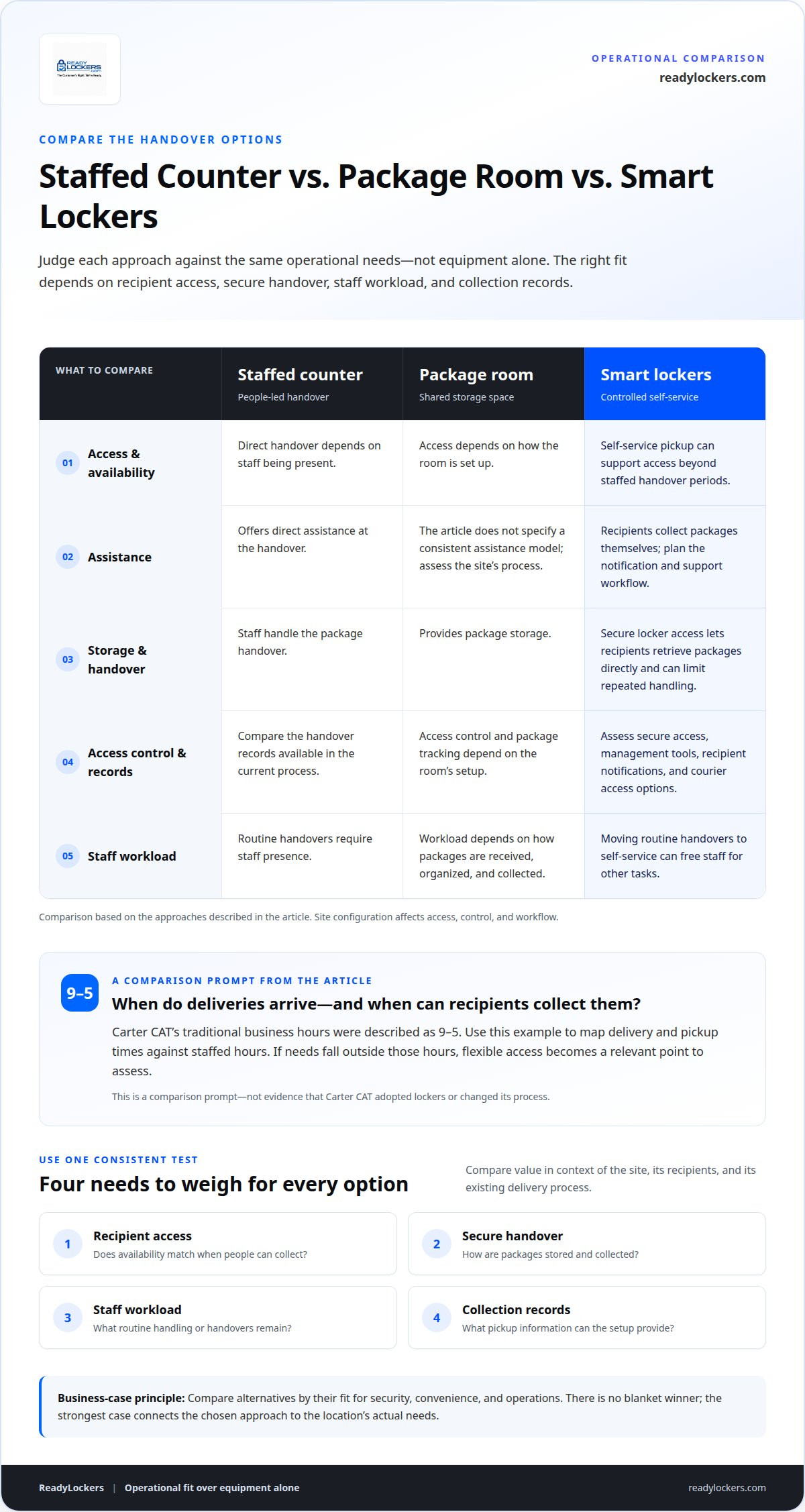
Compare smart lockers with staffed counters, reception desks, and ordinary package rooms. A staffed counter offers direct assistance but depends on staff presence. A package room provides storage, while access control and package tracking depend on its setup. Assess every option against the same needs: recipient access, secure handover, staff workload, and collection records. This makes the case for a particular approach specific to the site, rather than relying on a blanket claim that one method always wins.
Situation: Carter CAT’s traditional business hours were described as 9-5. Action: A business comparing staffed handover with self-service can map when deliveries arrive and recipients can collect them. Result: If needs fall outside staffed hours, flexible access becomes a relevant point of differentiation. The 9-5 example is a comparison prompt, not evidence that Carter CAT adopted lockers or changed its process.
Situation: Frisco Public Library managed a collection of 250,000 items during its move, while its building remained closed for almost two months. It would reopen on February 4, 2023. Action: Use this disruption as a planning scenario: compare how service alternatives handle access when a usual site is unavailable. Result: The example highlights continuity as a competitive criterion, without implying that the library used smart lockers.
A clear comparison also separates proven advantages from assumptions. For a Baltimore workplace serving over 3,100 employees, for example, decision-makers could examine delivery volume, access needs, and the burden on existing handover points. Workforce size alone does not establish locker demand. It cannot establish a business outcome on its own.
Build the comparison around observable operating needs. Document the current delivery route, recipient access windows, handover tasks, and security controls, then compare options against those same steps. Smart lockers are a strong fit where controlled, self-service pickup addresses a real gap; a staffed counter may suit recipients who need direct assistance. This evidence-based approach keeps the business case balanced and relevant to the location.
Device loss and accountability
A smart locker business case should account for misassigned devices, delayed returns, access errors, and system downtime. Consider whether employees can follow the checkout process and whether records show who took each device and returned it.
Situation: Porter Pipe had over 100 warehouse employees using 70-75 RF scanners a day. Employees spent about 2 hours a day searching for lost scanners or waiting for one. The company lost an estimated 13 weeks of production a year because of missing equipment. Porter Pipe was awarded Supply House of the Year in 2021, but the figures still point to an operational issue worth examining.
Action: A device-accountability assessment can map how scanners are assigned, stored, and returned. Define who may access each device, how checkouts are recorded, and what happens when equipment is overdue. A controlled locker workflow can connect access events with device custody. Clear return steps matter too: a checkout record alone does not show whether equipment was put back correctly.
Result: Porter Pipe’s reported search and waiting time illustrates how missing equipment can disrupt daily work. To evaluate a similar process, compare time spent locating devices before and after implementation, and review availability during busy periods. These measures help distinguish better accountability from simply adding storage. They can also reveal whether staff adoption, device capacity, or return habits limit the expected benefit.
Build the risks into the assessment. A device may be returned to the wrong compartment, remain checked out, or become unavailable during a system interruption. Poorly matched locker capacity can also leave equipment outside the controlled process. Track device assignment, access history, return status, and exceptions, then review recurring problems with the teams using the equipment. For a practical next step, explore locker access for device accountability as part of your operational assessment.
ReadyLockers: Smart Package Lockers
ReadyLockers provides Smart Package Lockers for properties seeking a structured approach to package handover. The system connects lockers with Locker Management Software, a Contactless Pickup System, and a Courier Access Interface. Couriers can deposit packages, while recipients receive SMS or QR code notifications and collect packages contactlessly, available 24/7.
Smart package lockers are relevant when delivery access, handover delays, or package accountability are central to your business case. ReadyLockers gives property teams a defined process for courier access and recipient collection, supported by locker management software. Assess the system against the customer patterns, security needs, and operational measures in this guide.
For a discussion about how ReadyLockers fits your property’s package handover needs, contact ReadyLockers.
Turn the business case into a practical next step
A business case for smart lockers, saved as a PDF, can serve as a working decision document rather than a one-time proposal. Use it to define the operating problem, identify the outcome the site needs, and agree on how success will be assessed. This gives property, operations, and technology teams a shared basis for planning.
ReadyLockers offers Smart Package Lockers, Locker Management Software, and a Contactless Pickup System. These offerings can support a package handover workflow shaped around your property’s needs. The next step is to discuss the delivery process, recipient experience, and operational priorities that matter at your location.
Discuss your smart locker project with ReadyLockers and explore a clear path from assessment to implementation. A focused plan can help your team make its next decision with confidence.
Frequently Asked Questions
What is a business case for smart lockers and what benefits do they offer?
A business case explains the operational need, implementation approach, expected value, and measures for assessing results. It helps decision-makers determine whether lockers fit a property’s delivery workflow. Benefits can include structured package access, clearer handover records, and recipient notifications. For example, a property team can decide how to track delivery exceptions and staff effort before choosing a system.
How do smart lockers compare with staffed package rooms and traditional mailrooms?
Smart lockers provide self-service access, while staffed package rooms offer direct assistance during staffed hours. Traditional mailrooms can support centralized sorting and handover, but the process depends on the property’s staffing and access arrangements. The right comparison depends on delivery volume, recipient needs, and the level of personal assistance required. A site can also combine staffed support for exceptions with locker-based routine collection.
Where can I find a smart locker business case PDF with cost and ROI data?
Use this guide as a framework, then build the PDF around your property’s delivery process, operating records, and a project-specific quote. A business case for smart lockers PDF is most useful when it shows the assumptions behind projected value instead of relying on a universal payback figure. ReadyLockers offers purchase, partnership, and licensing models, with custom project quotes. Include ongoing operating factors in your assessment.
What is the typical ROI and payback period for smart lockers?
There is no universal payback period. Assess ROI by comparing implementation and operating costs with measurable changes in staff time, handover delays, package handling, and losses.

Frequently Asked Questions
What is a business case for smart lockers and what benefits do they offer?+
A business case explains the operational need, implementation approach, expected value, and measures for assessing results. It helps decision-makers determine whether lockers fit a property’s delivery workflow. Benefits can include structured package access, clearer handover records, and recipient notifications. For example, a property team can decide how to track delivery exceptions and staff effort before choosing a system.
How do smart lockers compare with staffed package rooms and traditional mailrooms?+
Smart lockers provide self-service access, while staffed package rooms offer direct assistance during staffed hours. Traditional mailrooms can support centralized sorting and handover, but the process depends on the property’s staffing and access arrangements. The right comparison depends on delivery volume, recipient needs, and the level of personal assistance required. A site can also combine staffed support for exceptions with locker-based routine collection.
Where can I find a smart locker business case PDF with cost and ROI data?+
Use this guide as a framework, then build the PDF around your property’s delivery process, operating records, and a project-specific quote. A business case for smart lockers PDF is most useful when it shows the assumptions behind projected value instead of relying on a universal payback figure. ReadyLockers offers purchase, partnership, and licensing models, with custom project quotes. Include ongoing operating factors in your assessment.
What is the typical ROI and payback period for smart lockers?+
There is no universal payback period. Assess ROI by comparing implementation and operating costs with measurable changes in staff time, handover delays, package handling, and losses.