Package Management for High-Rise Buildings: Lockers or Package Centers
Learn how package management for high-rise buildings balances lockers, package centers, and staff workflows for secure pickup and smoother daily operations.

Effective package management for high-rise buildings combines secure, automated lockers with a package center when delivery volume or building layout calls for a shared drop-off area. Lockers give residents a self-service pickup point, while a staffed workflow can handle exceptions, oversized deliveries, and busy periods. The right balance depends on available space and how deliveries move through the building.
More storage alone will not solve every delivery problem. Package management for high-rise buildings also depends on locker placement, resident notifications, courier access, and clear staff responsibilities. These details shape how each delivery moves from arrival to pickup.
This guide explains how automated lockers work, when a package center in a high-traffic common area makes sense, and how staff workflows affect daily operations. Use these factors to plan package management for high-rise buildings around an organized pickup process for residents and building teams.
Key Takeaways
- Choose automated lockers when self-service pickup and secure package handling are priorities; placement and access design affect how well they fit a building.
- A package center works best when its location supports resident flow and its process keeps arrivals, storage, and collection organized.
- Clear staff workflows help manage delivery exceptions without making package handling a constant interruption to other resident services.
- Compare locker-based, staffed, and hybrid approaches by considering building layout, delivery patterns, available staff, and the experience residents need.
Automated package lockers
Automated lockers give apartment and condominium residents a secure, self-service place to collect deliveries. In a high-rise, placing them near the lobby or another shared route can make pickup easier without an extra trip between floors.
Locker and staffed-room trade-offs
Smart lockers automate package storage and pickup; a staffed room relies on employees to receive, organize, and release deliveries. The choice affects both resident pickup and staff workloads. Compare the building’s layout, delivery patterns, available space, and staffing workflow. Lockers near a lobby may suit residents passing through, while a staffed room can handle items that do not fit standard compartments.
Package-room rules and requirements
Package-room planning must account for USPS and courier procedures, applicable fire requirements, and accessibility needs. These factors affect where deliveries can be accepted and stored, and whether residents and authorized personnel can reach the room safely. Keep routes and exits clear, and provide an accessible path to pickup areas. Align room design and delivery instructions with locally applicable requirements instead of assuming one layout suits every property.
Access controls and delivery procedures
Access controls limit who can enter delivery areas, while consistent procedures define how packages move from courier to recipient. Together, these measures reduce casual access and make handoffs easier to track. Direct couriers to a designated entrance, restrict access to approved personnel, and assign each parcel to its recipient before pickup. Clear instructions also help prevent packages from being left in elevator lobbies or unsecured common areas.
Handling special package types
Oversized, refrigerated, and perishable packages need handling routes suited to their size or storage needs. Standard lockers may not fit a large box, and an ordinary room does not provide refrigeration. Set a separate process, such as a designated oversized holding area or prompt handoff to the recipient. For food or other temperature-sensitive items, use appropriate cold storage when the building has it, and communicate pickup arrangements clearly.
Package centers in high-traffic common areas
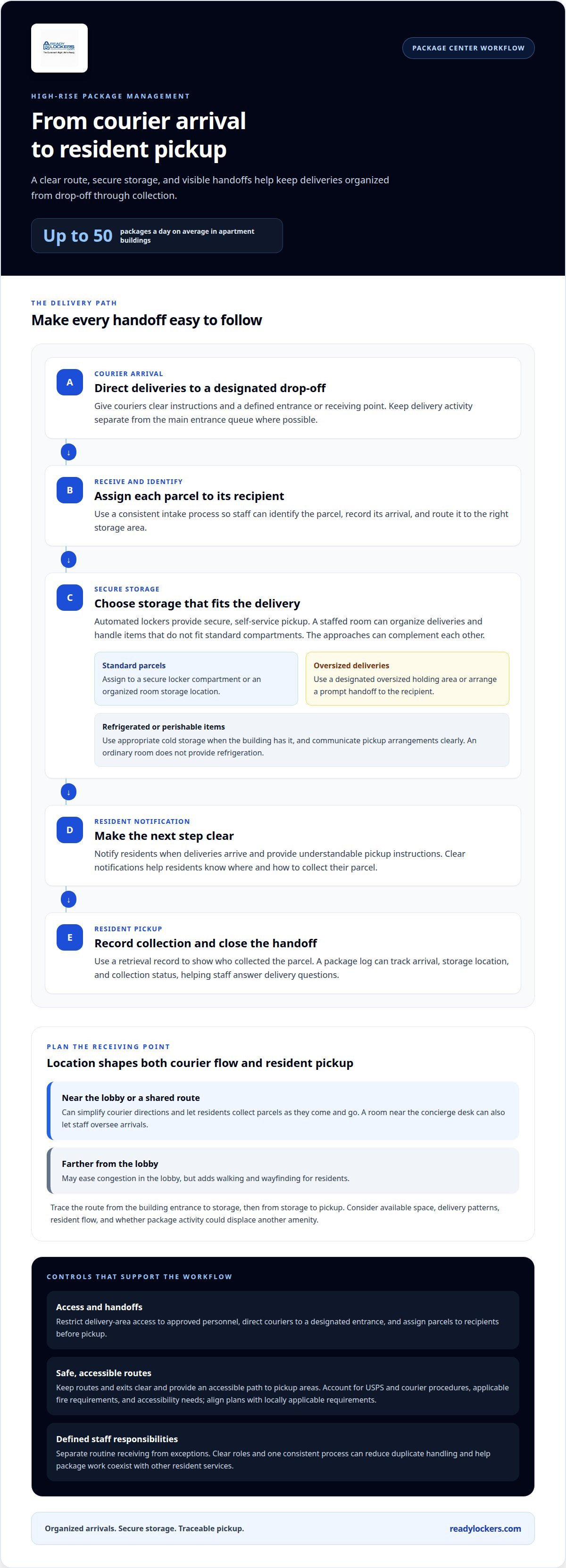
A package center gives couriers a designated place to leave residential deliveries. Locate it near a common route, such as the lobby, so residents can collect parcels as they come and go. In a rental tower, the location should also keep delivery activity separate from the main entrance queue.
A secure package room can notify residents when deliveries arrive and track who retrieves them. That record creates a clearer handoff than parcels left on a lobby table. Apartment buildings receive up to 50 packages a day on average, so an organized receiving point can help prevent common areas from becoming temporary storage.
Choose a location by tracing the delivery route from the building entrance to storage, then from storage to resident pickup. A room beside the concierge desk, for example, can simplify courier directions and let staff oversee arrivals. A center farther from the lobby may ease congestion there, but add walking and wayfinding for residents.
Define the room’s workflow before deliveries begin. Couriers need a clear drop-off point; staff need a consistent way to identify and record parcels; residents need an understandable pickup notification. Notifications and retrieval records make each step visible. They also help staff identify uncollected packages and answer questions about a delivery.
Building boards should weigh location, access, available space, and staff involvement together. A large room can accommodate package staging, but using valuable common space may displace another resident amenity. A smaller center can preserve lobby space, yet require more frequent organization when deliveries arrive together. The building’s delivery patterns and rental operations determine which trade-off matters most.
For buildings considering a more automated pickup point, smart package locker systems can complement a package center by assigning deliveries to secure compartments. The two approaches can also support different parcel types and pickup needs within one residential property.
Staff workload and package management
Apartment buildings receive up to 50 packages a day on average, adding recurring tasks to property management. Staff may accept deliveries, sort items, answer tenant questions, and handle exceptions alongside guest check-ins and other resident services. A defined workflow helps keep package work from disrupting amenities, maintenance coordination, and front-desk responsibilities.
Separate routine handling from exceptions. A staff member can record a parcel on arrival, route it to its assigned storage area, and direct recipient questions through one consistent process. Clear role assignments reduce duplicate handling and make delays easier to identify. A package log can record arrival, storage location, and collection status without relying on memory or informal notes.
High-rise boards also need to retain skilled onsite staff amid competing service and hospitality demands. Constant manual sorting can take time away from resident support. Automated storage and management tools can reduce repetitive handling, leaving staff available for unusual deliveries and resident concerns.
For property management teams, package operations should be planned alongside other building priorities. Construction, repairs, or maintenance can change access routes or reduce usable space, so temporary procedures may be needed during a lobby project. Boards can also consider staffing and package-room needs when allocating common areas for resident amenities or building operations.
Package handling carries risks of misplaced, damaged, or improperly released deliveries. Responsibility and insurance coverage depend on the building’s governing documents, policies, and procedures. Keep records that clearly show how packages move through the property.
A practical staff workflow can define:
- Who accepts deliveries and records each arrival.
- Where standard and oversized parcels are stored.
- How staff handle tenant questions and delivery exceptions.
- How collection or unresolved issues are recorded at shift handoff.
These steps make package duties more predictable, while keeping them distinct from concierge service and other resident-facing work.
How do smart package lockers compare with staffed package rooms for high-rise buildings?
Smart lockers automate package storage and pickup; staffed rooms rely on employees to receive, organize, and release deliveries. In a lobby, lockers let residents collect parcels without waiting for staff. A staffed room offers direct assistance when a parcel needs special handling or a resident has a question.
The main difference is how each approach uses staff time and space. Lockers need a suitable location and a clear process for couriers to deposit deliveries. Staffed rooms need assigned responsibilities for accepting parcels, logging arrivals, and managing collection. A building with a concierge team may already have a natural point of contact, while a property seeking less manual handling may prioritize automation.
- Pickup: Locker recipients use a notification, such as an SMS or QR code, for contactless collection. Staffed rooms may require an employee to locate and hand over each parcel.
- Exceptions: A room gives staff a way to handle items that need individual attention. A locker workflow can direct parcels that do not fit the usual process to staff.
- Space: Lockers require a designated installation area. A package room needs space for parcel staging and organized storage.
A hybrid setup can address different delivery needs in one building. Standard parcels can go into lockers, for example, while unusually large deliveries follow a staff-managed process. This arrangement works best when courier instructions and staff responsibilities clearly distinguish the two routes.
To choose a system, map each delivery from building entrance through storage and pickup. Then weigh available space, resident access, staff capacity, and the types of exceptions the building handles. The best fit is the one whose daily process matches those operating conditions, not simply the one that looks simplest on a floor plan.
Explore how automated locker pickup can fit your building when reducing staff involvement in routine parcel handoffs is a priority.
ReadyLockers: Smart Package Lockers
ReadyLockers helps high-rise teams organize parcel storage and resident pickup with Smart Package Lockers, Locker Management Software, a Contactless Pickup System, and a Courier Access Interface. Couriers place packages in secure lockers, and residents receive instant SMS or QR code notifications. Pickup is contactless and available 24/7.
Smart lockers can suit buildings seeking a defined delivery point and less manual coordination for routine parcels. Locker management software supports the package workflow, while the courier interface connects delivery access with locker drop-off. Residents can retrieve packages without waiting for a staff handoff, and building teams can manage exceptions separately.
For a building assessing automated pickup alongside its existing package-room process, contact ReadyLockers to discuss how smart lockers could fit its delivery setup.
Make Package Planning Part of Your Building’s Next Step
Package needs can change as residents, delivery patterns, and shared spaces evolve. Treat the receiving area as part of ongoing building operations, not as a fixed lobby feature. Regular reviews can help property teams spot friction early, adjust responsibilities, and keep parcel handling aligned with how residents use the building.
For package management for high-rise buildings, start by defining what a better daily process should achieve. Consider where deliveries enter, how residents collect them, and which tasks should remain with onsite staff. These priorities provide a practical basis for planning a system that fits the property without adding unnecessary complexity.
ReadyLockers offers Smart Package Lockers, Locker Management Software, and a Contactless Pickup System to support organized delivery handling. Start a conversation with ReadyLockers about your building’s package setup and take the next step toward a process designed around your residents and operations.
Frequently Asked Questions
What package management systems are used in high-rise residential buildings?
High-rise buildings commonly use staffed package rooms, automated lockers, concierge-managed receiving, or a combination. The right setup depends on how deliveries are accepted, where parcels can be stored, and whether residents need staff assistance. A building might direct routine parcels to lockers and route unusual deliveries through its receiving team. Compare these workflows against the property’s layout and service model.
How do high-rise buildings handle package delivery, storage, and resident pickup?
Buildings typically establish a receiving point, identify each parcel’s intended resident, store it securely, and provide a clear pickup process. Plan how staff should handle a delivery with an unclear unit number or damaged packaging. Record the issue and keep the parcel separate until it can be resolved, so it does not get confused with routine pickups.
What staffing and operating procedures are needed to manage packages in a high-rise?
Staffing needs depend on the delivery workflow, the amount of manual sorting, and the assistance residents require. Assign responsibility for accepting parcels, recording exceptions, and handing unresolved items to the next shift. A shift handoff can note a parcel awaiting resident identification, so the next employee knows its status. Review recurring exceptions to identify where instructions or workflows need adjustment.
What USPS, courier, fire code, and accessibility rules affect package rooms in U.S. buildings?
Package-room plans must account for USPS and courier procedures, applicable fire requirements, and accessibility needs. Keep routes and exits clear, provide an accessible path to pickup areas, and align room design and delivery instructions with locally applicable requirements.

Frequently Asked Questions
What package management systems are used in high-rise residential buildings?+
High-rise buildings commonly use staffed package rooms, automated lockers, concierge-managed receiving, or a combination. The right setup depends on how deliveries are accepted, where parcels can be stored, and whether residents need staff assistance. A building might direct routine parcels to lockers and route unusual deliveries through its receiving team. Compare these workflows against the property’s layout and service model.
How do high-rise buildings handle package delivery, storage, and resident pickup?+
Buildings typically establish a receiving point, identify each parcel’s intended resident, store it securely, and provide a clear pickup process. Plan how staff should handle a delivery with an unclear unit number or damaged packaging. Record the issue and keep the parcel separate until it can be resolved, so it does not get confused with routine pickups.
What staffing and operating procedures are needed to manage packages in a high-rise?+
Staffing needs depend on the delivery workflow, the amount of manual sorting, and the assistance residents require. Assign responsibility for accepting parcels, recording exceptions, and handing unresolved items to the next shift. A shift handoff can note a parcel awaiting resident identification, so the next employee knows its status. Review recurring exceptions to identify where instructions or workflows need adjustment.
What USPS, courier, fire code, and accessibility rules affect package rooms in U.S. buildings?+
Package-room plans must account for USPS and courier procedures, applicable fire requirements, and accessibility needs. Keep routes and exits clear, provide an accessible path to pickup areas, and align room design and delivery instructions with locally applicable requirements.