Military Base Package Management: 2026 Practical Guide
Master military base package management in 2026. Learn how to streamline routine parcel handoffs, secure chain of custody, and evaluate modern smart lockers.

What if the biggest challenge in military base package management isn’t where parcels wait, but who is authorized to receive and release them? Deliveries may arrive at multiple buildings for different recipient groups. Manual handoffs can add staff work and make package tracking harder.
That’s why a clear process should come before choosing locker hardware. Teams need to define who can accept routine parcels, how recipients are identified, and how each handoff is recorded. Access, privacy, and security procedures can vary, so a solution that fits one location may not suit another.
This guide explains how to map an accountable routine parcel process, where smart lockers may reduce staff handling and missed handoffs, and what to verify before procurement. It also covers how locker management software, courier access interfaces, and SMS or QR pickup notifications can support an organized handoff where installation policies permit. Use the guidance to distinguish routine parcels from materials that may be restricted, and to identify the local policy, technical, accessibility, and records questions to confirm with the responsible authority. Lockers can support approved procedures, but they don’t replace them.
Key Takeaways
- Define who receives, holds, notifies, and releases routine parcels before selecting a package-handling approach.
- Military base package management works best when every handoff follows a locally approved process with clear accountability.
- Compare staffed receiving, manual package rooms, and smart lockers based on workload, pickup needs, access administration, space, and exceptions.
- Review delivery patterns, parcel sizes, placement, connectivity, accessibility, and permitted courier routes before proposing lockers.
- Evaluate ReadyLockers’ modular hardware and management software for routine parcels, then verify installation-specific requirements and any needed integrations.
Military base package management: define the delivery problem before choosing a system
Military base package management coordinates routine parcel receipt, recipient notification, temporary custody, and pickup. It is an operating process, not simply a storage decision. Facilities, mailroom staff, housing teams, recipients, couriers, and security authorities may all influence how parcels move, who can accept them, and what records are needed.
Start by mapping the current handoffs. Where do routine packages arrive? Who accepts them, and how do recipients learn they’re ready? If a parcel moves to another building or holding area, when does responsibility transfer? The answers help identify whether the main issue is the arrival location, staff workload, unclear ownership, or the pickup process.
Keep routine parcel handling distinct from official mail, official materials, and items with controlled or other special handling requirements. Military mail systems provide context on military postal services, but each base’s process still needs to distinguish postal operations from other package handoffs. A locker manages a handoff; it does not provide the courier’s delivery service.
Which delivery problems should the process solve?
Check whether lobby congestion, staff interruptions, missed handoffs, or uncertainty about package ownership are happening in the current workflow. Don’t assume these issues affect every installation. Review arrival points, acceptance responsibilities, notification methods, and the exception process for an unclaimed or incorrectly addressed parcel. A specific problem statement helps teams compare options against operational needs instead of choosing equipment first.
Which packages belong in a routine pickup workflow?
The responsible installation authority should define eligible parcel types and identify prohibited, restricted, or specially handled categories. Do not route classified, sensitive, hazardous, controlled, or otherwise restricted materials into a routine locker workflow. Convenience and automation come second to physical security and handling policies. If eligibility is unclear, pause and seek direction from the appropriate authority.
Document the boundaries of the workflow. Specify which staff or couriers may place eligible parcels, who may collect them, and how exceptions are escalated. A smart locker may suit routine parcels where installation policies permit, but its access controls, records, placement, and proposed integrations must be reviewed against local requirements before procurement. This ties the system decision to an approved process and makes responsibility visible at each handoff.
How military base package management works from courier arrival to pickup
A reliable handoff connects authorized access, correct parcel placement, recipient notification, and pickup records. The sequence below is a planning model only: every step is subject to local approval. Installation authorities must define who may enter, which parcels are eligible, and what happens when the routine process doesn’t fit.
The Army Postal Program explains military postal procedures for mail sent to service members overseas. A base’s routine parcel workflow is a separate operational process and should follow its own approved rules.
- Step 1, approve arrival and access. The installation determines permitted courier routes, access conditions, and authorized users. A locker vendor can’t set installation access policy.
- Step 2, direct eligible parcels. An authorized courier or receiving staff member brings an approved routine parcel to the designated receiving point. Special-handling items follow their separate procedures.
- Step 3, place and record. If permitted, the parcel is assigned to an available compartment and its status is recorded in the selected process. Decide who handles oversized parcels, failed delivery attempts, and unavailable compartments.
- Step 4, notify the recipient. An approved system may send an SMS or QR code notification when a parcel is ready for pickup. The notification communicates package status; it doesn’t, by itself, establish identity or authorization.
- Step 5, complete pickup. The recipient follows the approved access and collection procedure. Contactless pickup may reduce staff involvement. Pickup outside staffed hours is appropriate only if site operations and installation policy permit it.
What happens when a courier arrives?
The installation, not the locker vendor alone, defines courier arrival and access procedures. Confirm who can deliver, where parcels may be left, and who is responsible if a parcel won’t fit or a compartment is unavailable. Assign someone to own exceptions before launch so parcels don’t remain in an unclear custody state.
How do notification and pickup steps work?
After approved placement, an automated SMS or QR notification can tell the intended recipient that a parcel is ready. Administrators may use available status or usage records to review placements and pickups, subject to local privacy and records rules. A package-status record documents a handoff event; it does not prove regulatory or security compliance.
For installations evaluating this approach, review ReadyLockers smart package lockers and management software as one possible hardware and software option for routine parcels, subject to local review and approval.
Compare staffed receiving, manual package rooms, and smart lockers for a base
The right approach depends on parcel volume, recipient schedules, available staff, and installation procedures. A staffed desk provides direct oversight. A manual package room relies on staff to organize storage and tracking. Smart lockers can organize routine parcel placement and pickup through hardware and software. None removes the need to define approved access, handling, and exception procedures. For policy context, consult the official Air Force mail management procedures and confirm which guidance applies to the installation.
| Factor | Staffed receiving | Manual package room | Smart lockers |
|---|---|---|---|
| Staff workload | Staff accept parcels and coordinate recipient handoffs. | Staff organize storage and manage notifications or pickup records. | Software can support notifications and pickup records, though staff still manage exceptions. |
| Pickup flexibility | Usually depends on staffed pickup hours. | Depends on room access rules and local operating hours. | May support self-service pickup outside staffed hours if site operations and policies permit. |
| Access administration | Staff oversee each handoff directly. | Local procedures control room access and package release. | Access management is a platform function that must be configured and approved locally. |
| Space needs | Requires a receiving point and room for parcels awaiting collection. | Requires suitable storage space and an organized layout. | Requires a suitable locker location and enough capacity for expected parcel sizes and volume. |
| Exceptions | Staff can route unusual deliveries through established procedures. | Staff must identify and resolve parcels that don’t fit the standard process. | Oversized parcels, unavailable compartments, and other exceptions still need a defined staff process. |
When might a staffed or manual process remain appropriate?
For a site with low delivery volume, limited locker space, or packages requiring direct staff oversight, a staffed desk or manual room may be a practical fit. Consider staffing availability, secure storage capacity, and the hours recipients can collect parcels. Manual handling isn’t inherently unsafe, and lockers aren’t automatically the best option. Military base package management should match the approved workflow and operating conditions, not a preference for more technology.
When could smart lockers fit routine parcel pickup?
Lockers may suit recurring routine parcels when recipient pickup patterns, staff workload, and site layout support a self-service option. SMS or QR notifications can tell recipients a parcel is ready, while courier access management can help administer approved placement procedures. These are platform functions, not security certifications or proof of compliance. For more on system capabilities, see the smart locker management software guide and the contactless delivery locker technology guide. Confirm installation-specific access, privacy, records, and procurement requirements before selecting a system.
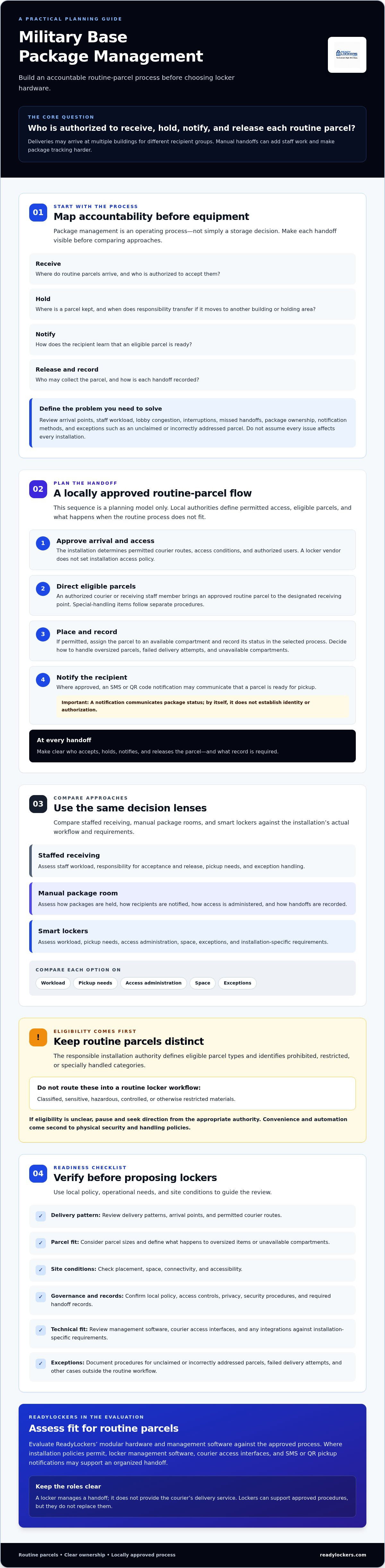
Use this readiness checklist before introducing lockers on a military base
Before evaluating hardware, establish operating requirements and site constraints. For Military base package management, the readiness review should connect actual parcel demand with approved access, space, technology, and oversight. A locker layout that fits the building but conflicts with courier routes or recipient access procedures won’t solve the operational problem.
- Measure demand: Review delivery volume, parcel dimensions, recipient groups, peak periods, and current staff workload. Note which parcels fall outside the proposed routine pickup scope.
- Map the site: Identify possible locations, available power and connectivity, accessibility needs, visibility for oversight, and permitted courier routes. Check how recipients will reach the location under approved site procedures.
- Confirm operating rules: Ask responsible authorities to define access permissions, incident escalation, privacy expectations, and records handling, including applicable retention requirements.
- Assign ownership: Identify who manages day-to-day operations, handles exceptions, and contacts the appropriate authority if a system or pickup issue occurs.
Use the smart locker installation guide as a reference for site planning, then validate each requirement with installation stakeholders. Facilities, logistics or mailroom staff, security authorities, procurement, IT, and affected recipient groups may all need to review the proposal. Each should confirm applicable installation, purchasing, data, access, and technical requirements.
Which stakeholders and requirements need early review?
Keep assumptions visible. Mark proposed integrations, security controls, certifications, and compliance claims for verification rather than treating them as established capabilities. Confirm that the chosen site supports the approved placement and pickup process, and that responsible authorities have reviewed how package-status information will be accessed and handled.
How should a phased rollout be evaluated?
Begin with a defined routine-parcel use case, eligible recipients, an operating owner, and a named escalation contact. Keep the initial scope clear enough to review before adding locations or package categories.
Agree on measures before the rollout, such as pickup completion, package dwell time, staff interruptions, and exception volume. Review the results with stakeholders against the original workflow and local requirements. If the process creates new access, space, or staffing issues, resolve them before expansion. A measured rollout helps determine whether lockers fit the site instead of assuming automation is right for every situation.
For an option to assess against your approved requirements, explore ReadyLockers smart package lockers.
Evaluate ReadyLockers for routine military base package management
ReadyLockers combines modular smart locker hardware with cloud-based management software. For an approved routine-parcel workflow, that combination may help coordinate courier placement, recipient notifications, contactless pickup, and administrative review. Evaluate it against a defined need. It is not a substitute for installation policy or evidence of military approval.
Modular configurations can be planned around a site’s layout and anticipated package volume. The platform supports courier access management, automated SMS or QR notifications, contactless pickup, and usage analytics. These functions may help organize the handoff from an authorized courier to a recipient and give administrators information to review parcel activity. They don’t establish identity verification, security certification, compliance, or suitability for restricted materials.
What ReadyLockers can support in a routine-delivery workflow
For eligible parcels, authorized placement can be followed by an SMS or QR notification letting the intended recipient know a package is ready. Contactless pickup can reduce the need for a staff-mediated exchange where installation procedures permit it. ReadyLockers sells locker hardware and software; it does not provide courier or delivery services. The installation’s designated delivery process remains separate and must be approved locally.
What to confirm before evaluating a vendor
Before procurement, ask the responsible authorities to approve the proposed use case and location. Confirm installation-specific requirements for access, security controls, accessibility, privacy, records handling, purchasing, and any needed technical integrations. Request clear confirmation of what the system supports. Don’t infer military suitability or government procurement eligibility from a feature description.
- Which routine parcels and recipient groups are in scope, and which are excluded?
- Who authorizes courier access, manages exceptions, and reviews available usage information?
- Are required integrations supported, and have data practices and accessibility provisions been reviewed?
- What local approvals must be complete before procurement or installation?
The smart package lockers buyer's guide can help structure these vendor questions. Use the answers to compare the proposed system with the approved workflow, site constraints, and staff responsibilities.
For military base package management, document requirements before taking the next step. If the use case is limited to eligible routine parcels and the responsible authorities confirm the site and system requirements, request a system discussion to assess fit. If approval or technical suitability is unresolved, keep those questions open before proceeding.
Build an accountable process, then choose the right tools
Effective Military base package management begins with an approved, clearly owned routine-parcel workflow. Define who accepts deliveries, how recipients are notified, and how exceptions are handled before deciding whether staffed receiving, a package room, or lockers best fit the site.
Smart lockers may help organize eligible parcel handoffs, but their suitability depends on local approval, site conditions, and verified technical requirements. ReadyLockers pairs modular locker hardware with a cloud-based management platform that supports courier access management, automated SMS or QR notifications, contactless pickup, and usage analytics. These functions can support routine operations, but they don’t replace installation procedures or establish security approval.
If your documented use case aligns with approved routine-parcel needs, discuss a routine package-locker use case with ReadyLockers. Bring your requirements and open questions to assess fit before moving forward.
Frequently Asked Questions
How does package management work on a military base?
Military base package management coordinates receipt, notification, temporary custody, and recipient pickup for eligible parcels. The installation defines the approved process, including where deliveries arrive, who may accept them, how recipients are notified, and how exceptions are handled. Keep routine parcels distinct from mail, official materials, and items requiring special handling. Make responsibility clear at each handoff without assuming every building or recipient group follows the same procedure.
Can smart lockers be used on a military base?
Smart lockers may be considered for routine parcels if the installation approves the use case, location, access procedures, and system requirements. They can pair locker hardware with software for courier access management, SMS or QR notifications, contactless pickup, and usage analytics. Those features don’t establish military approval, security certification, or procurement eligibility. Ask the responsible authorities to confirm whether the proposed system and its data practices fit local requirements before procurement.
Are package lockers appropriate for classified or sensitive materials?
Don’t assume package lockers are appropriate for classified, sensitive, hazardous, controlled, or otherwise restricted materials. Those items may have distinct handling procedures, and convenience or automation shouldn’t override installation policy. The responsible authority must define eligible parcel categories and direct deliveries that fall outside routine pickup to the correct process. If an item’s status or handling requirements are unclear, keep it out of the locker workflow until an authorized official provides direction.
How do recipients know when a package is ready for pickup?
Recipients can be notified when an eligible parcel is placed and recorded through the approved process. ReadyLockers supports automated SMS or QR code pickup notifications. A message can indicate that a package is ready, but it should not be treated as proof of identity or authorization. The installation must decide how recipient access is controlled and what steps complete a valid pickup, including what to do if a notification fails or a recipient can’t collect the parcel.
What should a base evaluate before installing package lockers?
Start with delivery volume, package dimensions, recipient groups, peak periods, and staff workload. Then review proposed placement, space, power, connectivity, accessibility, visibility, and permitted courier routes. Facilities, logistics or mailroom teams, security authorities, IT, procurement, and affected recipients may need to confirm requirements. Ask authorities to review access rules, privacy, data practices, records handling, integrations, and purchasing eligibility. Treat certifications, security controls, and compliance claims as items to verify.
Do package lockers replace a military base mailroom?
No. Package lockers can support a defined routine-parcel pickup process, but they don’t automatically replace a mailroom or its other responsibilities. A site may still need staff to receive or route mail, manage exceptions, handle parcels that don’t fit, and oversee procedures requiring direct attention. Before introducing lockers, define what remains with the mailroom and which eligible parcels, if any, may follow a separate locker-based handoff.
Can couriers access military base package lockers directly?
Only if the installation authorizes the access method and the courier’s route under local procedures. A locker system may support courier access management, but that function doesn’t grant permission to enter an installation or determine who is authorized to deliver. Confirm who may access the receiving location, how credentials or procedures are administered, and who handles failed deliveries or unavailable compartments. The installation, not the locker vendor alone, sets the applicable access rules.

Frequently Asked Questions
Which stakeholders and requirements need early review?+
Keep assumptions visible. Mark proposed integrations, security controls, certifications, and compliance claims for verification rather than treating them as established capabilities. Confirm that the chosen site supports the approved placement and pickup process, and that responsible authorities have reviewed how package-status information will be accessed and handled.
How should a phased rollout be evaluated?+
Begin with a defined routine-parcel use case, eligible recipients, an operating owner, and a named escalation contact. Keep the initial scope clear enough to review before adding locations or package categories. Agree on measures before the rollout, such as pickup completion, package dwell time, staff interruptions, and exception volume. Review the results with stakeholders against the original workflow and local requirements. If the process creates new access, space, or staffing issues, resolve them before expansion. A measured rollout helps determine whether lockers fit the site instead of assuming automation is right for every situation. For an option to assess against your approved requirements, explore ReadyLockers smart package lockers. ReadyLockers combines modular smart locker hardware with cloud-based management software. For an approved routine-parcel workflow, that combination may help coordinate courier placement, recipient notifications, contactless pickup, and administrative review. Evaluate it against a defined need. It is not a substitute for installation policy or evidence of military approval. Modular configurations can be planned around a site’s layout and anticipated package volume. The platform supports courier access management, automated SMS or QR notifications, contactless pickup, and usage analytics. These functions may help organize the handoff from an authorized courier to a recipient and give administrators information to review parcel activity. They don’t establish identity verification, security certification, compliance, or suitability for restricted materials.
How does package management work on a military base?+
Military base package management coordinates receipt, notification, temporary custody, and recipient pickup for eligible parcels. The installation defines the approved process, including where deliveries arrive, who may accept them, how recipients are notified, and how exceptions are handled. Keep routine parcels distinct from mail, official materials, and items requiring special handling. Make responsibility clear at each handoff without assuming every building or recipient group follows the same procedure.
Can smart lockers be used on a military base?+
Smart lockers may be considered for routine parcels if the installation approves the use case, location, access procedures, and system requirements. They can pair locker hardware with software for courier access management, SMS or QR notifications, contactless pickup, and usage analytics. Those features don’t establish military approval, security certification, or procurement eligibility. Ask the responsible authorities to confirm whether the proposed system and its data practices fit local requirements before procurement.
Are package lockers appropriate for classified or sensitive materials?+
Don’t assume package lockers are appropriate for classified, sensitive, hazardous, controlled, or otherwise restricted materials. Those items may have distinct handling procedures, and convenience or automation shouldn’t override installation policy. The responsible authority must define eligible parcel categories and direct deliveries that fall outside routine pickup to the correct process. If an item’s status or handling requirements are unclear, keep it out of the locker workflow until an authorized official provides direction.
How do recipients know when a package is ready for pickup?+
Recipients can be notified when an eligible parcel is placed and recorded through the approved process. ReadyLockers supports automated SMS or QR code pickup notifications. A message can indicate that a package is ready, but it should not be treated as proof of identity or authorization. The installation must decide how recipient access is controlled and what steps complete a valid pickup, including what to do if a notification fails or a recipient can’t collect the parcel.
What should a base evaluate before installing package lockers?+
Start with delivery volume, package dimensions, recipient groups, peak periods, and staff workload. Then review proposed placement, space, power, connectivity, accessibility, visibility, and permitted courier routes. Facilities, logistics or mailroom teams, security authorities, IT, procurement, and affected recipients may need to confirm requirements. Ask authorities to review access rules, privacy, data practices, records handling, integrations, and purchasing eligibility. Treat certifications, security controls, and compliance claims as items to verify.
Do package lockers replace a military base mailroom?+
No. Package lockers can support a defined routine-parcel pickup process, but they don’t automatically replace a mailroom or its other responsibilities. A site may still need staff to receive or route mail, manage exceptions, handle parcels that don’t fit, and oversee procedures requiring direct attention. Before introducing lockers, define what remains with the mailroom and which eligible parcels, if any, may follow a separate locker-based handoff.
Can couriers access military base package lockers directly?+
Only if the installation authorizes the access method and the courier’s route under local procedures. A locker system may support courier access management, but that function doesn’t grant permission to enter an installation or determine who is authorized to deliver. Confirm who may access the receiving location, how credentials or procedures are administered, and who handles failed deliveries or unavailable compartments. The installation, not the locker vendor alone, sets the applicable access rules.