Inbound Package Management Platform: A 2026 Guide to Smarter Receiving
Discover how an inbound package management platform streamlines parcel intake, courier access, and secure pickup to eliminate delivery chaos at your property.

What if recording a delivery is only half the job? An inbound package management platform should guide each parcel from courier handoff to recipient pickup, rather than leaving staff to manage the gaps with manual logs, sorting, and follow-up messages. When deliveries keep arriving, a dependable process matters just as much as knowing a package is on site.
A useful platform connects courier access, package intake, recipient notifications, and secure pickup so staff have a clearer handoff and recipients know when their parcels are ready. In this guide, you’ll learn how the full inbound package workflow works, which platform capabilities to compare with your property’s needs, and how smart lockers and management software can support contactless pickup. We’ll also look at how a connected hardware and software system, such as ReadyLockers, can be configured around different property layouts and package volumes.
Key Takeaways
- An inbound package management platform organizes the handoff after parcels arrive at a property, rather than tracking shipments on their way there.
- Compare how a platform handles courier access, package deposits, recipient notifications, and pickup to assess whether it supports the complete receiving workflow.
- Map delivery patterns, users, site layout, and pickup expectations before deciding how package handling should work at your property.
- Separate essential receiving functions from optional reporting and analytics so your evaluation reflects real operational needs.
- ReadyLockers connects smart locker hardware with cloud-based management software, including courier access management, SMS or QR notifications, and usage analytics.
What Is an Inbound Package Management Platform, and What Problem Does It Solve?
An inbound package management platform organizes the work that begins when a parcel reaches a property and ends when it is handed to its recipient. It brings delivery information and receiving tasks into a consistent process, rather than leaving staff to rely on scattered notes, paper logs, or memory.
Package management coordinates a property’s receipt, handling, and handoff of deliveries; package tracking reports a shipment’s progress toward its destination. That distinction matters because a carrier’s tracking page may show that a parcel was delivered, but it doesn’t necessarily tell property staff where it was placed, who needs to collect it, or whether it has been picked up.
Without a structured receiving process, staff may need to log arrivals, sort parcels, find suitable storage, identify recipients, send updates, and answer follow-up questions. Each task takes attention, and the handoff can become unclear when deliveries arrive during busy periods or are handled by different staff members. A platform helps coordinate the property-side workflow, while the courier remains responsible for transporting the parcel.
How Is Inbound Package Management Different from Package Tracking?
Carrier tracking follows a shipment’s progress before it reaches the receiving location and may record a delivery scan. Inbound management starts with the arrival itself: the courier gains access, the parcel is received, and the property coordinates storage and recipient pickup. For background on the broader concept, see this overview of internal package tracking systems. The key distinction is operational: tracking describes shipment status, while receiving management organizes what happens at the property.
This boundary helps set realistic expectations. A receiving platform can support an organized courier-to-recipient handoff. Its value lies in making the property’s own package process easier to understand and manage.
Which Operations Benefit from a Structured Receiving Process?
Apartments, offices, warehouses, hotels, hospitals, schools, retail locations, and HOAs all receive deliveries, but their needs differ. An apartment community may need a clear way to notify residents, while an office may focus on routing items to employees or departments. A warehouse may handle deliveries for ongoing operations, and a hotel or hospital may need receiving practices suited to its staff and site.
The common challenge is keeping delivery information connected to the right recipient and handoff, not forcing every property into one workflow. Consider where couriers arrive, who accepts parcels, how recipients are notified, and how pickup is completed. Those details reveal where manual work accumulates and which steps a structured process should improve.
Start by looking at the handoff, not just the delivery record. When staff can see how parcels move from arrival to pickup, they can identify gaps, clarify responsibilities, and choose an approach that fits the property’s layout and users.
How an Inbound Package Management Platform Connects Delivery to Pickup
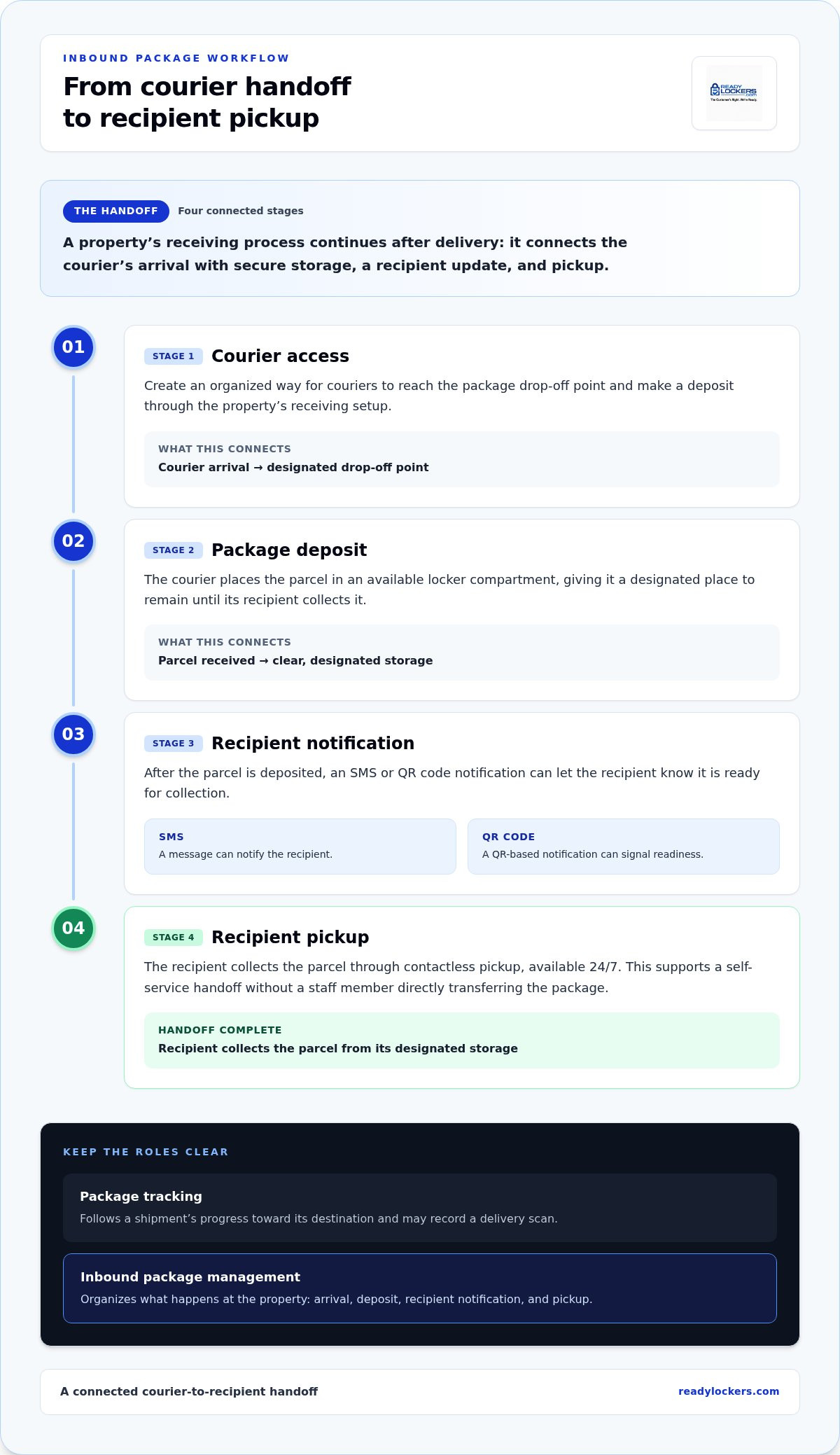
A delivery is complete for the courier when the parcel reaches its destination. For the property, the handoff continues until the right recipient can collect it. An inbound package management platform links the courier’s arrival with parcel deposit, a recipient update, and pickup, so each step has a clear place in the process.
The handoff moves through four stages: courier access, package deposit, recipient notification, and recipient pickup. Connecting these stages helps reduce gaps between a parcel arriving and its recipient knowing it’s ready. It also gives the property a consistent process to build around, rather than relying on separate, informal steps.
What Happens When a Courier Arrives?
The courier access step establishes an organized way for couriers to reach the package drop-off point. With courier access management, the property can coordinate arrivals and deposits through its receiving setup. The courier places the parcel in an available locker compartment, connecting the physical delivery to the property’s package-handling process.
This matters because receiving isn’t only about recording that a parcel arrived. The package needs a designated place where it can remain available for its recipient. A locker-based process gives the courier a clear deposit point and helps keep the package handoff distinct from general front-desk or staff activity.
How Do Recipients Know a Package Is Ready?
Once a package is deposited, SMS or QR code notifications can let the recipient know it’s ready for collection. The notification bridges the gap between courier drop-off and pickup, so the recipient doesn’t have to rely solely on staff to pass along the update. Recipients can then use contactless pickup, available 24/7, to collect the package.
The combination supports a self-service handoff: the courier deposits the parcel, the recipient receives a notification, and pickup can happen without a staff member directly transferring the package. The exact flow should fit the property’s layout and receiving practices. Keep the central aim clear: a useful notification connects the parcel’s arrival with the next action the recipient needs to take.
For colleges and universities, package operations are a distinct part of campus mail services. The National Association of College and University Mail Services provides a relevant professional context for considering how institutions organize mail and package handling. The same handoff principle applies across property types, even though the people, spaces, and daily routines differ.
When evaluating a receiving setup, trace one package through the full sequence. Ask where the courier enters the process, where the parcel is deposited, how the recipient is notified, and how collection works. This walkthrough can reveal whether a system connects the physical handoff or only captures delivery information. For properties considering a connected locker and management approach, align software, courier access, and pickup with the actual receiving workflow.
Which Inbound Package Platform Capabilities Should You Compare?
Compare capabilities against the receiving work your property actually needs, not the longest feature list. A useful inbound package management platform assessment starts with the full parcel journey: how staff or couriers handle arrival, where packages are stored, how recipients are notified, and how pickup is completed. Feature fit depends on the property’s workflow, layout, users, and handoff responsibilities.
Use this comparison to identify where each approach may fit. The right-hand option connects software with physical locker storage and self-service pickup. It is more than a recordkeeping tool because it also provides a designated place for the parcel and a way for recipients to collect it.
| Capability | Manual handling | Software-led receiving | Locker-connected self-service |
|---|---|---|---|
| Package workflow | Staff manage records and handoffs manually. | Software organizes package information and receiving tasks. | Software coordinates package handling alongside locker deposits and pickup. |
| Courier access | Arrival and drop-off follow the property’s existing process. | Consider how access and deposits fit the property’s process. | Courier access management supports an organized locker deposit process. |
| Recipient notification | Staff communicate package readiness through existing procedures. | Assess whether notifications fit the receiving workflow. | SMS or QR code notifications can connect deposit with recipient awareness. |
| Pickup | Staff coordinate a direct handoff. | Staff use the property’s existing storage and handoff arrangements. | Recipients collect packages through contactless pickup. |
Does Your Operation Need Package Logging or a Locker-Connected Workflow?
Software-led receiving may suit a property that already has appropriate package storage and a workable staff-managed handoff. It can help organize receiving information without changing how recipients physically collect deliveries. A locker-connected workflow addresses both sides: the platform helps coordinate package handling, while the locker provides a designated place for deposit and collection.
These functions are related but distinct. Software organizes information and operational steps; locker hardware provides the physical compartments. If staff still need to sort parcels, locate them, and arrange each handoff, compare the whole process rather than judging a solution by its logging capability alone.
How Should You Assess Notifications, Access, and Analytics?
Review how SMS or QR code notifications fit the way recipients learn that packages are ready. Consider who manages courier access and how arrivals align with the property’s receiving responsibilities. Then decide whether operational reporting or analytics would help staff understand package activity. Treat analytics as added visibility, not a promised reduction in workload or a substitute for a clear process.
Separate essential requirements from useful extras. Start with a reliable receiving record, a defined storage and handoff method, and recipient communication that fits your operation. Then consider optional reporting, such as usage analytics, if staff would use that information to review activity or plan operations. This keeps the comparison grounded in practical needs and helps avoid giving attention to features that don’t address a real workflow gap.
How to Plan an Inbound Package Platform for Your Property
Plan around how deliveries move through your property, not around a one-size-fits-all feature list. An inbound package management platform should suit the people receiving parcels, the space available, and the way recipients collect them. A practical review follows a sequence: map deliveries, identify users, assess the site, and set pickup expectations.
- Map delivery activity. Note where couriers arrive, where packages are currently placed, and how they move from arrival to collection. Look for patterns across typical days and busier periods rather than relying on a single snapshot.
- Identify the users. List who receives packages, who manages courier access, and who collects deliveries. These roles may differ by property or by delivery type, so make responsibilities clear.
- Review the site layout. Consider the receiving area, available space, and the path couriers and recipients use to reach it. The physical setup should work with the property’s daily routines.
- Define pickup expectations. Decide how recipients should learn that packages are ready and how collection fits the site’s access and operating practices.
What Should You Map Before Introducing a New Workflow?
Document current arrival points, storage arrangements, and the people involved in each handoff. Separate routine parcels from unusual or oversized deliveries, since they may need different handling. This map gives staff a shared view of the process and helps identify where packages wait, who needs to act, and where recipient communication fits. For implementation considerations, use this smart locker installation guide as a practical reference.
How Do Property Type and Volume Shape the Setup?
Recipient patterns vary. Apartment communities may receive parcels for residents, while offices may handle deliveries for employees or departments. Warehouses, hotels, hospitals, schools, retail locations, and HOAs also have distinct users, spaces, and receiving routines. Consider when deliveries tend to arrive and how that timing affects storage and pickup. Modular locker configurations can be tailored to the property layout and delivery-volume requirements, rather than assuming one setup suits every site.
Residential planning also involves the relationship between shared receiving areas and resident pickup. For those considerations, the apartment locker guide offers a property-specific perspective. Across settings, use observed delivery patterns to inform planning, but avoid treating one busy period as a fixed capacity formula. Review package mix, site constraints, and the recipient handoff together.
Before selecting an approach, write down the workflow you want staff, couriers, and recipients to follow. Then compare the planned steps with the available space and the property’s actual delivery rhythms. This makes it easier to identify a setup that fits operational needs, whether the site is residential, commercial, or institutional. Explore how ReadyLockers can support your package workflow with connected locker hardware and management software.
How ReadyLockers Connects Package Management with Secure Pickup
ReadyLockers brings smart package locker hardware together with cloud-based management software, connecting the property’s receiving process to recipient pickup. The lockers provide physical compartments for package deposits and collection, while the platform supports courier access management, recipient notifications, and usage analytics. Together, these components give properties a structured way to coordinate the handoff.
This connected approach matters because software and storage solve related but different parts of package handling. The platform helps coordinate information and activity; the locker provides a designated location for parcels. An inbound package management platform can support the process from courier deposit through recipient collection, while the property retains responsibility for its receiving workflow.
What Does the ReadyLockers Platform Bring Together?
Modular smart locker units pair with cloud-based management so the setup can be tailored to a property’s layout and package-volume requirements. Courier access management supports an organized arrival and deposit process. After a package is placed in a locker, SMS or QR code notifications can inform the recipient that it is ready. Recipients can then use contactless pickup, available 24/7.
Usage analytics add operational visibility. Property teams can use package activity information to understand how the locker setup is being used and consider whether it continues to suit their receiving needs. Analytics provide information for operational review, not a guarantee of a particular result. For a closer look at the software side, explore the smart locker management software guide.
The pieces work as a connected handoff: courier access supports the deposit, the locker provides a secure place for the package, and a notification tells the recipient it is ready to collect. This arrangement can reduce reliance on a staff member being the only link between arrival and pickup, while giving recipients a contactless collection option. Property teams can shape the workflow around their site and users.
What Is the Next Step Toward a Locker-Connected Workflow?
Start with the factors that determine how the system needs to fit: property layout, delivery patterns, recipient needs, and the space available for lockers. Consider when packages tend to arrive, who receives them, and how recipients will reach the pickup area. These practical details help guide a modular configuration suited to the property rather than an assumed standard setup.
Apartments, offices, and institutional properties may have different users and delivery rhythms, but each benefits from planning the physical placement and recipient handoff together. For residential settings, the apartment locker guide offers additional context for planning around residents and shared spaces.
Ready to connect package management with secure, contactless pickup? Explore ReadyLockers solutions and consider how modular lockers and cloud-based management can support your property’s receiving workflow.
Make Your Next Receiving Decision With Confidence
Turn your property’s package-handling priorities into a clear decision. Bring the people involved in receiving and pickup into the conversation, then agree on what a better handoff should look like for your site. A focused review can help separate essential operational needs from features that are simply nice to have.
Use those priorities to assess whether an inbound package management platform fits the way your property works today and the workflow you want to establish. The goal isn’t to add technology for its own sake. It’s to choose an approach that makes responsibilities clearer and package pickup more practical for staff and recipients.
Ready to consider a locker-connected approach for your property? Explore ReadyLockers package solutions and take the next step toward a receiving workflow that fits your operation.
Frequently Asked Questions
What is an inbound package management platform?
An inbound package management platform is a digital system that helps an organization coordinate incoming deliveries after they reach its property. Depending on the setup, it can support package records, courier access, recipient notifications, or locker-based collection. Carrier tracking answers, “Where is the parcel on its route?” Receiving management answers, “What should happen now that it has arrived?” Defining which question your team needs to solve helps clarify the platform’s role.
How does an inbound package management platform work?
An inbound package management platform typically supports the receiving process from courier arrival through recipient collection. For example, a courier deposits a package at the designated receiving point, and the property’s process records or stores it before the recipient is notified. In a locker-connected setup, the recipient collects the parcel from a locker. The exact sequence depends on the property and system, so map staff responsibilities before introducing a new workflow.
Can an inbound package platform work without smart lockers?
Yes. Some receiving software can help staff record deliveries and notify recipients while packages remain in existing storage areas. A locker-connected setup adds physical compartments for secure, self-service collection. For example, a staffed office with an established package room may prioritize organized records, while a property seeking self-service pickup may prefer a connected locker workflow. Choose based on storage, staffing, and how recipients are expected to collect deliveries.
Who should use an inbound package management platform?
Property and operations teams that regularly receive deliveries can use a platform to bring more structure to package handling. Potential settings include apartments, offices, warehouses, hotels, hospitals, schools, retail locations, and HOAs. A school may coordinate deliveries for departments, while an apartment community may serve individual residents. Suitability depends on the site’s delivery patterns, layout, and current process, so start by identifying where staff spend time managing incoming parcels.
Do recipients need an app to collect a package from ReadyLockers?
ReadyLockers provides recipient notifications through SMS or QR code, and contactless pickup is available 24/7. Property teams can plan how recipient details will be maintained and how notifications fit the site’s existing package communications.
What should a property consider before implementing an inbound package platform?
Before implementation, identify delivery arrival points, the people responsible for receiving packages, recipient groups, available space, and current pickup practices. Review typical delivery patterns and note where the existing process creates extra handling or confusion. Then compare software-led receiving with a locker-connected workflow. If parcels already have suitable storage but staff need clearer records, software may address the main gap; if self-service pickup is a priority, assess the physical locker setup too.

Frequently Asked Questions
How Is Inbound Package Management Different from Package Tracking?+
Carrier tracking follows a shipment’s progress before it reaches the receiving location and may record a delivery scan. Inbound management starts with the arrival itself: the courier gains access, the parcel is received, and the property coordinates storage and recipient pickup. For background on the broader concept, see this overview of internal package tracking systems. The key distinction is operational: tracking describes shipment status, while receiving management organizes what happens at the property. This boundary helps set realistic expectations. A receiving platform can support an organized courier-to-recipient handoff. Its value lies in making the property’s own package process easier to understand and manage.
Which Operations Benefit from a Structured Receiving Process?+
Apartments, offices, warehouses, hotels, hospitals, schools, retail locations, and HOAs all receive deliveries, but their needs differ. An apartment community may need a clear way to notify residents, while an office may focus on routing items to employees or departments. A warehouse may handle deliveries for ongoing operations, and a hotel or hospital may need receiving practices suited to its staff and site. The common challenge is keeping delivery information connected to the right recipient and handoff, not forcing every property into one workflow. Consider where couriers arrive, who accepts parcels, how recipients are notified, and how pickup is completed. Those details reveal where manual work accumulates and which steps a structured process should improve. Start by looking at the handoff, not just the delivery record. When staff can see how parcels move from arrival to pickup, they can identify gaps, clarify responsibilities, and choose an approach that fits the property’s layout and users. A delivery is complete for the courier when the parcel reaches its destination. For the property, the handoff continues until the right recipient can collect it. An inbound package management platform links the courier’s arrival with parcel deposit, a recipient update, and pickup, so each step has a clear place in the process. The handoff moves through four stages: courier access, package deposit, recipient notification, and recipient pickup. Connecting these stages helps reduce gaps between a parcel arriving and its recipient knowing it’s ready. It also gives the property a consistent process to build around, rather than relying on separate, informal steps.
What Happens When a Courier Arrives?+
The courier access step establishes an organized way for couriers to reach the package drop-off point. With courier access management, the property can coordinate arrivals and deposits through its receiving setup. The courier places the parcel in an available locker compartment, connecting the physical delivery to the property’s package-handling process. This matters because receiving isn’t only about recording that a parcel arrived. The package needs a designated place where it can remain available for its recipient. A locker-based process gives the courier a clear deposit point and helps keep the package handoff distinct from general front-desk or staff activity.
How Do Recipients Know a Package Is Ready?+
Once a package is deposited, SMS or QR code notifications can let the recipient know it’s ready for collection. The notification bridges the gap between courier drop-off and pickup, so the recipient doesn’t have to rely solely on staff to pass along the update. Recipients can then use contactless pickup, available 24/7, to collect the package. The combination supports a self-service handoff: the courier deposits the parcel, the recipient receives a notification, and pickup can happen without a staff member directly transferring the package. The exact flow should fit the property’s layout and receiving practices. Keep the central aim clear: a useful notification connects the parcel’s arrival with the next action the recipient needs to take. For colleges and universities, package operations are a distinct part of campus mail services. The National Association of College and University Mail Services provides a relevant professional context for considering how institutions organize mail and package handling. The same handoff principle applies across property types, even though the people, spaces, and daily routines differ. When evaluating a receiving setup, trace one package through the full sequence. Ask where the courier enters the process, where the parcel is deposited, how the recipient is notified, and how collection works. This walkthrough can reveal whether a system connects the physical handoff or only captures delivery information. For properties considering a connected locker and management approach, align software, courier access, and pickup with the actual receiving workflow. Compare capabilities against the receiving work your property actually needs, not the longest feature list. A useful inbound package management platform assessment starts with the full parcel journey: how staff or couriers handle arrival, where packages are stored, how recipients are notified, and how pickup is completed. Feature fit depends on the property’s workflow, layout, users, and handoff responsibilities. Use this comparison to identify where each approach may fit. The right-hand option connects software with physical locker storage and self-service pickup. It is more than a recordkeeping tool because it also provides a designated place for the parcel and a way for recipients to collect it.
Does Your Operation Need Package Logging or a Locker-Connected Workflow?+
Software-led receiving may suit a property that already has appropriate package storage and a workable staff-managed handoff. It can help organize receiving information without changing how recipients physically collect deliveries. A locker-connected workflow addresses both sides: the platform helps coordinate package handling, while the locker provides a designated place for deposit and collection. These functions are related but distinct. Software organizes information and operational steps; locker hardware provides the physical compartments. If staff still need to sort parcels, locate them, and arrange each handoff, compare the whole process rather than judging a solution by its logging capability alone.
How Should You Assess Notifications, Access, and Analytics?+
Review how SMS or QR code notifications fit the way recipients learn that packages are ready. Consider who manages courier access and how arrivals align with the property’s receiving responsibilities. Then decide whether operational reporting or analytics would help staff understand package activity. Treat analytics as added visibility, not a promised reduction in workload or a substitute for a clear process. Separate essential requirements from useful extras. Start with a reliable receiving record, a defined storage and handoff method, and recipient communication that fits your operation. Then consider optional reporting, such as usage analytics, if staff would use that information to review activity or plan operations. This keeps the comparison grounded in practical needs and helps avoid giving attention to features that don’t address a real workflow gap. Plan around how deliveries move through your property, not around a one-size-fits-all feature list. An inbound package management platform should suit the people receiving parcels, the space available, and the way recipients collect them. A practical review follows a sequence: map deliveries, identify users, assess the site, and set pickup expectations.
What Should You Map Before Introducing a New Workflow?+
Document current arrival points, storage arrangements, and the people involved in each handoff. Separate routine parcels from unusual or oversized deliveries, since they may need different handling. This map gives staff a shared view of the process and helps identify where packages wait, who needs to act, and where recipient communication fits. For implementation considerations, use this smart locker installation guide as a practical reference.
How Do Property Type and Volume Shape the Setup?+
Recipient patterns vary. Apartment communities may receive parcels for residents, while offices may handle deliveries for employees or departments. Warehouses, hotels, hospitals, schools, retail locations, and HOAs also have distinct users, spaces, and receiving routines. Consider when deliveries tend to arrive and how that timing affects storage and pickup. Modular locker configurations can be tailored to the property layout and delivery-volume requirements, rather than assuming one setup suits every site. Residential planning also involves the relationship between shared receiving areas and resident pickup. For those considerations, the apartment locker guide offers a property-specific perspective. Across settings, use observed delivery patterns to inform planning, but avoid treating one busy period as a fixed capacity formula. Review package mix, site constraints, and the recipient handoff together. Before selecting an approach, write down the workflow you want staff, couriers, and recipients to follow. Then compare the planned steps with the available space and the property’s actual delivery rhythms. This makes it easier to identify a setup that fits operational needs, whether the site is residential, commercial, or institutional. Explore how ReadyLockers can support your package workflow with connected locker hardware and management software. ReadyLockers brings smart package locker hardware together with cloud-based management software, connecting the property’s receiving process to recipient pickup. The lockers provide physical compartments for package deposits and collection, while the platform supports courier access management, recipient notifications, and usage analytics. Together, these components give properties a structured way to coordinate the handoff. This connected approach matters because software and storage solve related but different parts of package handling. The platform helps coordinate information and activity; the locker provides a designated location for parcels. An inbound package management platform can support the process from courier deposit through recipient collection, while the property retains responsibility for its receiving workflow.
What Does the ReadyLockers Platform Bring Together?+
Modular smart locker units pair with cloud-based management so the setup can be tailored to a property’s layout and package-volume requirements. Courier access management supports an organized arrival and deposit process. After a package is placed in a locker, SMS or QR code notifications can inform the recipient that it is ready. Recipients can then use contactless pickup, available 24/7. Usage analytics add operational visibility. Property teams can use package activity information to understand how the locker setup is being used and consider whether it continues to suit their receiving needs. Analytics provide information for operational review, not a guarantee of a particular result. For a closer look at the software side, explore the smart locker management software guide. The pieces work as a connected handoff: courier access supports the deposit, the locker provides a secure place for the package, and a notification tells the recipient it is ready to collect. This arrangement can reduce reliance on a staff member being the only link between arrival and pickup, while giving recipients a contactless collection option. Property teams can shape the workflow around their site and users.
What Is the Next Step Toward a Locker-Connected Workflow?+
Start with the factors that determine how the system needs to fit: property layout, delivery patterns, recipient needs, and the space available for lockers. Consider when packages tend to arrive, who receives them, and how recipients will reach the pickup area. These practical details help guide a modular configuration suited to the property rather than an assumed standard setup. Apartments, offices, and institutional properties may have different users and delivery rhythms, but each benefits from planning the physical placement and recipient handoff together. For residential settings, the apartment locker guide offers additional context for planning around residents and shared spaces. Ready to connect package management with secure, contactless pickup? Explore ReadyLockers solutions and consider how modular lockers and cloud-based management can support your property’s receiving workflow. Turn your property’s package-handling priorities into a clear decision. Bring the people involved in receiving and pickup into the conversation, then agree on what a better handoff should look like for your site. A focused review can help separate essential operational needs from features that are simply nice to have. Use those priorities to assess whether an inbound package management platform fits the way your property works today and the workflow you want to establish. The goal isn’t to add technology for its own sake. It’s to choose an approach that makes responsibilities clearer and package pickup more practical for staff and recipients. Ready to consider a locker-connected approach for your property? Explore ReadyLockers package solutions and take the next step toward a receiving workflow that fits your operation.
What is an inbound package management platform?+
An inbound package management platform is a digital system that helps an organization coordinate incoming deliveries after they reach its property. Depending on the setup, it can support package records, courier access, recipient notifications, or locker-based collection. Carrier tracking answers, “Where is the parcel on its route?” Receiving management answers, “What should happen now that it has arrived?” Defining which question your team needs to solve helps clarify the platform’s role.
How does an inbound package management platform work?+
An inbound package management platform typically supports the receiving process from courier arrival through recipient collection. For example, a courier deposits a package at the designated receiving point, and the property’s process records or stores it before the recipient is notified. In a locker-connected setup, the recipient collects the parcel from a locker. The exact sequence depends on the property and system, so map staff responsibilities before introducing a new workflow.
Can an inbound package platform work without smart lockers?+
Yes. Some receiving software can help staff record deliveries and notify recipients while packages remain in existing storage areas. A locker-connected setup adds physical compartments for secure, self-service collection. For example, a staffed office with an established package room may prioritize organized records, while a property seeking self-service pickup may prefer a connected locker workflow. Choose based on storage, staffing, and how recipients are expected to collect deliveries.
Who should use an inbound package management platform?+
Property and operations teams that regularly receive deliveries can use a platform to bring more structure to package handling. Potential settings include apartments, offices, warehouses, hotels, hospitals, schools, retail locations, and HOAs. A school may coordinate deliveries for departments, while an apartment community may serve individual residents. Suitability depends on the site’s delivery patterns, layout, and current process, so start by identifying where staff spend time managing incoming parcels.
Do recipients need an app to collect a package from ReadyLockers?+
ReadyLockers provides recipient notifications through SMS or QR code, and contactless pickup is available 24/7. Property teams can plan how recipient details will be maintained and how notifications fit the site’s existing package communications.
What should a property consider before implementing an inbound package platform?+
Before implementation, identify delivery arrival points, the people responsible for receiving packages, recipient groups, available space, and current pickup practices. Review typical delivery patterns and note where the existing process creates extra handling or confusion. Then compare software-led receiving with a locker-connected workflow. If parcels already have suitable storage but staff need clearer records, software may address the main gap; if self-service pickup is a priority, assess the physical locker setup too.