Package Management ROI for Commercial Real Estate Returns
Learn how to calculate package management ROI for commercial real estate by weighing operating costs, rental potential, payback periods, and five-year NPV.

Package management ROI for commercial real estate depends on whether the measurable gains outweigh the investment. Calculate ROI by subtracting investment cost from net gain, dividing by investment cost, and multiplying by 100. The key is to account for both the costs of operating the system and the financial benefits it may support.
That calculation is useful only when it reflects how the property actually operates. Operating expenses, potential rental income, and the time needed to recover the investment all affect the result. A five-year net present value (NPV) also shows how future cash flows compare with the upfront investment.
This guide explains how to assess these factors, distinguish ROI from payback period and NPV, and identify what shapes the investment case. It offers a practical framework for evaluating package management without assuming every property will achieve the same savings or rental impact.
Key Takeaways
- Separate recurring operating costs from financing and other property expenses to see what actually affects net operating income.
- Assess whether package handling can support tenant experience or space use before treating potential rent gains as income.
- Use ROI to measure returns against investment, payback to assess recovery time, and five-year NPV to evaluate future cash flows.
- Connect the financial model to the property’s package workflow to identify where smart lockers and management software may fit.
Net operating income and operating expenses
Package workflows affect operating costs, but their financial value depends on a property’s actual income and expenses. Assess operating performance separately from financing when evaluating an investment.
Net operating income (NOI) is rental income minus operating expenses, property management fees, and other property costs. It excludes mortgage payments and depreciation. For example, $500,000 in gross income minus $150,000 in operating expenses produces $350,000 in NOI. At a $3,500,000 property value, that NOI represents a 10% cap rate. Appreciation is separate from operating income, while a 12% cash-on-cash return measures a different investment outcome.
Traditional mailrooms rely on staff to receive, sort, and distribute deliveries. Locker systems provide secure pickup compartments, while package management software can coordinate courier access, delivery notifications, and recipient pickup.
Building, fire, accessibility, and privacy requirements can affect package-room locations, access routes, and the handling of recipient information. Requirements vary by property and jurisdiction, so factor them into space planning and system design.
Multifamily operations software should support package records, courier access, and recipient notifications. Implementation typically starts with assessing delivery volume and available space, then selecting a workflow, configuring access, and communicating pickup procedures. Convenient, organized pickup can improve the tenant experience and support retention.
Operating Expense Optimization
Operating expense optimization means reducing avoidable costs while maintaining effective property operations. Package management may help by reducing staff time spent receiving, sorting, and storing deliveries. Compare current labor demands and related expenses with system costs. Track actual results against the property budget, and keep tax treatment separate from NOI calculations.
Package Management Costs and Labor Savings
Software and service costs depend on the system and property requirements, with custom quotes available. Potential labor savings come from streamlining package intake, notifications, and pickup instead of manually managing each handoff. Record the staff tasks involved today, then compare them with the new workflow to assess its effect on operating efficiency.
Value-add improvements and rent increases
A value-add improvement can support rental income when it makes a property more useful or attractive to tenants. Better package handling may improve the tenant experience, but convenience alone does not establish that rents will rise. Model any rent increase separately, using comparable demand, lease terms, and the improvement’s operating expenses.
Consider a multifamily property where deliveries repeatedly interrupt front-desk work. A more organized package process may smooth daily operations and strengthen the building’s amenity offering. The financial case should distinguish measurable rental income from operational benefits, without treating a possible rent premium as guaranteed income.
Electronic rent payments affect collections, not package operations directly. They can simplify payment records and help property teams identify outstanding balances. Late fees, where applicable, depend on lease terms and property processes. Forecast only collected rent and supportable reductions in lost income. Do not count a fee as dependable recurring revenue simply because it appears in a lease.
Gross rent multiplier (GRM) is property price divided by gross rental income. It offers a quick comparison of price and income, but does not account for operating expenses. Pair GRM with NOI analysis to understand whether a proposed improvement affects revenue, costs, or both.
These are distinct modeled benefits, not results attributable to package management. Use them to understand how a financial model separates income sources, not as projected gains for a specific property.
For package management, record the tenant benefit and any measurable operational change separately from rent assumptions. That keeps the value-add case clear. Explore package management options as one way to consider how delivery workflows fit the property’s amenity strategy.
ROI, payback period, and five-year NPV
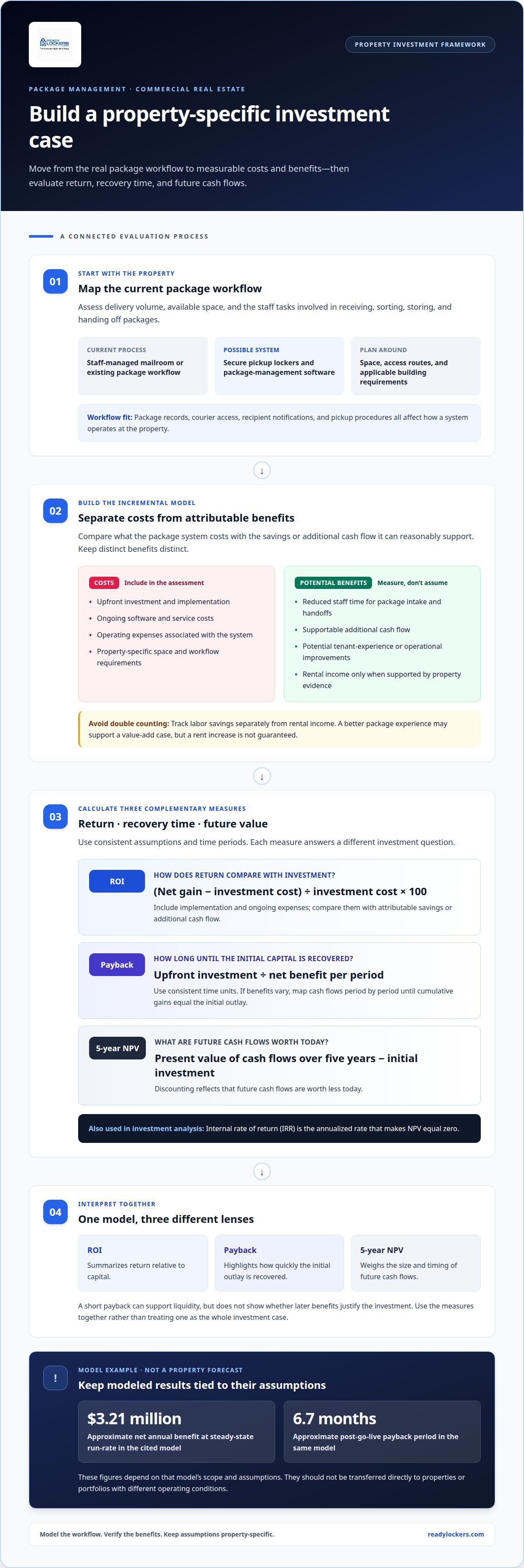
Evaluate a package-management investment using incremental gains and costs, not the property’s entire return. ROI equals net gain divided by investment cost, multiplied by 100. Include implementation and ongoing expenses, then compare them with attributable savings or additional cash flow. For example, separate labor savings from rental income so the calculation doesn’t count the same benefit twice.
Payback period estimates how long net cash benefits take to recover the initial capital. Divide the upfront investment by the net benefit per period, using consistent time units. If benefits vary, map cash flows period by period until cumulative gains equal the initial outlay. A short payback can support liquidity, but does not show whether later benefits justify the investment.
Five-year NPV estimates the present value of cash flows over five years, minus the initial investment. Discounting reflects that future cash flows are worth less today. This is an example of a broader optimization model, not a package management forecast.
The same modeled program reports approximately $3.21 million in net annual benefit at steady-state run-rate and a post-go-live payback period of approximately 6.7 months. Those results depend on that model’s scope and assumptions. They shouldn’t be transferred directly to another property or portfolios with different operating conditions.
Use all three measures together. ROI summarizes return relative to capital, payback highlights recovery timing, and NPV weighs the size and timing of future cash flows. The internal rate of return is the annualized rate that makes NPV equal zero. Property management teams can compare scenarios with these measures and test how changing benefit assumptions affects the decision.
For commercial real estate, cash-on-cash return is pretax cash flow divided by total cash invested. It is particularly useful for properties financed heavily with debt.
What is package management in commercial real estate?
Package management coordinates how deliveries move from couriers to recipients within a commercial property. In an office building, the workflow may include courier access, secure package placement, recipient notification, and pickup. It replaces scattered handoffs with a defined process that property teams can assess alongside other building operations.
For example, a courier places a delivery in a secure locker, and the recipient receives an SMS or QR code notification. The recipient then collects the package through contactless pickup. This approach gives tenants a clear handoff process and can help prevent package theft and missed deliveries. Pickups can be available 24/7, supporting access outside staffed desk hours.
Package handling can be organized through several connected elements:
- Delivery access: a courier interface supports the courier’s entry into the package workflow.
- Secure holding: lockers provide a designated place for packages awaiting collection.
- Recipient notification: SMS or QR code details tell the recipient when pickup is ready.
- Pickup: contactless collection completes the handoff without requiring a desk exchange.
For property managers, the practical value is a consistent process across office or multifamily buildings. A staffed mailroom and a locker-based workflow handle deliveries differently: one depends on staff receiving and distributing packages, while the other provides couriers and recipients with a designated handoff point. The right model depends on delivery patterns, available space, and building operations.
To assess the workflow, map each handoff from courier arrival through recipient pickup. Note where packages wait, which staff tasks are involved, and how tenants receive pickup information. Then compare the current process with the proposed setup, keeping measurable operating changes separate from assumed rental gains.
Review how a coordinated package workflow could fit your property’s delivery and pickup process.
ReadyLockers: Smart Package Lockers
ReadyLockers provides Smart Package Lockers for commercial properties that need a designated place for deliveries and recipient pickup. Locker Management Software supports the package workflow, while the Courier Access Interface connects courier delivery with locker placement.
This setup can suit offices or multifamily buildings where staff spend time handling incoming packages or recipients need a consistent pickup process. The Contactless Pickup System lets recipients collect deliveries without a desk handoff.
For an ROI assessment, compare the current package-handling workflow with the proposed one. Account for relevant operating expenses and track measurable changes, such as staff tasks and package-handling steps. Keep operational benefits separate from assumed rent increases.
Contact ReadyLockers to discuss package management for your property.
Turn the investment case into an operating plan
Make the next step a property-specific assessment. Define the package workflow you want to improve, identify measurable operating changes, and assign those benefits realistic assumptions. This connects your financial model to day-to-day building operations rather than broad estimates.
Package management ROI for commercial real estate is most useful when the investment model reflects how deliveries move through your property. ReadyLockers offers Smart Package Lockers, Locker Management Software, and a Contactless Pickup System to support package handling and recipient pickup. Consider how these options fit your building’s workflow and financial priorities.
Contact ReadyLockers to discuss your property and explore an approach that fits its package-management needs. A clear operating plan is a practical foundation for making the next investment decision with confidence.
Frequently Asked Questions
What Affects ROI?
ROI reflects the investment’s full lifecycle costs and the benefits the property can directly attribute to package handling. Package management ROI for commercial real estate should account for equipment and software expenses, staff time, space impacts, and measurable operational changes. For example, a staffed reception desk may have a different cost profile from a property where personnel handle deliveries alongside other duties. Test conservative and higher-benefit scenarios.
How does package management reduce operating costs for commercial properties?
A consistent workflow can reduce operating costs by streamlining package intake, notifications, and pickup coordination. To evaluate the effect, identify staff time spent logging deliveries, locating recipients, answering package inquiries, and managing collection areas. Compare these tasks before and after adoption, then account for software expenses and any remaining staff work. This shows whether package-handling time is reduced or simply reassigned.
What ROI metrics should commercial property owners use to evaluate package management?
Use ROI, payback period, and five-year NPV together, and add cash-on-cash return when financing is material. For a package-specific decision, track attributable labor changes and operating cash flow separately from broader property appreciation. Across a portfolio, apply consistent assumptions, then compare results by building type and delivery workflow. This helps distinguish repeatable operating benefits from outcomes driven by one property’s conditions.
What security, privacy, and liability risks come with commercial property package management?
Package theft and delivery disruptions are risks that secure lockers and a defined pickup process can help address. Handle recipient information carefully, and account for local privacy requirements in system design.

Frequently Asked Questions
What Affects ROI?+
ROI reflects the investment’s full lifecycle costs and the benefits the property can directly attribute to package handling. Package management ROI for commercial real estate should account for equipment and software expenses, staff time, space impacts, and measurable operational changes. For example, a staffed reception desk may have a different cost profile from a property where personnel handle deliveries alongside other duties. Test conservative and higher-benefit scenarios.
How does package management reduce operating costs for commercial properties?+
A consistent workflow can reduce operating costs by streamlining package intake, notifications, and pickup coordination. To evaluate the effect, identify staff time spent logging deliveries, locating recipients, answering package inquiries, and managing collection areas. Compare these tasks before and after adoption, then account for software expenses and any remaining staff work. This shows whether package-handling time is reduced or simply reassigned.
What ROI metrics should commercial property owners use to evaluate package management?+
Use ROI, payback period, and five-year NPV together, and add cash-on-cash return when financing is material. For a package-specific decision, track attributable labor changes and operating cash flow separately from broader property appreciation. Across a portfolio, apply consistent assumptions, then compare results by building type and delivery workflow. This helps distinguish repeatable operating benefits from outcomes driven by one property’s conditions.
What security, privacy, and liability risks come with commercial property package management?+
Package theft and delivery disruptions are risks that secure lockers and a defined pickup process can help address. Handle recipient information carefully, and account for local privacy requirements in system design.